
CASE STUDY
Building a Governed Intelligence Operating System
The Leadership Lab / Decision System
Decision Systems
AI Strategy
Portfolio Strategy
STRATEGIC OPERATING MODEL
AI & Product Strategy Lead
The Leadership Lab is a governed intelligence operating system that shows how AI-assisted strategy work can be structured, controlled, reviewed, and translated into repeatable execution.
The system connects market signals, opportunity evaluation, learning strategy, operating workflows, portfolio evolution, Thinking outputs, resume strategy, and professional positioning into a single governed loop.
The goal was not to use AI to generate more content. It was to design a system where AI supports sensemaking, synthesis, drafting, comparison, critique, and scenario generation while human review controls final decisions, claims, edits, and published outputs.
I led the system end to end as architect, operator, and reviewer. I defined the decision logic, governance rules, workflow structure, evidence controls, escalation model, portfolio architecture, and feedback loops that allow the system to operate with speed, consistency, and accountability.
Leadership Lab
SPECIAL AREA
A governed intelligence operating system for strategy, positioning, and execution.
- Evaluate opportunities
- Interpret market signals
- Operationalize AI-assisted workflows
- Evolve portfolio strategy
- Publish intelligence outputs
- Govern positioning and execution
Challenge
The challenge was not simply building a portfolio.
The challenge was creating a system that could continuously interpret a changing market, evaluate opportunities, protect positioning, guide learning, produce credible outputs, and support application execution without becoming reactive, inconsistent, or ungoverned.
Conventional portfolios often show outcomes, visuals, and narratives, but they rarely expose how judgment works. They do not show how decisions are made, how tradeoffs are handled, how signals influence positioning, or how AI-assisted work is controlled.
At the same time, the market was shifting quickly. AI governance, product strategy, decision intelligence, Web3 infrastructure, and enterprise transformation roles were converging. Without a governed system, it would be easy to overreact to isolated signals, overbuild portfolio content, overclaim AI experience, or let resumes, LinkedIn, case studies, and applications drift into different stories.
The opportunity was to design a governed intelligence operating system that made decision-making observable, repeatable, evidence-based, and useful for real execution.
Key Drivers
- Rapid convergence of AI, product strategy, governance, and enterprise transformation roles
- Need to interpret market signals without overfitting to noise
- Risk of fragmented positioning across portfolio, resume, LinkedIn, applications, and interviews
- Need to demonstrate applied AI fluency through governance, not output volume
- Need to protect against unsupported claims, technical overreach, and role drift
- Need to make decision logic visible to recruiters, hiring managers, and senior leaders
- Need for repeatable workflows that could turn intelligence into action
- Need for human review, evidence grounding, escalation, and quality control
My Role
I served as AI & Product Strategy Lead for the system, owning the operating model from framing through execution.
I defined the decision architecture, scoring logic, governance rules, escalation model, market intelligence process, workflow structure, output standards, knowledge documents, portfolio architecture, and human review controls.
My role combined product strategy, AI governance, operating-model design, portfolio strategy, market intelligence, workflow design, and implementation discipline.
I also operated the system directly, using it to evaluate roles, refine positioning, update the portfolio, produce Thinking briefings, guide resume strategy, prepare LinkedIn updates, and prioritize what should be built, refined, monitored, or avoided.
Scope
- Governed Opportunity Decision System v2
- Everything Prompt v9 Operating Constitution
- Claude Decision System mirror
- Decision System Framework Documents v2
- Market Intelligence Framework
- Portfolio Evolution Framework
- AI-assisted operating workflows
- Resume Writer workflow
- Portfolio Writer workflow
- Thinking section intelligence briefings
- Lab architecture and page system
- Product, AI, and Web3 portfolio refinement model
- Resume and portfolio knowledge documents
- LinkedIn positioning updates
- Analytics review to monitor page behavior, audience engagement, and evidence-based iteration
Approach & Methodology
Approach
- Governance-first rather than output-first
- Decision-system design over prompt use
- Evidence grounding over narrative convenience
- Human review over automated judgment
- Structured workflows over ad hoc AI usage
- Market signals converted into action
- Portfolio evolution tied to decision logic
- Enterprise relevance over personal experimentation
Methodology
- Market signal analysis across job descriptions, role patterns, LinkedIn content, industry movement, and emerging technology themes
- Decision System scoring and escalation logic for opportunity evaluation
- AI-assisted synthesis, critique, drafting, comparison, and scenario testing
- Human review for claims, final decisions, edits, published outputs, and application strategy
- Portfolio transformation review across Product, AI, and Web3 cases
- Knowledge document creation to preserve consistency across resume, portfolio, and application workflows
- Continuous recalibration through feedback, role testing, site updates, and output review
- Analytics review to monitor page behavior, audience engagement, and evidence-based iteration
Solution
I designed the system as a governed intelligence operating model with six connected layers.
Each layer performs a distinct function, but the value comes from the closed loop between them.
- Market signals inform decisions
- Decisions guide workflows
- Workflows produce outputs
- Outputs update the portfolio
- Portfolio changes strengthen positioning
- Feedback recalibrates the system
Operating Constitution
I created my Everything Prompt v9 as the operating constitution for the broader system.
It defines the role, voice, positioning constraints, workflow modes, governance rules, output standards, anti-drift controls, and human review expectations used across strategy, portfolio, resume, LinkedIn, interview, and Thinking workflows.
This prevents each AI-assisted session from restarting from scratch or drifting into generic advice.
What this layer defines
- Core positioning
- Audience logic
- Tone and language rules
- Portfolio guardrails
- Resume and application constraints
- AI and Web3 overclaim protections
- Workflow modes
- Human review standards
- Quality checks before output
Why It Matters
In enterprise AI, uncontrolled outputs create trust problems.
The operating constitution gives the system continuity, constraint, and repeatability. It ensures AI-assisted work remains aligned to the same strategy, evidence boundaries, and governance model across tools and workflows.
Governed Opportunity Decision System
I designed the Governed Opportunity Decision System to evaluate job descriptions, market signals, LinkedIn content, articles, portfolio gaps, and strategic questions.
The system classifies inputs, evaluates fit, detects market signals, applies scoring thresholds, identifies escalation risks, and recommends action.
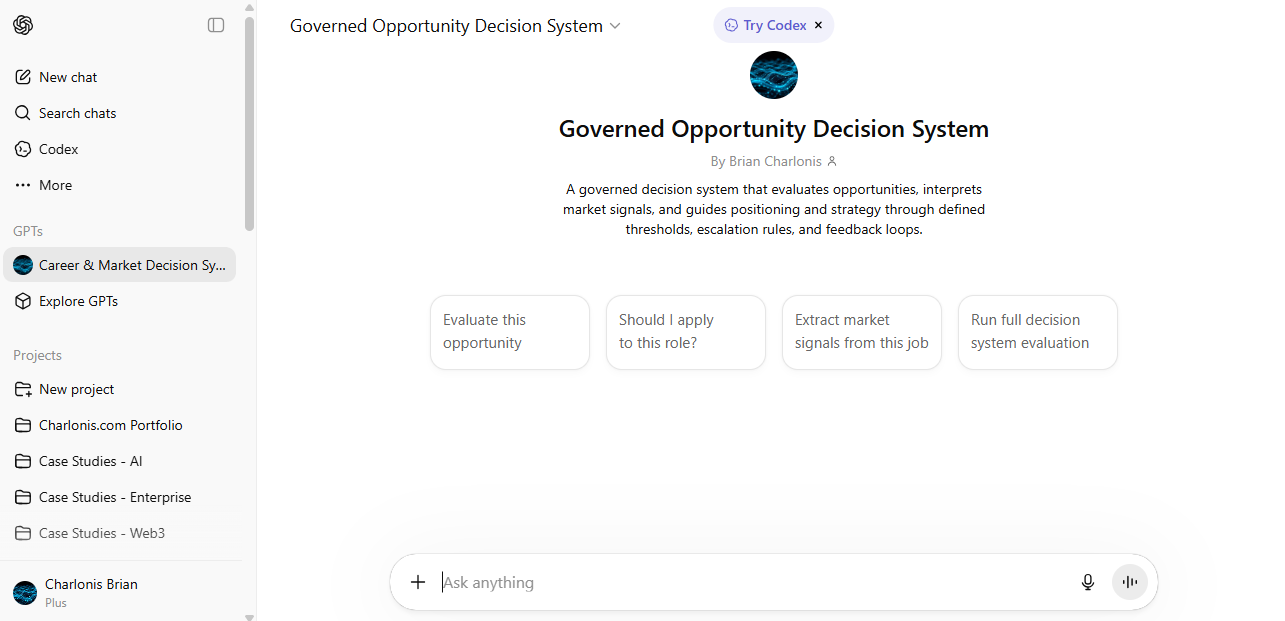
Governed Opportunity Decision System v9
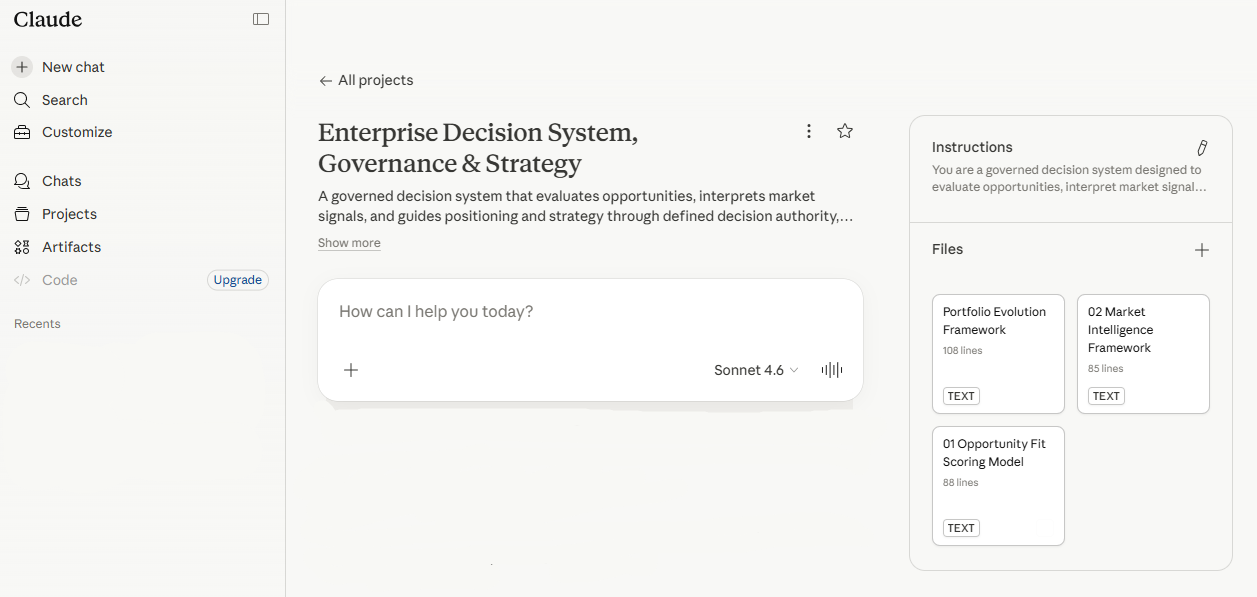
Claude Decision System mirror
For job descriptions, the system produces:
- Composite score
- Base classification
- Escalation status
- Final classification
- Market intelligence insights
- Role alignment assessment
- Overclaim risks
- Portfolio proof points
- Cases to emphasize
- Cases to downplay
- Resume positioning angle
- Keywords to include
- Application recommendation
- Follow-up questions when needed
Decision Classifications
- Strong Fit
- Strategic Stretch
- Do Not Apply
Governance Override
- A high score does not automatically mean apply.
- If material ambiguity exists around authority, scope, technical depth, AI ownership, implementation expectations, domain requirements, or overclaim risk, the system triggers escalation.
- Strong Fit with escalation becomes Strategic Stretch — Escalation Required.
Why It Matters
This mirrors enterprise AI governance.
The system does not allow output confidence to override risk controls. It requires traceability, escalation visibility, and human review before action.
Market Intelligence & Thinking Layer
I created a market intelligence workflow that converts unstructured signals into decision-ready insights.
Inputs include job descriptions, market activity, hiring patterns, LinkedIn content, industry reports, regulatory movement, emerging technology signals, portfolio gaps, and application feedback.
Signals are classified based on:
- Reinforce current positioning
- Expand positioning
- Challenge assumptions
- Require portfolio action
- Should be monitored
The Thinking section publishes selected outputs from this intelligence layer as briefings on AI governance, decision systems, programmable infrastructure, and enterprise transformation.
Intelligence Briefings
Why It Matters
The Thinking section is not generic thought leadership.
It is the published intelligence layer of the Lab. It shows how market signals are interpreted, synthesized, and translated into strategic implications for enterprise leaders.
AI-Assisted Operating Workflows
I structured repeatable workflows that translate decision logic into execution.
These workflows use AI for synthesis, drafting, comparison, critique, and scenario generation, while human review governs final decisions, claims, edits, submissions, and published outputs.
Core Workflows
- Opportunity Evaluation
- Resume & Application Strategy
- Portfolio Writing & Case Refinement
- Market Intelligence & Thinking Outputs
- LinkedIn Positioning & Outreach
- Interview Preparation & Case Defense
- Strategic Reflection & Continuity
Workflow Model
Input → Evaluate → Draft → Review → Refine → Publish or Act → Learn
Governance Controls
- Evidence grounding
- Role drift detection
- Overclaim review
- Escalation rules
- Human approval
- Tone consistency
- Output traceability
- Portfolio alignment
- Feedback loops
Why It Matters
This demonstrates AI operationalization at the workflow level.
The system does not treat AI as a content engine. It treats AI as part of a governed operating model where inputs, constraints, review gates, and outputs are defined.
Portfolio Evolution System
I redesigned the portfolio as structured proof of judgment, not a gallery.
Cases were reviewed through a framework that evaluated:
- Transformation signals
- Governance signals
- Ambiguity reduction
- Operationalization pathways
- Implementation readiness
- Organizational adoption considerations
- Downstream-team enablement
- Enterprise relevance
- Overclaim risk
Portfolio action decisions are classified as:
- Must Build
- Should Refine
- Monitor
- No Action
This governs whether a case, page, artifact, or section should be created, revised, deferred, or avoided.
Enterprise Transformation Stack
- Enterprise Product & Platform Foundation
- Institutional AI Governance
- AI Capability Strategy & Roadmapping
- Operational AI Governance
- Programmable Financial Infrastructure
Why It Matters
In enterprise transformation, portfolio decisions should reflect strategic relevance, evidence strength, and audience value, not volume.
The portfolio now demonstrates how enterprise product transformation connects to AI governance, decision systems, and programmable infrastructure.
It also shows that portfolio development itself is governed by market signal, strategic relevance, evidence strength, and audience value.
Human Governance & Feedback Layer
Human judgment remains the control layer.
AI supports analysis and output generation, but final decisions remain human-reviewed and evidence-grounded.
This layer governs:
- What gets published
- What claims are allowed
- Which roles are pursued
- Which cases are emphasized
- Which signals are acted on
- Which portfolio changes are made
- Which resume claims are safe
- Which outputs need refinement
- Which assumptions require escalation
The system is designed to improve through feedback loops
- Current feedback sources include manual review, application testing, role evaluation, portfolio coherence checks, LinkedIn positioning review, Google Analytics review, and Search Console indexing signals.
- Google Analytics is used to monitor page behavior, case interest, audience engagement, and navigation patterns so portfolio decisions can be refined based on observed signals, not assumptions.
Why It Matters
This is the difference between AI-assisted work and governed AI-assisted work.
The system is structured so that judgment, evidence, escalation, and review remain visible.
Enterprise Relevance
This case is directly relevant to enterprise AI adoption because it mirrors the same problems organizations face when operationalizing AI.
Enterprise Challenges & System Response
AI creates speed, but speed without governance creates risk.
The Lab defines input rules, decision thresholds, escalation logic, evidence controls, workflow boundaries, review gates, and feedback loops.
Teams need to evaluate AI use cases before they scale.
The Decision System evaluates opportunities, classifies signals, scores fit, surfaces risks, and recommends action before resources are committed.
AI outputs must remain traceable and accountable.
Outputs are grounded in source evidence, portfolio knowledge documents, user-provided facts, and explicit overclaim controls.
AI adoption requires operating models, not isolated tools.
The Lab connects Decision System logic to operating workflows, portfolio development, Thinking outputs, resume strategy, LinkedIn positioning, and interview preparation.
Human accountability cannot disappear.
Human review governs final decisions, edits, published outputs, application submissions, and strategic changes.
Outcomes

Impact Summary

Built a governed intelligence operating system for strategy, positioning, portfolio development, and application execution.
Updated 21 supporting Product, AI, and Web3 portfolio cases, then rebuilt the flagship case to explain the operating system behind the portfolio.
Created 7 repeatable AI-assisted workflows governed by evidence, escalation logic, role constraints, and human review.
Mirrored the Decision System across ChatGPT and Claude to demonstrate cross-platform portability.
Created 3 Decision System framework documents and 4 knowledge/reference documents to synchronize portfolio writing, resume strategy, site positioning, and job-search execution.
Repositioned the Lab as the operating system behind the portfolio and Thinking as its published intelligence layer.

System Outputs Created
- Governed Opportunity Decision System v2
- Claude Decision System mirror
- Decision System Framework Documents v2
- Everything Prompt v9 Operating Constitution
- Portfolio Case Knowledge Document v2
- Resume Knowledge Document v2
- Site Positioning Reference v1
- Job Search Guidance v1
- AI-assisted operating workflow model
- Updated Product portfolio case system
- Updated AI portfolio case system
- Updated Web3 portfolio case system
- Updated Lab architecture
- Updated Thinking intelligence briefings
- Updated About, Approach, Resume, Portfolio, and Home page positioning
- LinkedIn profile update strategy
- Google Analytics instrumentation
- Sitemap submission and Google Search Console indexing workflow

Evidence & Outcome Signals
- Built a governed intelligence operating system connecting market intelligence, opportunity evaluation, AI-assisted workflows, portfolio evolution, resume strategy, LinkedIn positioning, Thinking outputs, and human review.
- Updated 21 supporting portfolio cases across Product, AI, and Web3, then rebuilt the flagship case as the 22nd case to explain the operating system behind the portfolio.
- Created 7 repeatable AI-assisted operating workflows across opportunity evaluation, resume strategy, portfolio writing, market intelligence, LinkedIn positioning, interview preparation, and strategic reflection.
- Created 3 Decision System framework documents, 4 knowledge/reference documents, and Everything Prompt v9 Operating Constitution to synchronize decision logic, evidence boundaries, workflow rules, and human review standards.
- Mirrored the Decision System across ChatGPT and Claude, demonstrating cross-platform portability and consistent use of scoring, escalation, market intelligence, and portfolio action logic.
- Used Google Analytics, sitemap submission, and Google Search Console indexing workflow to support evidence-based review of page behavior, search visibility, and external AI-assisted site analysis.

Signals Monitored
- Role convergence across AI, product strategy, governance, and enterprise transformation
- Demand for AI governance, human review, explainability, escalation logic, and accountability
- Demand for implementation readiness, operating models, workflow transformation, and decision-system design
- Growth of decision intelligence, structured problem solving, and AI-assisted knowledge workflows
- Institutional interest in tokenization, settlement, provenance, programmable compliance, and governed infrastructure
- Portfolio engagement, page behavior, and navigation patterns through Google Analytics

Decision Thresholds
- Prioritize roles and portfolio work that reinforce enterprise product strategy, AI governance, decision systems, and regulated transformation
- Escalate when authority, scope, technical depth, AI ownership, implementation expectations, or overclaim risk is unclear
- Do not pursue opportunities that reposition the work as design-only, delivery-only, technical AI engineering, or crypto speculation
- Refine portfolio assets when market signals expose a material proof gap
- Avoid new content when it adds volume without strategic value
- Require evidence grounding before claims become resume, portfolio, LinkedIn, or application language

Actions Taken
- Created and tested the Governed Opportunity Decision System
- Mirrored the Decision System in Claude to demonstrate portability across AI environments
- Developed framework documents for opportunity scoring, market intelligence, and portfolio evolution
- Created Everything Prompt v9 Operating Constitution as the system’s operating constitution
- Built knowledge documents for portfolio cases, resume writing, site positioning, and job-search execution
- Refined 21 supporting Product, AI, and Web3 portfolio cases using the transformation framework
- Rebuilt the flagship case to explain the governed intelligence operating system behind the portfolio
- Repositioned the Lab as a governed intelligence operating system and reframed Thinking as its published intelligence layer
- Updated core site pages and LinkedIn positioning to align with the operating thesis
- Used Google Analytics, sitemap submission, and Google Search Console indexing to create a feedback loop for portfolio review and iteration
Artifacts

Operating Constitution
- Defined the role, voice, positioning constraints, workflow modes, governance rules, output standards, and anti-drift controls used across the system.
- Served portfolio writing, resume strategy, LinkedIn positioning, interview preparation, Thinking outputs, and strategic continuity.
- Established the rules that keep AI-assisted work consistent, grounded, and human-reviewed.

Governed Opportunity Decision System
- Defined how job descriptions, market signals, articles, LinkedIn content, portfolio gaps, and strategic questions are evaluated.
- Served opportunity evaluation, application strategy, market intelligence, and portfolio prioritization.
- Produced scoring, classifications, escalation status, market insights, proof points, resume inputs, and application recommendations.

Decision System Framework Documents
- Defined the scoring model, market intelligence model, and portfolio evolution model.
- Served the Claude Decision System mirror and broader workflow consistency.
- Enabled repeatable evaluation across opportunities, signals, and portfolio actions.

AI-Assisted Operating Workflow Model
- Mapped how inputs move through evaluation, drafting, review, refinement, publication, action, and learning.
- Served resume writing, portfolio refinement, Thinking outputs, LinkedIn positioning, interview preparation, and strategic reflection.
- Clarified how AI supports execution without replacing judgment.
Market Intelligence & Thinking Layer
- Translated market signals into intelligence briefings and strategic implications.
- Served the Thinking section and portfolio evolution process.
- Connected role patterns, governance signals, infrastructure trends, and enterprise constraints to public-facing insights.
Portfolio Evolution System
- Defined how cases, cards, tags, artifacts, recommended links, and page narratives are selected, refined, monitored, or avoided.
- Served Product, AI, Web3, Lab, Thinking, Home, Portfolio, About, Approach, and Resume pages.
- Ensured the portfolio demonstrates judgment rather than volume.
Analytics & Feedback Instrumentation
- Google Analytics to review page behavior, case interest, audience engagement, and navigation patterns.
- Serves feedback loops across site pages, portfolio cases, LinkedIn traffic, and application activity.
- Supports evidence-based iteration of site structure, case emphasis, portfolio navigation, and application strategy.
Key Takeaways
AI-assisted work becomes more valuable when governed by clear rules, thresholds, escalation logic, and human review
Decision systems make judgment visible by exposing how inputs become actions
Market signals should guide learning, portfolio evolution, resume strategy, and public positioning
Portfolio strategy is stronger when it is governed by evidence, audience value, and strategic relevance
Responsible AI is not only a policy topic. It is an operating model problem
Human oversight matters most when systems become faster, more automated, and more persuasive
A portfolio can demonstrate AI operationalization when it shows the system behind the outputs
Reflection
What I Would Do Differently
- Define baseline analytics review points earlier before major site revisions
- Define workflow documentation earlier before the number of operating modes expanded
- Create knowledge documents sooner to reduce manual continuity work across resume, portfolio, and application workflows
- Separate public-facing system language from internal prompt language earlier
- Build a Notion companion workspace after the public site, portfolio, and workflow system were stable
AI Opportunities
- Develop an AI-driven decision log for future role evaluations, case revisions, portfolio changes, and application outcomes
- Create a reusable governance playbook for AI-assisted knowledge work in regulated enterprises
- Use site analytics and application feedback to improve portfolio emphasis, recommended case paths, and resume strategy
- Expand the Decision System into a structured operating dashboard for opportunity evaluation, market intelligence, and portfolio actions
Supporting AI Professional Specializations
IBM

Generative AI for Executives & Business Leaders Specialization
Developed a strategic understanding of generative AI, including foundational concepts, integration strategies, and business use cases for practical executive decision-making.
Vanderbilt University

Generative AI Strategic Leader Specialization
Learned advanced generative AI concepts, including deep research, prompt engineering, and agentic AI, with a focus on strategic leadership and decision-making.
Vanderbilt University
Prompt Engineering & Trustworthy AI Specialization
Acquired practical skills in designing effective AI prompts, advanced data analysis, and principles for trustworthy generative AI deployment.
Web3 Opportunities
- Explore verifiable provenance for portfolio artifacts, case authorship, learning credentials, and decision records
- Evaluate credentialing models that connect learning, artifacts, authorship, and verification
- Assess proof-of-contribution models for collaborative strategy work where authorship, decision rights, and artifact ownership require clearer governance
Supporting Web3 Professional Specializations
INSEAD

Blockchain Revolution Specialization
Explored blockchain technologies and applications, focusing on transactions, business opportunities, and strategic analysis for enterprise adoption.
Recommended
If you liked this case study, you may also be interested in these…

CASE STUDY
INSTITUTIONAL GOVERNANCE
Enterprise Governance & Policy Architecture for AI Systems
Institutionalized an enterprise AI charter, risk taxonomy, capital gating model, and vendor governance framework that formalized board-level oversight and capital discipline before further AI scale.
AI Governance
Enterprise Strategy

CASE STUDY
AI PRODUCT STRATEGY
Enterprise Risk & Compliance AI Capability Roadmap
Established a governance-aligned AI capability roadmap, prioritization model, and Build-vs-Buy framework that enabled disciplined AI investment and structured platform evolution.
AI Strategy
Product Roadmap

CASE STUDY
OPERATIONAL AI GOVERNANCE
Human-in-the-Loop Governance for AI Decision Systems
Designed a threshold-governed AI decision system integrating simulation modeling, escalation controls, executive oversight dashboards, and enterprise accountability architecture.
Decision Systems
AI Governance

CASE STUDY
SETTLEMENT INFRASTRUCTURE
Designing a Capital-Efficient Cross-Border Settlement Strategy Using XRPL
Structured a cross-border settlement system enabling capital-efficient transactions under liquidity, regulatory, and operational constraints.
Settlement Strategy
Treasury Infrastructure
Want to see how governed AI-assisted strategy works in practice?
I’m happy to walk through the decision logic behind the portfolio, the operating model, and how this system supports AI governance, product strategy, market intelligence, and enterprise transformation.