
CASE STUDY
Enterprise Governance & Policy Architecture for AI Systems
AI
Product Strategy
INSTITUTIONAL GOVERNANCE
AI Strategy Lead
A Global Financial Institution needed to scale AI adoption without introducing unmanaged regulatory, operational, and reputational risk. Existing efforts were fragmented, with inconsistent controls, unclear accountability, and no standardized approach to risk classification or capital allocation.
I designed an enterprise AI governance system that structured how AI decisions are authorized, funded, monitored, and controlled. The work focused on defining institutional decision rules, not deploying individual models, ensuring AI could scale within clearly defined governance boundaries.
Challenge
AI adoption was accelerating across business units, but governance mechanisms had not evolved to match. Teams operated with inconsistent risk definitions, fragmented validation processes, and limited executive visibility into how AI-driven decisions were being made.
This created a system-level failure where decision authority, accountability, and control were unclear, increasing exposure to regulatory breaches, model risk, and operational instability.
The opportunity was to establish an institutional governance model that defined how AI decisions are classified, approved, funded, and monitored, enabling controlled scale without introducing unmanaged risk.
Key Drivers
- Fragmented AI pilots across multiple jurisdictions
- Inconsistent validation and monitoring standards
- Vendor proliferation without centralized exposure tracking
- Capital allocation disconnected from governance maturity
- Board-level demand for structured AI oversight
- Regulatory complexity across North America and EU
My Role
I led the design of the enterprise AI governance architecture, working across risk, compliance, technology, and executive leadership to define how AI systems would operate within institutional constraints.
My role focused on structuring decision authority, risk classification, and capital allocation models, ensuring AI adoption aligned with regulatory expectations and enterprise risk tolerance.
I facilitated alignment across stakeholders to move from fragmented experimentation to a coordinated, governance-driven operating model.
Scope
- Enterprise AI Charter development
- Cross-jurisdiction risk-tier taxonomy design
- Capital gating framework integration
- Vendor governance and sourcing discipline
- AI Standards Council authority definition
- Executive and board reporting integration
- Phased rollout across 6 months following 3-month architecture design
Approach & Methodology
Approach
- Systems-first institutional design
- Governance before acceleration
- Risk-tier sequencing prior to capital deployment
- Vendor exposure discipline
- Board-aligned operating model integration
Methodology
- Enterprise AI inventory mapping across jurisdictions
- Regulatory exposure analysis and risk classification modeling
- Governance readiness scoring design
- Capital allocation scenario modeling
- Vendor transparency and concentration risk assessment
- Executive workshops to define decision rights hierarchy
- Operating model integration planning
Solution
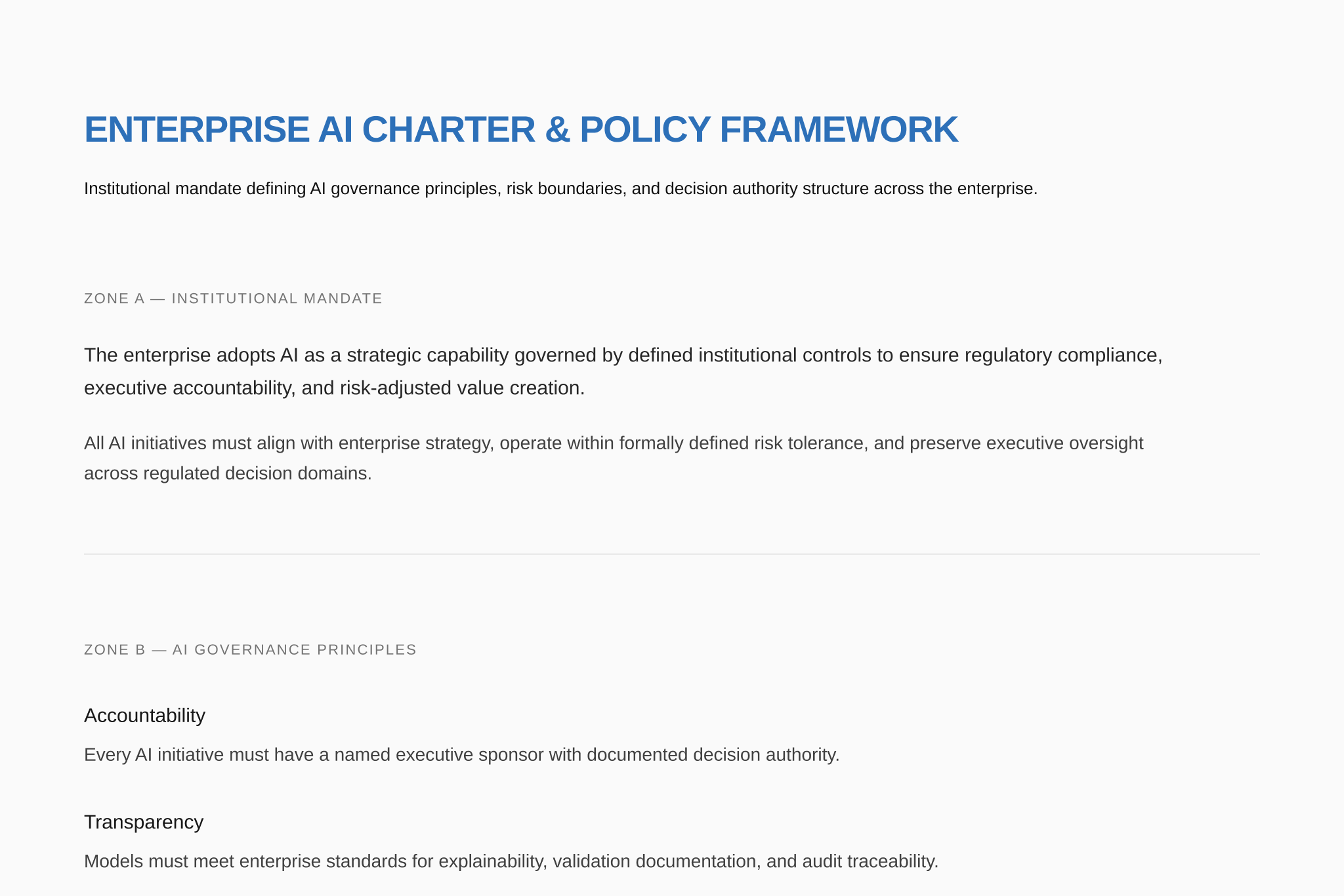
The solution was an enterprise AI governance system structured across policy definition, risk classification, capital allocation, and vendor control. These components defined how AI decisions are authorized, funded, monitored, and governed across the institution.
Enterprise AI Charter and Policy Framework
Defined the institutional mandate for AI adoption, establishing governance principles, decision rights, and accountability structures.
Capabilities
- Formal institutional AI mandate
- Governance principles anchored in accountability and transparency
- Explicit risk appetite boundaries
- Defined decision rights hierarchy
- Structured governance cadence integrated with executive oversight
This positioned AI as an institutional capability governed by structured authority rather than decentralized experimentation.
View Figma Prototype:
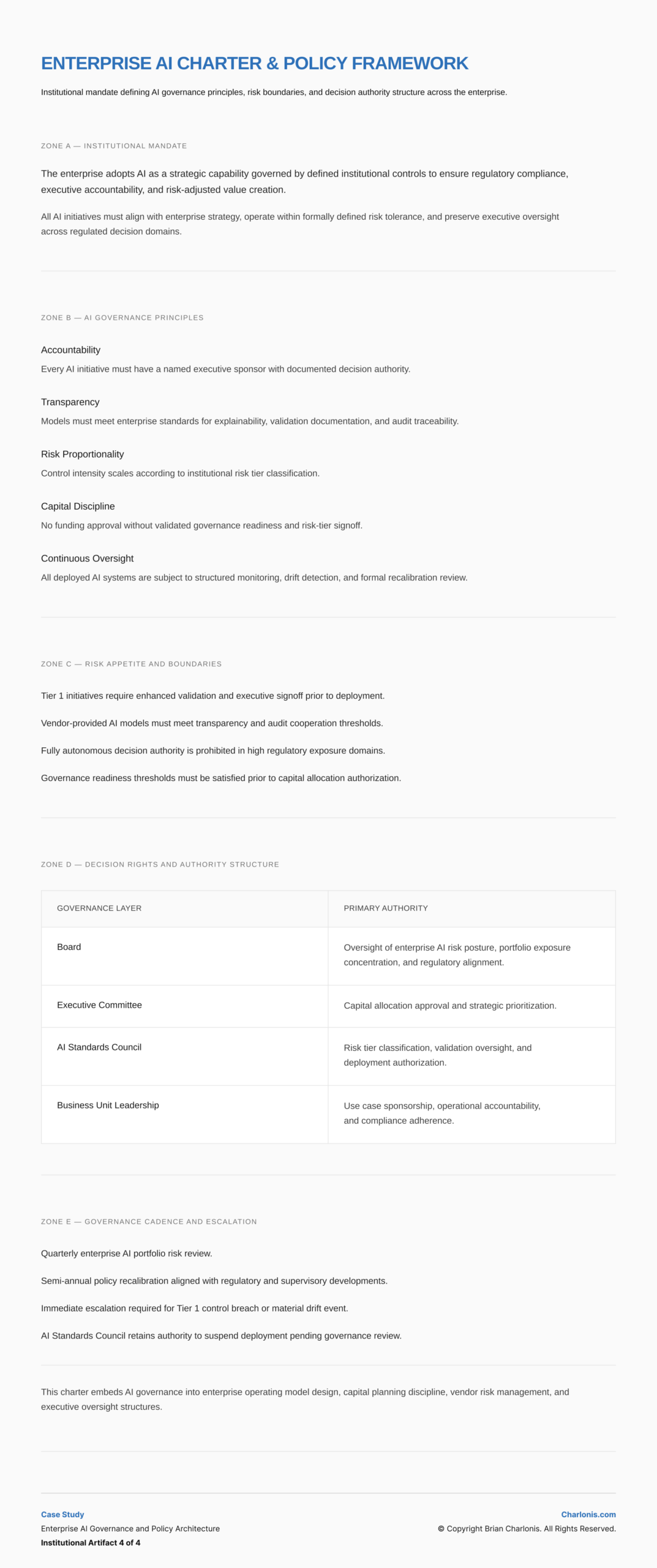
Enterprise AI Portfolio Risk Taxonomy Model
Established a standardized model for classifying AI initiatives based on regulatory exposure, financial materiality, data sensitivity, and autonomy.
Capabilities
- Scoring across regulatory exposure, financial materiality, data sensitivity, and autonomy
- Tier-based validation intensity requirements
- Monitoring cadence differentiation by risk level
- Board reporting structured by tier
This enabled proportional governance across jurisdictions and business lines.
View Figma Prototype:
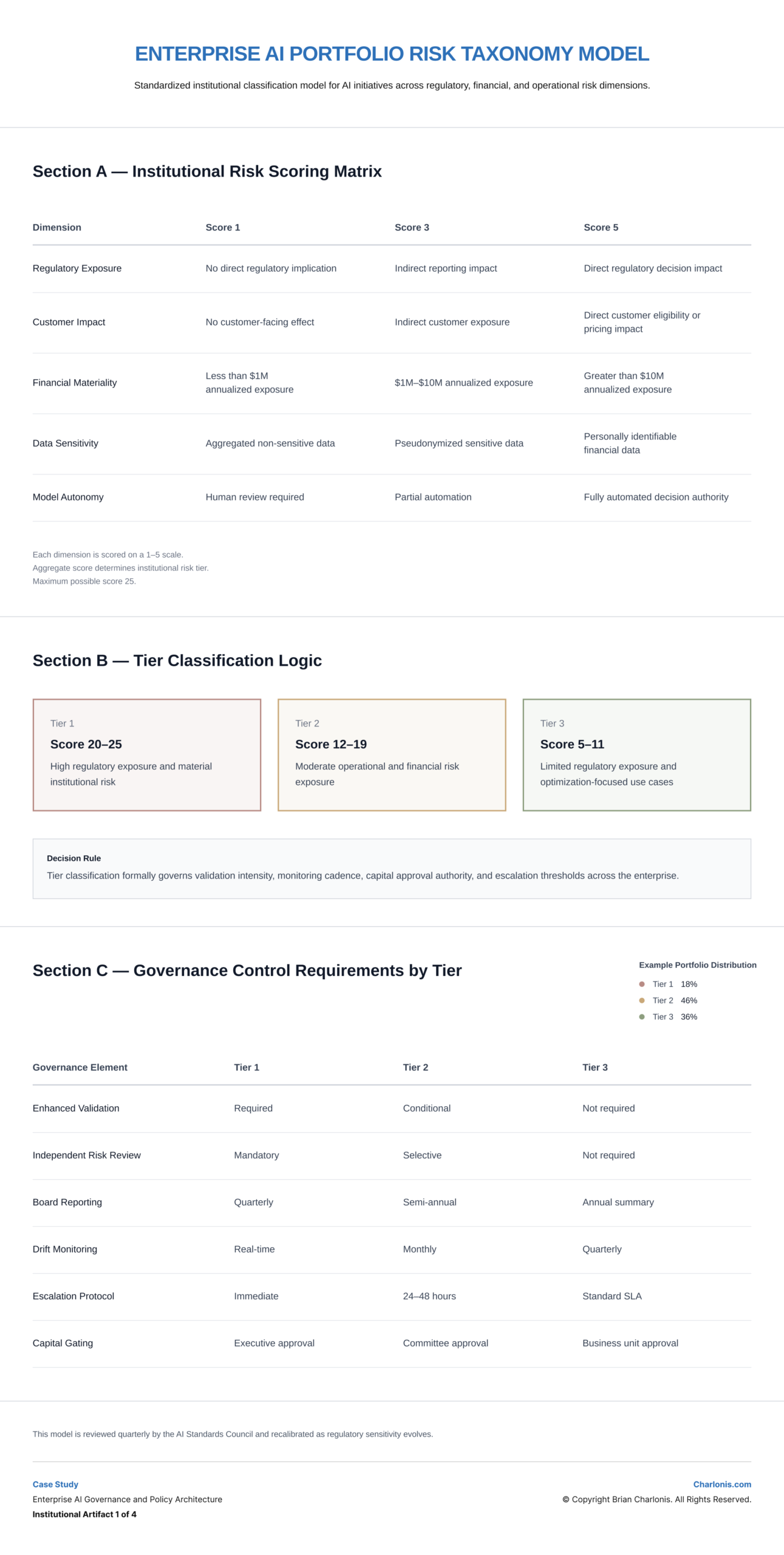
Enterprise AI Capital Allocation Governance Model
Integrated governance readiness directly into capital approval processes, ensuring funding decisions were conditioned on risk classification and control maturity.
Capabilities
- Weighted governance readiness scoring
- Tier-based funding gates
- Conditional approval thresholds with remediation requirements
- Escalation triggers for validation backlog and control breach
- Integration with executive capital committee review
No AI initiative could receive funding without meeting defined governance thresholds.
View Figma Prototype:
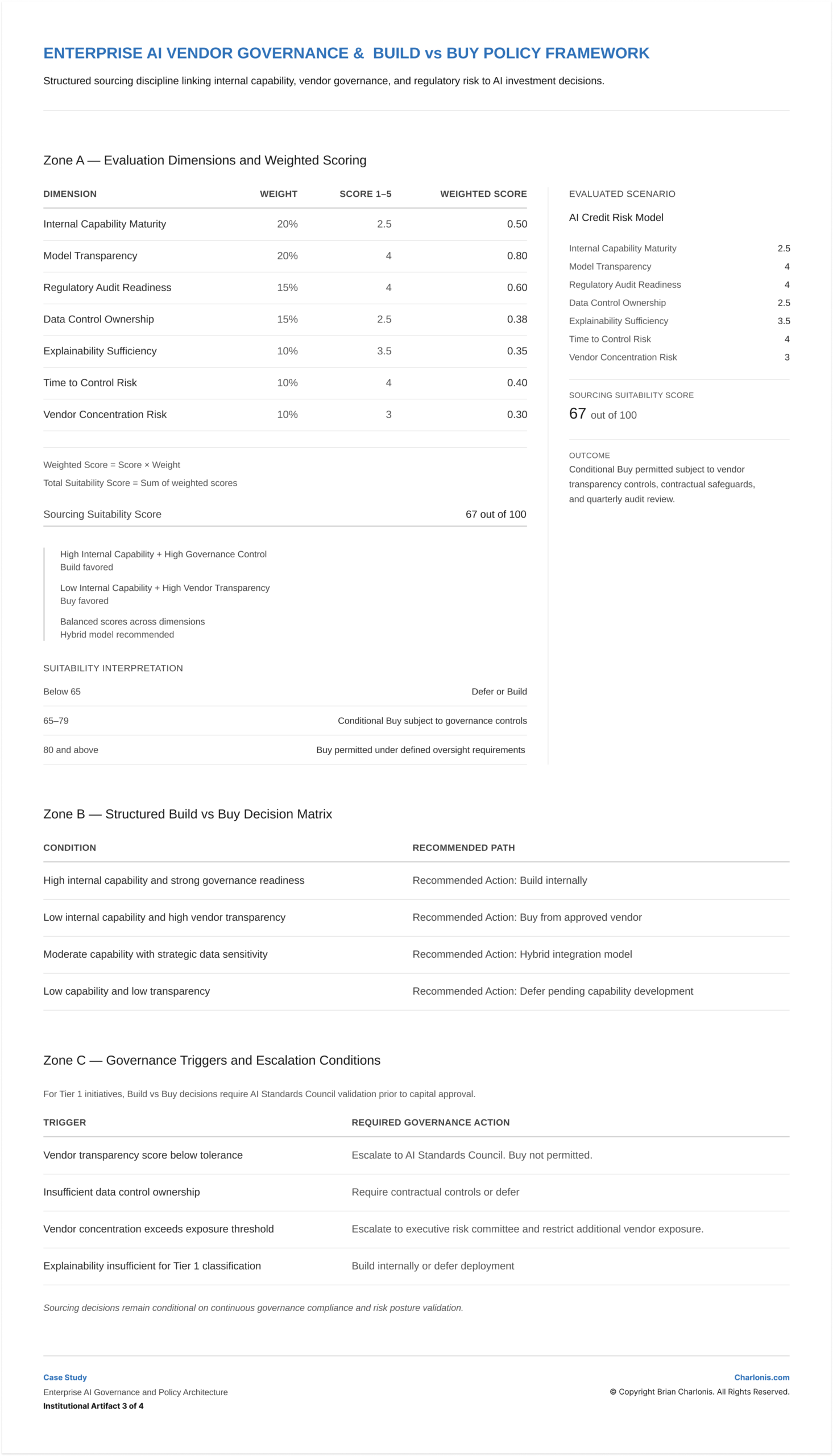
Enterprise AI Vendor Governance & Build vs Buy Policy Framework
Structured sourcing decisions around institutional risk posture, ensuring vendor selection aligned with regulatory, operational, and control requirements.
Capabilities
- Vendor transparency and audit-readiness scoring
- Regulatory exposure alignment
- Vendor concentration risk controls
- Hybrid sourcing evaluation criteria
- Conditional buy thresholds subject to governance controls
Vendor decisions became governance decisions embedded in capital and risk oversight.
View Figma Prototype:
ENTERPRISE AI VENDOR GOVERNANCE & BUILD vs BUY POLICY FRAMEWORK

Enterprise & Experience Implication
- AI governance shifts experience from opaque system behavior to structured, accountable decision-making.
- This changes how users interpret, trust, and interact with AI systems, requiring visibility into how decisions are made, when escalation occurs, and where human intervention is required.
- Without this, AI-driven experiences become inconsistent, difficult to trust, and operationally risky at scale.
Tradeoffs & Decisions
- Prioritized institutional control and risk clarity over speed of experimentation.
- This limited early-stage AI deployment flexibility but ensured that scaling efforts did not introduce unmanaged regulatory or operational risk.
- The approach reduced fragmentation and improved decision consistency, while introducing the risk of slower innovation cycles and potential shadow experimentation outside formal governance structures.
Outcomes
Established a governance foundation that enabled AI adoption to scale within clearly defined institutional constraints, improving decision consistency, risk visibility, and executive control.

Impact Summary

Institutionalized AI governance prior to enterprise-scale expansion
Reduced capital inefficiency and vendor sprawl
Strengthened cross-jurisdiction regulatory discipline
Elevated AI oversight to structured board accountability

Success Metrics
- 100% enterprise AI inventory capture across jurisdictions
- 35% reduction in duplicate vendor AI spend
- 28% improvement in AI capital review cycle time
- 100 percent Tier-1 initiatives subject to enhanced validation prior to funding
- Enterprise AI policy adoption across 12 business lines within 6 months
- Formal quarterly AI portfolio review instituted at board level

Signals Monitored
- Portfolio risk-tier distribution shifts
- Governance readiness score averages
- Vendor concentration exposure levels
- Validation backlog trends
- Drift and control breach events

Decision Thresholds
- No Tier-1 funding without enhanced validation signoff
- Conditional capital release tied to documented remediation plans
- Vendor concentration above tolerance triggers executive review
- Governance readiness thresholds required before allocation authorization

Actions Taken
- Centralized AI inventory under governance control
- Institutionalized AI Standards Council authority
- Embedded governance scoring into capital planning
- Standardized vendor risk review process
- Integrated quarterly board AI portfolio review
Artifacts

Enterprise AI Charter and Policy Framework
- Defined institutional mandate, governance principles, and authority structure.
- Served executive leadership and board risk committee.
- Anchored AI governance within enterprise operating model design.

Enterprise AI Portfolio Risk Taxonomy Model
- Standardized cross-domain risk classification.
- Served model risk and compliance teams.
- Enabled proportional validation, monitoring, and reporting intensity.
Enterprise AI Capital Allocation Governance Model
- Integrated governance readiness into funding workflows.
- Served executive capital committee.
- Aligned AI investment with institutional risk posture.
Enterprise AI Build vs Buy Decision Framework
- Structured vendor evaluation and sourcing discipline.
- Served procurement and risk governance leadership.
- Reduced uncontrolled vendor exposure and concentration risk.
Key Takeaways
AI systems require governance before scale, not after deployment
Decision quality depends on how authority, thresholds, and escalation are defined
Capital allocation is a governance mechanism, not just a funding process
Without structured oversight, AI adoption introduces systemic risk rather than value
Reflection
What I Would Do Differently
- Introduce cross-border supervisory advisory review earlier in charter design
- Expand scenario modeling to include regulatory stress testing
- Integrate internal audit earlier into funding gate validation
AI Opportunities
- Automated governance readiness scoring using adaptive monitoring frameworks
- Continuous validation automation via probabilistic monitoring models
- Enterprise explainability aggregation dashboards
Supporting AI Professional Specializations
University of Pennsylvania

AI for Business Specialization
Built foundational knowledge of AI applications across marketing, finance, and people management, with emphasis on AI strategy and governance for business leaders.
IBM

Generative AI for Executives & Business Leaders Specialization
Developed a strategic understanding of generative AI, including foundational concepts, integration strategies, and business use cases for practical executive decision-making.
Vanderbilt University

Generative AI Strategic Leader Specialization
Learned advanced generative AI concepts, including deep research, prompt engineering, and agentic AI, with a focus on strategic leadership and decision-making.
Web3 Opportunities
- Tokenized validation artifact provenance for immutable audit traceability
- Smart contract-enforced capital gating tied to governance thresholds
Supporting Web3 Professional Specializations
Duke University

Decentralized Finance (DeFi): The Future of Finance Specialization
Gained expertise in DeFi infrastructure, primitives, opportunities, and risks, enabling evaluation and strategy for decentralized financial systems.
INSEAD

Blockchain Revolution Specialization
Explored blockchain technologies and applications, focusing on transactions, business opportunities, and strategic analysis for enterprise adoption.
University of Pennsylvania
FinTech: Foundations & Applications of Financial Technology Specialization
Developed a comprehensive understanding of fintech ecosystems, including payments, digital currencies, lending, and the application of AI, InsurTech, and real estate technology within regulated financial environments.
Recommended
If you liked this case study, you may also be interested in these…

CASE STUDY
AI PRODUCT STRATEGY
Enterprise Risk & Compliance AI Capability Roadmap
Established a governance-aligned AI capability roadmap, prioritization model, and Build-vs-Buy framework that enabled disciplined AI investment and structured platform evolution.
AI
Product Strategy

CASE STUDY
OPERATIONAL AI GOVERNANCE
Human-in-the-Loop Governance for AI Decision Systems
Designed a threshold-governed AI decision system integrating simulation modeling, escalation controls, executive oversight dashboards, and enterprise accountability architecture.
AI
Product Strategy

CASE STUDY

Modernizing Global Cash & Treasury Management
Led definition of a global treasury decision system adopted by executives as the modernization direction, embedding compliance, fraud validation, and automation into workflows to improve decision confidence, reduce risk, and support scalable global operations.
CX
Product Strategy

CASE STUDY
TOKENIZED FINANCIAL MARKETS
Modernizing Private Credit Infrastructure Through Governed Tokenization
Designed a governance-first tokenization operating model that formalized asset eligibility, capital gating, escalation routing, and executive oversight before pilot capital deployment.
AI
Product Strategy
Web3
Institutional Governance Before Acceleration.
AI strategy in regulated finance requires structured governance, capital discipline, and board accountability. If you are designing enterprise AI oversight at scale, let’s connect.