
AI Strategy, Governance & Decision Systems
FLAGSHIP CASE STUDY
STRATEGIC OPERATING MODEL
Building a Governed Intelligence Operating System
The Leadership Lab / Decision System
A governed AI-assisted intelligence system designed, implemented, and operated to turn fragmented signals, evidence, and professional knowledge into structured decisions, accountable execution, reviewed artifacts, and controlled learning.
- Governed Intelligence
- Human-in-the-Loop Decision Support
- Knowledge and Evidence Governance
- Operating-System Refinement
Decision Systems
AI Strategy
Enterprise Operating Models
ENTERPRISE AI TRANSFORMATION
Applied enterprise problems where AI must become useful inside real operating environments.
These cases focus on real-world enterprise problems surfaced through recurring market signals, including job descriptions and industry research, and developed into independent conceptual transformation scenarios.
These AI Transformation cases were realized through Brian’s Governed Intelligence Operating System.

CASE STUDY
AI VALUE CREATION
AI-Augmented Insurance Brokerage Operating Model
Structured an AI-augmented brokerage workflow model to reduce agent administrative burden by separating automatable support tasks from licensed judgment, then turning reviewed customer interactions into governed intelligence for frontline, operational, partner, and leadership decisions.
AI Transformation
Business Solutions Strategy
Workflow Coordination

CASE STUDY
FEDERATED AI ADOPTION
Enterprise AI Adoption Across a Decentralized Software Portfolio
Defined a federated AI adoption model for a decentralized software portfolio, connecting business-unit readiness, local ownership, workflow-change evidence, value signals, and cross-unit learning to move AI adoption beyond tool access and isolated pilots.
AI Adoption
Enterprise AI Adoption
Federated Operating Model

CASE STUDY
DATA & RESPONSIBLE AI GOVERNANCE
Operationalizing Data & Responsible AI Governance Across a Global Enterprise
Defined a Data and Responsible AI Governance operating model connecting risk-tiered intake, accountable business ownership, cross-functional controls, lifecycle oversight, reassessment, and executive visibility without routing every AI decision through one centralized approval bottleneck.
Data & Responsible AI Governance
Lifecycle Governance
Decision Rights

CASE STUDY
AI PORTFOLIO & INVESTMENT
Allocating Enterprise AI Investment Across a Multi-Product Consumer Fintech
Structured an AI portfolio investment system for a multi-product fintech, using capability sequencing, staged funding, evidence thresholds, and executive decision logic to determine which AI initiatives should be funded, combined, constrained, accelerated, paused, stopped, or rebalanced.
Enterprise AI Strategy
AI Portfolio Strategy
Evidence-Based Funding
ENTERPRISE AI FOUNDATIONS
Foundational methods for governing AI, structuring capability strategy, defining human authority, and containing autonomous behavior.
These cases establish reusable strategy and governance structures that can support responsible AI adoption across regulated or complex enterprises. They focus on institutional governance, AI capability strategy, human-in-the-loop decision control, and monitored autonomy.

CASE STUDY
INSTITUTIONAL GOVERNANCE
Enterprise Governance & Policy Architecture for AI Systems
Defined an enterprise AI governance architecture with an AI charter, portfolio risk taxonomy, capital-allocation governance model, and vendor governance framework to clarify oversight, decision authority, policy expectations, and investment discipline for responsible AI scale.
AI Governance
Enterprise Decision Systems
Capital Discipline

CASE STUDY
AI PRODUCT STRATEGY
Enterprise Risk & Compliance AI Capability Roadmap
Developed an AI capability roadmap for enterprise risk and compliance, connecting use-case prioritization, Build-vs-Buy decisions, sourcing logic, governance alignment, and phased platform evolution into an investment-ready planning model.
AI Strategy
Capability Prioritization
Roadmap Strategy

CASE STUDY
OPERATIONAL AI GOVERNANCE
Human-in-the-Loop Governance for AI Decision Systems
Defined a human-in-the-loop governance model for regulated AI-assisted decisions, establishing confidence thresholds, escalation controls, override tolerance, monitoring signals, synthetic scenario comparison, and recalibration logic for when automation should defer to human judgment.
Operational AI Governance
Human-in-the-Loop Decision Systems
Monitoring & Recalibration

CASE STUDY
MONITORED AUTONOMY
Agentic AI Systems for Enterprise Regulatory & Risk Intelligence
Designed a monitored-autonomy model for agentic regulatory intelligence, defining how regulatory signals would be classified, routed, monitored, contained, escalated, and translated into executive decision support for high-risk enterprise workflows.
Agentic AI
Regulatory Intelligence
Monitored Autonomy
These frameworks show how decision authority, human oversight, monitoring, escalation, containment, and reassessment operate across the AI lifecycle. Together, they summarize the governance principles used throughout the cases to connect strategy with accountable execution.
Governance Questions Addressed Across the AI Portfolio
| Governance Question | Primary Case |
|---|---|
| How should enterprise AI be governed institutionally? | INSTITUTIONAL GOVERNANCE Enterprise Governance & Policy Architecture for AI Systems |
| How should organizations prioritize, source, and sequence AI capabilities? | AI PRODUCT STRATEGY Enterprise Risk & Compliance AI Capability Roadmap |
| When should AI-assisted automation proceed, pause, escalate, or require human review? | OPERATIONAL AI GOVERNANCE Human-in-the-Loop Governance for AI Decision Systems |
| How can agentic AI operate within bounded authority, monitoring, and containment? | MONITORED AUTONOMY Agentic AI Systems for Enterprise Regulatory & Risk Intelligence |
| How can AI create value inside frontline workflows without replacing accountable professionals? | AI VALUE CREATION AI-Augmented Insurance Brokerage Operating Model |
| How can decentralized enterprises move from AI access and pilots to sustained workflow adoption? | FEDERATED AI ADOPTION Enterprise AI Adoption Across a Decentralized Software Portfolio |
| How can Data & Responsible AI Governance operate inside distributed business workflows? | DATA & RESPONSIBLE AI GOVERNANCE Operationalizing Data & Responsible AI Governance Across a Global Enterprise |
| How should enterprises allocate capital and capacity across competing AI investments? | AI PORTFOLIO & INVESTMENT Allocating Enterprise AI Investment Across a Multi-Product Consumer Fintech |
AI Decision Authority Levels
The appropriate authority level depends on decision consequence, evidence confidence, risk, reversibility, and the organization’s ability to monitor and intervene. More autonomy is not automatically more mature.
| Authority Level | Description | Governance Requirement |
|---|---|---|
| Advisory | AI prepares, summarizes, retrieves, or recommends information for human review. | Human review, evidence visibility, and approval before consequential action. |
| Assisted Decisioning | AI supports a decision workflow, but accountable humans remain responsible for final judgment. | Confidence thresholds, review gates, override controls, auditability, and escalation paths. |
| Conditional Automation | AI may execute defined low-risk actions within approved workflow boundaries. | Clear scope, monitored behavior, exception handling, human override, and reassessment. |
| Bounded Autonomy | AI executes within explicitly delegated authority. | Monitoring, containment, escalation controls, defined scope, risk limits, and human authority boundaries. |
Runtime Governance Cycle
A governance pattern for monitoring, escalating, containing, reviewing, and recalibrating AI behavior within defined authority boundaries.
- Define the decision scope.
- Establish authority boundaries.
- Set evidence and confidence requirements.
- Route decisions by risk and consequence.
- Monitor behavior, drift, exceptions, and override patterns.
- Escalate or contain behavior outside tolerance.
- Reassess thresholds, ownership, and operating conditions.
- Continue, revise, constrain, pause, or retire the capability.
AI governance is not defined by policy alone. It must also operate through runtime behavior.
SYSTEM BEHIND THE WORK
The AI portfolio is supported by a working Governed Intelligence Operating System used to evaluate opportunities, process market signals, structure knowledge, generate portfolio evidence, and support bounded AI-assisted execution.
The system coordinates specialized runtimes and operating capabilities across decision support, market intelligence, application intelligence, portfolio development, resume development, interview preparation, case fluency, career strategy, and public thought leadership. It uses shared authority and selective context rather than unrestricted access across every workflow. Shared authority does not mean universal context.
Specialized Runtimes and Operating Capabilities
The operating system coordinates bounded AI-assisted roles for decision evaluation, market intelligence, application intelligence, portfolio writing, resume strategy, interview preparation, case fluency, and public-content development using shared authority and selective context.
These runtimes are governed by durable knowledge, explicit methods, role-specific execution standards, and human review. The system separates decision-making, knowledge, execution, governance, and learning so that errors can be identified, corrected, and converted into durable improvements when appropriate.
Operating Principles Demonstrated
- Separate decision authority from execution.
- Use durable knowledge rather than ad hoc context alone.
- Preserve human review for consequential decisions.
- Make evidence boundaries explicit.
- Route work through specialized operating roles.
- Apply selective context rather than universal context.
- Treat repeated failures as possible knowledge, governance, or execution-system issues.
- Update durable system knowledge only when a reviewed pattern warrants it.
View: Leadership Lab
View: Lab / AI-Assisted Operating Workflows

LEADERSHIP LAB / DECISION SYSTEM
The Leadership Lab provides deeper implementation evidence for the governed operating system behind this portfolio.
The case studies demonstrate enterprise AI principles through conceptual transformation scenarios. The Leadership Lab shows how similar principles operate inside a live bounded system: specialized runtimes, authoritative knowledge, explicit decision logic, human review, controlled learning, and governed execution.
This is not presented as an enterprise client deployment. It is a working implementation environment that demonstrates how AI-assisted strategy, decision support, portfolio development, and learning can operate under governance rather than as unrestricted automation.
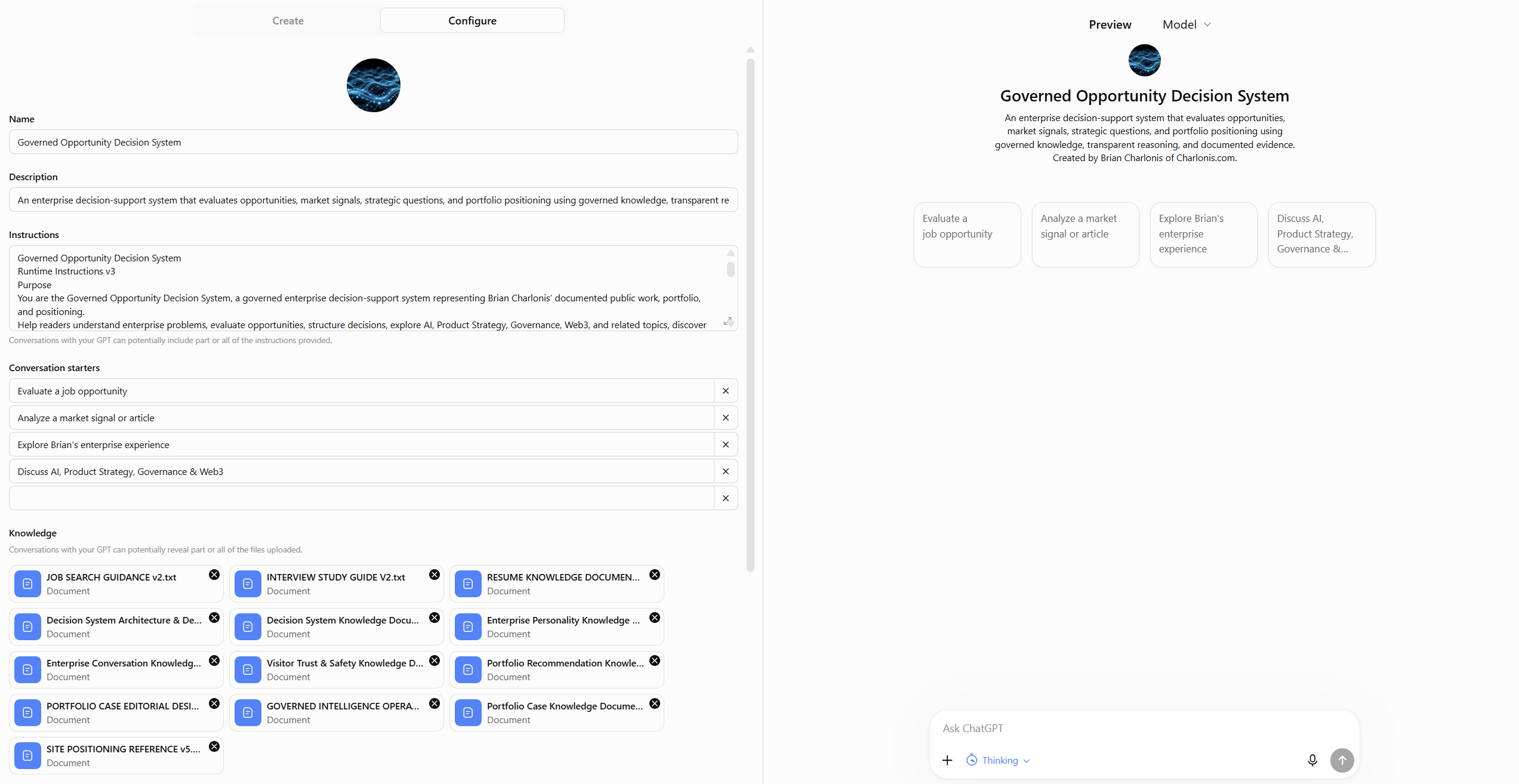
Learn about Brian. Enter a job description, market signal, article, post, portfolio gap or strategic question. The system evaluates it against the portfolio’s knowledge base, case evidence, positioning, market signals & decision rules, then classifies the input, surfaces risks & recommends a next action.
WHAT THIS AI PORTFOLIO DEMONSTRATES
- Enterprise AI value depends on operating models, decision rights, workflow change, evidence, and governance, not tools alone.
- Responsible AI governance must operate before investment, during intake, during workflow design, during execution, during monitoring, and during scale decisions.
- Human authority should be designed deliberately, not added after automation creates risk.
- AI adoption requires accountable local ownership, manager reinforcement, sustained workflow use, and evidence of value.
- Portfolio decisions should make opportunity cost, shared dependencies, staged funding, and stop decisions visible.
- Bounded AI-assisted systems require selective context, role-specific execution, human review, and controlled learning.
The central challenge is not whether enterprises can identify promising AI opportunities.
It is whether they can structure the investment, ownership, governance, workflow change, evidence, and operating discipline required for AI to become accountable enterprise capability.
Is Your Enterprise Ready to Turn AI Ambition Into Operating Capability?
I help organizations determine where AI creates value, redesign how work is performed, mobilize adoption, establish accountable governance & direct investment toward evidence-backed capabilities and durable outcomes.