
I began building an AI-enabled Decision System to evaluate opportunities more consistently and connect recommendations to stronger evidence. The most important improvements did not come from adding more prompts, information, or capabilities. They came from separating responsibilities.
What began as one conversational environment gradually needed to evaluate opportunities, interpret evidence, recommend strategy, support execution, preserve historical records, and review whether earlier outputs had been sound. Each responsibility was useful. Together, however, they created a structural problem: the same environment was moving toward becoming the decision-maker, executor, keeper of evidence, and reviewer of its own behavior. That may be convenient, but it is not a strong accountability model.
Repeated use shifted the design away from one all-purpose assistant and toward a governed operating architecture with distinct roles, authoritative knowledge sources, operating rules, and review mechanisms. The architecture is still developing, and the work has not validated a universal model. It has, however, revealed three practical lessons that may matter whenever AI becomes part of consequential enterprise decisions.
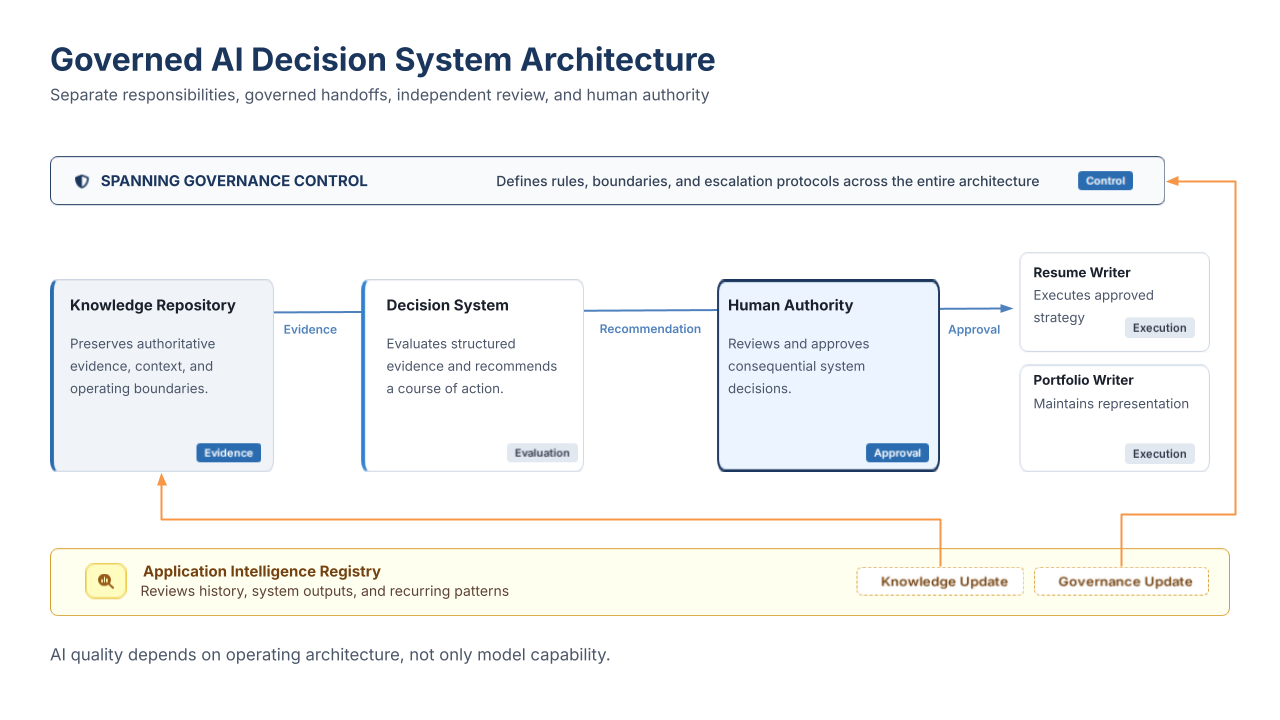
The first lesson was that a recommendation, its execution, and the review of the result should not automatically belong to the same system role.
The early Decision System supported a relatively contained activity: examining an opportunity, comparing it with available evidence, identifying strengths and gaps, and recommending a course of action. As the work expanded, the surrounding environment also needed to develop application strategy, create tailored materials, maintain portfolio evidence, preserve application history, and evaluate patterns across previous decisions.
Those activities are connected, but they are not the same responsibility.
Evaluating an opportunity requires interpreting evidence and weighing tradeoffs. Writing a resume requires translating an approved strategy into a specific artifact. Maintaining portfolio evidence requires preserving an accurate representation of demonstrated work. Reviewing application history requires comparing earlier decisions and outputs without simply reproducing their assumptions.
Keeping these responsibilities inside one undifferentiated role created several risks.
Execution could begin before the decision was sufficiently clear. A writing capability might compensate for an incomplete strategy by choosing its own emphasis, producing a coherent artifact while concealing unresolved questions in the original recommendation.
The system producing the output could also become the primary judge of whether that output was appropriate. It would naturally review the work through the same assumptions and evidence interpretation that produced it.
Responsibility would become difficult to locate. If an application used weak evidence, was the problem in the assessment, evidence source, strategy, writing execution, or later review? Without distinct roles and handoffs, every failure belongs vaguely to “the AI.”
The design response was specialization.
The Decision System evaluates opportunities, interprets evidence, identifies tradeoffs, classifies gaps, and recommends positioning or next actions. A Resume Writer translates an approved strategy into application materials. A Portfolio Writer maintains the public presentation of cases and capabilities. An Application Intelligence Registry preserves and compares application history and reports patterns in system behavior.
This separation does not mean that each capability must use unrelated technology or a completely different model. The more important requirement is separation of responsibility. Each role needs a defined purpose, authoritative inputs, expected outputs, boundaries, and decision authority.
Human authority also remains necessary. A recommendation can inform a decision without becoming the decision. An execution capability can prepare an artifact without determining whether the underlying strategy should be approved. A review capability can surface concerns without silently rewriting the architecture.
The broader enterprise implication is that organizations should define the operating roles surrounding AI, not merely deploy a capable assistant and allow responsibilities to accumulate.
For a consequential workflow, leaders should be able to answer:
The answers may differ by organization and risk level. The essential point is that convenience should not erase decision rights.
The second lesson was that knowledge and governance solve different problems.
As the Decision System developed, I created structured Knowledge Documents to preserve professional experience, portfolio cases, public positioning, system identity, methods, evidence boundaries, and other stable context. These sources improved continuity. The system no longer had to reconstruct the same facts from scattered conversations whenever it evaluated a new question.
But a larger and better-organized knowledge base did not automatically produce better judgment.
Knowledge can establish that an experience occurred, what a case demonstrates, which outcome was observed, or how a capability is publicly positioned. It cannot, by itself, determine how that evidence should be interpreted in a particular decision.
Governance addresses a different set of questions:
Consider a generic enterprise assistant evaluating whether a proposed initiative has executive sponsorship. The knowledge base may contain meeting notes, an approved budget, a strategic plan, and informal stakeholder comments. The system still needs governance rules to determine which sources represent formal authority, whether conflicting signals should be escalated, and how confidently it may classify the initiative as approved.
Adding more documents would not resolve a faulty authority rule.
This distinction matters because failures of knowledge and failures of interpretation can look similar.
Suppose a system understates a capability. The evidence may be absent. The system may have retrieved the wrong source. Or it may have found the correct evidence but interpreted the requirement too narrowly. Adding more information may help with the first problem while doing nothing to correct the second or third.
Knowledge should preserve what is known. Governance should define how that knowledge is used.
Separating them created a more maintainable architecture. Professional facts or case evidence could be updated without rewriting the operating rules for every specialized capability. An interpretation rule could be corrected without modifying the factual record. Different capabilities could use the same authoritative evidence while applying role-specific instructions.
The separation also made weaknesses easier to diagnose. When an output was poor, I could ask whether the source was incomplete, retrieval failed, interpretation was flawed, or execution departed from the approved strategy. That is more useful than concluding that the system simply needed “more context.”
For enterprises, the same distinction may apply across AI-enabled operating models. Organizations often combine several layers under labels such as AI platform, copilot, or knowledge assistant. Those layers may include:
Treating them as one capability can obscure which layer needs correction.
A larger knowledge base does not automatically create better judgment. A well-written policy does not guarantee correct retrieval. Better retrieval does not guarantee sound interpretation. Sound interpretation does not guarantee execution within approved boundaries.
Governance and knowledge must interact, but they should remain independently maintainable.
The third lesson emerged when the Application Intelligence Registry became a separate history and review layer.
The Registry was not designed to make the original opportunity recommendation or write application materials. Its purpose was to preserve records, normalize historical information, compare decisions and outputs, identify recurring patterns, and report where the broader system may have behaved inconsistently.
That narrower responsibility gave it a useful perspective.
Because the Registry was not responsible for defending the original decision, it could ask different questions. Had evidence been used consistently across similar opportunities? Had the system classified a capability too narrowly? Was stronger professional evidence available than the evidence emphasized in the final output? Did recurring patterns suggest that an operating rule needed revision?
The Registry later surfaced evidence-interpretation and retrieval issues that the decision-making and execution layers had not fully corrected themselves. Those findings require a separate discussion and will be examined in a later article. The important lesson here is architectural: the review became valuable because it was designed to examine the system rather than reproduce its original task.
This does not make the Registry an external auditor, a formal enterprise risk function, or proof that the architecture is effective. Its independence is limited to responsibility and review purpose. It operates within the broader architecture and uses related evidence.
Even that limited independence created a meaningful check.
Oversight becomes weak when it can only confirm that a process followed its own assumptions. A review layer must be able to question whether those assumptions were appropriate in the first place.
For enterprise AI systems, meaningful oversight may therefore require:
That final boundary matters. Oversight should identify and route findings, not become an uncontrolled second decision-maker. Corrections may require changes to knowledge, governance, operating instructions, execution processes, or human approval. The review layer should make the issue visible and traceable so the appropriate authority can decide what changes.
Independent oversight is therefore not only about catching incorrect outputs. It can also reveal architectural weaknesses: unclear authority, inconsistent evidence weighting, missing records, poor handoffs, or governance rules that no longer reflect how the system is being used.
The strongest lesson from this work is that AI system quality is not only a model problem.
As an AI-enabled workflow expands, performance depends increasingly on its surrounding operating architecture: how responsibilities are divided, where evidence is preserved, which rules govern interpretation, how decisions become actions, where human authority remains, and whether review can challenge the assumptions that produced an output.
A single assistant may remain useful. The problem begins when convenience allows one role to accumulate decision-making, execution, evidence control, and self-review without explicit boundaries.
The architecture I developed is still evolving. Its lessons should not be treated as universal requirements or as proof that specialization alone guarantees quality. Separation can create its own problems, including poor handoffs, duplicated instructions, inconsistent terminology, and unclear escalation paths.
But separation makes those problems more visible.
It becomes possible to identify whether a weakness belongs to knowledge, interpretation, execution, oversight, or the handoff between them. Corrections can then be directed toward the appropriate part of the architecture rather than adding another broad instruction to an already overloaded assistant.
That is a practical shift from treating AI as a prompting problem to treating it as an operating-model problem.
This flagship portfolio case presents the broader operating model connecting decision support, modular knowledge, specialized AI workflows, governance, and human accountability.
This Leadership Lab page provides supporting context for how governed AI workflows can assist decision-making while preserving responsibility boundaries and human authority.