
THE LAB >
AI-Assisted Operating Workflows
SPECIAL AREA
HOW GOVERNED WORK MOVES
AI-assisted work becomes reliable when specialized runtimes operate inside governed flows rather than acting as isolated prompt tools.
Work may begin with:
- A market signal.
- A job description.
- A recruiter interaction.
- A portfolio question.
- A case draft.
- Application history.
- An interview question.
- A knowledge gap.
- A governance issue.
- A strategic question.
This is not a rigid autonomous pipeline. Governance and human authority remain active throughout.
A representative operating flow is:
Signal / Input
→ Interpret
→ Decide
→ Ground
→ Route
→ Execute
→ Human Review / Action
→ Observe
→ Approved Learning
A signal is interpreted before it becomes work. The purpose, decision context, knowledge authority, risk level, and authority boundaries are established before execution begins. Relevant knowledge, methodology, governance, and execution standards are selected before a runtime produces an output. Human review remains responsible for consequential action. Outcomes, exceptions, and review findings may become governed learning only when a durable update is warranted.
This matters because AI-assisted work becomes unreliable when execution begins before the purpose is clear, before evidence is grounded, or before authority is defined.
Risk-Proportionate Automation
The operating system does not treat every task the same way.
Lower-risk bounded work can be automated more deeply when it is reversible, evidence-grounded, and governed by clear responsibility.
Higher-consequence, ambiguous, evidentiary, positioning, and pursuit decisions require deliberate human review or authorization before downstream automation continues.
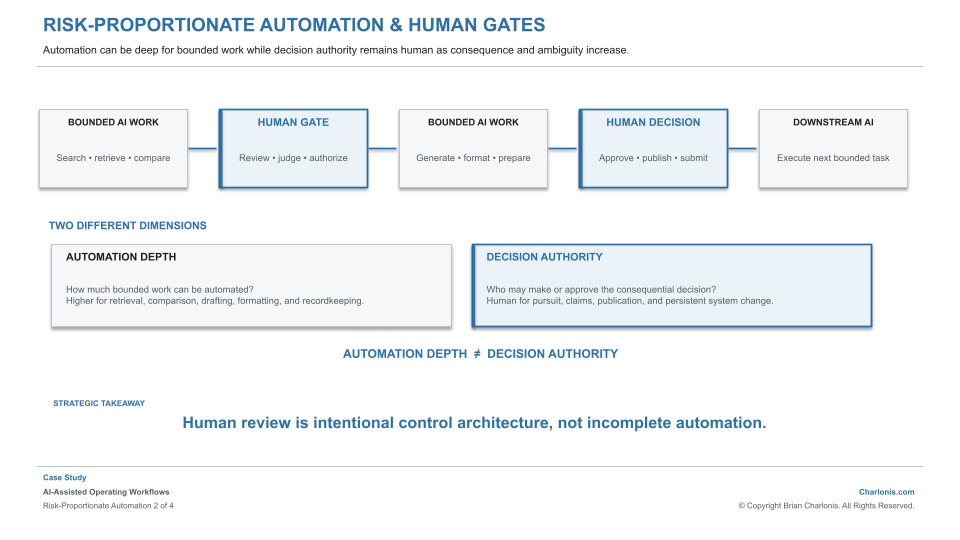
The Operating Principle
Automated bounded work
→ Human review / judgment / authorization
→ Next governed automated component
This means the system may automate work on both sides of a human gate while preserving explicit control at the gate itself.
A human checkpoint is especially appropriate when the workflow asks:
- Should this opportunity be pursued?
- Is this evidence sufficient?
- Is this claim defensible?
- Is this externally visible artifact ready to represent Brian?
- Does this outcome justify a change in governed knowledge?
- Should a component’s authority or scope change?
Human review is intentional control architecture, not incomplete automation. Technical automation depth does not equal decision authority.
SHARED AUTHORITY, SELECTIVE CONTEXT
Different runtimes do not consume every shared source. Each runtime receives only the authoritative knowledge, methodology, governance, and execution standards required for its bounded role.
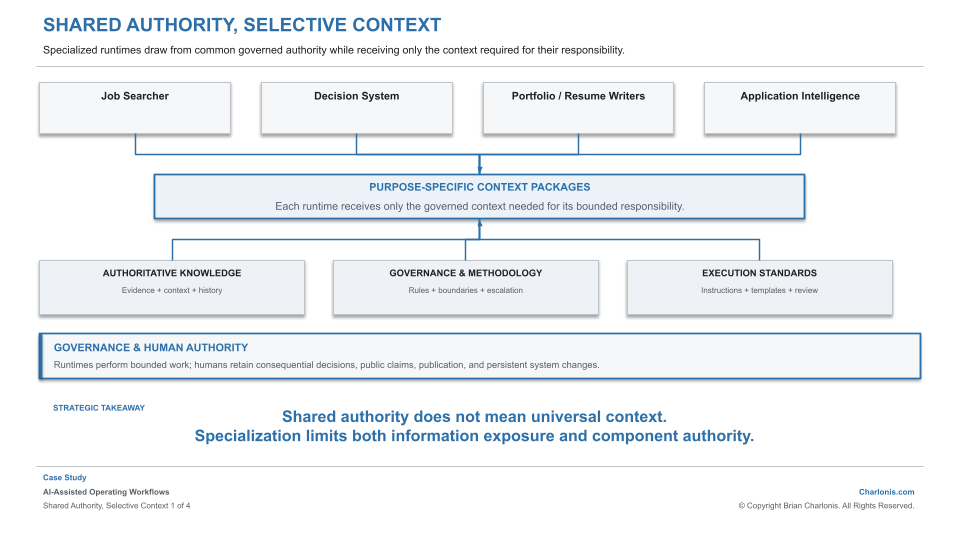
The supporting architecture separates three forms of shared authority:
Authoritative Knowledge
Defines what is known, supported, approved, and reusable.
Governance & Methodology
Defines how evidence may be interpreted, decisions made, recommendations bounded, escalation handled, and authority exercised.
Execution Standards
Define how specific work is produced, structured, constrained, and reviewed.
Human review controls persistent changes across all three.
Selective context keeps the system focused. It reduces drift, protects evidence boundaries, and helps each runtime perform its assigned role without becoming a generalized authority over the entire operating system.
Representative Components
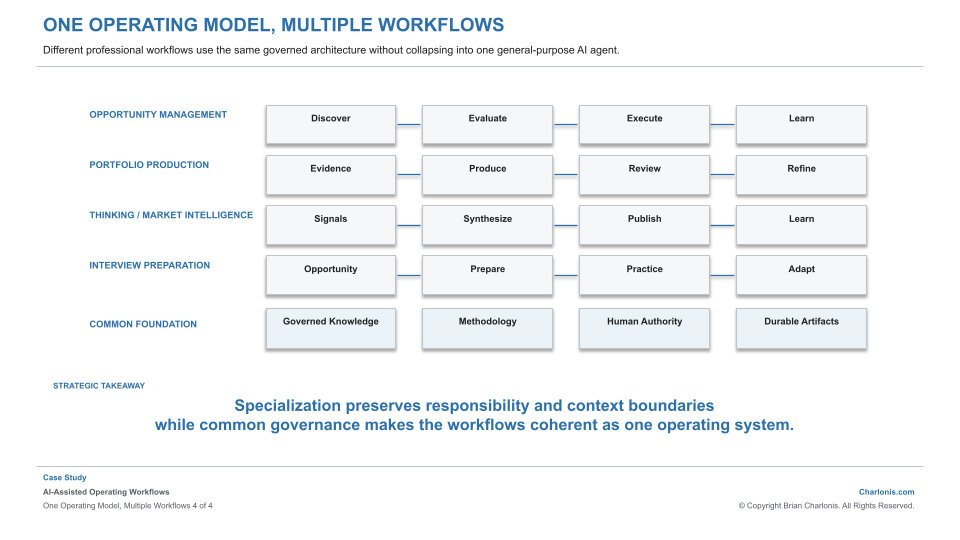
The operating model does not depend on one generic AI assistant doing everything.
It decomposes work into bounded components. Each component receives the knowledge, methodology, governance, and execution standards required for its responsibility.
Job Searcher – Discovery
Job Searcher discovers, validates, structures, and prioritizes relevant market opportunities before they enter formal evaluation.
It may use job-market signals, role-family priorities, search guidance, public positioning, location and employment constraints, prior discovery history, Application Intelligence data, and downstream observations.
It produces opportunity records, prioritized candidate queues, discovery rationale, preliminary risk flags, and structured handoffs.
Authority boundary: Job Searcher discovers and prioritizes opportunities. It does not determine fit or application decisions.
Governed Opportunity Decision System – Evaluation
The Governed Opportunity Decision System evaluates opportunities, market signals, portfolio questions, and strategic inputs before resources are committed.
It may use opportunity evidence, verified experience, portfolio evidence, public positioning, market intelligence, decision methodology, risk rules, and escalation logic.
It produces fit assessments, risk signals, evidence mapping, recommendations, portfolio implications, and next actions.
Authority boundary: The Decision System evaluates and recommends. Human judgment determines whether to proceed and which tradeoffs are acceptable.
Portfolio Writer and Resume Writer – Governed Execution
Portfolio Writer and Resume Writer translate verified evidence, approved strategy, public positioning, and decision outputs into public or application-facing artifacts.
They may use portfolio evidence, resume evidence, site positioning, editorial standards, opportunity requirements, claim boundaries, and human guidance.
They produce portfolio cases, structural revisions, resume drafts, cover letters, application answers, and role-specific evidence framing.
Authority boundary: These components may organize, tailor, and strengthen approved evidence. They may not invent experience, ownership, metrics, client implementation, technical authority, or business outcomes.
Application Intelligence – Observability and Durable History
Application Intelligence preserves application activity, opportunity history, recruiter interactions, submitted assets, outcomes, and follow-up context across time.
It produces opportunity history, duplicate-role awareness, follow-up intelligence, outcome records, and decision-support evidence.
Authority boundary: AIR organizes and preserves evidence. It does not determine causation or decide what should change. Human judgment determines what the observations mean.
The same bounded-authority model extends across the other specialized runtimes, including Career Advisor, Market Intelligence System, Interview Writer, Case Fluency and Insight, and Blog Writer.
A complete fleet inventory matters less than the operating principle: specialization increases depth only when selective context, bounded authority, human gates, and governed knowledge keep the system coherent.
REPRESENTATIVE GOVERNED OPERATING FLOWS
The operating system is easiest to understand through the way work moves.
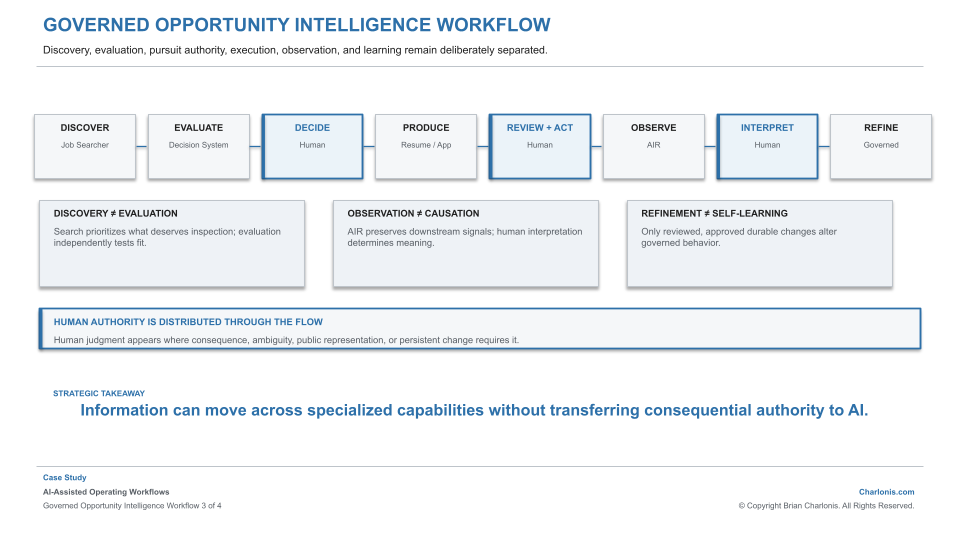
Market Discovery to Application Learning
Market Discovery
→ Opportunity Evaluation
→ Human Pursuit Decision
→ Resume / Application Development
→ Human Review
→ Application
→ AIR Observation
→ Human Interpretation
→ Governed Refinement
A job description or opportunity does not automatically become an application. It enters the system as an input that needs interpretation.
Job Searcher identifies and prioritizes opportunities for inspection. The Decision System independently evaluates fit, evidence support, positioning, risk, and recommended next action. Brian decides whether an opportunity should be pursued. Resume Writer may create application materials only after that decision. Application Intelligence preserves the record and later outcome.
Those records may expose signals about evidence retrieval, positioning, workflow quality, or market response. Human interpretation determines whether a system change is justified.
This is coordinated work, not autonomous agent-to-agent delegation.
Portfolio Case Production
Case Evidence / Draft / Gap
→ Portfolio Knowledge Selection
→ Portfolio Writer Draft
→ Evidence and Claim Review
→ Knowledge or Governance Correction Where Warranted
→ Revised Case
→ Human Approval
→ Publication or Archive
Case evidence enters the system through a draft, review finding, or portfolio gap. Portfolio knowledge and editorial standards determine what the Portfolio Writer can rely on. The draft is reviewed for evidence, claim boundaries, implementation ownership, and public positioning.
If production exposes a durable knowledge or governance gap, the appropriate authority is updated, the case is revised, and human approval determines whether it is published.
Market Signal to Strategic Learning
Market Signal
→ Pattern Review
→ Strategic Interpretation
→ Capability or Positioning Implication
→ Human Decision
→ Portfolio, Learning, or System Update Where Warranted
An external market signal enters through research, a job description, recruiter feedback, or repeated opportunity pattern. The Market Intelligence System assesses whether the signal is isolated or recurring. Career Advisor and/or the Decision System may interpret the strategic implication.
Human judgment determines whether the signal should affect positioning, portfolio priorities, learning investment, or operating-model updates.
Thinking Brief Production
Recurring Signal
→ Governed Evidence Review
→ Argument Framing
→ Blog Writer Draft
→ Public/Private Boundary Review
→ Human Approval
→ Published Intelligence Brief
A recurring market or enterprise signal enters the system through research, job-market observation, public technology developments, or repeated portfolio themes. The signal is interpreted against governed knowledge and public positioning.
Blog Writer may help structure a Thinking draft. Human review determines whether the argument is supported, public, useful, and aligned with evidence boundaries before publication.
Interview Preparation
Role / Interview Prompt / Case Question
→ Evidence Selection
→ Story or Response Draft
→ Claim-Boundary Review
→ Practice Material
→ Human Judgment
A role, interview prompt, case question, or concern enters the system as preparation input. Relevant resume evidence, case evidence, interview guidance, and claim boundaries are selected.
Interview Writer, Case Fluency and Insight may produce story options, case explanations, and practice material. Human judgment determines which stories are appropriate and how strongly they can be claimed.
DURABLE ARTIFACTS & HUMAN CONTROL
Human review is not merely an approval button inside an automated chain.
Important outputs and decisions persist outside individual runtime sessions so humans can review them, retain history, prepare for later work, preserve traceability, and re-enter workflows with durable context.
These artifacts may include opportunity evaluations, discovery records, application records, resume drafts, portfolio drafts, case revisions, interview preparation, Thinking drafts, knowledge updates, outcome records, and review notes.
Durable artifacts help distinguish the system from ephemeral chatbot interactions. They preserve state, evidence, and context independently of any one runtime session.
OBSERVABILITY & FEEDBACK LOOPS
Operation creates evidence about the system itself.
The system may retrieve the wrong evidence, interpret valid evidence incorrectly, overreach beyond its authority, lack knowledge needed for a reliable judgment, produce discovery false positives or false negatives, expose weaknesses through downstream outcomes, or require clearer boundaries between automated work and human judgment.
Those signals are not treated as failure of the overall architecture. They are treated as operating evidence.
The response is to inspect the friction, determine whether the problem originated in knowledge, retrieval, reasoning, governance, workflow, component responsibility, handoff, or human decision-making, make a governed change where justified, and operate the system again.
Closed-Loop Improvement Pattern
Operate
→ Observe
→ Diagnose
→ Classify
→ Refine
→ Re-operate
This does not mean autonomous retraining, self-learning, or unsupervised optimization. It means controlled refinement under human authority.
GOVERNANCE, HUMAN AUTHORITY & CONTROLLED LEARNING
Governance is what makes the operating model credible.
The system is designed to accelerate knowledge work without transferring authority to AI. Controls are embedded across the lifecycle so that recommendations, claims, outputs, artifacts, and system changes remain evidence-based, reviewable, and human-approved.
System Controls
- Approved methodologies and knowledge sources.
- Evidence and traceability requirements.
- Claim boundaries.
- Public/private context boundaries.
- Thresholds and escalation triggers.
- Runtime responsibilities and authority limits.
- Human review and approval gates.
- Durable artifacts and records.
- Controlled system updates.
Humans Remain Responsible
- Defining objectives.
- Resolving ambiguity.
- Evaluating tradeoffs.
- Approving consequential claims.
- Deciding whether to publish, submit, recommend, or act.
- Authorizing changes to the operating system.
- Determining whether a workflow issue becomes a durable system update.
AI performs bounded work. It does not hold organizational authority.
Controlled Learning
Execute
→ Review
→ Identify Gap
→ Decide Whether to Update
→ Update Appropriate Authority Where Warranted
→ Re-execute
→ Human Approval
→ Institutionalize Learning
Not every operating issue becomes a system change.
Distinguishing a one-off issue from a durable knowledge, governance, retrieval, reasoning, handoff, or execution problem is itself a governance decision.
- A case draft may reveal a one-off editorial issue. A resume draft may reveal a wording problem. A job description may reveal an isolated market signal. Those do not automatically require system change.
- A durable issue is different. If operation repeatedly exposes the same evidence gap, governance ambiguity, methodology weakness, runtime instruction problem, discovery issue, or public-positioning inconsistency, the system may need a governed update.
VISITOR TRUST & SAFETY
Governance extends beyond internal accuracy to what public readers are allowed to infer from Charlonis.com.
Public content must preserve implementation status, provenance, authority boundaries, outcome boundaries, confidentiality, independent-work boundaries, client-work boundaries, public/private context separation, and uncertainty where evidence is incomplete.
The system is designed to prevent unsupported transformations such as conceptual work becoming professional implementation, client objectives becoming achieved outcomes, collaboration becoming ownership, technology participation becoming engineering ownership, or independent AI capability becoming prior enterprise AI deployment.
Visitor trust is not a final copy-editing step. It is part of the operating architecture.
WHAT THIS DEMONSTRATES
AI-assisted execution becomes trustworthy when specialized capabilities operate from governed evidence, selective context, explicit decision logic, bounded authority, risk-proportionate automation, human review, durable artifacts, observability, and controlled learning.
The implemented runtimes provide the execution environment. The broader enterprise capability is the ability to convert intelligence and organizational knowledge into repeatable action through specialized execution, embedded governance, visible authority boundaries, traceable artifacts, human review, and controlled refinement.
The result is not a collection of prompts or disconnected AI experiments. It is a governed execution model for turning intelligence and organizational knowledge into accountable action.
The Lab >
Read the Market
Used AI to interpret structural change and define the constraints shaping AI, governance, product roles, and digital infrastructure.
Invest in Learning
Built a learning system combining AI strategy, infrastructure literacy, product strategy, and hands-on experimentation.
Define the Audience
Aligned the portfolio to how recruiters, hiring managers, and senior leaders evaluate systems-level capability.
Curate the Portfolio
Prioritized enterprise and regulated case studies demonstrating product judgment, governance, decision logic, and real-world constraints.
Design the Experience
Created a calm, scannable site experience tailored to senior-level readers.
How do workflows become trustworthy?
By making judgment, evidence, escalation, review, and human accountability visible.