CASE STUDY
Human-in-the-Loop Governance for AI Decision Systems
Designing the thresholds, escalation controls, override tolerance, monitoring signals, and recalibration model required to govern AI-assisted decisions in regulated workflows.
CASE STUDY
Designing the thresholds, escalation controls, override tolerance, monitoring signals, and recalibration model required to govern AI-assisted decisions in regulated workflows.
Operational AI Governance
Human-in-the-Loop Decision Systems
Monitoring & Recalibration
OPERATIONAL AI GOVERNANCE
Conceptual Transformation Scenario
AI & Product Strategy Lead
Brian designed a human-in-the-loop governance model that translated AI confidence signals into operational controls for regulated decision workflows. The work defined when automation could proceed, when human review was required, when exceptions should escalate, and how decision behavior should be monitored and recalibrated over time.
A Financial-services Organization needed to introduce AI into decision-making workflows without losing control, auditability, or user trust. Brian created a threshold-based decision-control system supported by five artifacts — a governance blueprint, risk-tier escalation architecture, executive governance dashboard, synthetic impact simulation model, and AI governance operating model — that made automation boundaries, review requirements, override tolerance, and recalibration logic explicit before scale.
The organization needed to improve decision speed and consistency while preserving reviewability, audit evidence, and accountability for higher-risk decisions.
AI systems were being introduced into operational workflows without clear rules for when decisions should be automated, reviewed by humans, escalated, or paused. This created inconsistent behavior, unclear accountability, and increased risk in regulated environments.
The problem was not whether AI could improve decision speed. It was deciding when automation should be allowed.
The challenge was existing approaches treated AI outputs as either fully automated or fully manual, with no structured model for determining when automation was appropriate, when humans needed to intervene, how exceptions should escalate, or how decision performance should be monitored over time.
The opportunity was to design a human-in-the-loop decision governance model that could improve efficiency while preserving accountability, transparency, auditability, and institutional trust.
How could a financial-services organization introduce AI into regulated decision workflows while defining when automation is appropriate, when humans must intervene, how exceptions should escalate, and how decision performance should be monitored over time?
In regulated decision environments, the challenge is not simply choosing between automation and human review. The challenge is defining the conditions under which each mode is appropriate.
I led the design of the human-in-the-loop decision governance model, translating AI confidence signals into operational controls for regulated workflows. My role focused on defining how AI-assisted decisions should be evaluated, escalated, monitored, and recalibrated over time.
This was an independent operational AI governance case developed as a conceptual transformation scenario for a regulated financial-services environment. I structured the governance problem around modeled decision thresholds, risk-tier escalation, override tolerance, executive monitoring, synthetic impact simulation, and recalibration cadence.
The work established a decision-control model that could help leadership determine when AI-assisted decisions could proceed, when human review was required, when escalation should occur, and when automation should be constrained, recalibrated, or paused.
My responsibilities included:
This case demonstrates independent strategy, operating-model design, decision-governance architecture, synthetic simulation logic, monitoring requirements, and institutional artifacts. It does not claim client-enterprise deployment, production implementation, model development, technical architecture ownership, compliance approval, Risk Committee authority, institutional adoption, measured operational improvement, or realized business outcomes.
Brian designed the end-to-end decision-governance model for translating AI confidence into automation permissions, human review requirements, escalation triggers, modeled override tolerance, monitoring signals, synthetic scenario comparison, and recalibration logic that could support implementation planning and executive governance review.
The solution was a human-in-the-loop AI decision operating model structured around modeled confidence thresholds, escalation logic, override tolerance, monitoring instrumentation, synthetic simulation, and recalibration.
It defined how AI-assisted decisions should move between automation, human review, escalation, monitoring, and governance review before broader workflow exposure.
The solution connected five operating-control questions:
Together, these components translated AI-assisted decision behavior into an operational governance system for balancing efficiency, control, accountability, auditability, and recalibration over time.
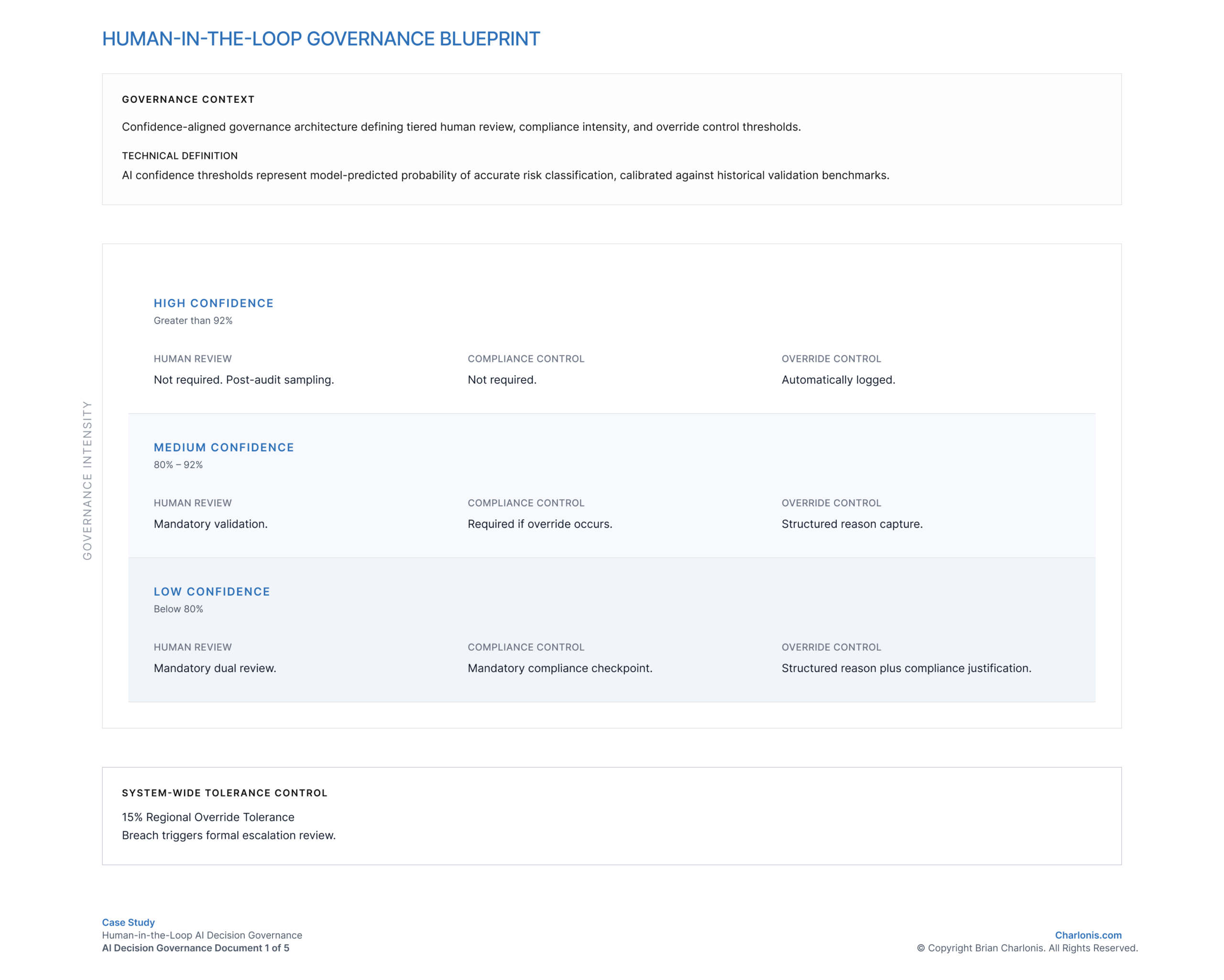
The governance blueprint linked modeled confidence thresholds to operating behavior by defining when AI-assisted decisions could proceed, when human review was required, and when escalation or restriction should occur. It established proposed low-, medium-, and high-risk decision bands so automation could be governed through explicit thresholds to be validated before implementation rather than ad hoc judgment.
Key Elements
Artifact type: Decision blueprint / threshold architecture.
The artifact linked modeled confidence bands, automation permissions, human review requirements, override tolerance, and escalation logic into a structured decision-control model.
This component would support risk leadership, product teams, compliance stakeholders, operations teams, and AI governance leaders in determining when AI-assisted decisions could proceed, when human review was required, and when automation should be constrained. It clarified how higher-risk decisions would remain subject to oversight while preserving efficiency at lower-risk levels.
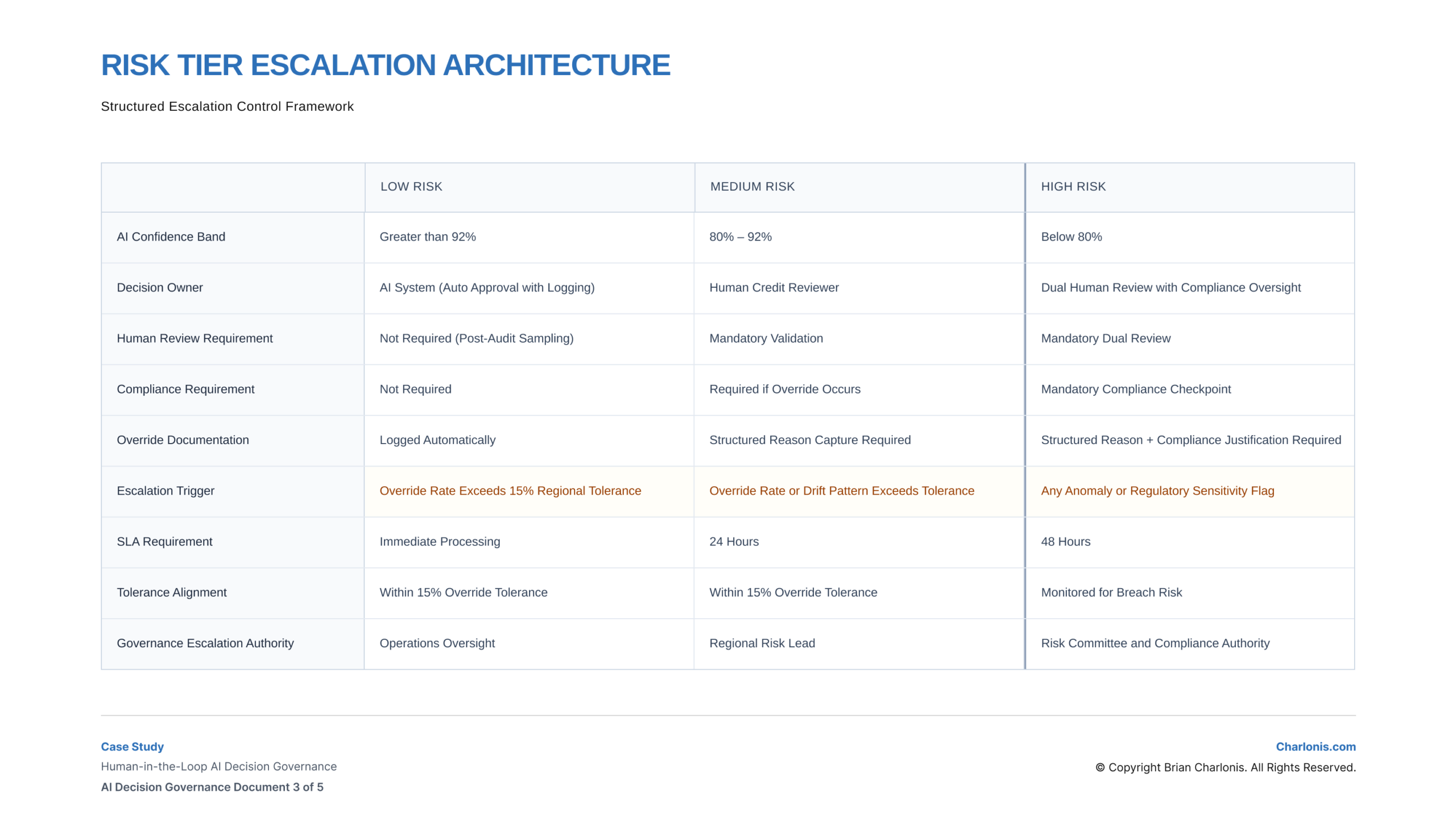
The escalation architecture translated decision risk into proposed ownership, timing, documentation, and authority-routing requirements. It formalized how exceptions should be handled across risk tiers so escalation would not depend on inconsistent local judgment or informal interpretation.
Key Elements
Artifact type: Escalation model / operating control.
The artifact defined proposed ownership, SLA controls, compliance triggers, documentation requirements, escalation-routing logic, and governance intervention triggers by risk tier.
This component would support operations, risk governance, compliance, product, and delivery stakeholders in deciding which decisions could remain in workflow, which required human review, which needed escalation, and which should trigger governance intervention. It clarified how exception handling could become consistent, auditable, and accountable across decision tiers.
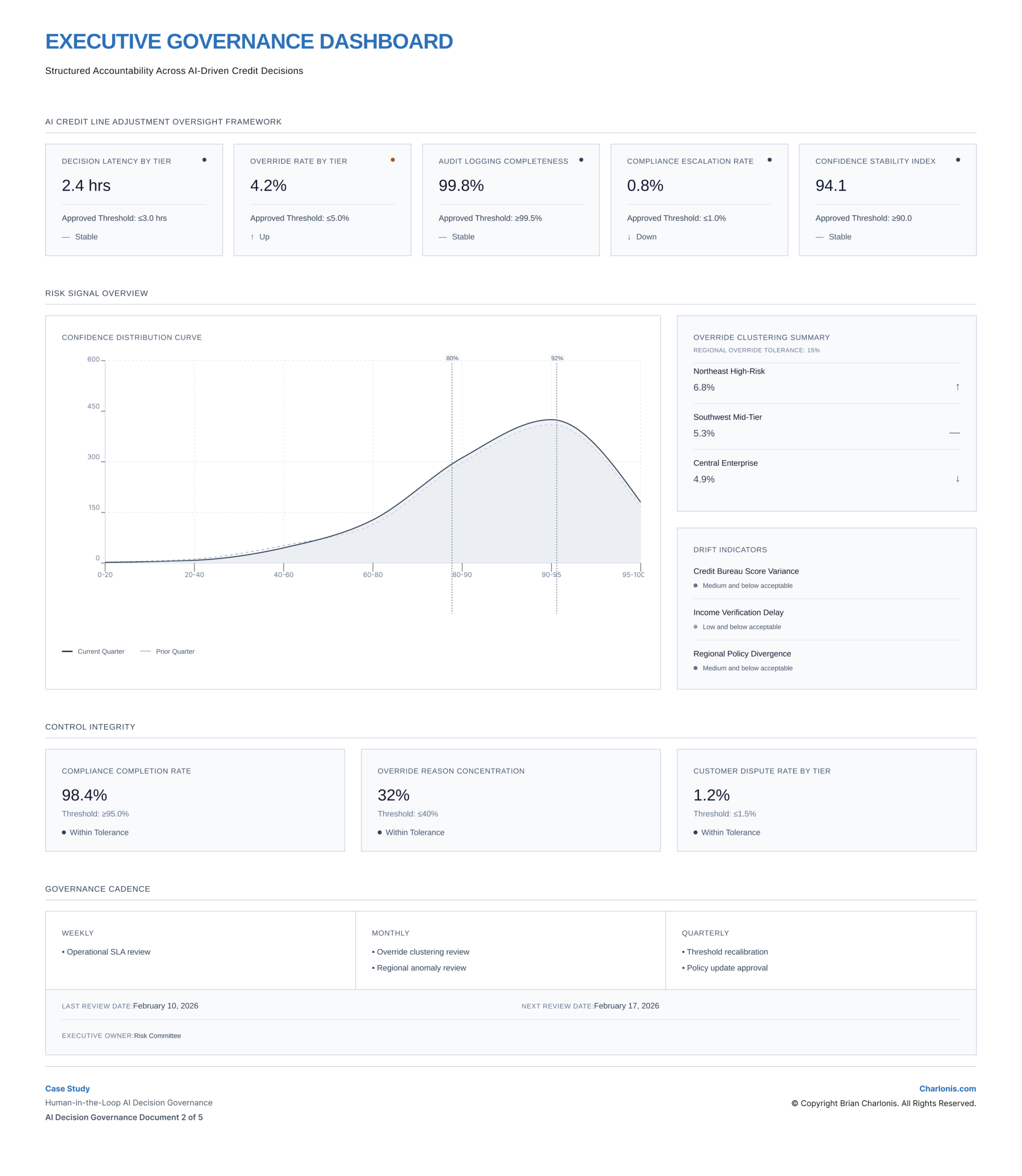
The executive governance dashboard made AI-assisted decision behavior visible to executive and risk governance stakeholders. It showed where human intervention was increasing, where performance was changing, and where recalibration might be needed, so governance leaders could evaluate whether automation remained inside agreed operating boundaries.
Key Elements
Artifact type: Monitoring view / executive oversight.
The artifact connected thresholds, modeled override tolerance, latency, drift, audit completeness, escalation signals, and review workload into a governance-ready monitoring view.
This component would support executive leadership, Risk Committee review, risk governance, compliance, and operational leaders in deciding when to continue, recalibrate, constrain, escalate, or pause AI-assisted workflows. It clarified that governance monitoring should reveal boundary health, not simply report activity volume.
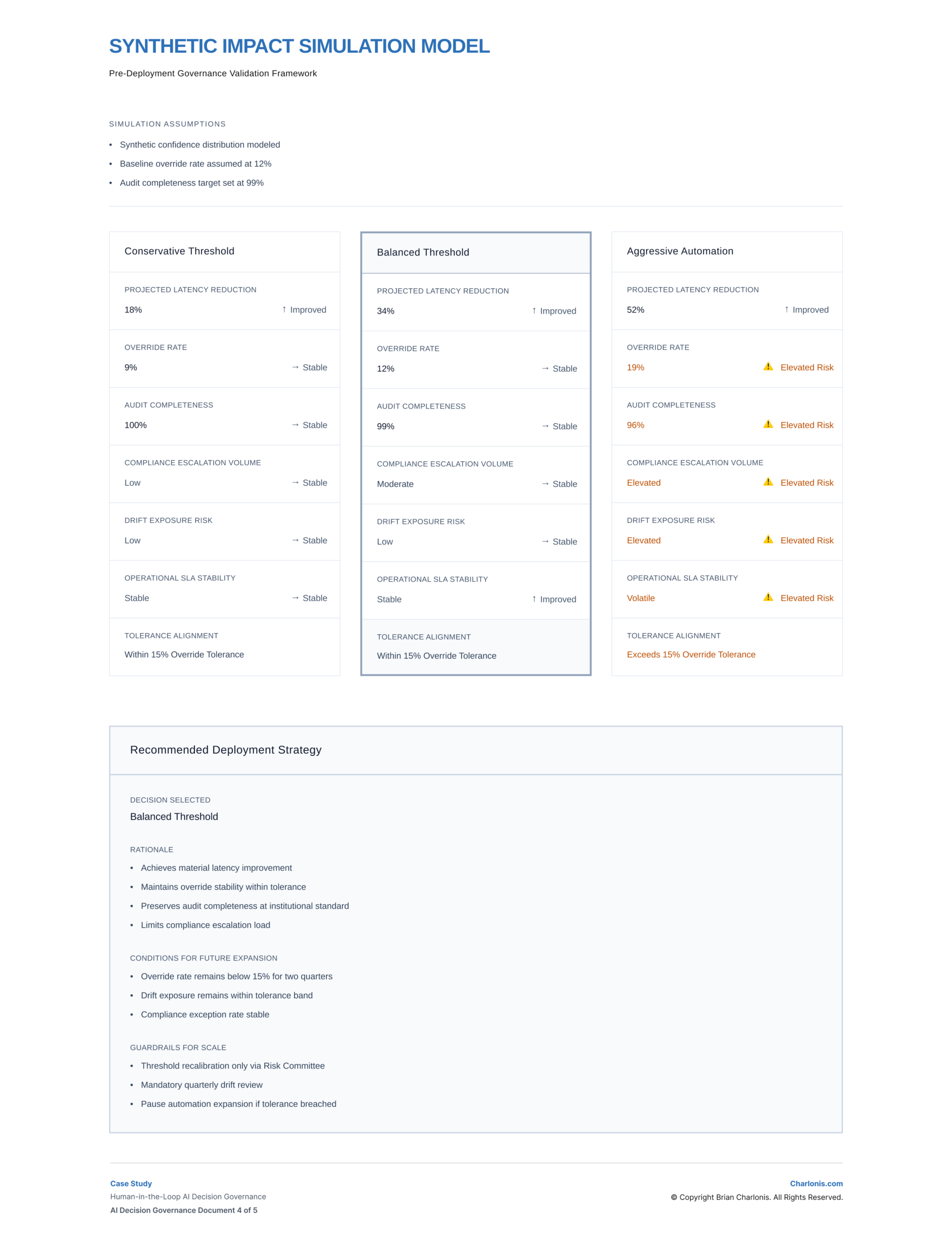
The simulation model compared conservative, balanced, and aggressive automation scenarios before scale. It helped evaluate the tradeoff between decision speed, control, compliance load, and audit integrity so leadership would not treat maximum automation as the goal.
Key Elements
Artifact type: Scenario testing / decision simulation.
The artifact modeled deployment tradeoffs across conservative, balanced, and aggressive automation scenarios before broader workflow exposure.
This component would support executive decision-makers, risk review stakeholders, product teams, and implementation planners in determining which automation posture should be selected, constrained, tested further, or rejected before broader workflow exposure. It reframed the decision from “How much can we automate?” to “Which operating posture creates the best balance of efficiency, control, and accountability?”
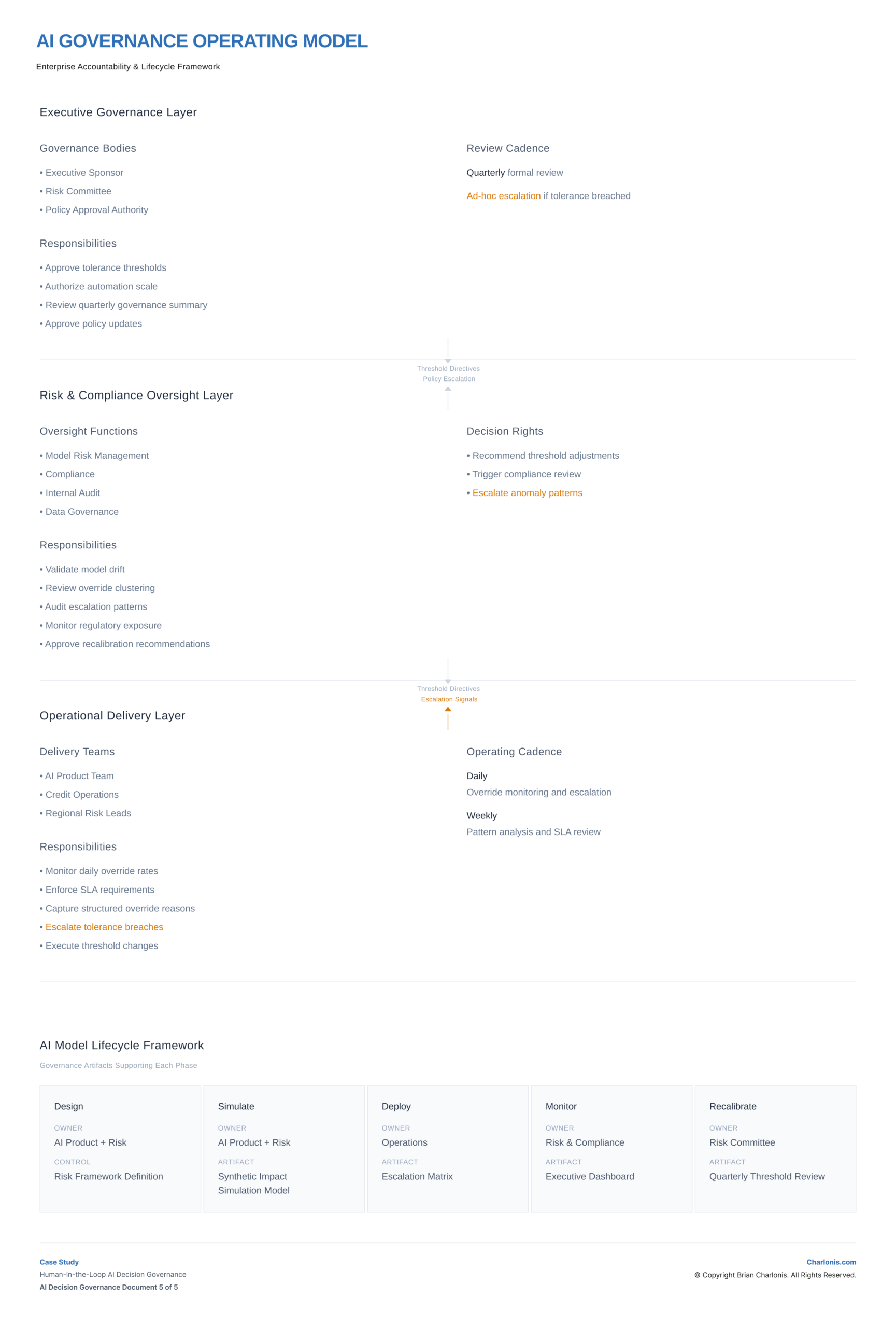
The operating model defined the closed-loop governance system for sustained AI decision oversight. It connected design, simulation, deployment planning, monitoring, and recalibration so AI-assisted workflows would not be treated as one-time deployments.
Key Elements
Artifact type: Operating model / recalibration loop.
The artifact mapped proposed accountability across executive governance, risk oversight, operational delivery, and ongoing recalibration cycles.
This component would support cross-functional leadership, risk governance, compliance, operations, product, and AI oversight stakeholders in determining how AI-assisted workflows should be introduced, monitored, reviewed, recalibrated, constrained, or expanded over time. It clarified that monitoring should lead to governance action, not passive reporting.
This case produced a human-in-the-loop governance model, synthetic impact simulation, monitoring model, escalation architecture, and decision-ready threshold logic. It was developed as an independent conceptual enterprise strategy case and does not claim production deployment, institutional adoption, measured operational improvement, or realized business outcomes.




Brian completed the governance model, threshold architecture, escalation controls, dashboard requirements, synthetic simulation logic, and recalibration model that could support implementation planning and executive governance review. Model development, technical architecture, production deployment, legal interpretation, compliance approval, Risk Committee decision-making, operational delivery, institutional adoption, and realized operational outcomes remained outside the scope of the case.
The central challenge was not whether humans should remain involved in AI-assisted decisions.
It was whether the organization could define the thresholds, tolerances, escalation rules, monitoring signals, and recalibration cadence that determine when human judgment is required.

CASE STUDY
AI VALUE CREATION
Structured an AI-augmented brokerage workflow model to reduce agent administrative burden by separating automatable support tasks from licensed judgment, then turning reviewed customer interactions into governed intelligence for frontline, operational, partner, and leadership decisions.
AI Transformation
Business Solutions Strategy
Workflow Coordination

CASE STUDY
DATA & RESPONSIBLE AI GOVERNANCE
Defined a Data and Responsible AI Governance operating model connecting risk-tiered intake, accountable business ownership, cross-functional controls, lifecycle oversight, reassessment, and executive visibility without routing every AI decision through one centralized approval bottleneck.
Data & Responsible AI Governance
Lifecycle Governance
Decision Rights

CASE STUDY
INSTITUTIONAL GOVERNANCE
Defined an enterprise AI governance architecture with an AI charter, portfolio risk taxonomy, capital-allocation governance model, and vendor governance framework to clarify oversight, decision authority, policy expectations, and investment discipline for responsible AI scale.
AI Governance
Enterprise Decision Systems
Capital Discipline

CASE STUDY
STRATEGIC OPERATING MODEL
A governed AI-assisted intelligence system designed, implemented, and operated to turn fragmented signals, evidence, and professional knowledge into structured decisions, accountable execution, reviewed artifacts, and controlled learning.
Decision Systems
AI Strategy
Enterprise Operating Models
I help regulated enterprises design AI-assisted decision systems where automation, human review, escalation & recalibration are governed by explicit thresholds, not ad hoc judgment.