
CASE STUDY
Enterprise Governance & Policy Architecture for AI Systems
Institutionalizing the authority, risk taxonomy, capital discipline, vendor governance, and oversight model required before AI can scale in a regulated enterprise.
AI Governance
Enterprise Decision Systems
Capital Discipline
INSTITUTIONAL GOVERNANCE
Conceptual Transformation Scenario
AI & Product Strategy Lead
Brian designed an enterprise AI governance operating model that translated fragmented AI activity into a structured control system for responsible adoption. The work established how AI initiatives could be classified, authorized, funded, monitored, escalated, and governed before further scale.
A Regulated Financial-services Institution needed a way to preserve business ownership while creating consistent enterprise controls for AI risk, funding discipline, vendor exposure, and executive oversight. Brian created four institutional artifacts — an AI charter, portfolio risk taxonomy, capital allocation governance model, and vendor governance / build-vs-buy framework — that made governance authority, decision thresholds, and oversight requirements more explicit and decision-ready.
CHALLENGE
AI activity was increasing across the institution, but governance was fragmented across business units, jurisdictions, functions, funding decisions, and sourcing paths. Governance maturity had not kept pace with adoption pressure.
The problem was not AI interest. The problem was institutional control.
The challenge was leadership lacked a consistent system for determining which AI initiatives could proceed, what level of oversight they required, how funding should be conditioned, which vendor exposures needed escalation, and when executive or board review was necessary.
The opportunity was to define an enterprise AI governance operating model that could turn fragmented experimentation into controlled adoption by connecting authority, risk classification, capital discipline, vendor governance, escalation, and oversight before further AI scale.
Key Drivers
- AI initiatives required consistent classification across business units, jurisdictions, and exposure types.
- Funding decisions needed to reflect governance readiness, not only sponsor enthusiasm or technical promise.
- Vendor sourcing decisions needed to account for transparency, auditability, data control, and concentration risk.
- Executive and board oversight needed portfolio-level visibility into material exposure and unresolved risk.
- Business units needed to retain ownership while operating within consistent enterprise controls.
- Governance needed to function as a decision system, not only as a policy layer.
Strategic Question
How could a global financial institution move from fragmented AI experimentation to controlled enterprise adoption by defining risk-tiered authority, capital gating, vendor governance, and executive / board oversight before further AI scale?
In a regulated financial institution, fragmented AI adoption can create inconsistent validation standards, limited portfolio visibility, unclear decision authority, uncontrolled vendor exposure, and capital allocation disconnected from risk readiness.
MY ROLE
I led the design of the enterprise AI governance operating model, translating fragmented AI activity into a structured control system for responsible adoption. My role focused on clarifying how AI initiatives would be classified, authorized, funded, monitored, sourced, escalated, and reviewed across a regulated enterprise.
This was an independent enterprise AI strategy and governance case developed as a conceptual transformation scenario for a regulated financial-services environment. I structured the governance problem around institutional authority, portfolio risk classification, funding eligibility, vendor exposure, and executive oversight, then translated that logic into decision-ready artifacts.
The work established a governance architecture that could help leadership determine what could move forward, what required remediation, what needed executive review, and what should not receive capital until governance conditions were met.
My responsibilities included:
- Defining the enterprise AI governance direction and institutional authority model.
- Structuring risk-tiered classification logic for AI initiatives.
- Designing capital-gating logic tied to governance readiness and control maturity.
- Establishing vendor governance and build-vs-buy decision discipline.
- Translating executive and board oversight into portfolio-level decision signals.
- Creating institutional artifacts that made governance logic tangible and reviewable.
This case demonstrates independent strategy, operating-model design, governance architecture, decision logic, and institutional artifacts. It does not claim client-enterprise deployment, production implementation, legal interpretation, audit execution, board authority, institutional adoption, measured risk reduction, or realized financial outcomes.
Engagement at a Glance
Brian’s Scope
Brian designed the end-to-end governance architecture for classifying AI initiatives, defining authority and escalation logic, conditioning capital release, evaluating vendor sourcing paths, and translating institutional AI governance into artifacts that could support implementation planning and executive decision-making.
HOW I LED THE WORK
- Reframed AI governance as an enterprise operating system, using authority, risk, capital, sourcing, and oversight logic to move the work beyond policy documentation.
- Established authority before acceleration, defining decision rights and escalation paths so AI scale would depend on explicit governance conditions rather than decentralized momentum.
- Structured portfolio exposure through risk-tiered classification, using regulatory exposure, customer impact, financial materiality, data sensitivity, and autonomy to make oversight proportional.
- Connected capital allocation to governance readiness, using scoring, funding gates, remediation requirements, and escalation triggers to prevent investment from moving ahead of control maturity.
- Treated vendor sourcing as a governance decision, incorporating transparency, audit readiness, data control, explainability, time-to-control risk, and concentration exposure into build-vs-buy logic.
- Preserved business ownership within enterprise controls, separating accountable use-case sponsorship from institutional governance authority and oversight requirements.
- Translated executive and board oversight into decision-relevant portfolio signals, focusing attention on material exposure, unresolved risk, governance readiness, and escalation decisions.
SOLUTION
The solution was an enterprise AI governance operating model that connected institutional authority, risk classification, capital discipline, vendor control, escalation, and executive oversight into one decision system.
Instead of treating governance as a policy document or review checklist, the model defined how AI initiatives should be classified, conditioned, funded, sourced, monitored, and escalated before broader adoption.
The solution connected four governance questions:
- Who has authority to govern AI?
- How should AI initiatives be classified?
- What must be true before capital is released?
- How should institutional exposure be controlled across sourcing, escalation, and executive oversight?
Together, these components created a governance architecture for moving from decentralized experimentation to controlled enterprise AI adoption while preserving business ownership within consistent institutional controls.
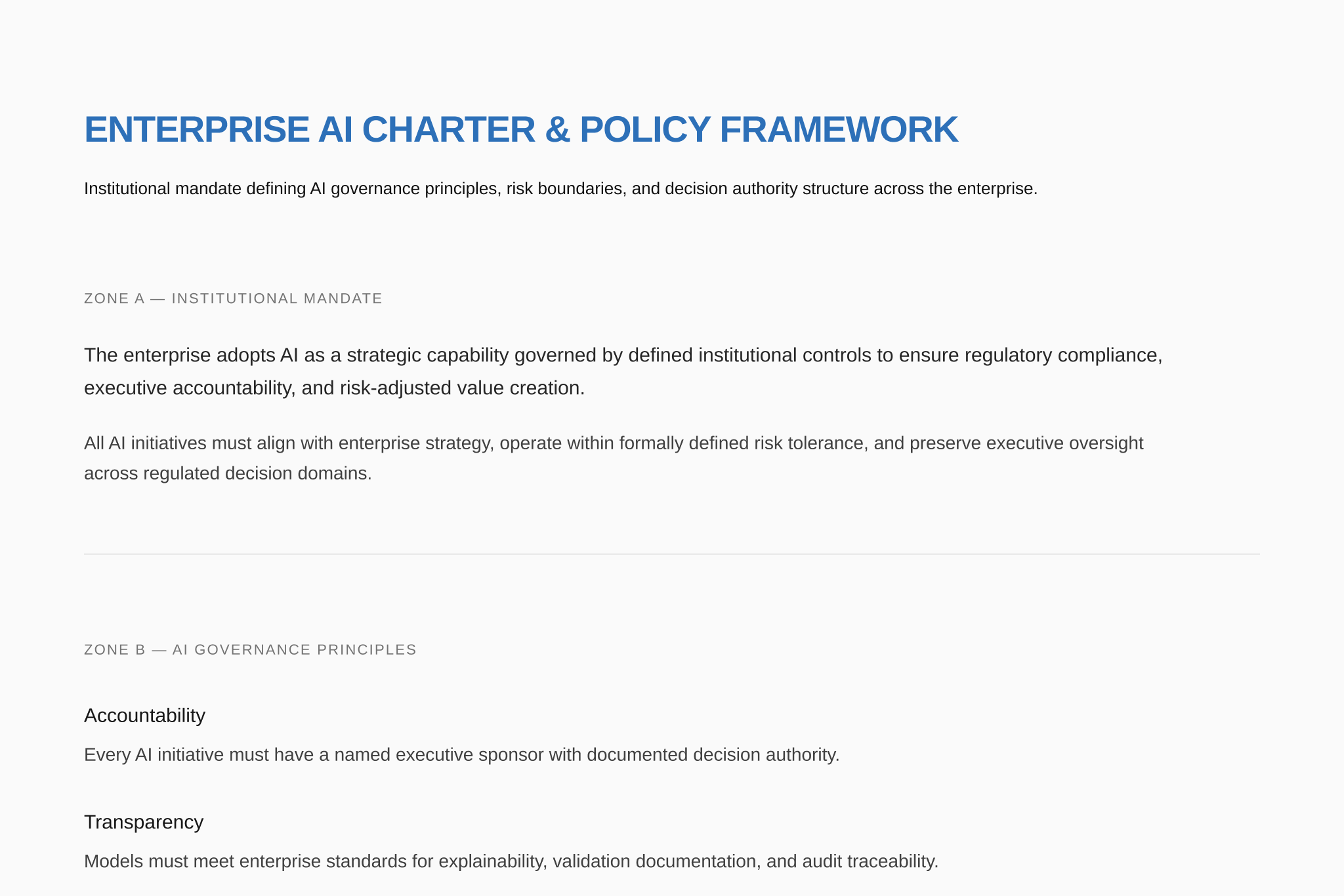
Enterprise AI Charter & Policy Framework
The charter established the institutional mandate, governance principles, risk boundaries, decision rights, and oversight cadence for enterprise AI. It clarified that AI should be treated as a strategic capability governed through formal authority, with clear rules for approval, challenge, escalation, conditional approval, suspension, and oversight.
Key Elements
- Institutional AI governance mandate.
- Accountability, transparency, risk proportionality, capital discipline, and continuous oversight principles.
- Risk appetite and boundary conditions.
- Decision-rights hierarchy across board, executive committee, AI Standards Council, and business-unit leadership.
- Governance cadence and escalation requirements.
Artifact type: Institutional governance framework.
The artifact translated the governance mandate into decision rights, authority layers, risk boundaries, and escalation expectations that could guide enterprise AI oversight.
How It Shaped Decisions
The artifact translated the governance mandate into decision rights, authority layers, risk boundaries, and escalation expectations that could guide enterprise AI oversight.
Enterprise AI Portfolio Risk Taxonomy Model
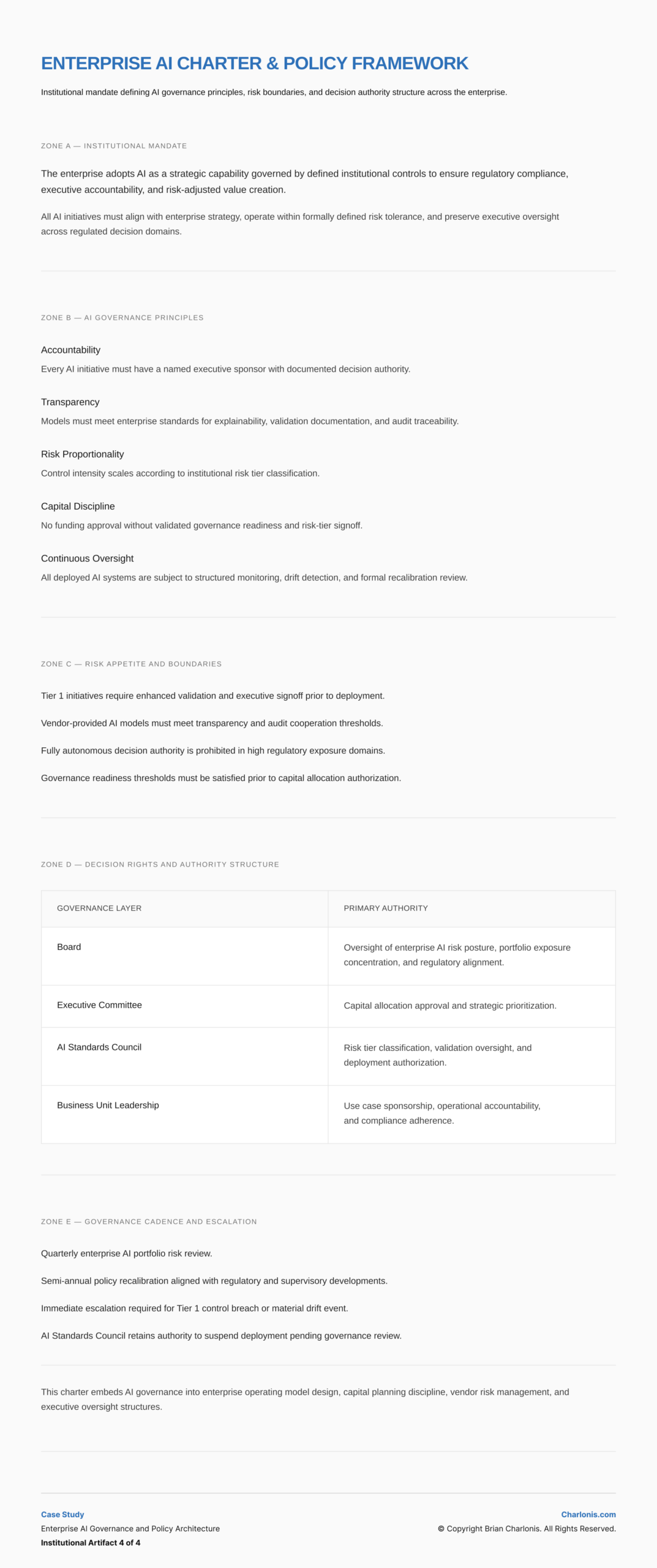
The risk taxonomy created a standardized classification model for AI initiatives across regulatory, financial, customer, data, and autonomy dimensions. It established a common language for distinguishing lower-risk optimization use cases from higher-impact initiatives requiring enhanced validation, monitoring, capital controls, or executive visibility.
Key Elements
- Institutional risk scoring matrix.
- Tier classification logic.
- Regulatory exposure, customer impact, financial materiality, data sensitivity, and model-autonomy dimensions.
- Tier-based governance control requirements.
- Monitoring cadence, escalation protocol, and capital-gating implications by tier.
Artifact type: Risk classification and control model.
The artifact showed how initiatives could be scored, classified, and routed into proportionate governance requirements based on material exposure.
How It Shaped Decisions
This component would support AI Standards Council review, business-unit planning, executive reporting, and capital approval decisions by making risk classification consistent across use cases and jurisdictions. It clarified which initiatives required standard review, enhanced validation, executive escalation, board visibility, remediation, funding restriction, or delayed approval.
Enterprise AI Capital Allocation Governance Model
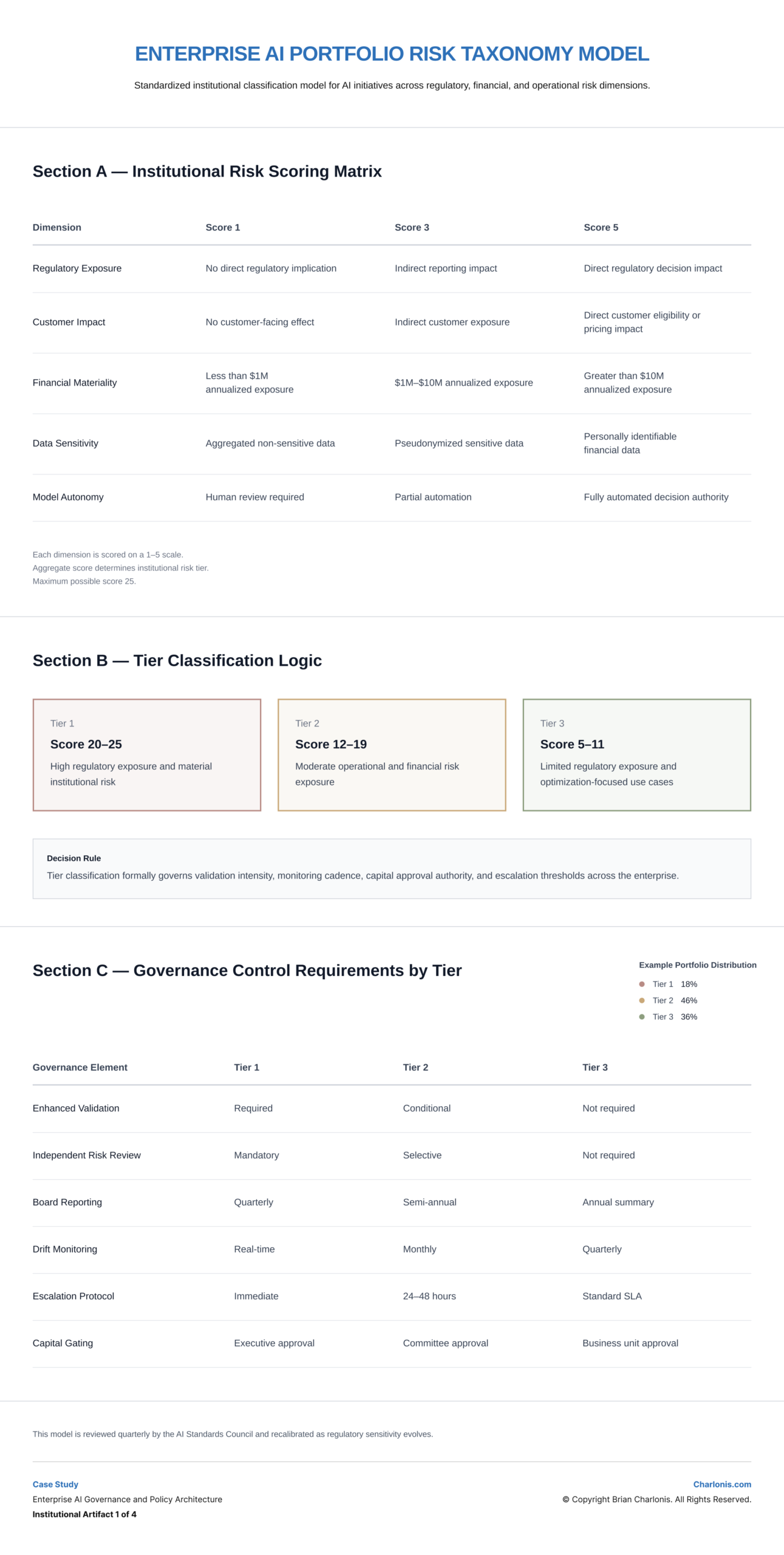
The capital allocation model connected funding eligibility to risk tier, governance readiness, validation preparedness, control maturity, vendor transparency, monitoring readiness, and regulatory sensitivity. It treated capital release as a governance control, ensuring that promising AI initiatives could not move forward on business-case appeal alone.
Key Elements
- Governance readiness scoring.
- Tier-based funding gate flow.
- Conditional approval thresholds.
- Remediation requirements before capital release.
- Capital escalation and control triggers.
Artifact type: Funding gate and governance-readiness model.
The artifact showed how governance readiness scoring, funding rules, executive review, and control triggers could be connected before capital allocation.
How It Shaped Decisions
This component would support capital committee review, AI Standards Council oversight, and executive funding decisions by clarifying when initiatives were eligible for capital, conditionally approved, remediated, escalated, paused, or restricted. It made funding eligibility dependent on governance readiness rather than urgency, enthusiasm, or isolated technical promise.
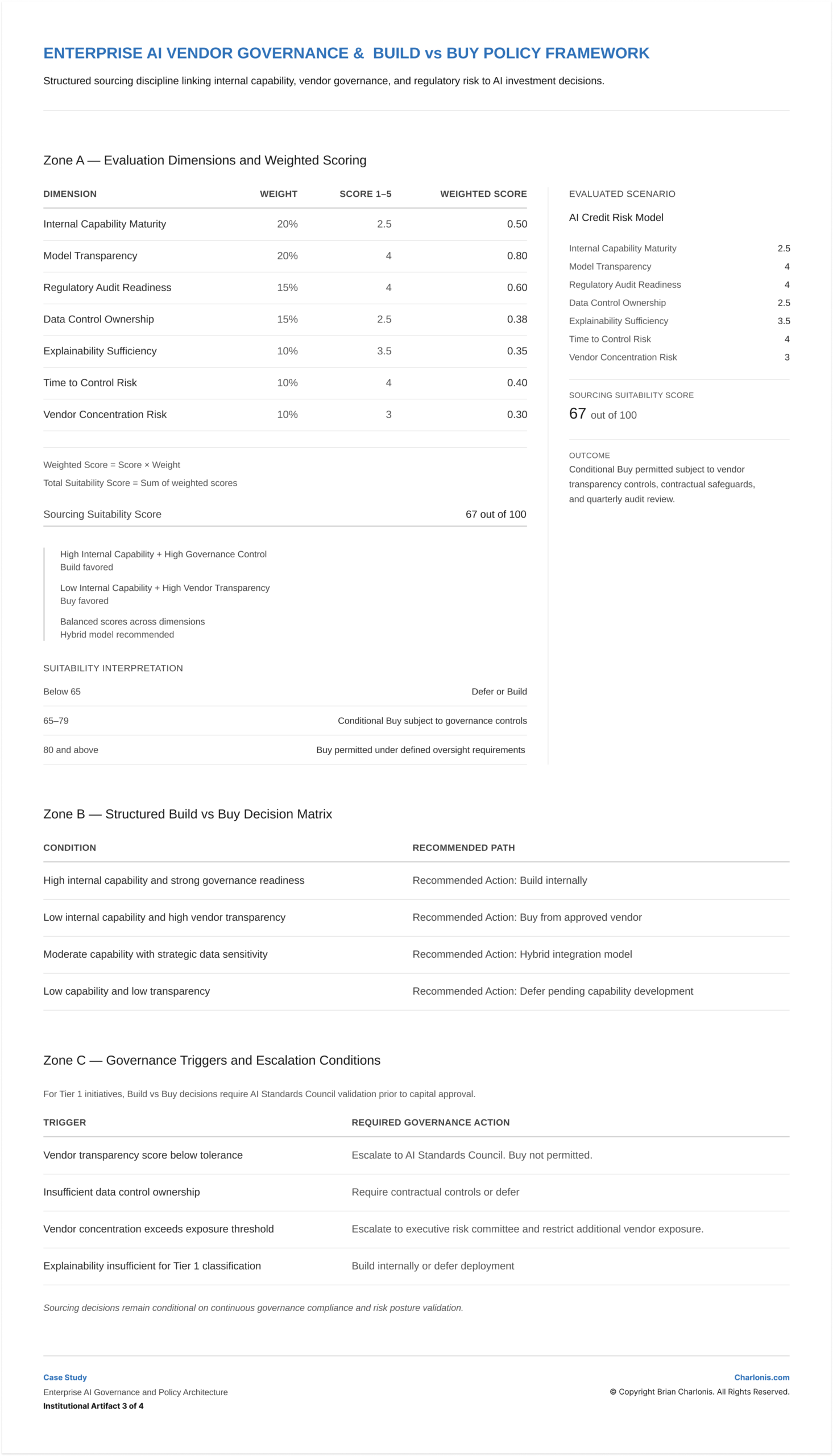
Enterprise AI Vendor Governance & Build vs Buy Policy Framework
The vendor governance framework connected AI sourcing decisions to institutional capability, vendor transparency, audit readiness, data control, explainability, time-to-control risk, and concentration exposure. It positioned build-vs-buy decisions as enterprise governance decisions rather than procurement or delivery-speed choices alone.
Key Elements
- Weighted sourcing suitability scoring.
- Internal capability and vendor transparency evaluation.
- Regulatory audit readiness and data-control assessment.
- Build, buy, hybrid, defer, and restrict decision paths.
- Governance triggers and escalation conditions.
Artifact type: Vendor governance and sourcing decision framework.
The artifact showed how sourcing decisions could be scored, interpreted, and escalated based on control maturity, vendor exposure, and institutional risk.
How It Shaped Decisions
This component would support business, procurement, risk, compliance, and technology leaders in deciding whether to build internally, buy from an approved vendor, use a hybrid integration model, defer pending capability development, or escalate when transparency, data control, or concentration risk exceeded tolerance. It clarified how fragmented vendor adoption could be prevented from becoming unmanaged enterprise exposure.
TRADEOFFS & DECISIONS
Speed vs Institutional Control
- Tradeoff: Business units may want to accelerate AI experimentation before enterprise governance is fully defined.
- Response: I structured the model so charter authority, risk classification, and capital gates would be established before further scale. Acceleration remained possible, but only under defined authority and governance conditions.
Business Autonomy vs Enterprise Authority
- Tradeoff: Local teams understand their opportunities, but inconsistent governance creates enterprise exposure.
- Response: I preserved business ownership while standardizing decision rights, risk tiers, and escalation requirements across the enterprise.
Capital Access vs Governance Readiness
- Tradeoff: Promising initiatives may seek funding before validation, monitoring, ownership, or remediation requirements are mature.
- Response: I conditioned capital release on governance readiness, control maturity, and documented remediation requirements where needed.
Vendor Innovation vs Concentration Risk
- Tradeoff: Vendors can accelerate capability development, but unmanaged vendor adoption increases dependency, auditability exposure, data risk, and concentration risk.
- Response: I treated sourcing as a governance decision embedded in capital and risk oversight rather than a procurement or delivery-speed decision alone.
OUTCOMES
This case produced an enterprise AI governance operating model, four institutional artifacts, and decision-ready logic for authority, classification, capital gating, vendor governance, escalation, and oversight. It was developed as an independent conceptual enterprise strategy case and does not claim production deployment, institutional adoption, measured risk reduction, or realized capital-allocation outcomes.

Impact Summary
- Established a common basis for institutional AI governance decisions.
- Created a proportional authority and escalation model for AI initiatives.
- Connected capital eligibility to governance readiness and control maturity.
- Clarified vendor and sourcing governance as part of enterprise AI oversight.
- Created portfolio-level visibility logic for material AI exposure and unresolved risk.

Evidence
- Enterprise AI Charter & Policy Framework defined mandate, governance principles, risk boundaries, authority structure, escalation cadence, and oversight responsibilities.
- Enterprise AI Portfolio Risk Taxonomy Model standardized initiative classification across regulatory exposure, customer impact, financial materiality, data sensitivity, and autonomy.
- Enterprise AI Capital Allocation Governance Model connected governance readiness scoring, risk tier classification, funding gates, remediation requirements, and capital approval authority.
- Enterprise AI Vendor Governance & Build vs Buy Policy Framework structured sourcing decisions around transparency, audit readiness, data control, explainability, vendor concentration, and build-vs-buy discipline.
- The model defined governance readiness logic that could condition funding, require remediation, trigger escalation, or restrict expansion.
- The model created representative portfolio signals for tracking material AI exposure, higher-risk initiatives, remediation status, and vendor concentration.

Signals Monitored
- AI initiative distribution by business unit, jurisdiction, and risk tier.
- Higher-risk initiatives awaiting validation, remediation, or executive review.
- Governance readiness and remediation status by initiative.
- Vendor concentration exposure across models, platforms, business units, and jurisdictions.
- Material AI risks requiring executive or board attention.

Decision Thresholds
- Require enhanced validation before capital release for higher-risk AI initiatives.
- Require governance readiness thresholds before capital authorization.
- Route material regulatory, financial, customer, or operational exposure to executive or board-level oversight.
- Pause or restrict initiatives when control breaches, validation backlogs, or unresolved conditions exceed tolerance.
- Require remediation plans before conditional approvals can progress.
Brian completed the governance architecture, decision logic, and institutional artifacts that could support implementation planning, executive review, and phased governance adoption. Legal interpretation, technical implementation, model validation, audit execution, board authority, production deployment, institutional adoption, and realized financial outcomes remained outside the scope of the case.
LEADERSHIP REFLECTION
What This Case Demonstrates
- Enterprise AI governance becomes more actionable when it is designed as a decision system rather than a policy layer.
- Capital discipline can become a governance mechanism when funding eligibility is tied to risk tier, control maturity, validation readiness, and remediation status.
- Vendor sourcing decisions should be governed as institutional exposure decisions, not only as procurement or delivery-speed choices.
- Business ownership and enterprise governance can coexist when decision rights, escalation rules, and authority boundaries are explicit.
What I Would Validate Next
- Whether AI initiatives enter enterprise inventory and funding processes consistently.
- Whether risk classification is applied consistently across business units and jurisdictions.
- Whether governance readiness is calibrated clearly enough before funding decisions.
- Whether AI Standards Council authority is strong enough to challenge, condition, or restrict initiatives.
What I Would Watch Closely
- Governance becoming paperwork rather than decision authority.
- Capital gates being bypassed through local funding paths.
- AI Standards Council authority becoming advisory without consequence.
The central challenge was not whether the institution could pursue more AI initiatives.
It was whether the organization could scale AI adoption through authority, risk classification, capital discipline, vendor control, and executive oversight without allowing fragmented experimentation to become unmanaged institutional exposure.
EMERGING TECHNOLOGY OPPORTUNITIES
AI could improve governance operations by helping teams identify initiatives, classify risk inputs, detect readiness gaps, surface vendor exposure, retrieve policy requirements, and summarize portfolio-level oversight signals. Human authority and validation would remain necessary for approvals, capital release, risk acceptance, policy interpretation, and consequential governance decisions; conventional governance systems may remain sufficient where workflows are stable, evidence is complete, and escalation logic is already clear.
Artificial Intelligence
- Use AI-assisted inventory intelligence to identify AI initiatives across business units, vendors, workflows, and jurisdictions.
- Support risk classification by helping teams prepare consistent inputs across regulatory exposure, financial materiality, data sensitivity, autonomy, and customer impact.
- Review governance readiness by detecting missing documentation, unresolved ownership, incomplete validation evidence, unmet funding conditions, or remediation gaps.
- Strengthen executive portfolio reporting by summarizing material exposure, unresolved risk, decision queues, remediation status, readiness scores, and board-review items.
RECOMMENDED

CASE STUDY
DATA & RESPONSIBLE AI GOVERNANCE
Operationalizing Data & Responsible AI Governance Across a Global Enterprise
Defined a Data and Responsible AI Governance operating model connecting risk-tiered intake, accountable business ownership, cross-functional controls, lifecycle oversight, reassessment, and executive visibility without routing every AI decision through one centralized approval bottleneck.
Data & Responsible AI Governance
Lifecycle Governance
Decision Rights

CASE STUDY
FEDERATED AI ADOPTION
Enterprise AI Adoption Across a Decentralized Software Portfolio
Defined a federated AI adoption model for a decentralized software portfolio, connecting business-unit readiness, local ownership, workflow-change evidence, value signals, and cross-unit learning to move AI adoption beyond tool access and isolated pilots.
AI Adoption
Enterprise AI Adoption
Federated Operating Model

CASE STUDY
OPERATIONAL AI GOVERNANCE
Human-in-the-Loop Governance for AI Decision Systems
Defined a human-in-the-loop governance model for regulated AI-assisted decisions, establishing confidence thresholds, escalation controls, override tolerance, monitoring signals, synthetic scenario comparison, and recalibration logic for when automation should defer to human judgment.
Operational AI Governance
Human-in-the-Loop Decision Systems
Monitoring & Recalibration

CASE STUDY
STRATEGIC OPERATING MODEL
Building a Governed Intelligence Operating System
A governed AI-assisted intelligence system designed, implemented, and operated to turn fragmented signals, evidence, and professional knowledge into structured decisions, accountable execution, reviewed artifacts, and controlled learning.
Decision Systems
AI Strategy
Enterprise Operating Models
Can Your AI Governance Model Control What It Funds?
I help regulated enterprises define the governance authority, capital discipline, vendor oversight & executive accountability required to move AI from experimentation to controlled adoption.