
CASE STUDY
Enterprise AI Adoption Across a Decentralized Software Portfolio
Creating the accountability, workflow change, evidence, and learning system required to move AI from isolated pilots into sustained business value.
AI Adoption
Enterprise AI Adoption
Federated Operating Model
FEDERATED AI ADOPTION
Conceptual Transformation Scenario
AI Transformation & Adoption Lead
Brian designed a Group AI Adoption Operating Model for translating uneven AI activity across a decentralized software portfolio into accountable business-unit adoption, workflow change, value evidence, and cross-unit learning. The work clarified how enterprise AI ambition could become locally owned operating change without removing business-unit autonomy.
A Decentralized Software Portfolio had AI capabilities, executive interest, pilots, Champions, and enablement activity, but lacked a repeatable system for turning access into sustained workflow adoption and credible business value. Brian created five artifacts: a Group AI Adoption Operating Model, Maturity-to-Intervention & Adoption Model, AI Adoption Accountability Network, Adoption Value & Scale Scorecard, and opportunity movement method. These clarified how federated enterprises could manage readiness, accountability, workflow change, evidence, learning, and scale decisions.
This case was realized through Brian’s Governed Intelligence Operating System. The system developed recurring market signals about uneven AI adoption, business-unit accountability, sustained workflow change, adoption evidence, and cross-unit learning into an independent conceptual transformation scenario.
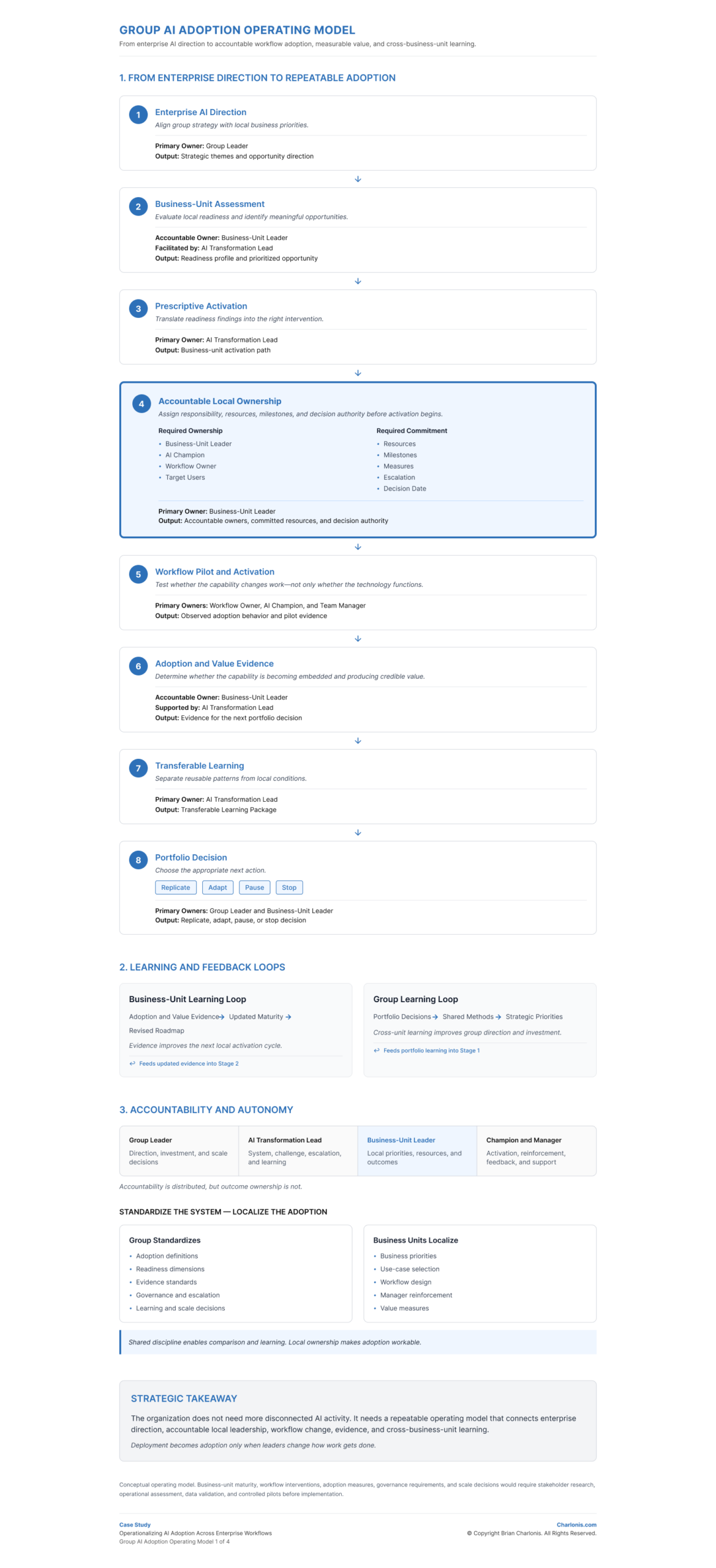
Group AI Adoption Operating Model
CHALLENGE
The organization had already made AI capabilities available across multiple business units. Leadership expected those investments to improve productivity, strengthen operations, accelerate customer-facing innovation, and create commercial value. Yet access to technology was not producing consistent organizational change.
Business units were moving at different speeds. Some had active pilots, while others remained in discovery. Similar opportunities were being explored independently. AI Champions often carried responsibility without sufficient authority, and managers were not consistently equipped to reinforce new workflow expectations.
Leadership could see tools enabled, employees trained, pilots launched, demonstrations completed, and use cases proposed. Those measures did not show whether target users repeatedly applied AI within intended workflows, whether roles and handoffs had changed, whether business-unit leaders were committing resources, whether managers were reinforcing new behaviors, whether credible value was emerging, or whether successful patterns could transfer to another unit.
The challenge was not lack of technology, executive interest, or potential use cases. The enterprise lacked a repeatable operating model for translating enterprise AI ambition into local accountability, sustained workflow change, credible evidence, and reusable learning.
The opportunity was to create a federated AI adoption system that could translate enterprise direction into business-unit action, assess readiness, assign accountability, activate workflow change, measure adoption and value, and determine when local learning should be sustained, revised, embedded, adapted, replicated, paused, or stopped.
Key Drivers
- Translate enterprise AI direction into practical business-unit priorities and adoption roadmaps.
- Assess readiness across leadership, workflow, workforce, data, delivery, and measurement conditions.
- Connect readiness gaps to specific interventions rather than a generic maturity score.
- Make business-unit leaders accountable for resources, workflow change, adoption outcomes, and value.
- Measure repeated workflow behavior rather than access, training, or initial experimentation.
- Capture local evidence and learning in a form that can support cross-unit decisions.
Strategic Question
How could a decentralized group move from AI tool deployment to sustained enterprise capability adoption while preserving business-unit autonomy?
This required more than AI enablement, training, or pilot activity. It required an operating model that connected local autonomy, leadership accountability, workflow adoption, manager reinforcement, evidence standards, and enterprise learning.
MY ROLE
I led the development of the conceptual adoption operating model, translating enterprise AI ambition, business-unit autonomy, workflow realities, leadership accountability, and value-realization needs into a coordinated transformation strategy. My role focused on defining how a federated enterprise could move from uneven AI activity to accountable workflow adoption and credible scale decisions.
This was an independent AI adoption and enterprise transformation case developed as a conceptual transformation scenario for a decentralized software portfolio. I structured the work around business-unit readiness, prescriptive intervention, adoption depth, local ownership, manager reinforcement, target-user behavior, evidence confidence, and cross-unit learning.
The work established an adoption operating model that could help leadership decide where to focus, what intervention a business unit required, whether ownership was sufficient, what evidence was needed, and what should continue, revise, embed, replicate, adapt, pause, or stop.
My responsibilities included:
- Defining the future-state Group AI Adoption Operating Model.
- Establishing business-unit readiness dimensions and prescriptive activation paths.
- Defining adoption progression from availability through value-producing workflow use.
- Clarifying accountability, decision rights, evidence flows, and escalation boundaries.
- Establishing adoption, workflow, value, trust, sustainability, and scale-readiness evidence.
- Formalizing transferable learning and evidence-based portfolio decisions.
This case demonstrates independent strategy, operating-model design, adoption-system architecture, accountability design, evidence-method development, and conceptual artifacts. It does not claim client-enterprise deployment, production implementation, technical model development, platform architecture ownership, vendor selection, MLOps ownership, production integration design, institutional adoption, measured productivity gains, or realized financial outcomes.
Engagement at a Glance
Brian’s Scope
Brian designed the end-to-end federated AI adoption system for translating enterprise direction into business-unit action, diagnosing readiness constraints, assigning local accountability, activating workflow change, measuring adoption and value evidence, capturing transferable learning, and supporting portfolio-level scale decisions.
HOW I LED THE WORK
- Began with the business unit and target workflow rather than the technology, using local operating conditions to determine whether AI adoption could become sustained workflow change.
- Preserved local autonomy while standardizing definitions, evidence, and decision expectations, creating consistency without prescribing one tool, one use case, or one uniform rollout.
- Used readiness assessment as an intervention method, diagnosing leadership, workflow, workforce, data, delivery, and measurement constraints so support could be targeted rather than generic.
- Made leaders and managers accountable for operating change, separating the adoption system from local outcome ownership so central enablement would not absorb business-unit responsibility.
- Measured workflow behavior instead of deployment activity alone, distinguishing tool availability, initial use, embedded adoption, and value-producing operating change.
- Scaled learning before scaling technology, separating reusable enterprise patterns from local adaptation requirements before replication decisions were made.
- Required stronger evidence as decision consequence increased, aligning evidence confidence to whether leadership was continuing local learning, embedding work, replicating across units, pausing, adapting, or stopping.
SOLUTION
The solution was a Group AI Adoption Operating Model connecting enterprise direction to business-unit readiness, accountable local ownership, workflow activation, adoption evidence, value learning, and portfolio decisions.
It defined how a decentralized group could standardize the adoption system while allowing business units to retain ownership of their priorities, workflows, resources, activation timing, and outcomes.
The solution connected five adoption questions:
- How should enterprise AI direction translate into business-unit action?
- What level of support does each business unit need?
- Who owns local adoption, workflow change, and outcomes?
- What evidence proves adoption, value, and readiness to scale?
- How should an individual workflow opportunity move from idea to embedded use or scale decision?
Together, these components created a repeatable adoption system for managing AI adoption without centralizing every implementation or forcing one uniform rollout across different business units.
Group AI Adoption Operating Model
The operating model established the enterprise adoption loop connecting direction, assessment, activation, ownership, workflow change, evidence, learning, and portfolio decisions. It clarified how group leadership could set direction and investment boundaries while business units assessed readiness, selected meaningful workflow opportunities, and activated adoption through accountable local ownership.
Key Elements
- Enterprise AI direction and investment boundaries.
- Business-unit assessment and prescriptive activation.
- Accountable local ownership and workflow pilot activation.
- Adoption and value evidence.
- Transferable learning and portfolio decisions.
Artifact type: Operating model / adoption-system framework.
The artifact showed how enterprise direction becomes assessment, intervention, accountable ownership, workflow adoption, evidence, learning, and portfolio decisions.
How It Shaped Decisions
This component would support group leaders, business-unit leaders, transformation leads, activation teams, target users, and shared enabling functions in determining where to focus, what intervention a unit required, whether ownership was sufficient, what evidence was needed, and whether a pattern should continue, revise, embed, adapt, replicate, pause, or stop.
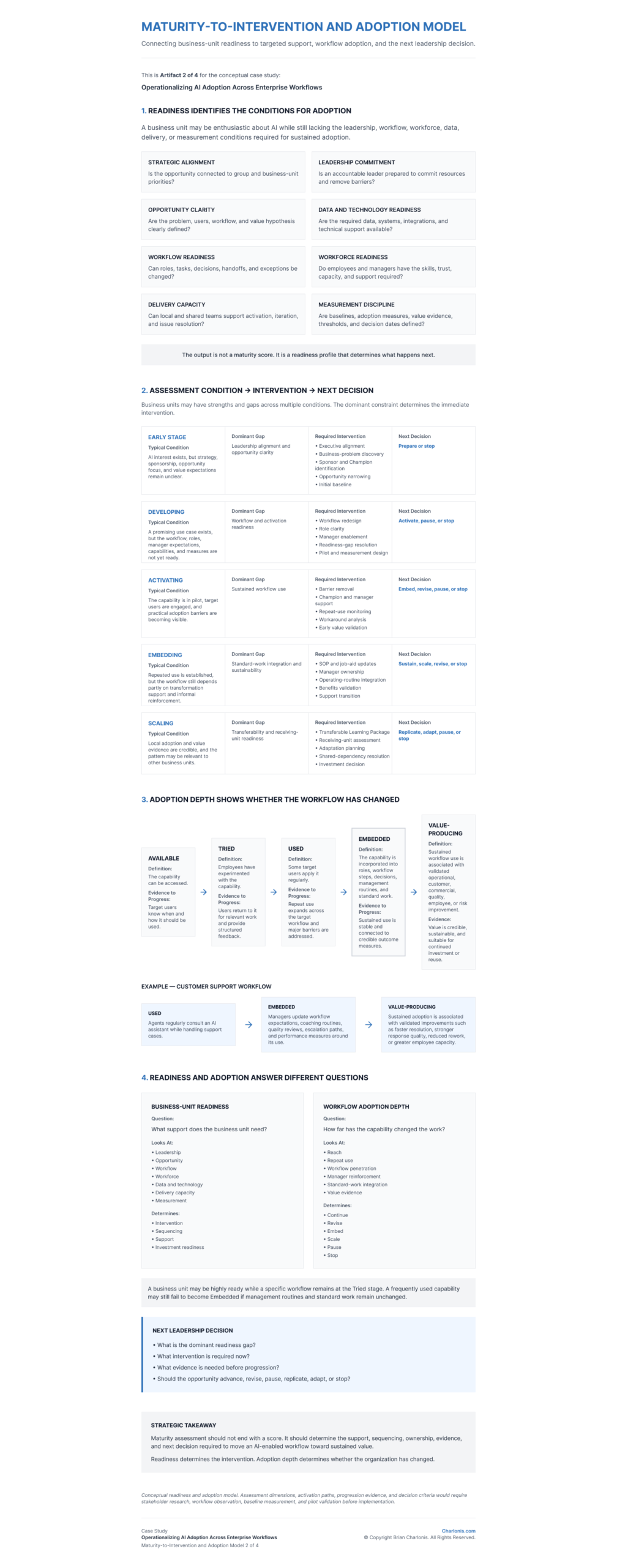
Maturity-to-Intervention & Adoption Model
The maturity-to-intervention model separated business-unit readiness from adoption depth. Readiness determined what support the business unit needed, while adoption depth determined whether the workflow had actually changed. The model avoided a generic maturity score by using readiness evidence to identify the dominant constraint and prescribe the next intervention.
Key Elements
- Readiness profile across strategic alignment, leadership commitment, opportunity clarity, data, workflow, workforce, delivery, and measurement conditions.
- Intervention conditions: Early Stage, Developing, Activating, Embedding, and Scaling.
- Adoption depth: Available → Tried → Used → Embedded → Value-Producing.
- Distinction between frequent use and embedded workflow adoption.
- Progression tied to the next leadership decision.
Artifact type: Readiness and adoption-depth framework.
The artifact showed how readiness determines intervention and adoption depth reveals whether the workflow has changed.
How It Shaped Decisions
This component would support business-unit leaders, adoption leads, activation teams, managers, and shared enabling functions in determining what support was required, whether a unit was ready to activate, whether use was becoming embedded, and what evidence was needed before progression.
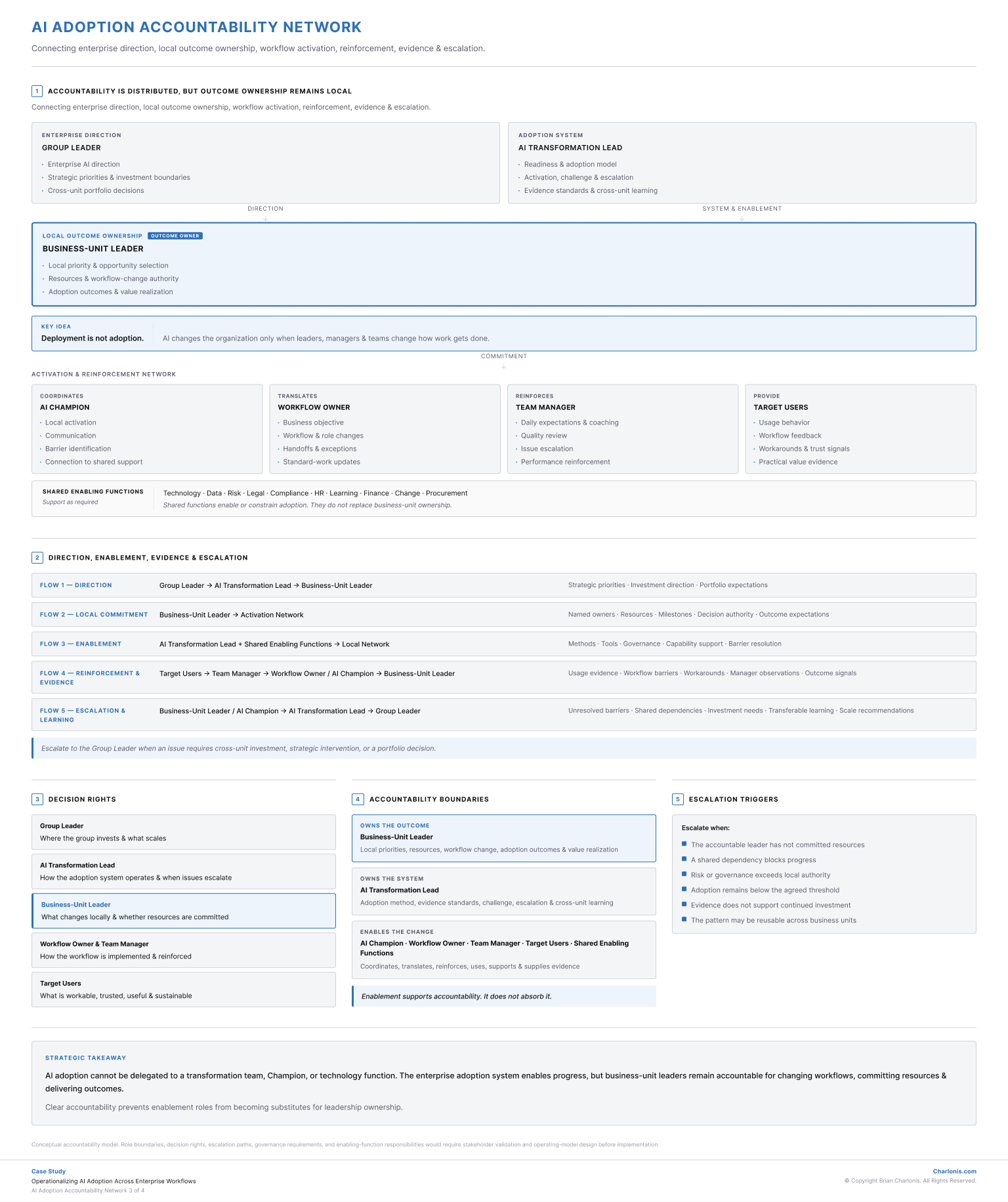
AI Adoption Accountability Network
The accountability network addressed the risk that AI adoption could become everyone’s responsibility and therefore no one’s outcome. It established ownership layers across group leadership, the AI Transformation Lead, business-unit leadership, and the activation network so enablement could support adoption without absorbing local accountability.
Key Elements
- Group Leader ownership of enterprise direction, strategic priorities, investment boundaries, and portfolio decisions.
- AI Transformation Lead ownership of the adoption system, readiness method, evidence standards, challenge, escalation, and cross-unit learning.
- Business-Unit Leader ownership of local priority, resources, workflow-change authority, adoption outcomes, and value realization.
- Activation support from AI Champions, Workflow Owners, Team Managers, Target Users, and shared enabling functions.
- Escalation relationships when barriers require leadership authority.
Artifact type: Accountability and activation model.
The artifact showed who owns enterprise direction, the adoption system, local outcomes, activation, reinforcement, evidence, and escalation.
How It Shaped Decisions
This component would support group leaders, transformation leads, business-unit leaders, activation teams, target users, and enabling functions in determining who commits resources, who owns local outcomes, who reinforces workflow change, when support is required, and when an issue must escalate.
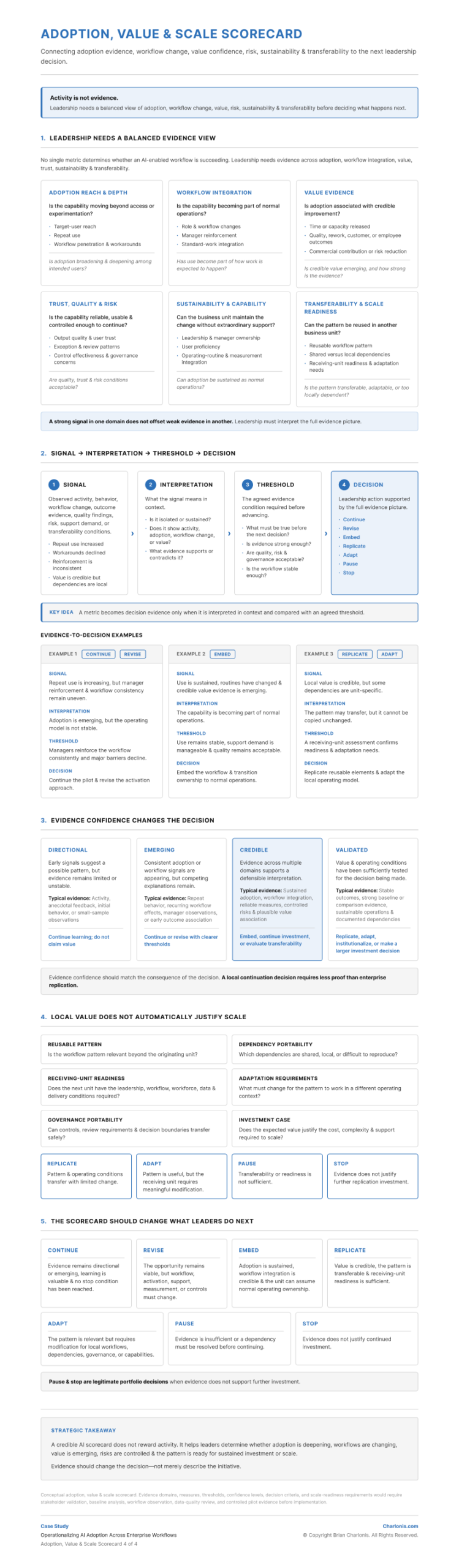
Adoption, Value & Scale Scorecard
The scorecard translated adoption, workflow integration, value, trust, quality, sustainability, transferability, and evidence confidence into leadership decisions. It rejected the idea that activity alone proves adoption, or that adoption alone proves value, by connecting signals, interpretation, thresholds, and decision consequence.
Key Elements
- Adoption reach and depth.
- Workflow integration.
- Value evidence.
- Trust, quality, and risk.
- Sustainability, capability, transferability, and scale readiness.
Artifact type: Decision framework / evidence scorecard.
The artifact showed how balanced evidence, confidence, thresholds, and transferability could support the next leadership decision.
How It Shaped Decisions
This component would support group leaders, business-unit leaders, transformation leads, finance, governance stakeholders, and shared enabling functions in determining whether evidence supported continued learning, workflow revision, normal operating ownership, replication, local adaptation, pause, or termination.
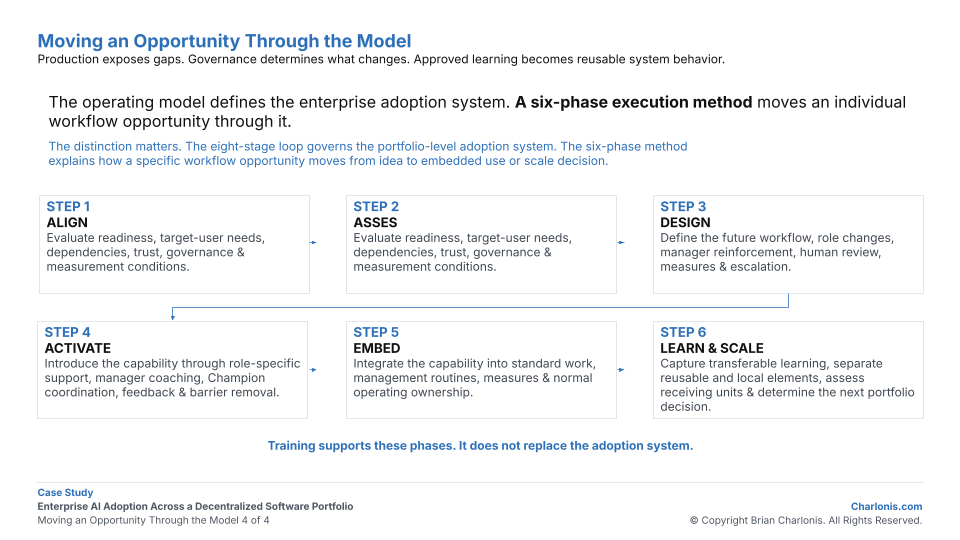
Moving an Opportunity Through the Model
The opportunity movement method translated the portfolio-level adoption system into a structured pathway for a specific workflow opportunity. It clarified how an opportunity would move from alignment through activation, embedding, learning, and scale decisions, while keeping training in its proper role as support rather than a substitute for adoption.
Key Elements
- Align and assess readiness, target-user needs, dependencies, trust, governance, and measurement conditions.
- Design the future workflow, role changes, manager reinforcement, human review, measures, and escalation.
- Activate through role-specific support, manager coaching, Champion coordination, feedback, and barrier removal.
- Embed into standard work, management routines, measures, and normal operating ownership.
- Learn and scale by separating reusable patterns from local adaptation needs.
Artifact type: Execution method / adoption pathway.
The artifact defined the execution method for moving a workflow opportunity from alignment through activation, embedding, learning, and scale decisions.
How It Shaped Decisions
This component would support transformation leads, business-unit leaders, Workflow Owners, managers, Champions, and shared enabling functions in determining how a specific opportunity should progress, what evidence was required, when barriers needed escalation, and whether learning was sufficient for embedding, adaptation, replication, or pause.
TRADEOFFS & DECISIONS
Group Consistency vs Local Autonomy
- Tradeoff: The group needed shared methods, definitions, and evidence standards, while business units needed flexibility to respond to their own customers, products, workflows, and operating conditions.
- Response: I standardized the adoption system while localizing opportunity selection, workflow design, activation, and value measures.
Speed vs Readiness
- Tradeoff: Leadership wanted rapid progress, but moving before sponsorship, workflow, data, skills, and measurement conditions were ready could create visible failure and distrust.
- Response: I used readiness evidence to determine the intervention and distinguish controlled learning from scale readiness.
Champion Energy vs Leader Accountability
- Tradeoff: Champions could accelerate adoption, but overreliance on them could allow leaders and managers to avoid changing resources, expectations, or operating routines.
- Response: I defined Champion responsibilities and limits while making leader commitments and management reinforcement visible.
Activity vs Value
- Tradeoff: Tool access, training completion, and initial use could create the appearance of momentum without demonstrating changed work or credible outcomes.
- Response: I required evidence of repeated workflow behavior, management reinforcement, operational integration, and business value before progression.
OUTCOMES
This case produced a federated AI adoption operating model, five conceptual artifacts, accountability logic, readiness-to-intervention method, evidence framework, and scale-decision model. It was developed as an independent conceptual transformation scenario and does not claim production deployment, institutional adoption, realized financial impact, quantified productivity improvement, or measured business gains.

Impact Summary
- Defined a repeatable operating model connecting enterprise direction, business-unit readiness, local accountability, workflow activation, evidence, and learning.
- Connected readiness conditions to prescriptive interventions while separating readiness from adoption depth.
- Clarified ownership across the Group Leader, AI Transformation Lead, Business-Unit Leader, and activation network.
- Created an evidence-based system for Continue, Revise, Embed, Replicate, Adapt, Pause, and Stop decisions.
- Distinguished enterprise replication from local deployment by making transferability and receiving-unit readiness explicit.

Evidence
- Group AI Adoption Operating Model defined the adoption loop connecting direction, assessment, activation, ownership, evidence, learning, and portfolio decisions.
- Maturity-to-Intervention & Adoption Model connected business-unit readiness, dominant constraints, intervention conditions, and adoption-depth progression.
- AI Adoption Accountability Network clarified ownership, reinforcement, enablement, evidence, and escalation relationships.
- Adoption, Value & Scale Scorecard established evidence domains, confidence levels, thresholds, and leadership decisions.
- Moving an Opportunity Through the Model defined the execution method for moving a workflow opportunity from alignment through activation, embedding, learning, and scale decisions.
- The model established proposed evidence, escalation, learning, and portfolio-decision logic for federated AI adoption.

Signals Monitored
- Leadership commitment, ownership clarity, readiness gaps, and unresolved dependencies.
- Target-user reach, repeat use, workflow penetration, abandonment, and workaround patterns.
- Manager reinforcement, operating-routine integration, support demand, and unresolved workflow barriers.
- Value, trust, quality, sustainability, evidence confidence, transferability, receiving-unit readiness, and progression against scale thresholds.

Decision Thresholds
- Do not advance without an accountable Business-Unit Leader, defined workflow, value hypothesis, required resources, decision date, and sufficient leader / manager ownership for issues requiring authority.
- Do not treat access, training, demonstrations, or initial experimentation as proof of adoption.
- Do not consider a capability embedded until workflow use is sustained, manager reinforcement is present, and normal operating ownership is credible.
- Do not replicate until value evidence is credible, reusable elements are understood, local dependencies are known, and receiving-unit readiness is sufficient.
Brian completed the adoption operating model, readiness-to-intervention method, accountability network, scorecard, opportunity pathway, and decision logic that could support stakeholder review and business-unit pilot planning. Production deployment, technical architecture, vendor selection, MLOps, production integration, realized business-unit adoption, financial results, and quantified operational outcomes remained outside the scope of the case.
LEADERSHIP REFLECTION
What This Case Demonstrates
- Deployment is not adoption; a capability going live does not prove employees use it, workflows changed, or value was created.
- Enterprise AI value is created through workflows, not licenses. Technology creates potential, while changed operating behavior creates value.
- The transformation lead owns the adoption system, evidence method, challenge process, and cross-unit learning; business-unit leaders own local outcomes.
- The organization should scale learning before scaling technology because local success does not automatically justify enterprise replication.
What I Would Validate Next
- How AI priorities, resources, and accountability are currently established across the group.
- Which readiness conditions are preventing selected workflows from progressing.
- What evidence leaders require before embedding or replicating a workflow.
- Which local practices, prompts, workflow changes, and enablement patterns are genuinely reusable.
What I Would Watch Closely
- Readiness assessments becoming reporting artifacts instead of intervention tools.
- Central support unintentionally absorbing local accountability.
- Activity or mandatory use being presented as value.
The central challenge was not getting more employees to try AI.
It was changing ownership, workflows, management routines, and evidence standards so useful AI capabilities could become part of how the organization operates, and so local learning could improve decisions across the enterprise.
RECOMMENDED

CASE STUDY
DATA & RESPONSIBLE AI GOVERNANCE
Operationalizing Data & Responsible AI Governance Across a Global Enterprise
Defined a Data and Responsible AI Governance operating model connecting risk-tiered intake, accountable business ownership, cross-functional controls, lifecycle oversight, reassessment, and executive visibility without routing every AI decision through one centralized approval bottleneck.
Data & Responsible AI Governance
Lifecycle Governance
Decision Rights

CASE STUDY
AI PORTFOLIO & INVESTMENT
Allocating Enterprise AI Investment Across a Multi-Product Consumer Fintech
Structured an AI portfolio investment system for a multi-product fintech, using capability sequencing, staged funding, evidence thresholds, and executive decision logic to determine which AI initiatives should be funded, combined, constrained, accelerated, paused, stopped, or rebalanced.
Enterprise AI Strategy
AI Portfolio Strategy
Evidence-Based Funding

CASE STUDY
AI VALUE CREATION
AI-Augmented Insurance Brokerage Operating Model
Structured an AI-augmented brokerage workflow model to reduce agent administrative burden by separating automatable support tasks from licensed judgment, then turning reviewed customer interactions into governed intelligence for frontline, operational, partner, and leadership decisions.
AI Transformation
Business Solutions Strategy
Workflow Coordination

CASE STUDY
MONITORED AUTONOMY
Agentic AI Systems for Enterprise Regulatory & Risk Intelligence
Designed a monitored-autonomy model for agentic regulatory intelligence, defining how regulatory signals would be classified, routed, monitored, contained, escalated, and translated into executive decision support for high-risk enterprise workflows.
Agentic AI
Regulatory Intelligence
Monitored Autonomy
Is AI Changing How Your Organization Works?
I help enterprises turn uneven AI activity into accountable workflow adoption, credible value evidence & disciplined scale decisions.