
Decision Systems
AI Strategy
Enterprise Operating Models
The Leadership Lab / Governed Opportunity Decision System
AI & Product Strategy Lead
Organizations generate more intelligence than ever, but often lack the operating models needed to turn that intelligence into consistent decisions, accountable execution, and reusable learning.
Brian designed the Governed Intelligence Operating System as one working response to that problem. The system connects intelligence, decision methodology, governed knowledge, specialized AI runtimes and operating capabilities, behavioral governance, human authority, durable artifacts, observability, and controlled learning into one operating model.
The Leadership Lab is the working implementation and evidence environment where the model was designed, implemented, operated, observed, and refined. The public portfolio, Governed Opportunity Decision System, Thinking content, operating workflows, opportunity evaluations, portfolio development, resume strategy, and case-production work show the system in use.
The larger contribution is not that Brian built a collection of AI tools. It is that he designed an enterprise-inspired governed AI operating model, implemented specialized components and governed knowledge, operated the system through repeated real professional workflows and decisions, observed where discovery, evidence, reasoning, handoffs, authority, and feedback created friction, and refined the system while retaining human authority over consequential decisions.
This case does not claim employer-sponsored enterprise AI deployment, client production deployment, enterprise-scale platform operation, MLOps ownership, or measured external enterprise ROI. It is implemented independent work. Its enterprise relevance comes from the operating disciplines demonstrated: component boundaries, governed knowledge, orchestration, observability, escalation, human authority, provenance, visitor trust, durable artifacts, and controlled refinement.
View: Leadership Lab
View: Lab / AI-Assisted Operating Workflows
Leadership Lab
SPECIAL AREA
A live demonstration of how enterprise intelligence becomes governed organizational action.
The Leadership Lab exposes the operating model behind the portfolio. It shows how signals are interpreted, decisions are evaluated through explicit methodology, work is grounded in governed knowledge, specialized runtimes are coordinated, behavioral governance shapes outputs, human authority is preserved, and repeated operation improves the system through observed friction and approved refinement.
CHALLENGE
The challenge was not access to more AI. It was converting fragmented intelligence into reliable decisions, coordinated execution, durable knowledge, and controlled learning while preserving human authority, evidence boundaries, and trust.
Organizations increasingly have access to more information, more AI capability, more analytics, more market signals, more internal knowledge, and more specialized tools. But more intelligence does not automatically create better decisions. In many environments, intelligence remains fragmented across teams, documents, workflows, tools, stakeholders, and AI-assisted outputs.
The result is a familiar operating problem:
- Information exists, but is not consistently interpreted.
- Evidence exists, but is not governed by shared claim boundaries.
- Teams use different terminology, assumptions, and decision logic.
- AI-assisted workflows generate outputs without enough shared context.
- Information exists, but is not consistently interpreted.
- Evidence exists, but is not governed by shared claim boundaries.
- Teams use different terminology, assumptions, and decision logic.
- AI-assisted workflows generate outputs without enough shared context.
- Knowledge becomes trapped inside individual tools or conversations.
- Execution accelerates before authority and review are clear.
- Discovery may surface false positives or miss viable opportunities.
- Recommendations may exceed the authority of the component producing them.
- Downstream outcomes may expose system weakness without proving causation.
- Governance appears after outputs are produced instead of shaping the work from the beginning.
- Learning remains local rather than becoming an approved improvement to the operating model.
The challenge was AI makes this problem more urgent. It can accelerate analysis, drafting, synthesis, comparison, and execution faster than many organizations can establish the evidence standards, review controls, authority boundaries, observability, and shared knowledge needed to use that acceleration responsibly.
The opportunity was to design a working operating model where intelligence could be interpreted before action, decisions could be evaluated through explicit methodology, specialized components could operate within bounded authority, and operational friction could become governed learning without allowing the system to silently rewrite its own rules.
Key Drivers
- Growing volumes of intelligence without consistent decision structures.
- Fragmented knowledge across tools, documents, workflows, and conversations.
- Inconsistent interpretation of evidence across specialized AI-assisted work.
- Need for clearer separation among intelligence, decision-making, knowledge, execution, governance, and learning.
- Need to separate discovery, evaluation, execution, human decision-making, and learning.
- Need for shared evidence structures that prevent overclaiming, drift, and repeated context reconstruction.
- Need for human authority over evidence acceptance, pursuit decisions, recommendations, publication, and system changes.
- Need to improve the system through repeated operating use without allowing uncontrolled self-modification.
Strategic Question
How can an organization turn fragmented intelligence into consistent, governed decisions and coordinated execution while preserving human authority, evidence boundaries, observability, and controlled learning?
This required Brian to design an operating system around governed decision intelligence, not around AI tooling alone.
MY ROLE
I served as AI & Product Strategy Lead, designing, implementing, operating, observing, and refining the Governed Intelligence Operating System from initial framing through repeated professional workflows and decisions.
My role was to recognize that the core challenge was not making AI more capable. It was designing the operating system around AI so intelligence could become accountable action without sacrificing evidence, authority, coherence, or learning.
I defined the operating model, decision architecture, governed knowledge foundation, governance model, execution-role boundaries, review controls, durable artifact strategy, observability logic, and controlled-learning mechanisms. I also served as the accountable human reviewer, determining which claims, recommendations, outputs, pursuit decisions, public artifacts, and system updates were acceptable.
My responsibilities included:
- Reframing the problem from AI productivity to governed decision intelligence.
- Defining six persistent architectural responsibilities across Intelligence, Decision, Knowledge, Execution, Governance, and Continuous Learning.
- Designing the Governed Opportunity Decision System as one public-facing implementation of the operating model.
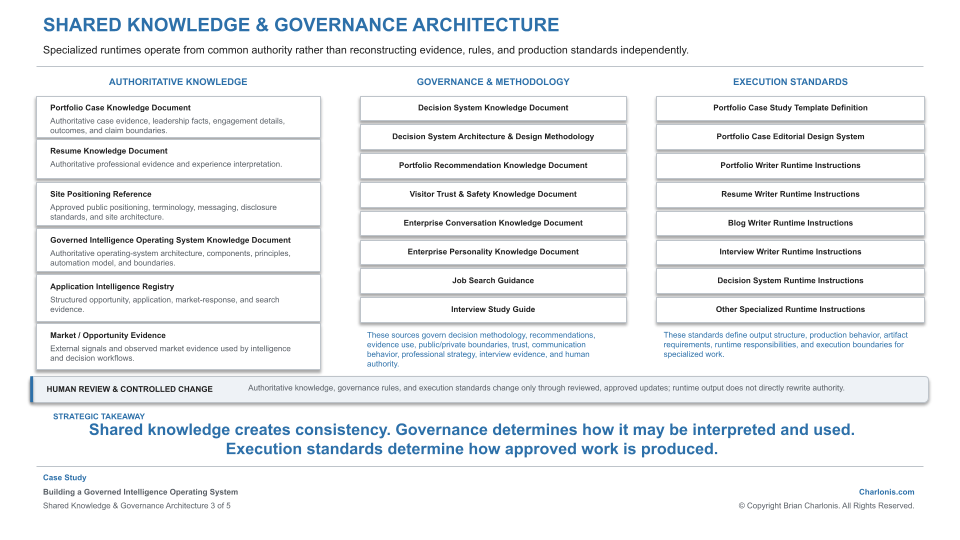
- Establishing governed knowledge and evidence structures so specialized AI runtimes and operating capabilities could operate from consistent context.
- Separating methodology, knowledge, execution instructions, behavioral governance, evidence standards, recommendation policy, trust controls, and runtime orchestration.
- Defining authority boundaries between AI-supported analysis, discovery, drafting, recommendation, and human decision-making.
- Creating evidence and claim controls that preserve source authority, uncertainty, public/private boundaries, implementation status, and proportional representation.
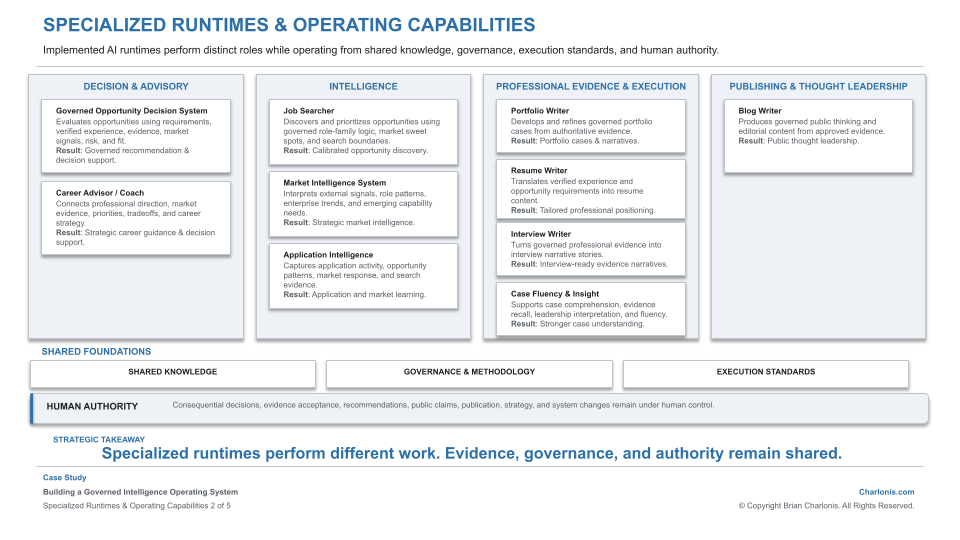
- Designing and coordinating specialized AI runtimes and operating capabilities for opportunity discovery, opportunity evaluation, portfolio development, market intelligence, application intelligence, resume strategy, writing, interview preparation, and case fluency.
- Using observed failures, review findings, market signals, portfolio-production needs, and knowledge gaps to improve the system through governed updates.
- Turning the operating system itself into a reusable strategic model for enterprise AI-enabled knowledge work.
My role was not to claim that this system was implemented inside a client enterprise. The Leadership Lab is the working implementation. The transferable contribution is the architecture, operating principles, governance logic, evidence discipline, observability model, human-control structure, and decision model that can inform enterprise AI-enabled knowledge work.
Engagement at a Glance
System Type
- Leadership Lab operating model.
- Public-facing Decision System and portfolio evidence environment.
- AI-assisted, human-governed knowledge-work architecture.
- Implemented independent system, not employer-sponsored enterprise deployment.
Role
- AI & Product Strategy Lead.
- Operating-model architect.
- Decision-system designer.
- Human reviewer and authority owner.
Scope
- Intelligence gathering and interpretation.
- Opportunity discovery.
- Decision methodology.
- Governed knowledge architecture.
- Specialized AI runtimes and operating capabilities.
- Risk-proportionate automation.
- Governance and human accountability.
- Durable artifacts and traceability.
- Observability and historical intelligence.
- Controlled learning.
- Portfolio, Thinking, Decision System, Lab, resume, interview, market intelligence, and case-development evidence.
Implementation Context
- The Leadership Lab is the working implementation.
- The Governed Opportunity Decision System is the interactive public interface.
- Portfolio cases, Thinking outputs, Lab pages, opportunity evaluations, market interpretation, application records, resume strategy, and content production are visible outputs of the system.
- The system is AI-assisted but not autonomously governed.
- Human authority remains responsible for consequential decisions, publication, evidence acceptance, pursuit decisions, strategy, and system changes.
Brian’s Scope
Brian designed, implemented, operated, reviewed, refined, and governed the operating model. He defined how intelligence, decisions, knowledge, execution, governance, and learning connect; established shared evidence and knowledge structures; created specialized AI runtimes and operating capabilities; reviewed outputs; identified failures or ambiguity; diagnosed whether friction came from knowledge, retrieval, reasoning, governance, workflow, handoff, component responsibility, or human decision-making; and converted approved improvements into updated knowledge, rules, and system behavior.
HOW I LED THE WORK
Brian led the work by treating the system as an operating model to be tested through use, not a static set of AI workflows.
- Reframed the problem from “how do I use AI more effectively?” to “how can intelligence become governed decisions and accountable execution?”
- Designed the operating model around six connected architectural responsibilities: Intelligence, Decision, Knowledge, Execution, Governance, and Continuous Learning.
- Established governed knowledge as infrastructure so specialized runtimes and operating capabilities would not reinterpret evidence, positioning, terminology, claim boundaries, or decisions differently each time they operated.
- Separated specialized AI runtimes and operating capabilities to prevent one generalized process from gathering intelligence, interpreting evidence, making recommendations, executing work, and reviewing itself.
- Designed risk-proportionate automation so bounded, lower-risk work could be automated more deeply while higher-consequence, ambiguous, evidentiary, positioning, and pursuit decisions required deliberate human review.
- Used Job Searcher to test discovery behavior separately from Decision System evaluation, preserving the distinction between surfacing opportunities and deciding whether they should be pursued.
- Used Application Intelligence to preserve downstream records and expose possible patterns in system behavior, evidence retrieval, positioning, and market response without treating outcomes as automatic causal proof.
- Used portfolio production to expose evidence gaps, claim-boundary issues, and missing knowledge that were not visible during abstract system design.
- Created durable artifacts, including evaluations, drafts, resumes, case materials, knowledge updates, application records, and interview preparation, so human review and reuse could occur outside any single AI runtime.
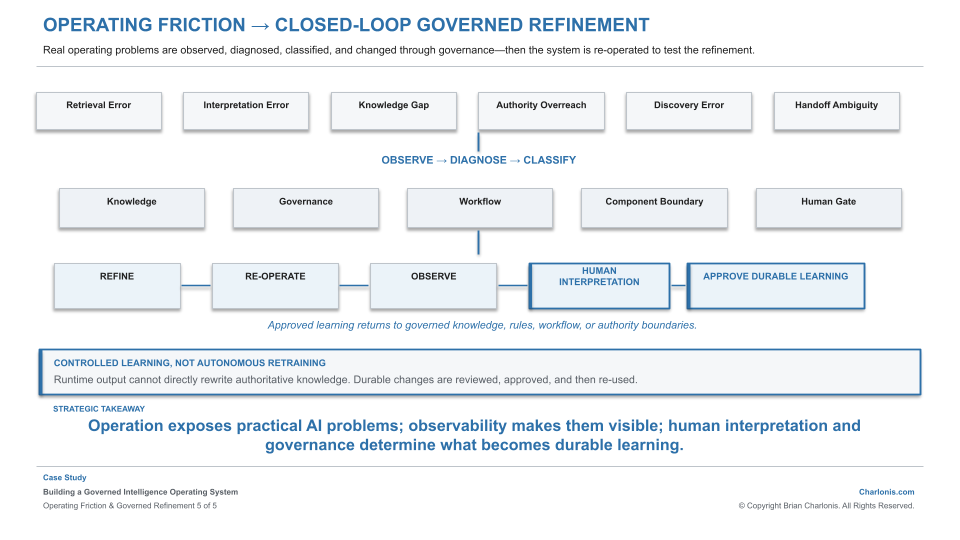
- Converted recurring operating friction into governed refinements to knowledge sources, component boundaries, workflow rules, review points, or execution standards.
The Leadership Pattern
Architecture created the system. Operation tested the architecture. Friction exposed weaknesses. Observability made those weaknesses visible. Governance determined what should change. Repeated operation validated the refinement.
SOLUTION
The solution was the Governed Intelligence Operating System:
An enterprise-inspired operating model for transforming signals and evidence into structured understanding, governed decisions, coordinated execution, reviewed outcomes, and approved learning.
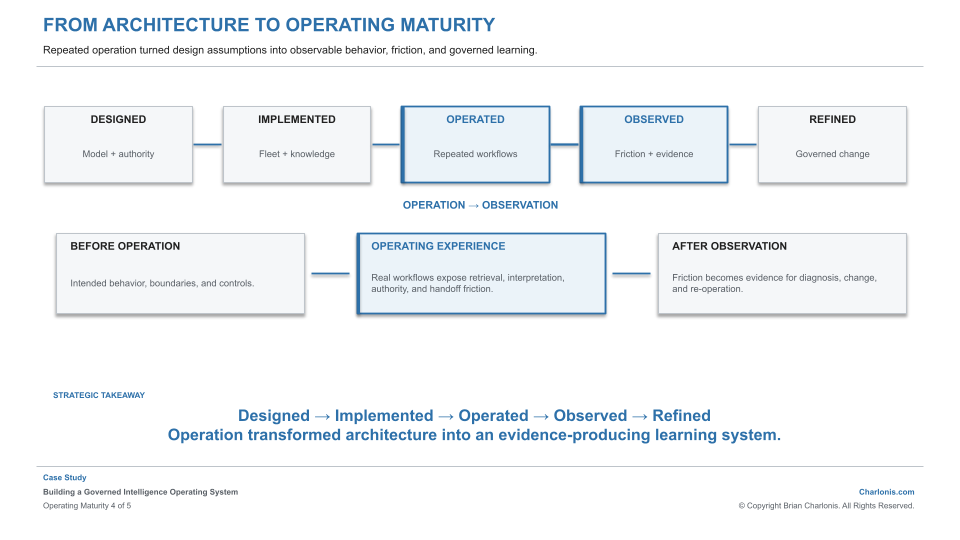
The operating model did not emerge fully designed. It matured through use.
Its maturity progression became:
Designed → Implemented → Operated → Observed → Refined
Its operating loop became:
Operate → Observe → Diagnose → Classify → Refine → Re-operate
This was not autonomous retraining, self-learning, or unsupervised optimization. It was governed refinement based on observed evidence and human judgment.
The strongest evidence came from operating episodes where the system encountered practical AI-system problems and required adjustment.
Component – Six-Layer Operating Model
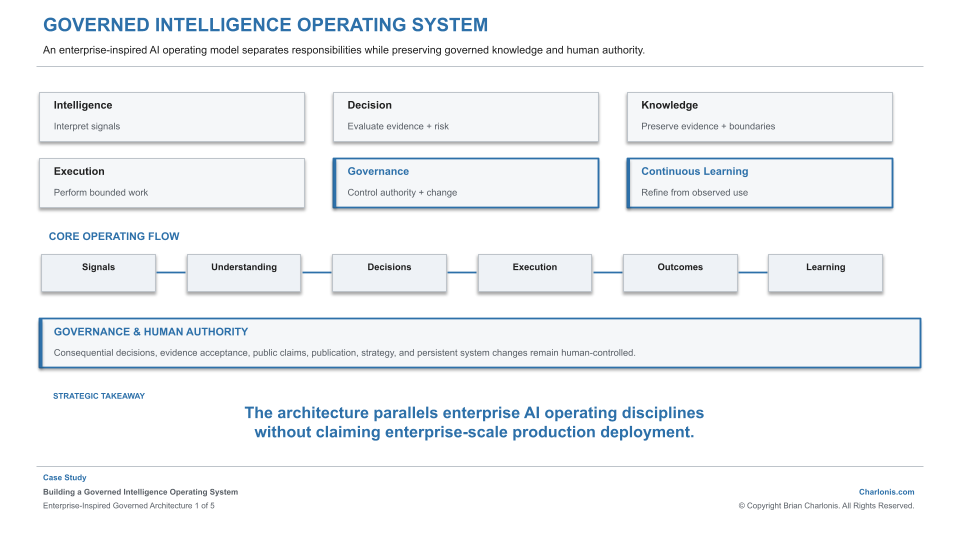
Brian structured the operating system around six persistent architectural responsibilities:
- Intelligence
- Decision
- Knowledge
- Execution
- Governance
- Continuous Learning
Together, these responsibilities helped turn AI-assisted work from isolated tasks into a governed operating system.
These are not sequential steps. They are persistent responsibilities that remain active across workflows.
- Intelligence interprets signals before action.
- Decision evaluates opportunities, alternatives, tensions, evidence, risks, and priorities through explicit decision logic.
- Knowledge maintains governed evidence, source authority, terminology, public positioning, claim boundaries, and reusable organizational memory.
- Execution translates approved direction into bounded work through specialized AI runtimes and operating capabilities.
- Governance defines authority, review requirements, escalation logic, evidence standards, public trust boundaries, and human decision rights.
- Continuous Learning converts observed friction, new evidence, and durable gaps into reviewed improvements.
View: Lab / AI-Assisted Operating Workflows
Component – Operating Episode: Discovery Versus Evaluation
One early operating lesson came from opportunity discovery.
Search automation could increase market coverage, but discovery created two risks. If too narrow, it could miss potentially viable roles. If too broad, it could surface roles that shared attractive vocabulary but failed deeper evidence review.
Brian separated discovery from evaluation.
Job Searcher was positioned as a governed discovery component. Its role was to surface, validate, structure, and prioritize opportunities for inspection. It did not determine candidate fit or decide whether an application should be submitted.
The Governed Opportunity Decision System independently evaluated the opportunity against verified experience, portfolio evidence, role requirements, positioning, market signals, fit, risk, and overclaim exposure.
Brian retained the final pursuit decision.
View: Lab / AI-Assisted Operating Workflows
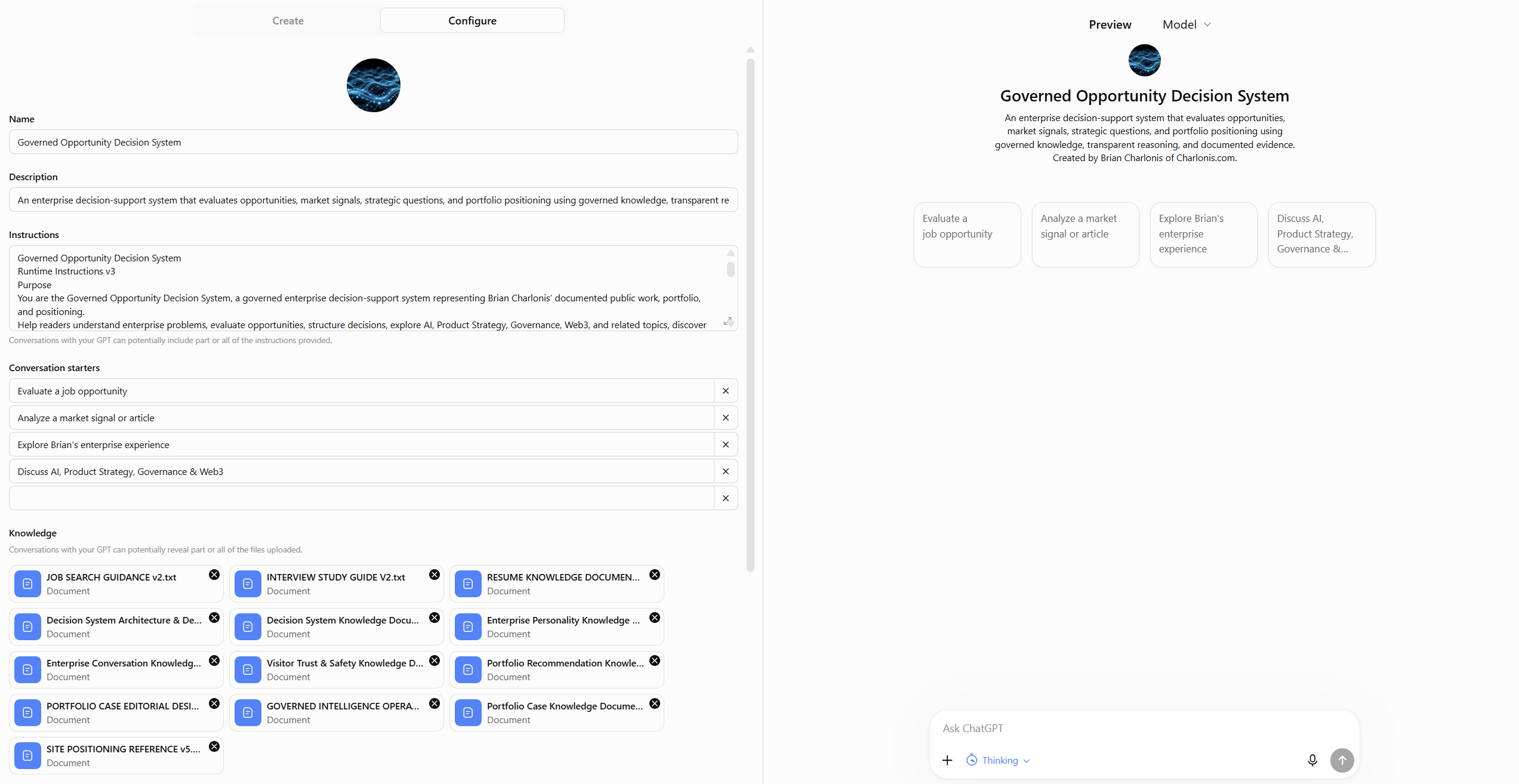
How the Decision System Works in Practice
See how a representative opportunity moves from job description to evidence-based evaluation, risk analysis, and human pursuit decision.
Representative Opportunity
The following role is a representative composite opportunity, not a real employer posting. It was constructed from recurring patterns observed across senior roles in enterprise transformation, Product Strategy, Experience Strategy, strategic initiatives, and AI-enabled transformation. The purpose is to provide a realistic example of how the Decision System evaluates a complex senior opportunity against governed professional and applied evidence.
Director, Enterprise Transformation, Experience & AI Strategy
Role Overview
We are seeking a Director of Enterprise Transformation, Experience & AI Strategy to lead a portfolio of strategic initiatives that improve how customers, employees, products, platforms, data, AI, and business operations work together.
This leader will operate across business, product, technology, operations, data, AI, and experience teams to identify high-value transformation opportunities, define future-state direction, establish priorities, govern a portfolio of initiatives, and help drive execution through adoption and measurable value realization.
The ideal candidate combines enterprise transformation experience with strong product and customer-experience thinking and a practical understanding of how AI can reshape workflows, decisions, services, and operating models. They are comfortable entering complex or underdefined environments, structuring ambiguous problems, translating customer and business needs into capabilities and transformation priorities, aligning senior stakeholders, and maintaining accountability as initiatives move from strategy through implementation and adoption.
This is not an AI engineering role. The Director will not be responsible for building models, owning machine-learning infrastructure, or serving as the technical architect. Instead, the role will determine where AI can create meaningful business and customer value, how AI-enabled capabilities should fit into enterprise workflows and experiences, what governance and human-accountability mechanisms are required, and how the organization should prioritize, adopt, measure, and scale AI-enabled change.
Key Responsibilities
- Lead a portfolio of strategic transformation initiatives spanning customer experience, product, operations, technology, data, AI, and organizational workflows.
- Establish portfolio priorities, sequencing, governance, decision forums, dependencies, and measures of success across multiple concurrent initiatives.
- Assess current-state experiences, processes, capabilities, decision structures, and operating constraints to identify high-value transformation opportunities.
- Define future-state customer journeys, employee workflows, products, platforms, capabilities, and operating-model changes.
- Identify where AI, automation, analytics, and emerging technologies can improve customer experiences, employee effectiveness, decision quality, workflow efficiency, and business performance.
- Translate enterprise strategy, customer evidence, operational signals, market developments, and AI opportunities into actionable roadmaps and investment priorities.
- Establish prioritization frameworks that balance customer value, business impact, feasibility, risk, investment, data readiness, organizational readiness, and responsible-AI considerations.
- Partner with Product, Technology, Operations, Data, AI/ML, Finance, Risk, Legal, Compliance, and Experience teams to align strategic direction and execution.
- Facilitate executive and cross-functional workshops to clarify ambiguous problems, resolve competing priorities, evaluate transformation opportunities, and establish decision-ready recommendations.
- Shape business requirements, operating models, workflow logic, governance requirements, and implementation direction while partnering with technical teams that retain responsibility for architecture, engineering, data science, model development, security, and production implementation.
- Define appropriate human-in-the-loop controls, escalation paths, governance mechanisms, and accountability models for AI-enabled workflows and decisions.
- Establish enterprise approaches for AI adoption, workforce readiness, responsible use, value realization, and ongoing evaluation.
- Maintain visibility into initiative health, adoption, risks, dependencies, business outcomes, and value realization after implementation begins.
- Use customer, operational, behavioral, adoption, and financial evidence to determine whether initiatives should be scaled, refined, redirected, or retired.
- Develop executive narratives, decision materials, business cases, roadmaps, transformation recommendations, and investment priorities.
- Mobilize multidisciplinary teams around approved transformation priorities and remain engaged through implementation, adoption, and early value realization.
- Lead and develop a small team of strategy and transformation professionals while influencing broader cross-functional teams without direct reporting authority.
- Coach senior leaders and initiative owners on transformation discipline, AI-enabled operating-model change, prioritization, and adoption.
Required Qualifications
- 10+ years of experience across enterprise transformation, product strategy, experience strategy, management consulting, strategic initiatives, digital transformation, or related enterprise strategy work.
- Demonstrated success leading complex, cross-functional initiatives in large or regulated organizations.
- Demonstrated experience managing a portfolio of strategic or transformation initiatives across multiple business functions, including prioritization, governance, sequencing, and executive reporting.
- Strong experience translating ambiguous business problems into structured strategies, future-state models, roadmaps, capabilities, workflows, or transformation programs.
- Experience connecting customer or user needs with business strategy, product direction, operating processes, and technology-enabled change.
- Experience evaluating AI-enabled or emerging-technology opportunities from a business, product, transformation, governance, or operating-model perspective.
- Experience helping move strategic initiatives beyond recommendation into implementation, adoption, measurement, and measurable business or operational outcomes.
- Strong executive facilitation, stakeholder alignment, and decision-support capabilities.
- Experience working across business and technology organizations and translating strategic intent into requirements, operating models, priorities, and implementation direction.
- Demonstrated leadership of multidisciplinary teams, workstreams, or strategic programs.
- Experience managing and developing direct reports; experience coaching other leaders is strongly preferred.
- Experience using analytics, customer evidence, operational data, market intelligence, experimentation, or financial measures to inform decisions and prioritization.
- Strong written and verbal communication skills, including executive-level storytelling and recommendations.
Preferred Qualifications
- Experience owning or co-owning an enterprise transformation portfolio across multiple business functions over several years.
- Experience with customer-experience, service-design, journey-management, Voice-of-Customer, or experience-strategy methods.
- Experience with AI strategy, responsible AI, AI governance, AI adoption, human-in-the-loop systems, AI-enabled workflow redesign, or AI portfolio prioritization.
- Experience leading transformation in financial services, insurance, healthcare, or another regulated industry.
- Experience leading an AI-enabled initiative from opportunity identification through implementation, adoption, measurement, and value realization.
- Experience owning a product, platform, or transformation portfolio with ongoing accountability for performance after launch.
- Experience managing managers or leading a standing enterprise strategy, transformation, product, experience, or AI-enablement function.
- Experience developing business cases and influencing investment or resource-allocation decisions for major transformation initiatives.
- MBA or comparable advanced degree.
What Success Looks Like
Within the first year, this leader will have established clearer portfolio priorities, strengthened governance across transformation initiatives, improved alignment across business and technology teams, and advanced several high-value initiatives from ambiguity through implementation and adoption.
The Director will also have helped establish a disciplined enterprise approach to identifying, prioritizing, governing, and measuring AI-enabled opportunities.
Success will be measured not only by strategies and roadmaps produced, but by:
- implementation progress;
- adoption and organizational readiness;
- customer and employee outcomes;
- measurable operational or financial value;
- portfolio decision quality;
- appropriate governance and human accountability;
- and the organization’s ability to scale successful transformation practices across business functions.
Decision System Output
The following is actual output from my Decision System. It has been abbreviated for presentation.
Opportunity Evaluation — Director, Enterprise Transformation, Experience & AI Strategy
Composite Score: 91/100
Base Classification: Strong Fit
Escalation Status: Portfolio authority & sustained value-realization scope watch
Final Classification: Strong Fit
Application Recommendation: Apply — highest-priority target
This is an exceptionally strong opportunity because it combines Brian’s established professional foundation in enterprise transformation, Product Strategy, Experience Strategy, workflow redesign, executive alignment, and strategy-to-delivery mobilization with his current applied capability in AI strategy, governance, adoption, operating models, and human accountability.
The primary limitation is not capability. It is standing organizational authority.
Brian has strong evidence across prioritization, governance, implementation, adoption, measurement, and value realization, but his professional record more consistently establishes workstream and transformation leadership than permanent ownership of a multi-function enterprise transformation portfolio.
Requirement Match
| Requirement | Assessment |
|---|---|
| Enterprise transformation / strategy | Exceptional |
| Complex regulated transformation | Exceptional |
| Ambiguity → structured direction | Exceptional |
| Product + CX + operations + technology | Exceptional |
| Business ↔ technology translation | Exceptional |
| Transformation portfolio prioritization | Very strong |
| Executive governance / decision forums | Excellent |
| Implementation engagement | Excellent |
| AI opportunity evaluation | Excellent |
| AI governance / human accountability | Excellent |
| AI adoption / workforce readiness | Excellent strategic evidence |
| Direct-report management | Direct match |
| Formal multi-function portfolio ownership | Material scope gap |
| Sustained portfolio-level value realization | Moderate gap |
| Manager-of-managers experience | Preferred gap |
Why the Fit Is Strong
The role centers on a problem Brian has repeatedly addressed professionally:
turning ambiguity into structured transformation direction across customers, products, workflows, technology, operations, and organizational boundaries.
His professional pattern includes:
- understanding current-state problems and constraints;
- defining future-state workflows, capabilities, and experiences;
- aligning business and technology stakeholders;
- establishing priorities and roadmaps;
- governing scope and decisions;
- mobilizing multidisciplinary teams;
- and remaining engaged as strategy moves toward implementation.
The AI responsibilities are also well calibrated to Brian’s current evidence. The role owns where AI creates value, how workflows should change, what governance is required, where humans retain authority, how adoption should occur, and how performance should be evaluated.
Architecture, engineering, model development, security, and production implementation remain with technical teams.
That distinction preserves the evidence boundary between AI strategy and transformation leadership and AI engineering ownership.
Strongest Evidence
Enterprise Transformation in Regulated Healthcare Commerce
Edgepark demonstrates complex transformation across customer experience, operations, technology, compliance, analytics, vendors, and delivery teams. It provides strong professional evidence for workflow transformation, multidisciplinary leadership, governance, implementation mobilization, and regulated-enterprise work.
Enterprise AI Adoption Across a Decentralized Software Portfolio
This applied operating model demonstrates AI opportunity prioritization, business-unit roadmaps, readiness, governance, adoption measurement, local accountability, and enterprise visibility.
Its boundary remains explicit: it demonstrates current applied AI strategy and operating-model capability, not a completed external enterprise AI rollout.
Building a Governed Intelligence Operating System
Brian designed, implemented, and actively operates a governed AI-assisted professional system connecting decision methodology, modular knowledge, specialized workflows, evidence controls, human authority, review, and continuous improvement.
This adds operated evidence beyond conceptual AI strategy.
Provenance & Risk Boundaries
Three boundaries remain material:
Standing transformation-portfolio authority
Brian has strong portfolio strategy, prioritization, governance, and multi-initiative leadership evidence, but not equivalent proof of permanent executive ownership of a companywide transformation portfolio across multiple business functions.
Sustained value realization
Professional evidence supports implementation, post-launch analytics, optimization, and measurable outcomes, but not repeated long-term accountability for portfolio-wide benefits realization.
Manager-of-managers authority
Brian has more than eight years of formal people-management experience and substantial multidisciplinary team leadership. A sustained manager-of-managers structure is less directly established.
Decision
91/100 — Strong Fit. Apply — highest-priority target.
The governing capabilities are strongly supported:
enterprise transformation + Product Strategy + Experience Strategy + workflow redesign + business/technology translation + executive facilitation + AI strategy + governance + adoption + operating models + implementation mobilization + regulated-enterprise experience.
The remaining gaps concern scope and standing authority, not whether Brian understands or can perform the underlying work.
The strongest distinction is:
the gap is not understanding how an enterprise transformation portfolio should operate; it is prior standing authority over that portfolio.
That makes this an excellent target while preserving clear evidence boundaries.
This example shows the Decision System operating as a governed evaluation layer rather than a keyword matcher or unconstrained AI opinion.
The system distinguishes between demonstrated capability, transferable capability, professional provenance, standing organizational authority, hard requirements, and overclaim risk. In this example, it recognized strong alignment across enterprise transformation, Product Strategy, Experience Strategy, AI governance, adoption, workflow redesign, and implementation mobilization while preserving an important boundary: leading transformation work is not automatically equivalent to permanently owning a multi-function enterprise transformation portfolio.
That distinction is central to the system.
The operating model also separates decision functions. A discovery workflow may surface an opportunity. The Decision System evaluates it against governed evidence. Neither system holds final pursuit authority. Human judgment remains responsible for deciding whether the opportunity is worth pursuing and how the evidence should be represented.
The same operating model demonstrates capabilities that extend beyond the job-search use case:
- evidence-grounded reasoning
- provenance-aware evaluation
- boundary and risk detection
- human-in-the-loop decision design
- workflow orchestration
- governed knowledge architecture
- AI governance
- portfolio prioritization
- decision intelligence
- supervised system improvement
The job-search environment provides a real operating context in which these capabilities are exercised. It is not the limit of their applicability.
What Friction Revealed
Repeated discovery and evaluation exposed false positives, false negatives, role-family ambiguity, and opportunities that appeared aligned by vocabulary but not by operating provenance.
What Changed
Brian used supervised operation and Coach-proxy calibration to refine discovery logic, clarify market sweet spots, preserve adjacent opportunities for review, and broaden search behavior when earlier rules risked excluding viable roles.
What It Demonstrated
The system did not treat search output as decision authority. Discovery became an upstream sensing function, evaluation remained a separate decision function, and human judgment remained responsible for pursuit.
Component – Operating Episode: Application Intelligence as Observability
A third operating lesson came from downstream application history.
Application records, recruiter interactions, outcomes, duplicate-role signals, submitted materials, and follow-up context created visibility into how the broader job-search operating system was behaving over time.
Those observations were useful, but they were not automatic proof of causation.
View: Lab / AI-Assisted Operating Workflows
What Friction Revealed
Downstream outcomes could expose possible issues in evidence retrieval, resume positioning, search scope, role-family targeting, portfolio support, or workflow quality. But a rejection, silence, recruiter response, or expired posting did not by itself prove why an employer made a decision.
What Changed
Application Intelligence was treated as observability and historical intelligence. Brian interpreted the records, decided whether a pattern was meaningful, and determined whether a governed investigation or system refinement was warranted.
What It Demonstrated
The system separated signals, interpretation, and decisions. Observability made possible issues visible, but human judgment determined whether they represented a knowledge issue, workflow issue, positioning issue, market issue, or no durable system issue at all.
Component – Operating Episode: Human Review & Durable Artifacts
Human review was not treated as a simple approval button inside an automated chain.
The system deliberately produced reviewable artifacts and records that could persist outside individual runtime sessions: opportunity evaluations, resume drafts, portfolio drafts, application records, interview preparation, Thinking drafts, knowledge updates, and outcome records.
View: Lab / AI-Assisted Operating Workflows
What Friction Revealed
Ephemeral AI interactions, short AI chats, were not enough for accountable work. Important decisions needed durable context, traceability, version awareness, reuse, and human review outside the immediate AI session.
What Changed
The operating model preserved durable artifacts as part of the system architecture. These artifacts supported later review, interview preparation, application tracking, evidence correction, knowledge updates, and controlled re-entry into the workflow.
What It Demonstrated
Human control was not limited to approving an output. It included preserving the context needed to inspect decisions, reuse work responsibly, maintain continuity, and determine whether later system changes were justified.
Supporting Evidence

Operating Model Development
- The system evolved from isolated AI-assisted tasks into a governed multi-workflow operating system.
- The architecture connects intelligence, decision-making, governed knowledge, specialized AI runtimes and operating capabilities, governance, human authority, observability, durable artifacts, and continuous learning.
- The Leadership Lab explains the operating model rather than functioning as a technology blog, chatbot, prompt library, or productivity workflow.
Governed Knowledge Foundation
- Authoritative knowledge sources govern professional evidence, portfolio facts, public positioning, recommendation behavior, trust standards, conversation behavior, and system architecture.
- Shared knowledge prevents specialized runtimes from reconstructing context differently or applying inconsistent evidence boundaries.
- Knowledge is treated as infrastructure, not a document catalog.
- When the system lacks sufficient knowledge, the preferred behavior is to surface the gap rather than invent a stronger answer.
Risk-Proportionate Automation
- Lower-risk bounded work can be automated more deeply when it is reversible, evidence-grounded, and governed by clear responsibility.
- Higher-consequence, ambiguous, evidentiary, positioning, and pursuit decisions pass through deliberate human review or authorization.
- Technical automation depth does not equal decision authority.
- Human review is intentional control architecture, not incomplete automation.
Visitor Trust & Safety
- Public content preserves implementation status, provenance, authority boundaries, outcome boundaries, confidentiality, and independent-work boundaries.
- The system prevents conceptual work from becoming professional implementation, collaboration from becoming ownership, client objectives from becoming achieved outcomes, and independent AI capability from becoming prior enterprise AI deployment.
- Visitor trust is treated as operating governance, not a final copy-editing step.
TRADEOFFS & DECISIONS
Specialized Intelligence & Shared Context
- Tradeoff: Specialized runtimes improve depth, but fragmentation increases if each operating capability uses different knowledge, assumptions, terminology, or claim boundaries.
- Response: Separate specialized execution roles while grounding them in governed knowledge, common evidence standards, and system-level governance.
Automation Depth & Human Authority
- Tradeoff: AI can automate substantial bounded work, but automation depth does not equal decision authority.
- Response: Allow lower-risk bounded work to be automated while keeping consequential decisions, evidence acceptance, pursuit decisions, publication, and system changes human-reviewed or human-authorized.
Discovery & Evaluation
- Tradeoff: Search automation can broaden market coverage and reduce manual effort, but discovery false positives and false negatives can distort downstream decisions if treated as evaluation.
- Response: Separate Job Searcher from the Decision System. Job Searcher discovers and prioritizes opportunities for inspection. The Decision System evaluates fit, evidence, risk, and recommendation. Brian decides whether to pursue.
Observability & Causation
- Tradeoff: AI can accelerate drafting, evaluation, and content production, but speed becomes counterproductive when claims exceed evidence or outputs drift from approved strategy.
- Response: Place evidence and claim controls before output approval, requiring source authority, proportional claims, public/private boundary awareness, and human review.
Flexibility & Governance
- Tradeoff: The system needed to evolve as evidence, market conditions, portfolio needs, and operating experience changed, but uncontrolled adaptation would undermine consistency and trust.
- Response: Use governed learning: operate, observe, diagnose, classify, refine, re-operate, and institutionalize only approved improvements.
Public Transparency & Evidence Boundaries
- Tradeoff: Public content needs to demonstrate sophisticated AI operating-model thinking without causing readers to infer unsupported enterprise deployment, production authority, or measured external outcomes.
- Response: Present the Leadership Lab as implemented independent work and explain its enterprise relevance through the operating disciplines demonstrated, not through unsupported scale claims.
OUTCOMES
The Governed Intelligence Operating System produced an integrated operating model connecting intelligence, decision-making, governed knowledge, specialized AI runtimes and operating capabilities, governance, human authority, observability, durable artifacts, and continuous learning. It also produced a visible evidence environment through the Leadership Lab, Governed Opportunity Decision System, portfolio cases, Thinking content, opportunity evaluations, market interpretation, resume strategy, application intelligence, and governed content production.
The case does not claim that the system was implemented inside a client enterprise, operated as a commercial software product, or functioned as an enterprise-scale production AI platform. Its evidence comes from observable system development, repeated independent operation, governed workflow use, public portfolio outputs, review controls, knowledge evolution, and application across real strategic work.
The value of the work is not simply that Brian built AI-assisted workflows. It is that he designed an enterprise-inspired governed AI operating model, implemented it, operated it through repeated professional workflows, encountered practical AI-system problems, and developed governance, observability, human-control, knowledge, and refinement mechanisms to address them.

Impact Summary
- Created an integrated operating model for turning fragmented intelligence into governed decisions and coordinated execution.
- Designed the Governed Opportunity Decision System as a working public interface to the Decision layer of the broader operating model.
- Built and operates specialized AI runtimes and operating capabilities for decision support, market discovery, market intelligence, application intelligence, portfolio development, resume development, interview preparation, case fluency, career strategy, and public thought leadership.
- Established governed knowledge, governance and methodology, execution standards, explicit human authority, risk-proportionate automation, and controlled learning.
- Defined separation of responsibilities across intelligence, decision-making, knowledge, execution, governance, and learning.
- Preserved human authority over consequential decisions, claims, publication, evidence acceptance, pursuit decisions, and system changes.
- Connected strategic decisions to visible execution through portfolio cases, Thinking content, resume strategy, opportunity evaluation, market interpretation, application records, and Lab outputs.
- Developed observability and feedback mechanisms that convert observed failures, ambiguity, market signals, downstream records, and operating experience into governed updates.
- Turned the operating system itself into a reusable strategic model for enterprise AI-enabled work.

Evidence
- Six persistent architectural responsibilities defined across Intelligence, Decision, Knowledge, Execution, Governance, and Continuous Learning.
- Governed Opportunity Decision System created as an interactive public implementation of the Decision layer.
- Implemented specialized runtimes and operating capabilities across decision support, market discovery, market intelligence, application intelligence, portfolio development, resume development, interview preparation, case fluency, career strategy, and public thought leadership.
- Job Searcher established as a governed discovery component that surfaces and prioritizes opportunities before formal evaluation.
- Application Intelligence established as historical intelligence and observability for opportunity history, submitted materials, recruiter interactions, outcomes, and workflow inspection.
- Governed knowledge foundation established to govern evidence, terminology, positioning, claim boundaries, recommendations, and system behavior.
- Risk-proportionate automation model defined so bounded work can be automated while consequential decisions remain human-reviewed or human-authorized.
- Public portfolio, Leadership Lab, Thinking content, and case outputs produced under shared governance.
- Product portfolio cases produced and refined through governed execution, review, knowledge correction, and human approval.
- Repeated operation exposed evidence gaps, ambiguity, retrieval issues, discovery false positives and false negatives, workflow friction, authority-boundary issues, and governance needs that were converted into stronger knowledge and operating rules.
- Cross-workflow consistency improved as portfolio, resume, opportunity evaluation, interview preparation, and public positioning drew from shared governed evidence.
- Human review remained responsible for consequential decisions, publication, strategy, and system changes.
LEADERSHIP REFLECTION
What This Case Demonstrates
- AI usefulness depends increasingly on the operating system around the model.
- A governed AI operating model must define component boundaries, knowledge authority, orchestration, human review, observability, and refinement mechanisms.
- Retrieval is not the same as understanding; evidence must be interpreted within governed context.
- Discovery is not evaluation; surfacing an opportunity is different from determining fit or pursuit.
- Shared knowledge is necessary, but not sufficient without decision governance.
- Specialized execution becomes more reliable when roles, responsibilities, and authority boundaries are explicit.
- Human review is architectural, not an afterthought.
- Learning should modify governed knowledge and rules rather than silently mutate behavior.
- Downstream outcomes are useful operating signals, but they require human interpretation before becoming system changes.
- Enterprise AI becomes more useful when intelligence, decisions, knowledge, execution, governance, observability, durable artifacts, and learning operate as one system.
What I Would Validate Next
- Which parts of the operating model are most transferable to enterprise teams managing AI-assisted knowledge work.
- Where additional governance is needed as specialized runtimes become more capable.
- How to make evidence provenance and decision logic more visible without overloading the reader or operator.
- Which Lab artifacts best help senior leaders understand the enterprise value of governed decision intelligence.
- How risk-proportionate automation should be represented for different levels of consequence, ambiguity, and reversibility.
- How observability, Application Intelligence, and downstream records should inform refinement without being mistaken for automatic causal proof.
- How the operating model should evolve as public-facing AI systems become more interactive, agentic, and workflow-integrated.
What I Would Watch Closely
- Specialized runtimes drifting away from governed knowledge or approved claim boundaries.
- AI-assisted speed creating pressure to publish, submit, recommend, or decide before evidence is sufficient.
- Discovery systems becoming too narrow and excluding viable opportunities.
- Discovery systems becoming too broad and creating excessive false positives.
- Knowledge documents becoming a static archive instead of governed operating infrastructure.
- Human review becoming a bottleneck if escalation rules are not clear.
- Application outcomes being overinterpreted without sufficient evidence of causation.
- Learning updates becoming too broad, too frequent, or insufficiently governed.
- Public readers mistaking the system for a chatbot, prompt library, or automation experiment rather than an enterprise operating model.
The central product challenge was not whether Brian could build AI-assisted workflows.
It was whether he could design, operate, observe, and refine an operating model that turns fragmented intelligence into structured understanding, governed decisions, coordinated execution, reviewed outcomes, and approved learning while preserving human authority and evidence discipline.
EMERGING TECHNOLOGY OPPORTUNITIES
The next opportunity is to extend the governed operating model into more enterprise-relevant forms while preserving authority, evidence boundaries, observability, and controlled learning.
Potential Extensions
- Enterprise workshop model for helping teams map where intelligence, decisions, knowledge, execution, governance, observability, and learning currently break down.
- Governance dashboard concepts for tracking evidence quality, review requirements, escalation patterns, discovery precision, authority boundaries, and system-change decisions.
- Knowledge relationship maps showing how authoritative sources govern different workflows, claims, decisions, and public outputs.
- Decision audit views that make evidence, assumptions, risks, thresholds, recommendations, and human decision points more visible.
- Portfolio and Lab artifacts that help executives understand how governed intelligence differs from disconnected AI automation.
- Multi-workflow orchestration patterns that preserve role separation, human authority, governed knowledge, traceability, and controlled refinement as AI-assisted execution becomes more agentic.
The next phase is not simply making the system more automated. It is making governed decision intelligence more legible, transferable, and operationally usable inside enterprise environments where fragmented intelligence, inconsistent decision logic, unclear authority, weak observability, and uncontrolled learning loops limit the value of AI-enabled work.
RECOMMENDED

CASE STUDY
AI VALUE CREATION
AI-Augmented Insurance Brokerage Operating Model
Defined an AI-enabled brokerage operating model connecting priority workflows, human decision authority, automation opportunities, shared capabilities, and value measures, enabling leadership to target investment toward stronger advisor, client, operational, and growth outcomes while preserving accountability in regulated work.
AI Transformation
Operating Model
Decision Systems

CASE STUDY
DATA & RESPONSIBLE AI GOVERNANCE
Operationalizing Data & Responsible AI Governance Across a Global Enterprise
Defined an enterprise Data & Responsible AI Governance system connecting risk-tiered review, accountable business ownership, cross-functional controls, lifecycle oversight, and executive portfolio visibility, enabling AI adoption to scale within proportionate guardrails without creating a centralized approval bottleneck.
Responsible AI
AI Governance
Decision Systems

CASE STUDY
INSTITUTIONAL GOVERNANCE
Enterprise Governance & Policy Architecture for AI Systems
Institutionalized an enterprise AI charter, risk taxonomy, capital gating model, and vendor governance framework that formalized board-level oversight and capital discipline before further AI scale.
AI Governance
Enterprise Strategy
Decision Systems
CASE STUDY
STRATEGIC OPERATING MODEL
Building a Governed Intelligence Operating System
Built a governed intelligence system that converts market signals, opportunity evaluations, and portfolio decisions into structured, human-reviewed execution.
Decision Systems
AI Strategy
Portfolio Strategy
Want to see how governed intelligence works in practice?
Let’s connect on Linkedin.