AI Transformation
Business Solutions Strategy
Workflow Coordination
AI VALUE CREATION
Conceptual Transformation Scenario
AI & Business Solutions Strategy Lead
Brian designed an AI-augmented insurance brokerage operating model that connected customer conversation preparation, interaction documentation, CRM updates, follow-up coordination, human review, and enterprise customer intelligence. The work defined how AI could reduce administrative burden around broker workflows while preserving licensed-agent judgment and accountability.
A Regional Insurance Distribution and Financial-Services Organization wanted to build on its existing CRM and operating capabilities without replacing licensed agents or introducing a disconnected AI tool. Brian created four artifacts: a current-to-future operating model, sales agent operational view, enterprise customer intelligence view, and enterprise value and performance view. These clarified how reviewed customer interactions could support frontline work, operational coordination, partner management, compliance awareness, and leadership decision-making.
This case was realized through Brian’s Governed Intelligence Operating System. The system developed recurring market signals about insurance distribution workflow burden, licensed-agent judgment, customer-interaction documentation, and enterprise customer intelligence into an independent conceptual transformation scenario.
CHALLENGE
The organization relied on existing CRM, policy, document, carrier, partner, communication, and reporting workflows to support sales, service, and relationship management. But much of the work surrounding customer conversations remained manual, fragmented, and difficult to translate into timely business insight.
Agents needed to prepare for conversations, find relevant customer context, document what occurred, update CRM records, coordinate follow-up, track commitments, and identify missing information. At the same time, marketing, partner, operations, compliance, and leadership teams lacked timely access to recurring customer needs, objections, product interests, service concerns, and workflow friction.
The challenge was not whether AI could summarize a conversation. It was whether the enterprise could use that capability to make the broker’s work easier, preserve professional judgment, and turn reviewed customer interactions into better organizational decisions.
The opportunity was to create a structured intelligence and coordination layer around existing systems that could reduce administrative effort, improve information quality, accelerate operational action, and connect frontline interactions to broader business decisions.
Key Drivers
- Reduce administrative work surrounding customer preparation, documentation, and follow-up.
- Improve the completeness and timeliness of CRM and workflow information.
- Give agents greater everyday value from existing technology.
- Identify stalled work, customer concerns, and capacity pressure sooner.
- Give business and partner teams earlier access to governed customer signals.
- Preserve licensed judgment through transparent, evidence-based, auditable human review.
Strategic Question
How could the organization use AI to reduce the work surrounding customer conversations, improve the speed and quality of CRM and workflow information, and help agents, managers, operations, partners, and leadership act from a shared understanding of the customer?
This required more than an AI summarization feature. It required an operating model that connected agent workflow value, CRM information quality, role-based access, human review, workflow coordination, enterprise intelligence, and value measurement.
SOLUTION
The solution was an AI-assisted conversation intelligence and workflow coordination layer around the organization’s existing CRM, policy information, carrier data, documents, communications, and operational workflows.
It was designed to improve the work surrounding customer conversations while preserving licensed-agent judgment and creating a governed path for reviewed frontline information to support broader enterprise decisions.
The solution connected four value-creation questions:
- How should AI reduce the work before and after customer conversations?
- How should licensed agents review, correct, approve, restrict, or escalate AI-prepared information?
- How should reviewed interaction signals support operations, partners, compliance, and leadership without exposing unrestricted customer-level data?
- How should value, adoption, workflow quality, governance, and business outcomes be measured before scale?
Together, these components created an AI-augmented brokerage operating model that connected frontline productivity, human judgment, workflow coordination, enterprise intelligence, and value measurement.
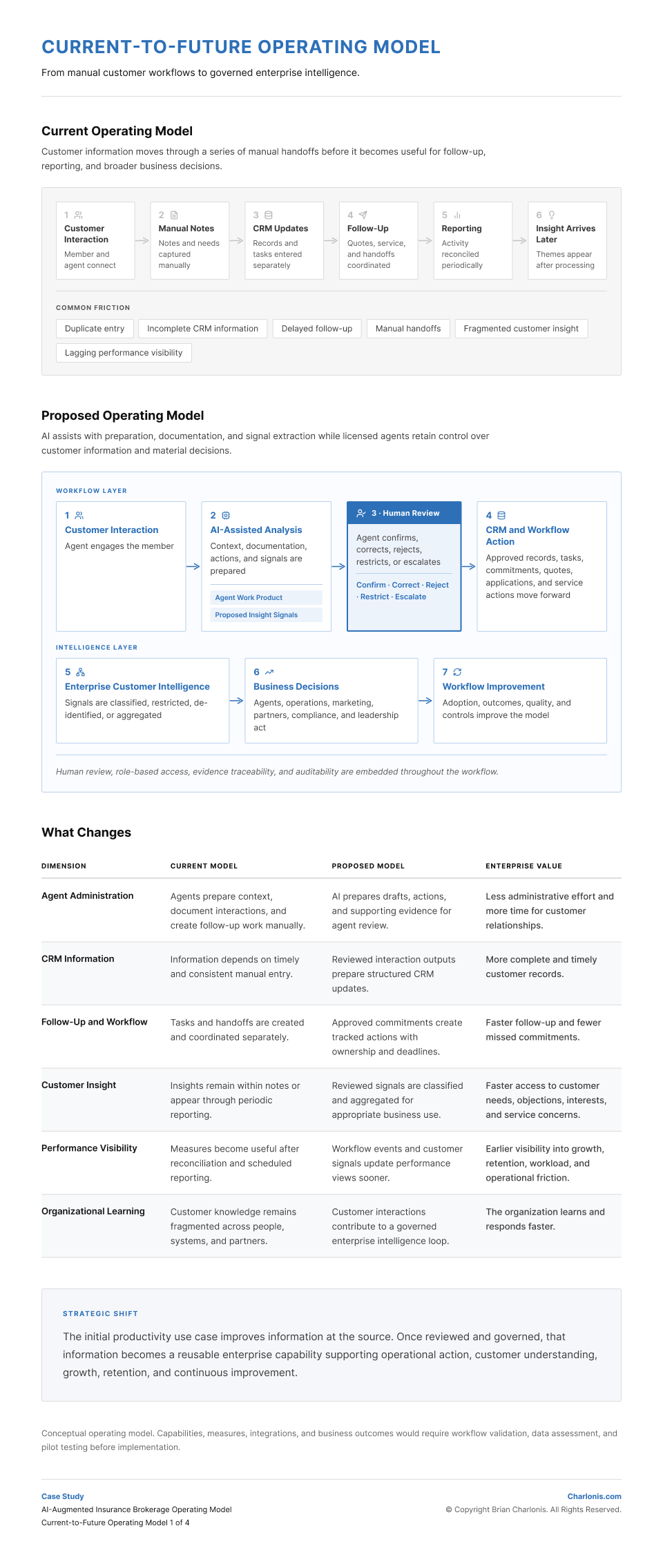
Current-to-Future Operating Model
The operating model showed how customer information moved through preparation, conversation, documentation, CRM updates, follow-up, reporting, and organizational learning. It established how the future state would use AI to prepare agent work products, route reviewed information into existing systems, coordinate operational work, and turn customer interactions into governed business intelligence.
Key Elements
- Current customer-interaction, CRM, follow-up, partner, and reporting workflow.
- Future-state AI-assisted preparation, documentation, and coordination layer.
- Human review before official record updates or customer-facing action.
- CRM, workflow, analytics, carrier, partner, and communication-system inputs.
- Reviewed signals flowing into operational and enterprise intelligence.
Artifact type: Operating model / workflow transformation map.
The artifact showed how customer information moves today and how the proposed model would change documentation, workflow action, reporting, and organizational learning.
How It Shaped Decisions
This component would support business, operations, technology, CRM, partner, and leadership stakeholders in deciding how AI should fit around existing systems rather than replace them. It clarified which workflow steps could be augmented, where human review was required, and what integration or configuration decisions would need to be evaluated before implementation.
Sales Agent Operational View
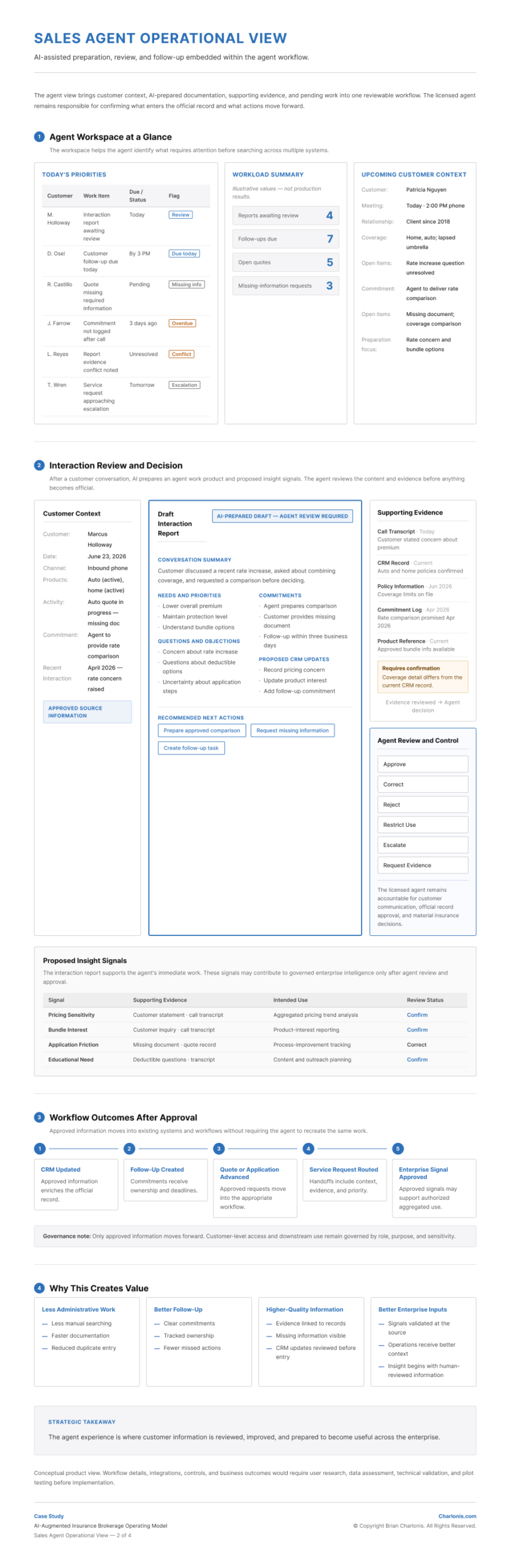
The sales agent view defined the frontline experience and control model for AI-assisted conversation work. It showed how agents could receive preparation context before conversations and review draft reports, CRM updates, follow-up tasks, commitments, missing information, supporting evidence, and recommended next actions afterward.
Key Elements
- Pre-conversation preparation brief assembled from approved sources.
- Draft interaction report after the customer conversation.
- Proposed CRM updates, follow-up tasks, commitments, and next actions.
- Supporting evidence for proposed insight signals.
- Agent controls to confirm, correct, reject, reclassify, restrict, or escalate.
Artifact type: Agent workflow / operational view.
The artifact showed immediate frontline value, supporting evidence, recommended next actions, and review controls agents could use before information entered customer workflows or broader enterprise intelligence.
How It Shaped Decisions
This component would support agents, managers, operations leaders, product stakeholders, and implementation teams in determining whether the AI layer created enough practical workflow value to earn adoption. It clarified that the first value test was not enterprise reporting, but whether the proposed experience could reduce agent effort, provide trustworthy evidence, and preserve control over customer information.
Enterprise Customer Intelligence View
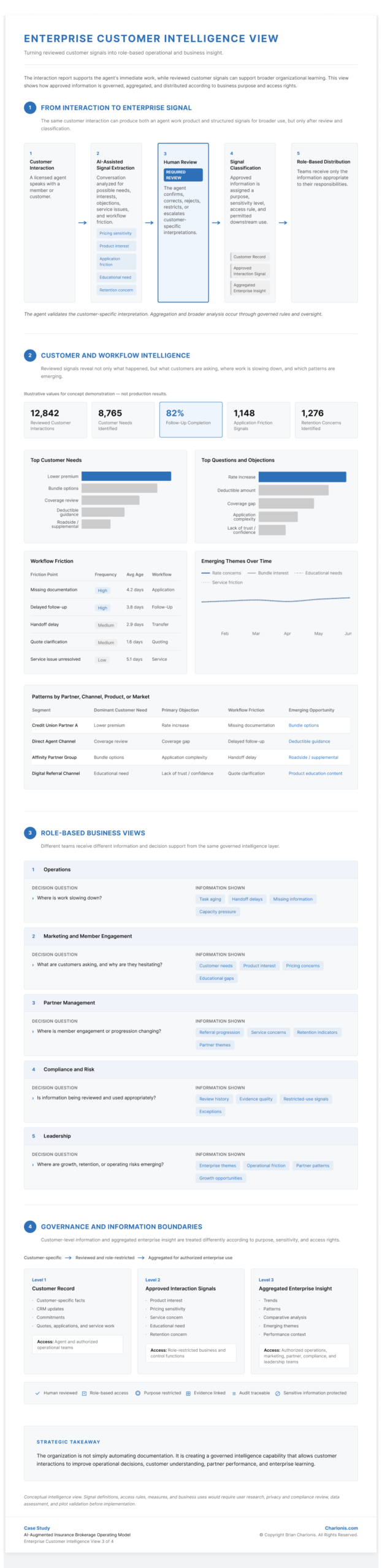
The enterprise customer intelligence view defined how reviewed customer-interaction signals could support business decisions beyond the immediate sales workflow. It organized customer needs, objections, product interests, service concerns, retention risk, channel preferences, application friction, partner patterns, and operational themes into role-based intelligence.
Key Elements
- Reviewed interaction signals from agent-approved customer conversations.
- Aggregated customer themes across agents, products, partners, channels, and markets.
- Role-based access separating customer-level data from business insight.
- Operational, marketing, partner, compliance, and leadership intelligence views.
- Evidence, consent, purpose, and access requirements for downstream use.
Artifact type: Enterprise intelligence / role-based decision view.
The artifact showed how reviewed interaction signals could support business decisions without exposing unrestricted customer-level information.
How It Shaped Decisions
This component would support marketing, operations, partner management, compliance, and leadership teams in determining which reviewed signals could inform action and which information should remain restricted. It clarified how frontline interactions could become governed enterprise intelligence rather than unstructured reporting or uncontrolled data reuse.
Enterprise Value and Performance View
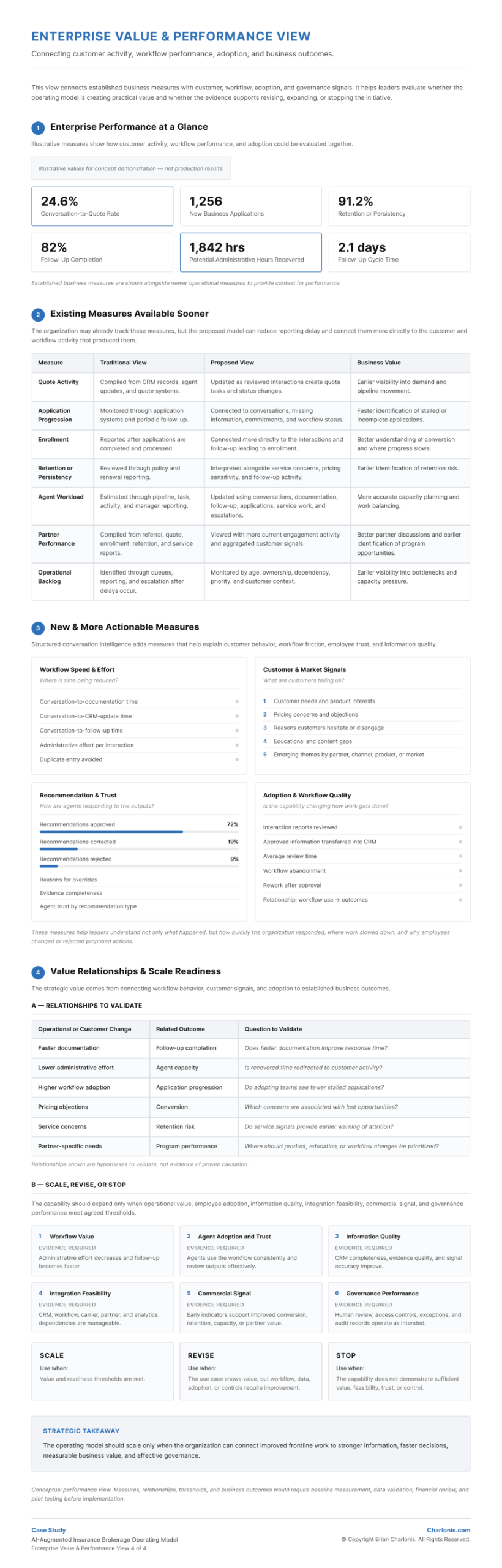
The enterprise value and performance view connected customer, workflow, adoption, governance, and business measures so leaders could assess whether the operating model was creating value before scaling. It distinguished established performance measures made available sooner from new measures created through structured conversation intelligence.
Key Elements
- CRM completeness, missing information, and duplicate-entry signals.
- Follow-up, quote, application, enrollment, and retention progression.
- Customer needs, objections, product interests, and service concerns.
- Agent adoption, trust, review behavior, overrides, and workflow abandonment.
- Evidence quality, exceptions, access controls, audit status, and workflow bottlenecks.
Artifact type: Value measurement / performance view.
The artifact connected customer, workflow, adoption, governance, and business measures to show what was changing, why it mattered, and what evidence would be needed before scale.
How It Shaped Decisions
This component would support executives, operations leaders, sales managers, compliance stakeholders, and transformation teams in deciding whether the model should continue, change, scale, or remain constrained. It clarified that productivity signals, information quality, adoption behavior, governance performance, and commercial indicators should be evaluated together rather than treated as isolated success measures.
OUTCOMES
This case produced an AI-augmented brokerage operating model, four conceptual artifacts, human-review logic, workflow coordination requirements, value measures, and scaling criteria. It was developed as an independent conceptual transformation scenario and does not claim production deployment, institutional adoption, measured administrative reduction, realized growth impact, carrier integration, CRM implementation, or quantified business gains.
- Defined an AI-augmented operating model intended to reduce the administrative work surrounding customer interactions.
- Connected conversation intelligence, human review, CRM updates, follow-up, operational workflows, and enterprise reporting into one coordinated information flow.
- Preserved licensed-agent judgment while using AI to prepare context, draft documentation, organize evidence, and recommend next actions.
- Established a governed path for reviewed customer signals to support operations, marketing, partner management, compliance, and leadership.
- Created a value-measurement model connecting workflow, adoption, information quality, governance, and business signals before scale.
- Current-to-Future Operating Model showed how customer information could move from conversation to documentation, workflow action, reporting, and organizational learning.
- Sales Agent Operational View defined the agent-facing work products, supporting evidence, recommended next actions, and review controls.
- Enterprise Customer Intelligence View structured how reviewed interaction signals could support role-based business decisions without unrestricted customer-level exposure.
- Enterprise Value and Performance View connected customer, workflow, adoption, governance, and business measures.
- The model defined human-review, correction, override, escalation, access, and prohibited-action requirements.
- The model established proposed pilot measures, governance requirements, auditability expectations, and scaling criteria.
- CRM completeness, documentation quality, missing information, and duplicate-entry signals.
- Follow-up, quote, application, enrollment, and retention progression.
- Customer needs, objections, product interests, service concerns, and application friction.
- Agent adoption and review behavior, evidence quality, exceptions, workflow bottlenecks, and capacity pressure.
- Permit low-risk drafting, summarization, retrieval, and task preparation only within approved data and workflow boundaries.
- Require human review before material customer information enters the official record, especially when information is missing, contradictory, outdated, or unsupported by approved sources.
- Require appropriately authorized human review before AI-generated recommendations, advice, or other consequential customer-facing actions are issued.
- Scale only when workflow value, adoption, information quality, integration feasibility, commercial signals, and governance performance meet agreed thresholds.
Brian completed the operating model, workflow logic, agent review controls, enterprise intelligence model, value-measurement view, and pilot-readiness criteria that could support implementation planning and stakeholder review. Production deployment, licensed insurance decisions, CRM implementation, technical architecture, vendor selection, carrier integration, compliance approval, institutional adoption, and realized business outcomes remained outside the scope of the case.