Tokenization Strategy
Private Credit Infrastructure
Governed Financial Systems
TOKENIZED FINANCIAL MARKETS
Conceptual Transformation Scenario
Web3 Product and Strategy Lead
Brian designed a governance-first tokenization operating model for evaluating how private credit infrastructure could be modernized through tokenized asset structures. The work focused on asset eligibility, jurisdictional boundaries, counterparty restrictions, capital authorization, servicing continuity, lifecycle transparency, monitoring instrumentation, escalation logic, and executive oversight.
A Global Financial Institution examined whether tokenized private credit could improve lifecycle transparency, servicing visibility, covenant monitoring, reporting, and executive oversight without disrupting existing servicing models or expanding institutional risk. Brian created four artifacts: a Private Credit Tokenization Eligibility Framework, Tokenized Private Credit Lifecycle & Control Architecture, Regulatory, Risk & Capital Gating Matrix, and Executive Oversight & Reporting Architecture, that clarified how tokenized private credit could be evaluated under eligibility discipline, capital controls, regulatory constraints, monitoring signals, human authority, and executive or board-level review.
Private credit operations relied on fragmented underwriting documentation, manual covenant tracking, opaque servicing workflows, and reconciliation-heavy reporting processes across multi-jurisdictional portfolios.
These limitations created operational friction, slowed risk visibility, and made it harder for leadership to understand asset performance across the private credit lifecycle.
Tokenization presented an opportunity to modernize these workflows through improved data synchronization, lifecycle transparency, and programmable asset structures. However, tokenization could not be evaluated as a technology upgrade alone. It needed to be assessed as an operating-model transformation across asset eligibility, servicing continuity, capital exposure, regulatory constraints, and executive oversight.
The challenge was this created a structural gap between legacy credit operations and emerging digital asset infrastructure. Leadership needed a structured way to determine how tokenized private credit could modernize portfolio operations without weakening controls or disrupting servicing.
The opportunity was to design a governance-first tokenization operating model that could help leadership evaluate eligibility, lifecycle modernization, capital gating, monitoring, and executive oversight before pilot authorization.
How could a global financial institution modernize private credit operations through governed tokenization while preserving asset eligibility discipline, servicing continuity, capital controls, regulatory alignment, and board-level oversight?
This required more than converting credit instruments into tokens. It required a governed operating model for deciding which assets were eligible, how capital exposure would be authorized, how servicing continuity would be preserved, how lifecycle events would be monitored, and where human authority remained required.
I served as Web3 Product and Strategy Lead, responsible for defining the institutional tokenization operating model and structuring how legal, compliance, treasury, credit risk, technology, operating, and executive stakeholders could evaluate tokenized private credit infrastructure.
My role focused on translating private credit modernization objectives into proposed governance and operating controls, including asset eligibility thresholds, counterparty restrictions, capital authorization rules, exposure caps, escalation triggers, lifecycle checkpoints, monitoring signals, and board-ready reporting structures.
I structured the work so leadership could evaluate tokenization as governed financial infrastructure rather than as a technology implementation question. The work emphasized asset eligibility, regulatory alignment, servicing continuity, capital discipline, human authority, and controlled pilot-readiness logic.
My responsibilities included:
This case demonstrates independent Web3 product strategy, tokenization operating-model design, financial-infrastructure analysis, governance-control structuring, monitoring-model design, and conceptual artifacts. It does not claim institutional adoption, production token issuance, deployed financial infrastructure, executed pilot implementation, realized liquidity gains, transaction volume, financial returns, legal approval, regulatory approval, capital-allocation authority, or enterprise engineering ownership.
Brian designed the end-to-end tokenization operating model for evaluating asset eligibility, capital authorization, lifecycle controls, servicing continuity, monitoring signals, escalation thresholds, executive reporting, board-level visibility, and pilot-readiness conditions that could support stakeholder review and implementation planning.
The solution was a governance-first tokenization operating model structured around asset eligibility, lifecycle visibility, servicing continuity, regulatory classification, capital controls, monitoring instrumentation, escalation logic, and executive oversight.
The solution connected four tokenized-infrastructure questions:
Together, these components created a controlled strategy for evaluating tokenized private credit infrastructure under institutional governance, capital discipline, servicing continuity, and regulatory constraint.
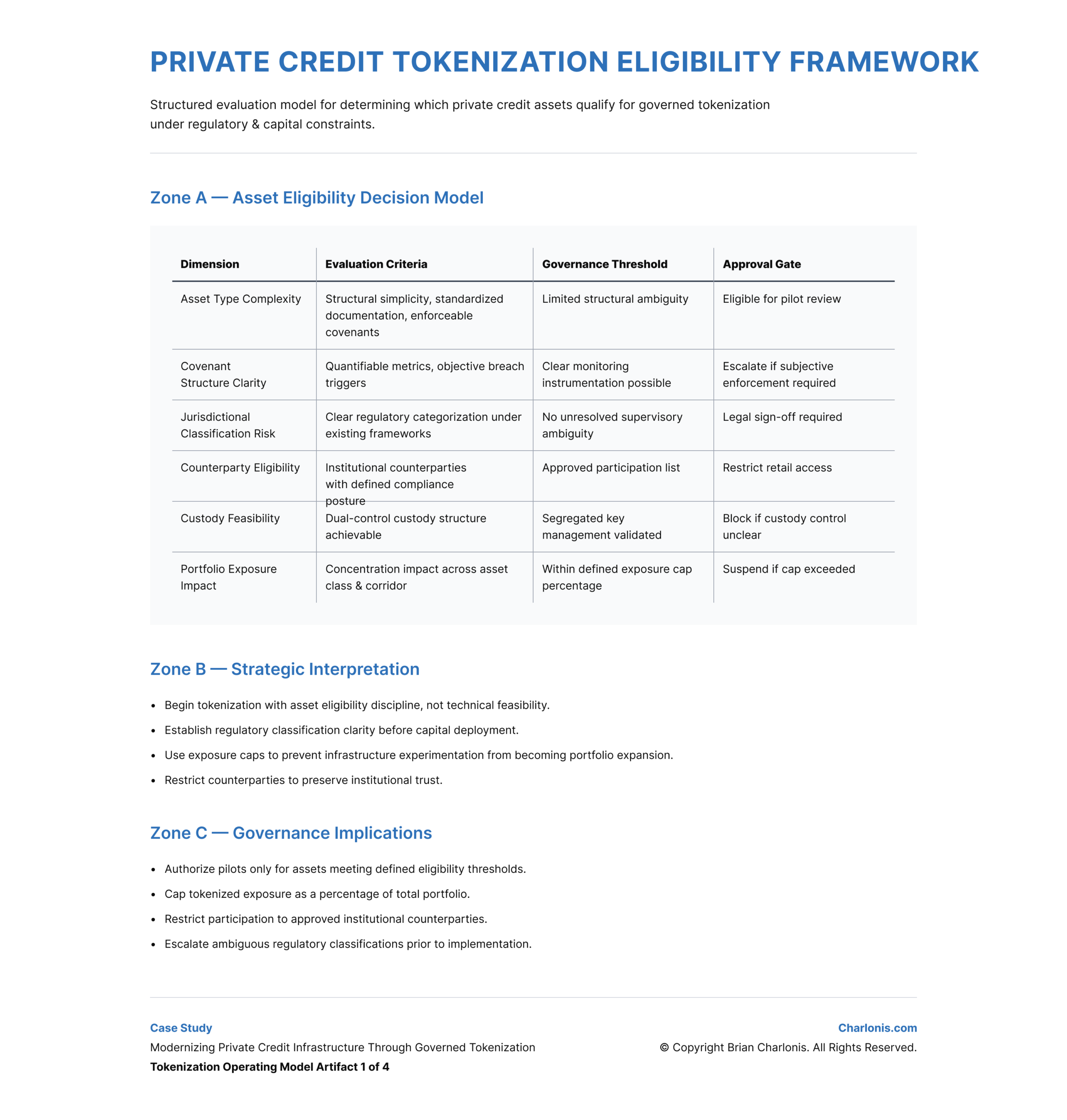
The eligibility framework defined how private credit assets could be assessed before inclusion in a tokenized infrastructure model. It focused on asset characteristics, jurisdictional boundaries, counterparty restrictions, exposure thresholds, and eligibility gates so tokenization would begin with institutional discipline rather than infrastructure selection.
Key Elements
Artifact type: Eligibility framework / asset-screening model.
The artifact defined structured asset inclusion criteria, jurisdictional boundaries, counterparty restrictions, and exposure thresholds for evaluating private credit assets before tokenized treatment.
This component would supports executive committee, treasury, credit risk, compliance, and legal stakeholders in determining which assets could be considered for tokenized infrastructure evaluation, which should remain excluded, and which eligibility conditions would need to be satisfied before pilot authorization.
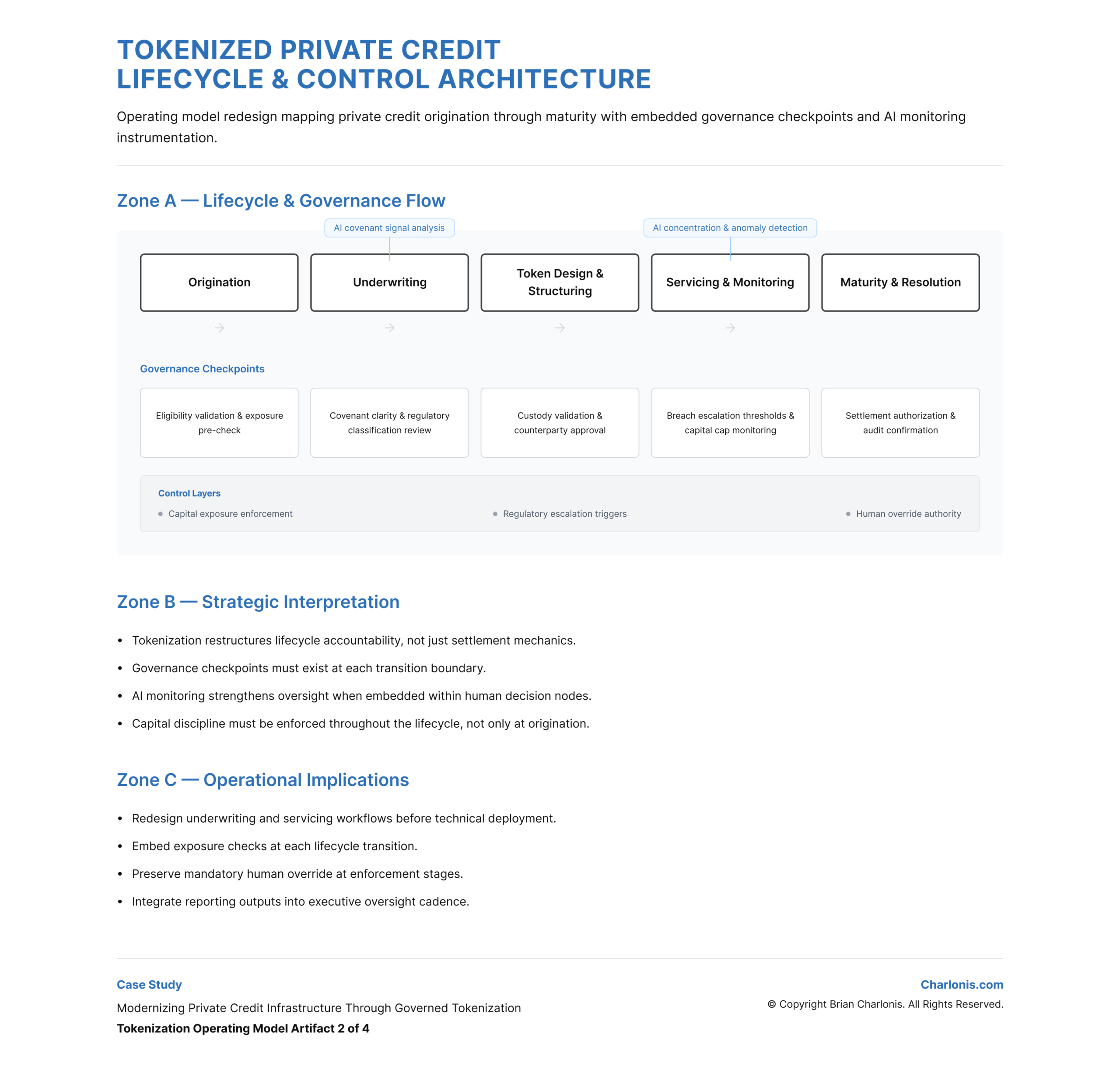
The lifecycle architecture mapped how tokenized private credit assets could move through origination, servicing, covenant monitoring, reporting, escalation, and maturity while preserving governance checkpoints and operational continuity. It clarified how tokenization could support lifecycle visibility without replacing existing servicing accountability.
Key Elements
Artifact type: Lifecycle control model / operating architecture.
The artifact mapped origination, servicing, covenant monitoring, reporting, escalation, and maturity with embedded governance checkpoints and monitoring instrumentation.
This component would support operations, compliance, technology, treasury, credit risk, and servicing stakeholders in determining how tokenized assets could fit into institutional workflows. It clarified automation boundaries while preserving servicing continuity, mandatory human oversight, and escalation control.
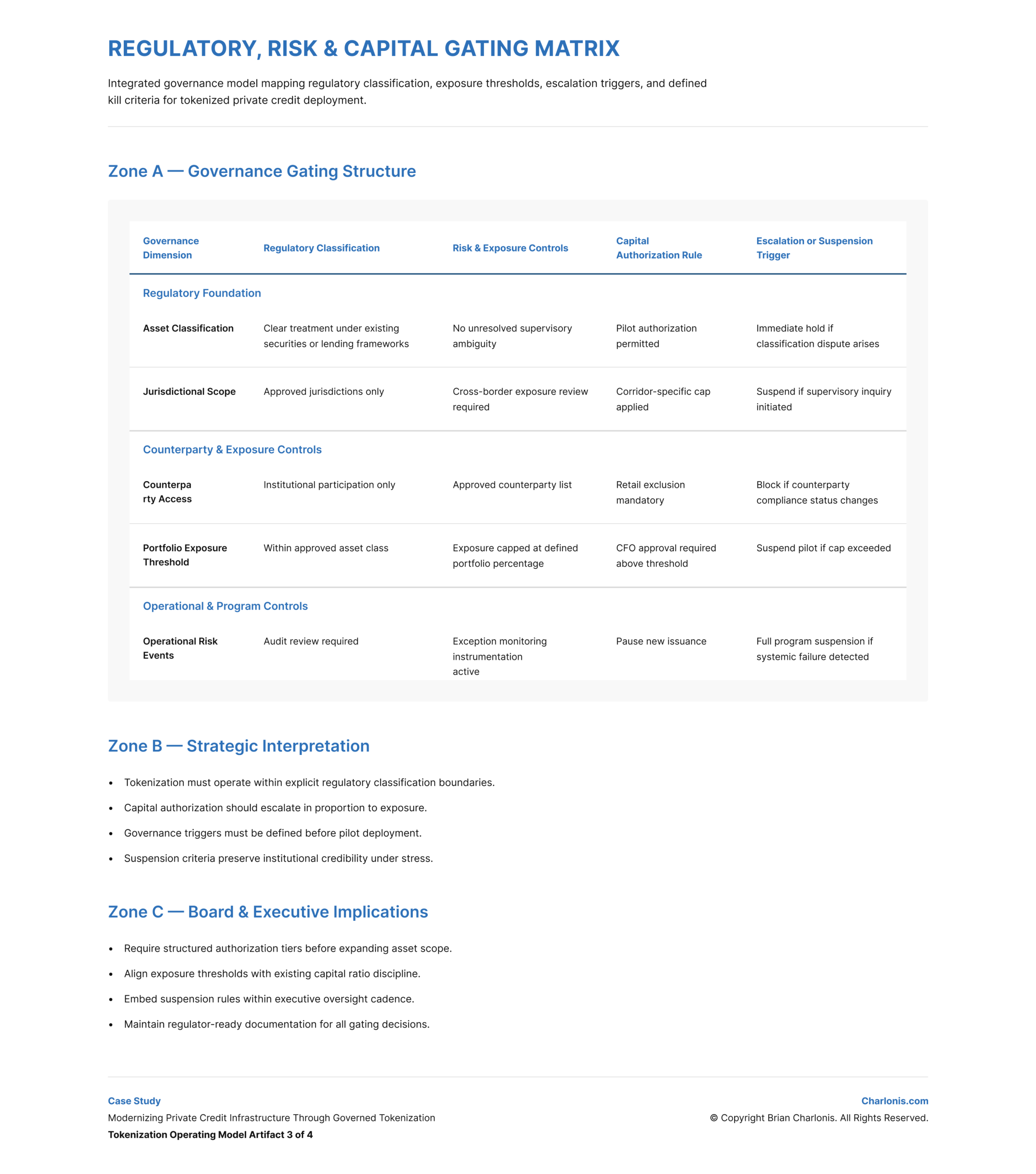
The gating matrix integrated regulatory classification, proposed capital authorization rules, designed exposure thresholds, escalation triggers, and suspension criteria into a unified decision model. It clarified when tokenized exposure could proceed, remain constrained, enter a hold state, or be suspended pending review.
Key Elements
Artifact type: Governance matrix / capital and regulatory gating model.
The artifact mapped origination, servicing, covenant monitoring, reporting, escalation, and maturity with embedded governance checkpoints and monitoring instrumentation.
This component would support legal, treasury, credit risk, compliance, executive oversight, and board risk committee stakeholders in determining whether a tokenized credit opportunity could proceed, require additional authorization, remain limited, enter a hold state, or be suspended. It clarified how institutional experimentation could remain bounded by supervisory, capital, and governance guardrails.
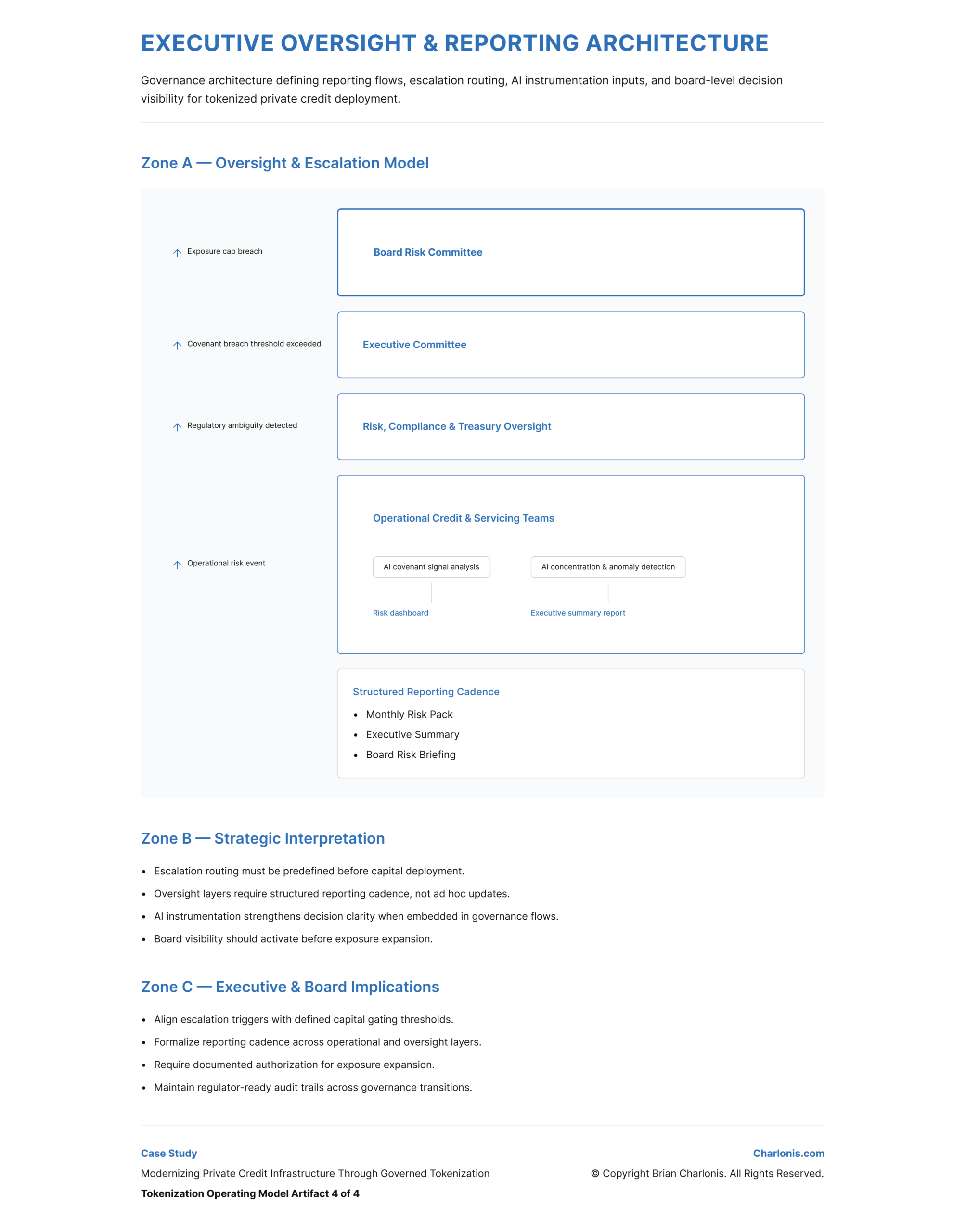
The executive oversight architecture defined how monitored signals, escalation routing, exposure visibility, and governance reporting could support leadership review. It positioned monitoring as an instrumentation layer for detecting covenant deviation signals, exposure concentration anomalies, reporting irregularities, and operational exceptions while preserving human-controlled enforcement.
Key Elements
Artifact type: Executive reporting / monitoring architecture.
The artifact defined escalation routing, monitored signals, reporting cadence, exposure visibility, and executive or board-level review structure for tokenized private credit infrastructure evaluation.
This component would support executive leadership, risk oversight, treasury, credit risk, compliance, and operating teams in determining when monitored signals required review, escalation, hold-state action, suspension, or further authorization. It clarified that monitoring could strengthen oversight when positioned as instrumentation, not as autonomous enforcement.
This case produced a governance-first tokenization operating model, four conceptual artifacts, asset eligibility logic, lifecycle-control architecture, capital-gating model, monitoring instrumentation, and executive reporting structure. It was developed as an independent conceptual transformation scenario and does not claim production token issuance, institutional adoption, deployed financial infrastructure, realized liquidity gains, transaction volume, financial returns, legal approval, regulatory approval, or client implementation outcomes.




Brian completed the tokenization operating model, eligibility framework, lifecycle-control architecture, regulatory and capital gating matrix, monitoring signal model, and executive reporting architecture that could support stakeholder review and implementation planning. Production token issuance, deployed financial infrastructure, legal interpretation, regulatory approval, capital-allocation authority, enterprise engineering ownership, institutional adoption, realized liquidity outcomes, transaction volume, and financial returns remained outside the scope of the case.
The central challenge was not whether private credit assets could be tokenized.
It was whether tokenized private credit infrastructure could be evaluated through asset eligibility discipline, capital controls, lifecycle oversight, monitoring instrumentation, human authority, and executive governance before broader institutional exposure could be considered.

CASE STUDY
AI PORTFOLIO & INVESTMENT
Designed a monitored-autonomy model for agentic regulatory intelligence, defining how regulatory signals would be classified, routed, monitored, contained, escalated, and translated into executive decision support for high-risk enterprise workflows.
Enterprise AI Strategy
AI Portfolio Strategy
Evidence-Based Funding

CASE STUDY
INSTITUTIONAL GOVERNANCE
Defined an enterprise AI governance architecture with an AI charter, portfolio risk taxonomy, capital-allocation governance model, and vendor governance framework to clarify oversight, decision authority, policy expectations, and investment discipline for responsible AI scale.
AI Governance
Enterprise Decision Systems
Capital Discipline

CASE STUDY
FEDERATED AI ADOPTION
Defined a federated AI adoption model for a decentralized software portfolio, connecting business-unit readiness, local ownership, workflow-change evidence, value signals, and cross-unit learning to move AI adoption beyond tool access and isolated pilots.
AI Adoption
Enterprise AI Adoption
Federated Operating Model

CASE STUDY
DATA & RESPONSIBLE AI GOVERNANCE
Defined a Data and Responsible AI Governance operating model connecting risk-tiered intake, accountable business ownership, cross-functional controls, lifecycle oversight, reassessment, and executive visibility without routing every AI decision through one centralized approval bottleneck.
Data & Responsible AI Governance
Lifecycle Governance
Decision Rights
If you are evaluating tokenized assets, private credit infrastructure or programmable financial systems in regulated environments, let’s connect on LinkedIn.