Agentic AI
Regulatory Intelligence
Monitored Autonomy
MONITORED AUTONOMY
Conceptual Transformation Scenario
AI & Product Strategy Lead
Brian designed an agentic AI regulatory intelligence operating model that structured how regulatory and risk signals could be gathered, classified, escalated, monitored, and surfaced for executive decision-making. The work defined monitored autonomy inside governance boundaries, clarifying how agentic AI could support faster awareness without creating unmanaged decision authority.
A Global Financial Services Organization needed to improve how executives monitored regulatory change and risk signals across fragmented data sources, manual reporting processes, and delayed intelligence workflows. Brian created an AI-native regulatory intelligence architecture, escalation threshold and severity framework, monitoring and instrumentation dashboard model, and executive regulatory intelligence brief template that made signal classification, authority boundaries, escalation logic, and executive decision support more explicit.
CHALLENGE
Regulatory monitoring relied on manual aggregation, periodic reporting, and siloed analysis, limiting the organization’s ability to respond to emerging risks in a timely and coordinated way.
AI capabilities existed, but lacked structured integration into decision-making workflows. Without a governed operating model, agentic AI could generate more intelligence while still producing inconsistent outputs, unclear accountability, unmanaged escalation paths, and limited executive trust.
The challenge was not generating more intelligence. It was defining how agentic AI could monitor signals, classify severity, route escalations, and support executive decisions while remaining inside clear authority boundaries, human review gates, and governance controls.
The opportunity was to design an AI-driven regulatory intelligence operating model that continuously monitored signals, classified severity, routed escalations, and supported executive decision-making within defined governance constraints.
Key Drivers
- Regulatory volatility required faster signal awareness.
- Executive decision-making depended on timely, structured intelligence.
- Escalation paths needed to be consistent across severity tiers.
- Governance visibility was limited across fragmented monitoring workflows.
- Risk containment required clear authority boundaries for agentic AI outputs.
- Monitoring needed to detect drift, override patterns, and escalation instability.
Strategic Question
How could a global financial-services organization use agentic AI to monitor regulatory and risk signals while preserving severity discipline, escalation clarity, human authority, governance containment, and executive decision accountability?
In regulated financial-services environments, the issue is not whether AI can find more signals. The issue is whether those signals can be classified, governed, escalated, and translated into decision-ready intelligence without allowing autonomous behavior to exceed institutional authority.
SOLUTION
The solution was an agentic AI regulatory intelligence operating model structured around signal detection, severity classification, authority boundaries, escalation routing, monitoring instrumentation, and executive-facing outputs.
It defined how regulatory information should be gathered, classified, escalated, contained, and translated into decision-ready intelligence.
The solution connected four governance questions:
- How should regulatory signals be detected, qualified, and classified?
- Where should agentic AI authority end and human or executive authority begin?
- How should monitoring reveal drift, override behavior, escalation instability, and containment breaches?
- How should intelligence be converted into executive-ready decisions and actions?
Together, these components created a monitored-autonomy model for using agentic AI in regulatory intelligence while preserving governance control, escalation clarity, and executive accountability.
Regulatory Signal Decision Engine
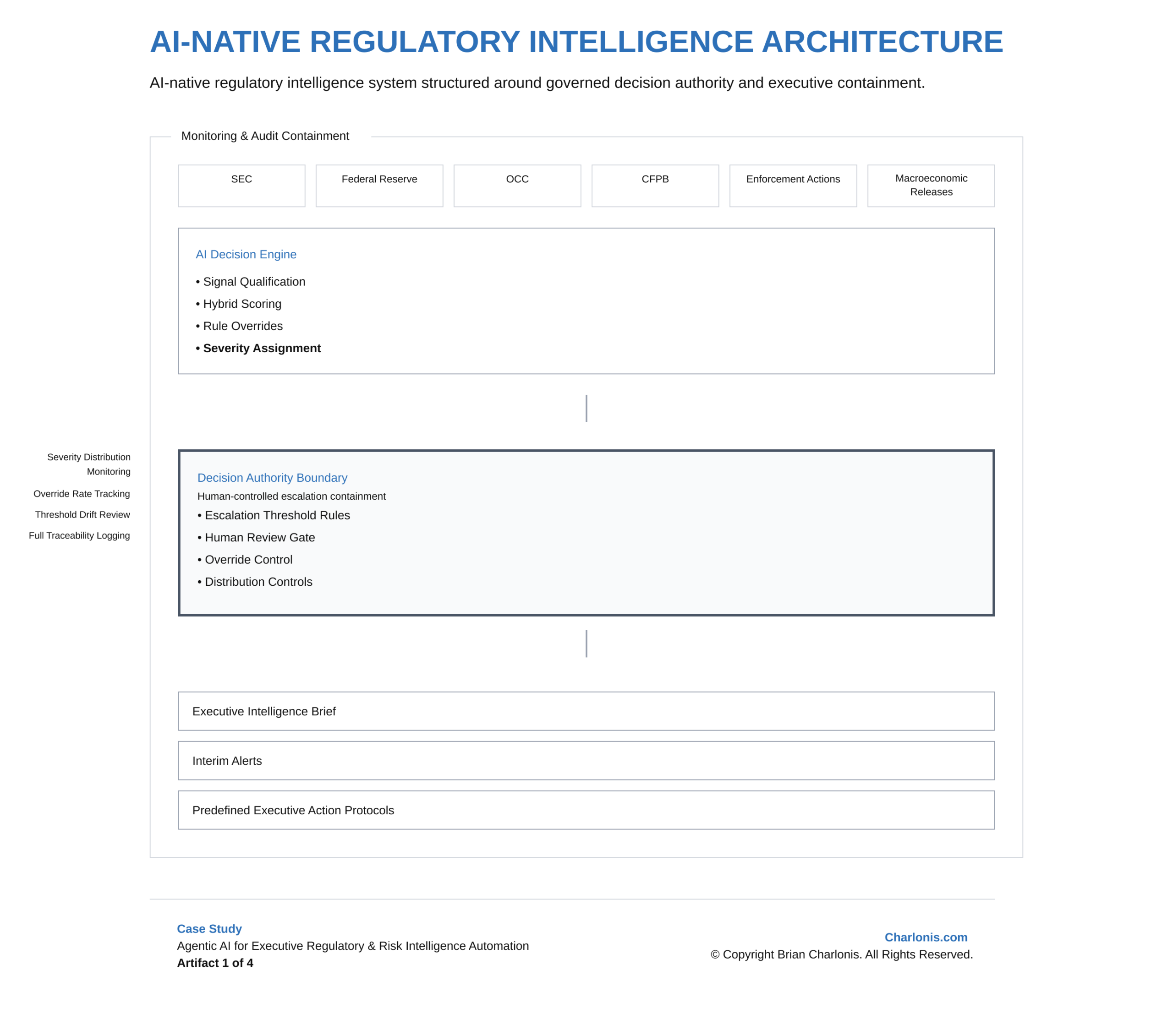
The decision engine organized incoming regulatory signals into a structured classification process. It defined how signals could be qualified, scored, classified by severity, and assigned confidence indicators tied to data quality and signal strength, making severity assignment a governed decision event rather than a reporting output.
Key Elements
- Regulatory signal intake and qualification.
- Hybrid weighted scoring with rule-based overrides.
- Severity classification logic.
- Confidence scoring tied to data quality and signal strength.
- Downstream routing based on severity and confidence.
Artifact type: Regulatory intelligence operating architecture.
The artifact defined signal flow, authority boundaries, decision logic, monitoring, and executive intelligence flow used to structure agentic regulatory intelligence.
How It Shaped Decisions
This component would support risk, compliance, product, and executive stakeholders in determining which regulatory signals required awareness, review, escalation, or executive attention. It clarified how signal severity could be assessed consistently and how agent-generated intelligence should enter governed decision workflows.
Decision Authority Boundary
The authority boundary defined where agentic AI could operate independently and where human review, escalation, or executive confirmation would be required. It converted autonomy from a binary choice into a governed operating condition, with designed authority rules varying by severity tier and decision criticality.
Key Elements
- Escalation thresholds based on severity.
- Proposed human review gates for elevated and critical classifications.
- Override controls with audit traceability.
- Proposed distribution restrictions based on decision criticality.
- Executive confirmation before distribution for critical classifications.
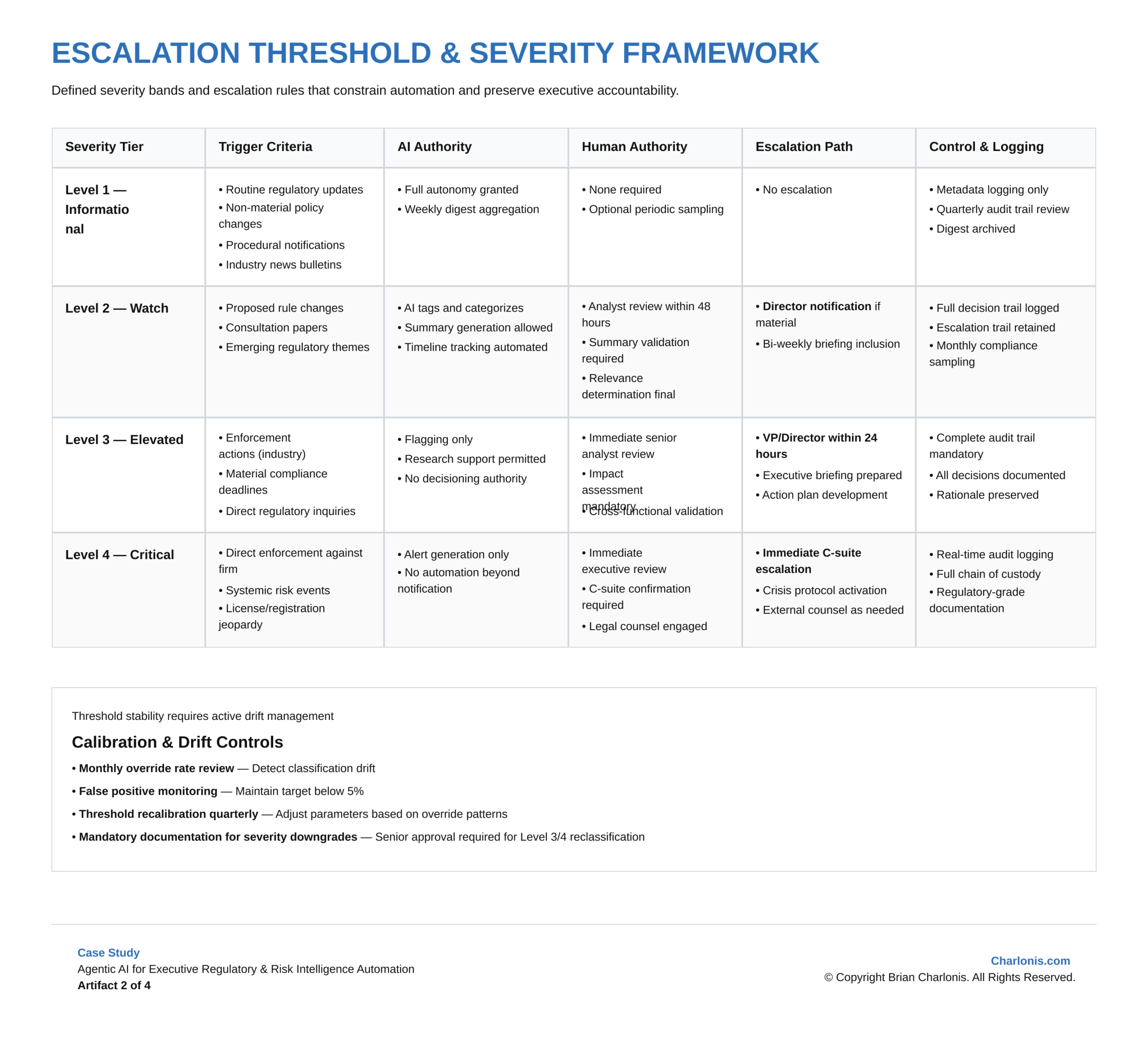
Artifact type: Severity framework / authority-boundary model.
The artifact defined severity bands, AI authority, human authority, escalation logic, review ownership, and distribution controls for agentic regulatory intelligence outputs.
How It Shaped Decisions
This component would support compliance, risk leadership, operational governance, and executive stakeholders in determining when AI-generated outputs could be distributed, when human validation was required, and when executive confirmation was necessary. It clarified how agentic autonomy could be constrained without eliminating its monitoring value.
Monitoring, Audit & Containment Layer
The monitoring layer transformed oversight from passive reporting into active governance instrumentation. It defined how the operating model should track severity distribution, escalation patterns, human override behavior, drift movement, and classification stability so that containment issues could trigger recalibration review.
Key Elements
- Severity distribution stability.
- Escalation frequency and routing patterns.
- Human override activity and intervention rates.
- Signal drift and classification stability.
- Breach triggers for override spikes and model instability.
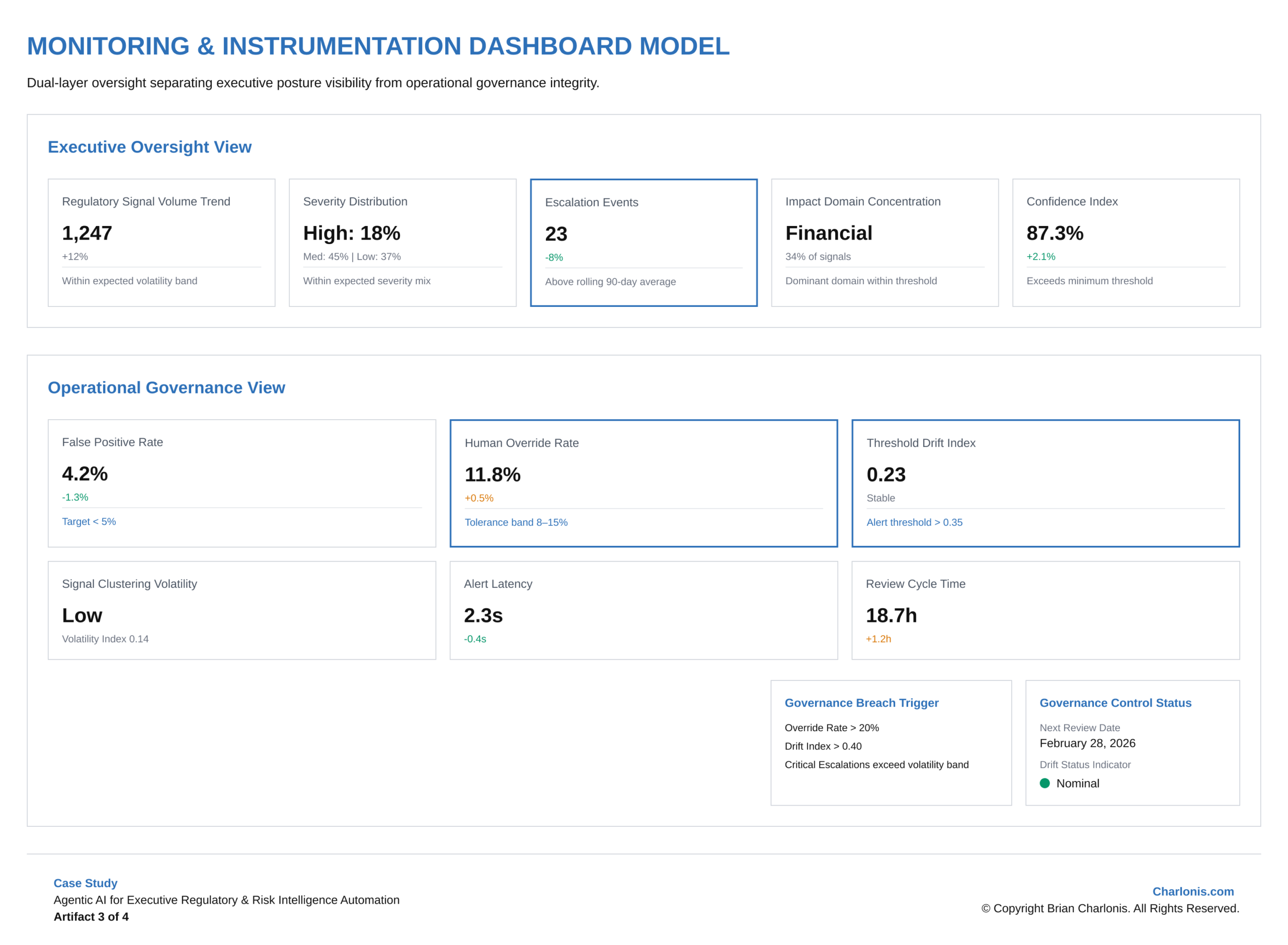
Artifact type: Monitoring dashboard / governance instrumentation model.
The artifact established tolerance bands, breach triggers, drift detection, override monitoring, escalation visibility, and recalibration indicators for agentic AI regulatory intelligence workflows.
How It Shaped Decisions
This component would support governance committees, product oversight, risk leadership, and operational teams in determining when the agentic system remained within tolerance, when review volume indicated instability, and when thresholds required recalibration. It clarified that monitoring should produce governance action, not simply operating visibility.
Executive Regulatory Intelligence Brief
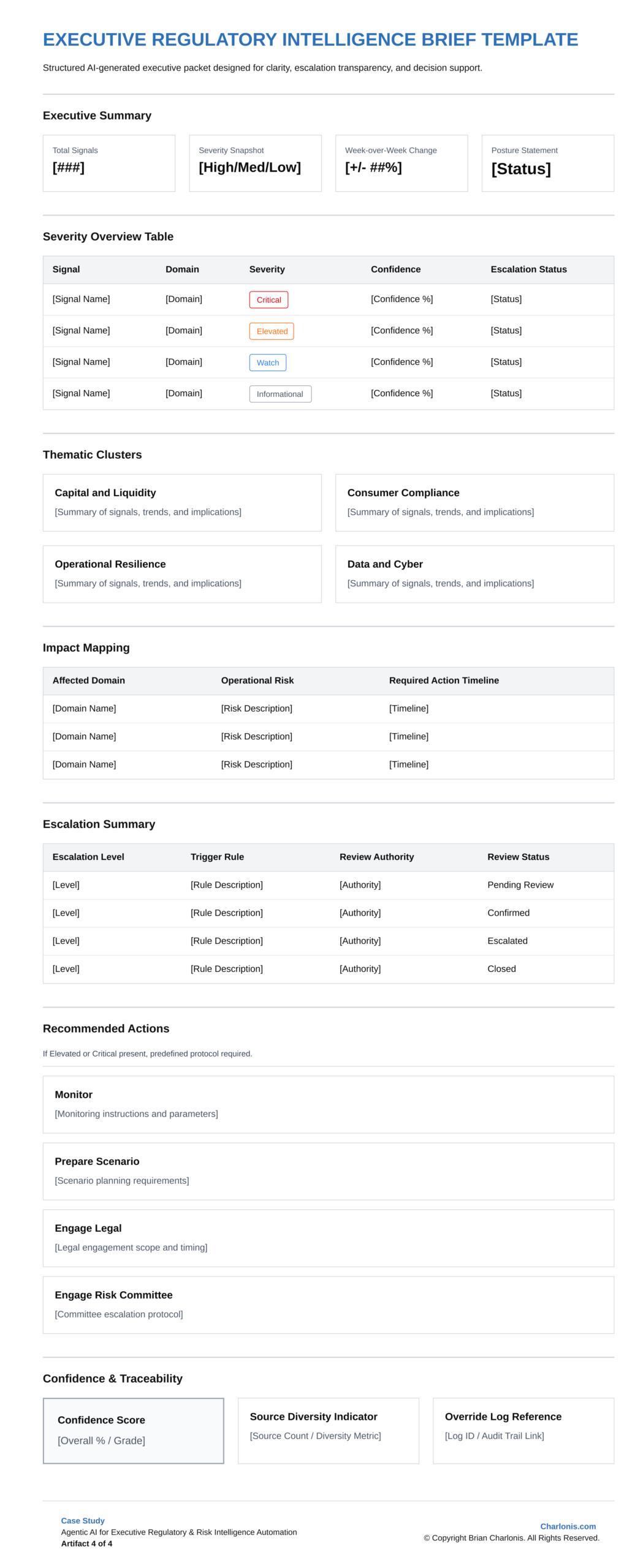
The executive brief translated regulatory signal activity into a structured decision interface for senior leaders. It prioritized decision clarity, urgency, exposure mapping, required action, review ownership, and confidence traceability over narrative depth or raw intelligence volume.
Key Elements
- Dynamic severity snapshot across active signals.
- Week-over-week signal movement and trend shifts.
- Impact mapping by regulatory and business exposure.
- Required actions with defined timelines.
- Escalation status, review ownership, and confidence traceability.
Artifact type: Executive briefing template / decision-support interface.
The artifact standardized the executive-facing packet for active regulatory signals, severity shifts, exposure mapping, required actions, escalation status, ownership, and confidence scoring.
How It Shaped Decisions
This component would support executive leadership and senior risk stakeholders in determining which regulatory signals required action, which exposures were changing, who owned review, and what decisions or escalations were pending. It clarified how agentic monitoring could become decision-ready executive intelligence rather than another reporting layer.
OUTCOMES
This case produced an agentic AI regulatory intelligence operating model, four institutional artifacts, and decision-ready logic for signal classification, authority boundaries, escalation, monitoring, containment, and executive briefing. It was developed as an independent conceptual enterprise strategy case and does not claim production deployment, institutional adoption, measured latency reduction, realized effort reduction, or operational performance outcomes.
- Established a monitored-autonomy model for agentic AI regulatory intelligence.
- Clarified how regulatory signals could be classified, routed, reviewed, escalated, and contained.
- Defined authority boundaries for AI-generated regulatory intelligence outputs.
- Created executive-facing intelligence logic focused on severity, exposure, ownership, and required action.
- Connected monitoring signals to containment triggers and recalibration review.
- AI-Native Regulatory Intelligence Architecture defined the decision engine, authority boundary, monitoring layer, and executive intelligence flow.
- Escalation Threshold & Severity Framework structured severity bands, AI authority, human authority, escalation rules, and review ownership.
- Monitoring & Instrumentation Dashboard Model established tolerance bands, breach triggers, drift detection, override monitoring, and escalation visibility.
- Executive Regulatory Intelligence Brief Template standardized the decision-ready packet for active regulatory signals, severity shifts, exposure mapping, required actions, and ownership.
- The model defined decision logic for using agentic AI to support regulatory awareness while preserving human and executive authority.
- The operating model established recalibration logic for adjusting thresholds when signal drift, override patterns, or escalation instability appeared.
- Severity distribution stability across regulatory signal categories.
- Override rates and human intervention patterns.
- Drift movement and classification stability.
- Escalation frequency, routing patterns, and elevated / critical human-review volume.
- Require mandatory human validation for elevated and critical classifications.
- Require documented and approved overrides when agent-generated severity or routing recommendations are changed.
- Trigger recalibration review when override spikes or drift instability appear.
- Require executive confirmation and reduced automation authority for critical or low-confidence conditions.
Brian completed the regulatory intelligence operating model, severity classification logic, authority-boundary model, monitoring dashboard requirements, executive briefing structure, and recalibration logic that could support implementation planning and executive governance review. Model development, technical architecture, production deployment, legal interpretation, compliance approval, executive decision-making, institutional adoption, and realized operational outcomes remained outside the scope of the case.