CASE STUDY
Allocating Enterprise AI Investment Across a Multi-Product Consumer Fintech
Structuring how leadership sequences capabilities, compares opportunities, allocates capital, and requires evidence before AI investments advance.
CASE STUDY
Structuring how leadership sequences capabilities, compares opportunities, allocates capital, and requires evidence before AI investments advance.
Enterprise AI Strategy
AI Portfolio Strategy
Evidence-Based Funding
AI PORTFOLIO & INVESTMENT
Conceptual Transformation Scenario
Enterprise AI Strategy & Investment Lead
Brian designed an enterprise AI investment system for translating a broad set of AI opportunities across products, operations, risk, compliance, customer service, and shared capabilities into a structured portfolio, capability roadmap, executive decision queue, and evidence framework. The work clarified how leadership could sequence investments, protect scarce capacity, fund shared foundations, and require stronger proof before broader exposure or additional capital.
A Multi-Product Consumer Fintech had more AI ideas than available capital, delivery capacity, shared foundations, governance attention, or reliable evidence. Brian created four artifacts: an enterprise AI capability roadmap, AI investment portfolio, executive investment decision view, and AI business case and evidence framework. These clarified how leadership could make AI funding, sequencing, scope, ownership, exposure, opportunity-cost, pause, stop, and rebalance decisions more explicit.
This case was realized through Brian’s Governed Intelligence Operating System. The system developed recurring market signals about competing AI opportunities, scarce capital, shared foundations, evidence gates, and portfolio tradeoffs into an independent conceptual transformation scenario.
A multi-product consumer fintech could generate plausible AI opportunities across nearly every part of the enterprise.
Representative opportunities included customer financial guidance, personalized product discovery, service-agent assistance, dispute and case automation, fraud and scam intelligence, credit decision support, compliance monitoring, enterprise knowledge retrieval, model evaluation and observability, and customer identity, permissions, and transaction intelligence.
Each opportunity could appear valuable when assessed independently. Leadership, however, had to make portfolio-level choices.
The challenge was not to select a single highest-ranked AI use case. It was to construct a portfolio that balanced near-term evidence, customer value, strategic differentiation, operational efficiency, risk reduction, shared-capability leverage, and controlled exposure.
The opportunity was to create an enterprise AI investment system that could compare opportunities, sequence shared dependencies, allocate staged funding, require evidence, make opportunity cost visible, and translate portfolio analysis into explicit executive decisions.
How could a rapidly growing, multi-product consumer-fintech enterprise allocate capital and delivery capacity across competing AI opportunities while balancing customer value, growth, efficiency, risk, readiness, dependencies, evidence, and shared-capability leverage?
Without an enterprise investment model, decisions could be shaped by sponsor influence, product-team urgency, enthusiasm for a particular technology, inconsistent business cases, unverified benefit assumptions, sunk-cost momentum, fragmented delivery budgets, local optimization, incomplete dependency visibility, and reluctance to stop weak pilots.
I led the development of the conceptual enterprise AI investment and decision system, translating a broad pipeline of AI opportunities into a structured capability roadmap, investment portfolio, executive decision agenda, and evidence framework.
This was an independent AI portfolio and investment strategy case developed as a conceptual transformation scenario for a multi-product consumer fintech. I approached the challenge as a capital-allocation and operating-model problem rather than a use-case-ranking exercise.
My role was to define how enterprise leadership could identify shared dependencies, sequence foundational capabilities, compare competing investments, connect funding stages to evidence, combine overlapping work, constrain high-exposure opportunities, reallocate scarce capacity, and establish hold, pause, and stop decisions.
My responsibilities included:
This case demonstrates independent strategy, portfolio architecture, investment decision-system design, staged-funding logic, evidence-framework development, and conceptual artifacts. It does not claim client-enterprise deployment, production implementation, financial modeling ownership, capital-allocation authority, product strategy ownership for every business line, technical architecture, regulatory interpretation, realized investment returns, or quantified business outcomes.
Brian designed the end-to-end enterprise AI investment system for sequencing shared capabilities, comparing opportunities, structuring portfolio balance, defining executive funding decisions, establishing evidence gates, and clarifying when investments should advance, narrow, combine, hold, pause, stop, or remain constrained.
The solution organized enterprise AI investment as a connected portfolio rather than a collection of independent use cases.
It linked capability dependencies, portfolio balance, executive capital-allocation decisions, and stage-appropriate evidence so leadership could determine what to fund, sequence, combine, constrain, accelerate, pause, or stop.
The solution connected four investment questions:
Together, these components created an enterprise AI investment system that structured executive judgment across strategic relevance, customer and business value, operational contribution, risk reduction, readiness, evidence confidence, shared-capability leverage, dependency risk, control requirements, economic viability, ownership, and opportunity cost.
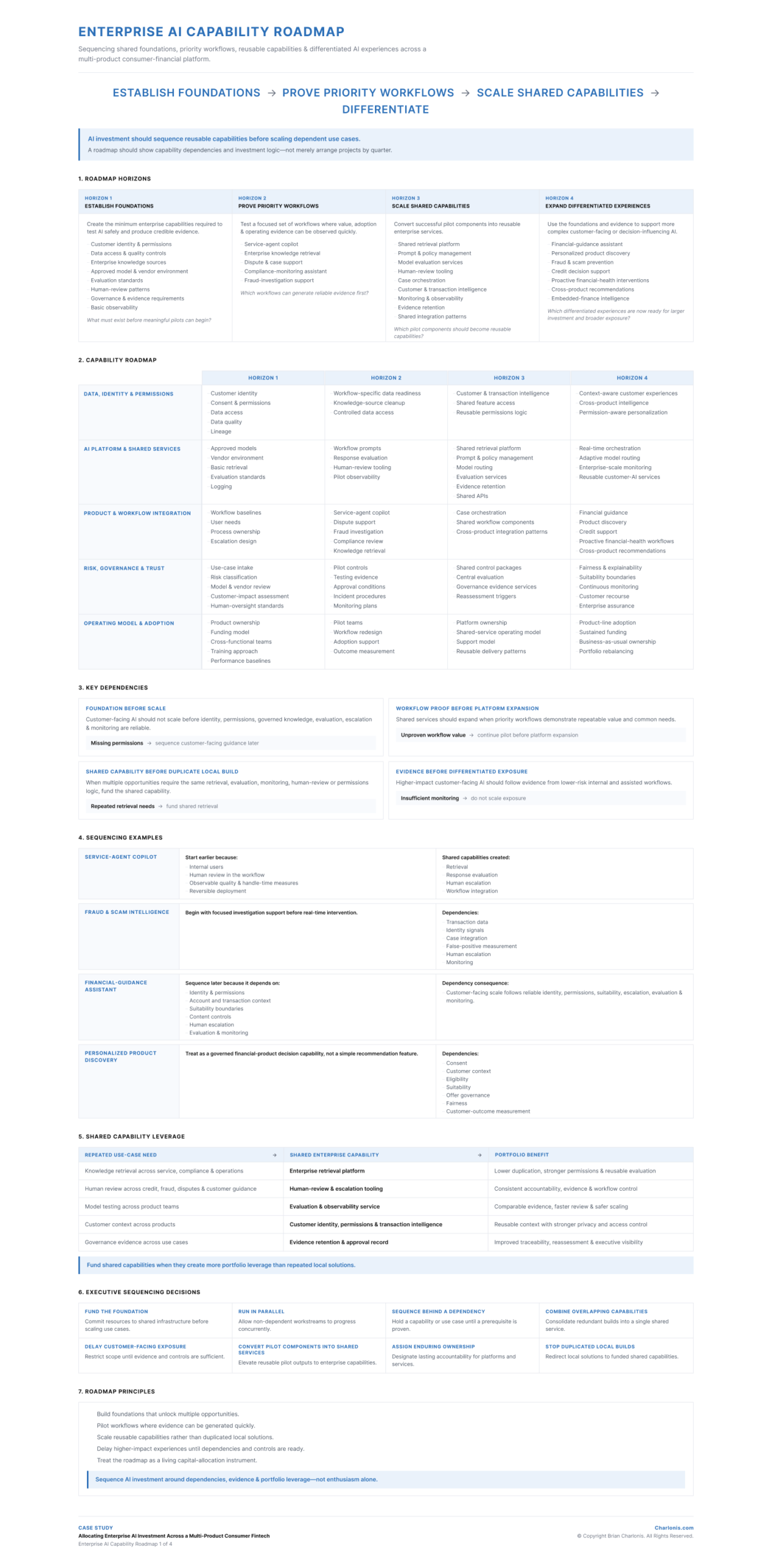
The roadmap established sequencing logic across foundations, priority workflows, shared capabilities, and differentiated customer experiences. It clarified that AI investment should not be sequenced by enthusiasm alone; leadership needed to understand which capabilities could proceed in parallel, which should remain constrained, which depended on stronger foundations, and which should become shared enterprise services.
Key Elements
Artifact type: Roadmap / capability sequencing model.
The artifact showed what shared capabilities must be established, which workflows could generate evidence earlier, which services should scale, and which customer-facing experiences should wait for stronger foundations.
This component would support executive leadership, product, technology, data, risk, operations, finance, and enterprise AI teams in deciding what to build first, what could proceed in parallel, what should be combined, which exposure should wait, and where enduring ownership was required.
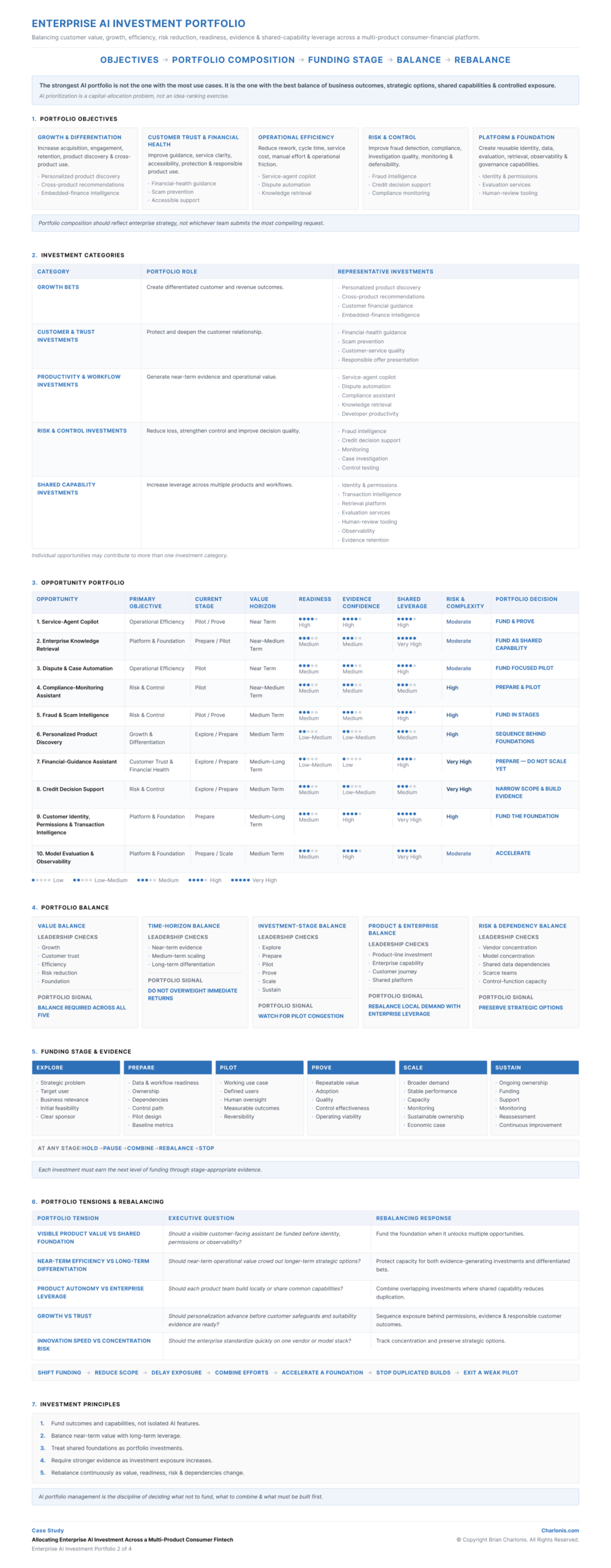
The portfolio model showed how competing opportunities contributed to a balanced enterprise investment portfolio rather than one ranked list. It compared opportunities across investment objective, funding stage, value horizon, readiness, evidence confidence, shared leverage, risk, complexity, and portfolio decision so leadership could see whether the portfolio was over-concentrated, duplicated, premature, or missing shared foundations.
Key Elements
Artifact type: Portfolio framework / investment model.
The artifact showed how representative AI opportunities could contribute to growth, customer trust, efficiency, risk reduction, and shared enterprise capability.
This component would support executive leadership, finance, product, technology, operations, risk, enterprise AI, and portfolio governance in deciding which opportunities to fund, accelerate, prepare, sequence, narrow, combine, hold, or rebalance and whether the portfolio was structurally sound.
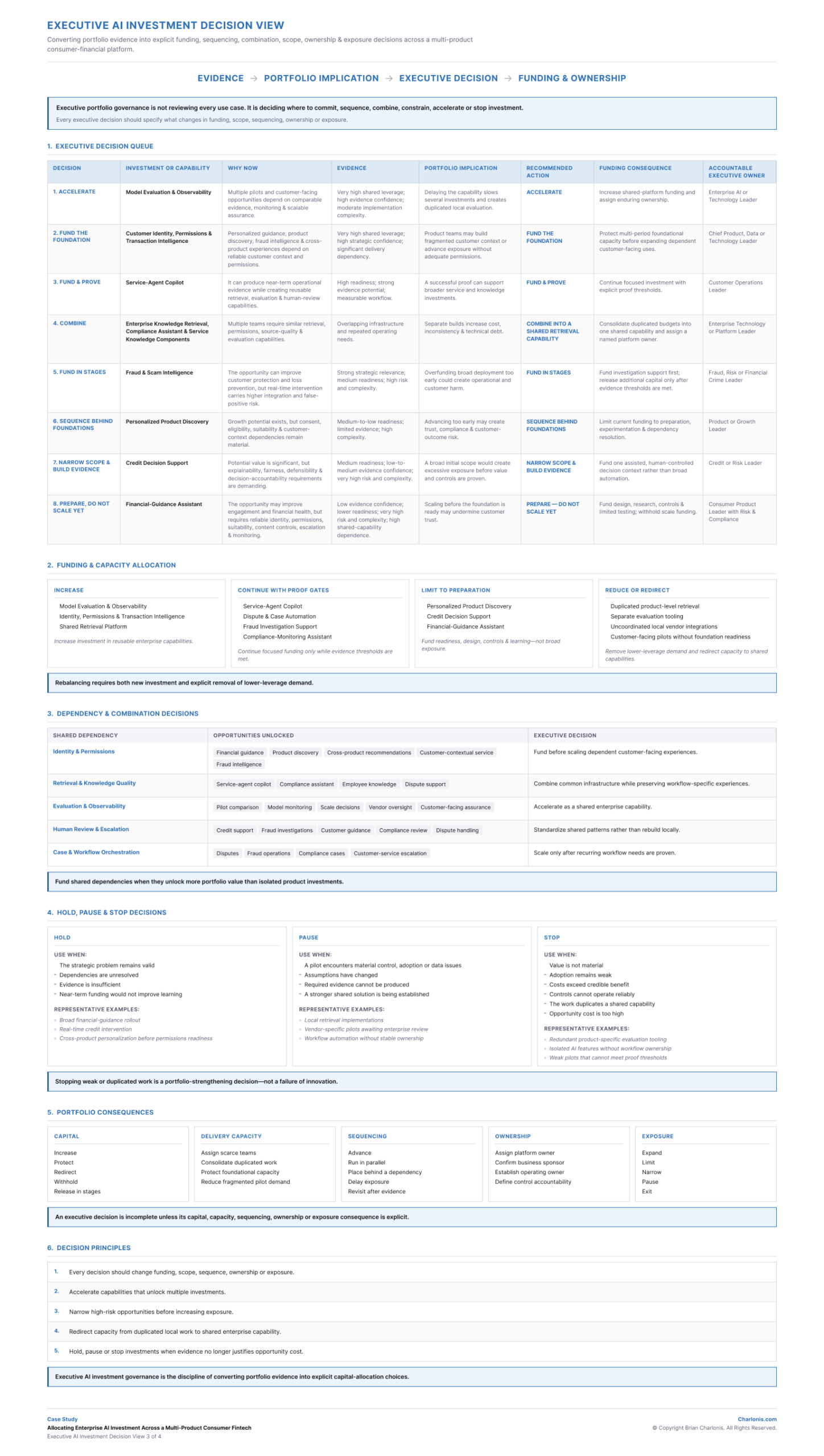
The decision view converted portfolio evidence into an executive action agenda. It focused leadership attention on decisions that materially changed funding, sequencing, ownership, scope, capacity, or exposure rather than reviewing every AI opportunity equally.
Key Elements
Artifact type: Executive decision register / capital-allocation view.
The artifact linked portfolio evidence to specific executive decisions, including accelerating, funding foundations, combining work, staging capital, narrowing scope, delaying exposure, assigning ownership, pausing, or stopping investment.
This component would support enterprise executives, finance, product, technology, risk, operations, and accountable investment owners in deciding where to increase funding, protect capacity, combine work, narrow scope, stage capital, delay exposure, assign ownership, pause, or stop.
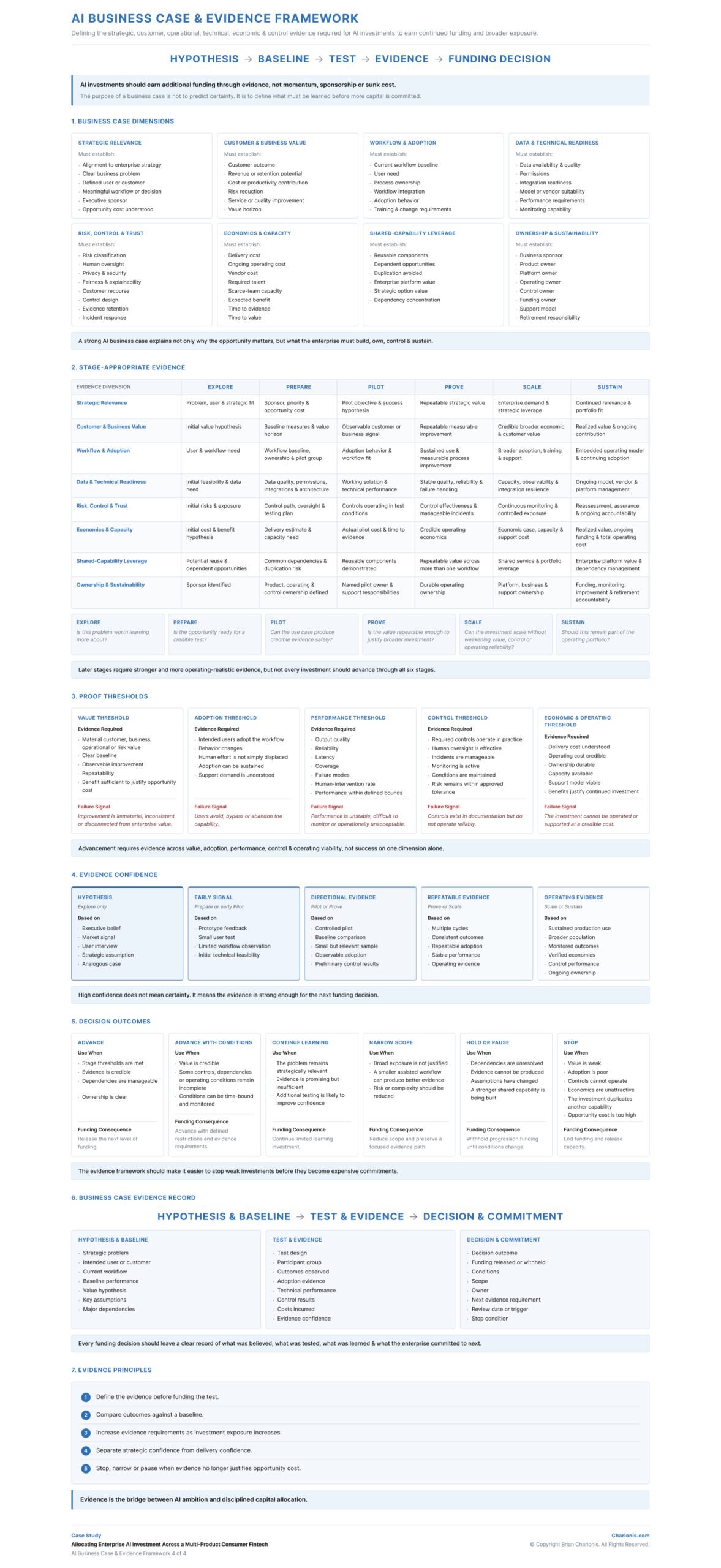
The business case and evidence framework defined what an investment must prove to earn continued funding, broader scope, or ongoing operating responsibility. It connected business-case dimensions, staged funding, proof thresholds, evidence confidence, and advancement outcomes so investments would progress through evidence rather than momentum, sponsorship, or sunk cost.
Key Elements
Artifact type: Evidence framework / funding gate.
The artifact showed what each investment must establish and prove before it earns additional capital, broader scope, or continued operation.
This component would support investment sponsors, executives, finance, product, technology, data, risk, operations, and portfolio governance in deciding whether an investment should advance, remain constrained, continue learning, narrow scope, pause, or stop and what evidence should be required next.
This case produced an enterprise AI investment system, four conceptual artifacts, portfolio-composition logic, staged-funding model, executive decision view, and evidence framework. It was developed as an independent conceptual transformation scenario and does not claim actual company investment decisions, realized financial returns, production deployment, quantified benefit, or institutional capital-allocation outcomes.




Brian completed the capability roadmap, investment portfolio model, executive decision view, evidence framework, staged-funding logic, and decision thresholds that could support stakeholder review and executive investment planning. Production deployment, detailed financial modeling, product requirements, technical architecture, regulatory interpretation, capital-allocation authority, realized investment returns, and quantified business outcomes remained outside the scope of the case.
The central challenge was not identifying an attractive AI opportunity.
It was deciding whether the enterprise should fund it now, what must be built first, what evidence would justify greater exposure, and which competing work should lose capacity as a result.

CASE STUDY
FEDERATED AI ADOPTION
Defined a federated AI adoption model for a decentralized software portfolio, connecting business-unit readiness, local ownership, workflow-change evidence, value signals, and cross-unit learning to move AI adoption beyond tool access and isolated pilots.
AI Adoption
Enterprise AI Adoption
Federated Operating Model

CASE STUDY
DATA & RESPONSIBLE AI GOVERNANCE
Defined a Data and Responsible AI Governance operating model connecting risk-tiered intake, accountable business ownership, cross-functional controls, lifecycle oversight, reassessment, and executive visibility without routing every AI decision through one centralized approval bottleneck.
Data & Responsible AI Governance
Lifecycle Governance
Decision Rights

CASE STUDY
INSTITUTIONAL GOVERNANCE
Defined an enterprise AI governance architecture with an AI charter, portfolio risk taxonomy, capital-allocation governance model, and vendor governance framework to clarify oversight, decision authority, policy expectations, and investment discipline for responsible AI scale.
AI Governance
Enterprise Decision Systems
Capital Discipline

CASE STUDY
MONITORED AUTONOMY
Designed a monitored-autonomy model for agentic regulatory intelligence, defining how regulatory signals would be classified, routed, monitored, contained, escalated, and translated into executive decision support for high-risk enterprise workflows.
Agentic AI
Regulatory Intelligence
Monitored Autonomy
I help enterprises structure how AI investments are sequenced, compared, funded & governed so capital moves toward stronger evidence, reusable capabilities & durable business outcomes.