
CASE STUDY
Enterprise Risk & Compliance AI Capability Roadmap
Translating enterprise AI ambition into prioritized risk and compliance capabilities, sourcing decisions, and phased implementation logic.
AI Strategy
Capability Prioritization
Roadmap Strategy
AI PRODUCT STRATEGY
Conceptual Transformation Scenario
AI & Product Strategy Lead
Brian designed a governance-aligned AI capability roadmap that translated fragmented risk and compliance AI opportunities into prioritized platform capabilities, sourcing decisions, and phased implementation logic. The work clarified where AI could create workflow value, which capabilities should be sequenced first, and what readiness conditions needed to be in place before investment and implementation.
A Global Financial Institution needed to introduce AI across risk and compliance functions without creating redundant investment, fragmented vendor adoption, unclear ownership, or regulatory exposure. Brian created four artifacts: an AI capability opportunity landscape, prioritization model, Build-vs-Buy decision framework, and phased roadmap. This made AI investment decisions more structured, comparable, and implementation-ready.
CHALLENGE
Risk and compliance functions relied on fragmented workflows, manual analysis, and siloed systems that limited responsiveness and increased operational overhead.
AI initiatives were emerging across the enterprise, but they lacked coordination, creating duplicated efforts, inconsistent controls, unclear value realization, and uneven alignment to institutional priorities.
The challenge was not identifying AI opportunities. It was determining which capabilities should be prioritized, which should be built or bought, how they should be sequenced, and what governance conditions needed to be in place before investment and implementation.
The opportunity was to define a structured AI capability roadmap that aligned use cases, investment decisions, sourcing strategy, implementation sequencing, and system evolution to institutional risk priorities and compliance requirements.
Key Drivers
- Lack of structured prioritization for AI capability investment.
- Unclear Build-vs-Buy sourcing discipline across platform capabilities.
- Risk of fragmented vendor adoption without institutional governance.
- Need to modernize legacy workflows using AI-enabled intelligence.
- Requirement to align AI investment with regulatory and governance constraints.
- Executive demand for a structured platform modernization roadmap.
Strategic Question
How could a global financial institution translate fragmented AI opportunities across risk and compliance into a governed capability roadmap that prioritized investment, protected institutional control, structured sourcing decisions, and sequenced implementation around workflow value and governance readiness?
This created a system-level issue where AI capability investments were disconnected from enterprise priorities, regulatory expectations, data readiness, sourcing discipline, and operational workflows.
MY ROLE
I led development of the enterprise AI capability roadmap, defining how AI capabilities should be prioritized, sourced, sequenced, and integrated into risk and compliance workflows. My role focused on translating regulatory, operational, sourcing, and data-readiness constraints into product strategy and investment decisions.
This was an independent AI product strategy case developed as a conceptual transformation scenario for a regulated financial-services environment. I structured the roadmap around capability opportunity, prioritization discipline, Build-vs-Buy logic, platform evolution, and phased implementation readiness.
The work created a roadmap-driven approach to AI capability development, helping move the strategy from isolated experimentation toward coordinated platform evolution.
My responsibilities included:
- Defining the AI capability landscape across risk and compliance workflows.
- Establishing structured prioritization logic for capability investment.
- Designing Build-vs-Buy sourcing decision criteria.
- Sequencing AI capabilities across a phased implementation roadmap.
- Aligning sourcing strategy with governance, regulatory, data-readiness, and operational constraints.
- Translating AI opportunities into product and platform evolution logic.
This case demonstrates independent product strategy, roadmap definition, sourcing logic, capability prioritization, and implementation-planning artifacts. It does not claim client-enterprise deployment, production implementation, platform ownership, vendor contracting, model deployment, institutional adoption, measured workflow improvement, or realized financial outcomes.
Engagement at a Glance
Brian’s Scope
Brian designed the end-to-end AI capability roadmap for identifying opportunity areas, prioritizing investment, evaluating sourcing paths, sequencing implementation, and translating risk and compliance AI ambition into artifacts that could support governance-aligned platform planning.
HOW I LED THE WORK
- Framed AI product strategy as platform evolution, using capability domains to move the work beyond isolated use cases and into a coordinated roadmap.
- Established governance-aligned investment discipline, using prioritization criteria to compare strategic impact, feasibility, data readiness, regulatory alignment, and platform value.
- Structured capability opportunity across risk and compliance workflows, creating a shared view of where AI could improve detection, classification, interpretation, orchestration, reporting, and optimization.
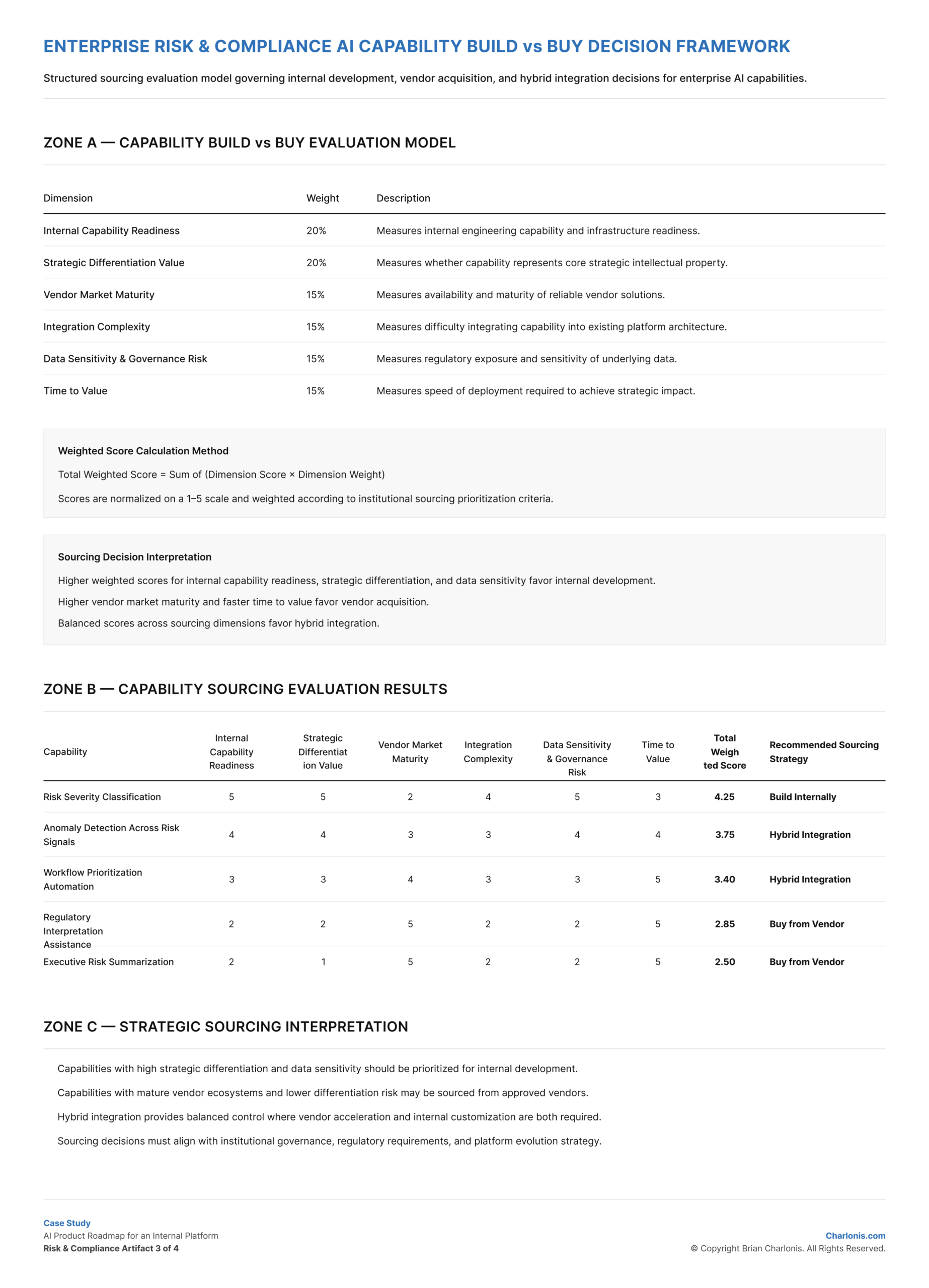
- Treated sourcing as a product strategy decision, using Build-vs-Buy logic to distinguish capabilities requiring internal control from those where vendor acceleration could be appropriate.
- Sequenced capabilities through phased implementation logic, aligning roadmap progression to platform maturity, governance readiness, sourcing strategy, and workflow value.
- Protected institutional differentiation by identifying which intelligence capabilities should remain internally governed because they affected strategic knowledge, risk judgment, or enterprise control.
- Translated executive AI ambition into implementation-ready planning logic, connecting capability investment to ownership, integration, governance, and phased system evolution.
SOLUTION
The solution was an enterprise AI capability operating model structured across opportunity identification, prioritization, sourcing strategy, and phased implementation.
It defined where AI should be applied, how investments should be evaluated, which capabilities should remain institutionally controlled, and how AI-enabled workflows could evolve across risk and compliance functions.
The solution connected four capability-planning questions:
- Where could AI create meaningful workflow value across risk and compliance?
- Which capabilities should be prioritized for investment?
- Which capabilities should be built internally, bought from vendors, or delivered through hybrid models?
- How should capability implementation be sequenced against governance readiness and platform maturity?
Together, these components created a governance-aligned roadmap for moving from fragmented AI experimentation toward coordinated risk and compliance platform evolution.
AI Capability Opportunity Landscape
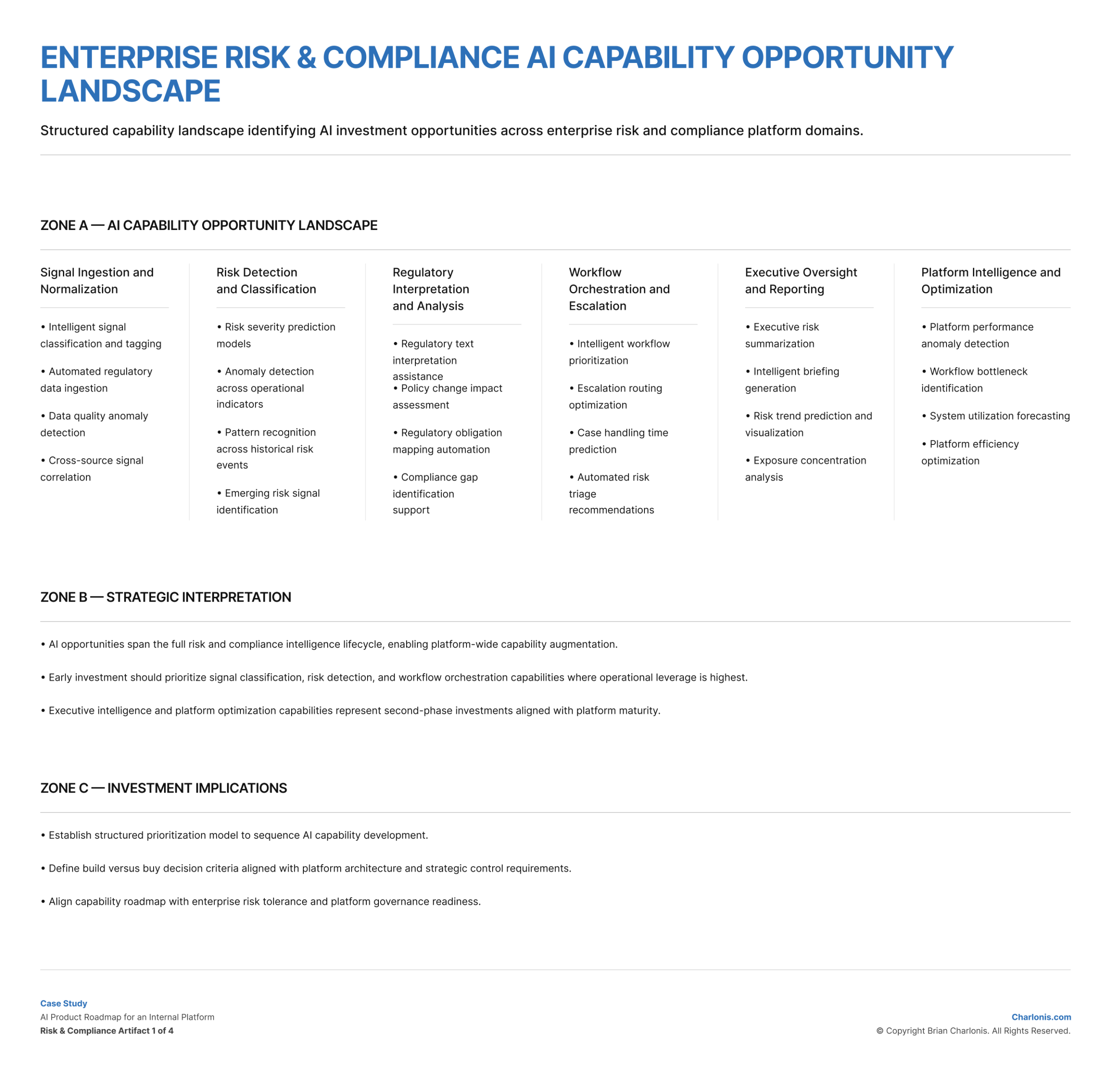
The opportunity landscape organized the AI capability universe across risk and compliance platform domains. It established where AI could support signal ingestion, risk detection, regulatory interpretation, workflow orchestration, executive reporting, and platform optimization, creating a shared view of potential value before investment decisions were made.
Key Elements
- Signal ingestion and normalization.
- Risk detection and classification.
- Regulatory interpretation and analysis.
- Workflow orchestration and escalation.
- Executive oversight, reporting, and platform optimization.
Artifact type: Capability landscape model.
The artifact mapped AI opportunity areas across risk and compliance platform domains and made the capability universe visible for prioritization and roadmap planning.
How It Shaped Decisions
This component would support risk, compliance, operations, technology, and executive stakeholders in determining where AI could create workflow value and where opportunities overlapped. It reduced ambiguity in the capability model and clarified how fragmented or redundant investment could be avoided.
AI Capability Prioritization Model
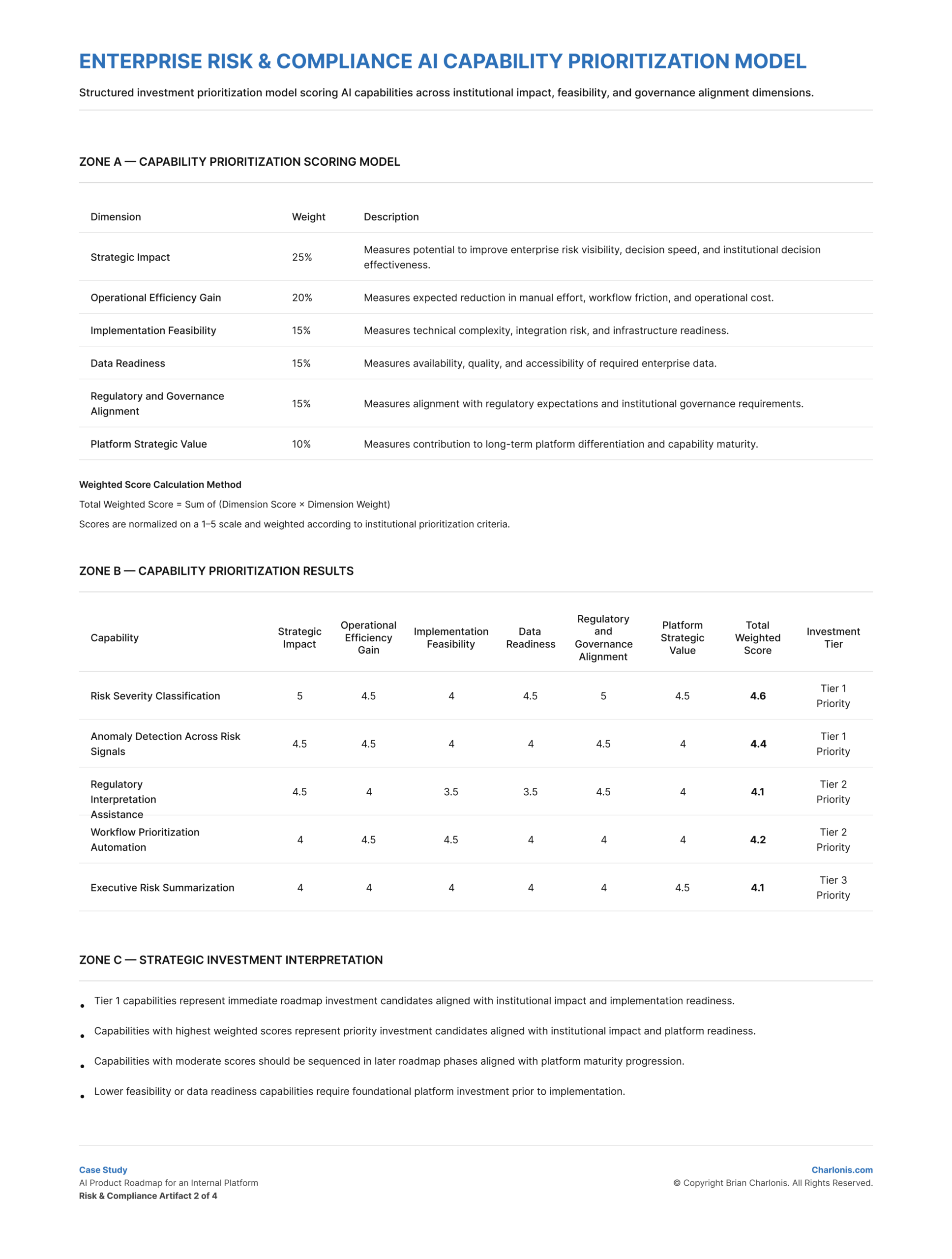
The prioritization model converted AI opportunity selection from subjective interest into structured investment logic. It evaluated capabilities across strategic impact, operational efficiency, feasibility, data readiness, regulatory alignment, and platform value so leadership could compare opportunities using shared criteria.
Key Elements
- Weighted capability scoring.
- Strategic impact and operational efficiency criteria.
- Implementation feasibility and data-readiness assessment.
- Regulatory and governance alignment.
- Platform strategic value.
Artifact type: Capability prioritization model.
The artifact showed how AI capabilities could be scored and tiered to support investment sequencing and executive decision-making.
How It Shaped Decisions
This component would support portfolio leaders, product teams, governance stakeholders, and executive sponsors in determining which capabilities should be funded and developed first. It clarified priority tiers and helped align AI investment with institutional value, governance readiness, and platform strategy.
AI Capability Build-vs-Buy Decision Framework
The capital allocation model connected funding eligibility to risk tier, governance readiness, validation preparedness, control maturity, vendor transparency, monitoring readiness, and regulatory sensitivity. It treated capital release as a governance control, ensuring that promising AI initiatives could not move forward on business-case appeal alone.
Key Elements
- Governance readiness scoring.
- Tier-based funding gate flow.
- Conditional approval thresholds.
- Remediation requirements before capital release.
- Capital escalation and control triggers.
Artifact type: Funding gate and governance-readiness model.
The artifact showed how governance readiness scoring, funding rules, executive review, and control triggers could be connected before capital allocation.
How It Shaped Decisions
This component would support capital committee review, AI Standards Council oversight, and executive funding decisions by clarifying when initiatives were eligible for capital, conditionally approved, remediated, escalated, paused, or restricted. It made funding eligibility dependent on governance readiness rather than urgency, enthusiasm, or isolated technical promise.
Phased AI Capability Roadmap
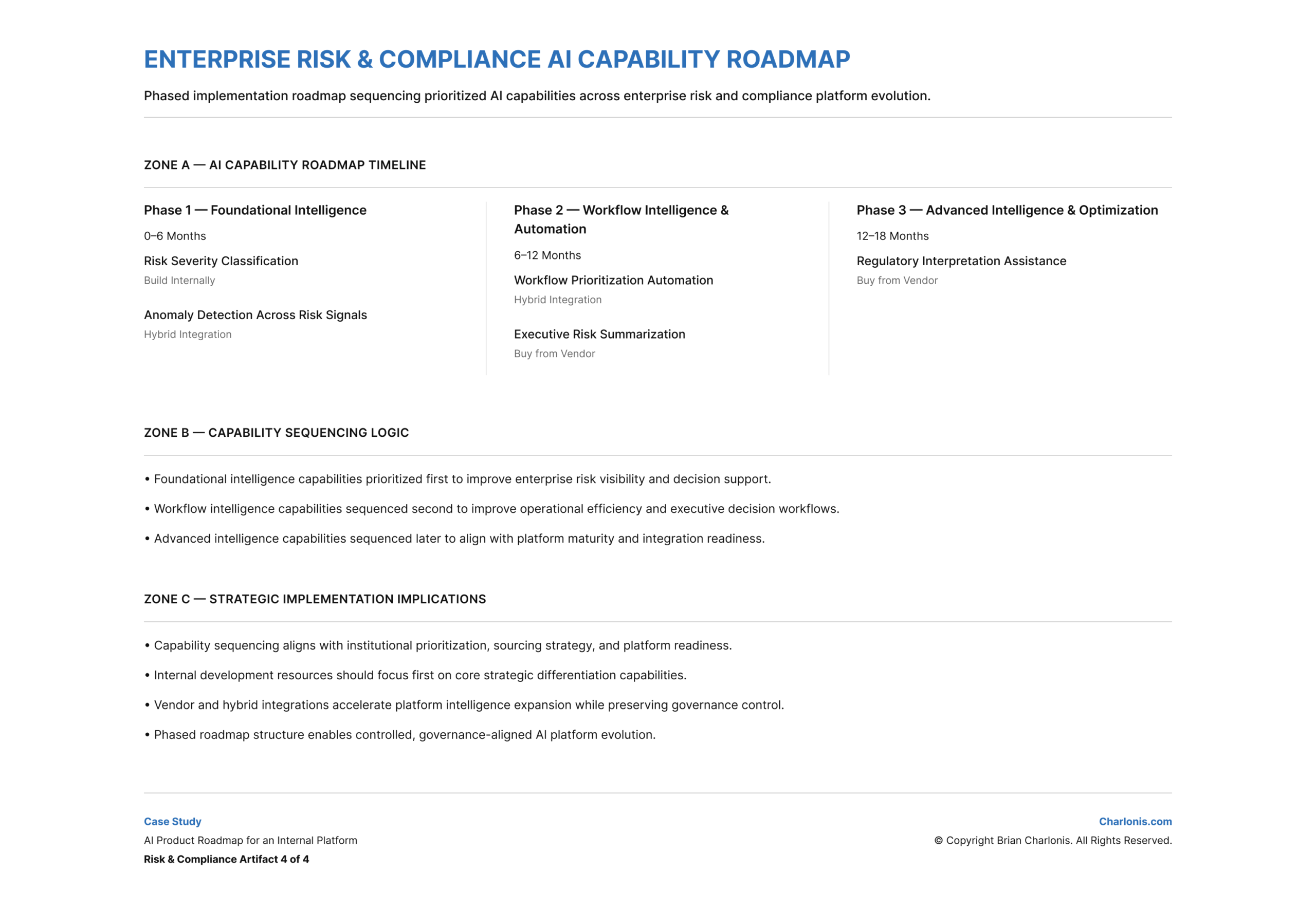
The roadmap sequenced AI capability development across phased platform evolution, aligning capability introduction to governance constraints, workflow readiness, data maturity, sourcing strategy, and platform maturity. It provided a controlled path for moving from foundational intelligence toward workflow intelligence, automation, and advanced optimization.
Key Elements
- Phase 1: Foundational Intelligence.
- Phase 2: Workflow Intelligence and Automation.
- Phase 3: Advanced Intelligence and Optimization.
- Sequencing based on governance readiness and platform maturity.
- Alignment to workflow ownership, oversight, and sourcing strategy.
Artifact type: Phased roadmap timeline.
The artifact showed how AI capabilities could be sequenced over time based on readiness, governance constraints, sourcing decisions, and platform evolution.
How It Shaped Decisions
This component would support executive sponsors, technology teams, product leaders, and implementation stakeholders in determining when capabilities should be introduced and which dependencies needed to be resolved first. It clarified that advanced automation should not be sequenced before workflow ownership, oversight conditions, data readiness, and governance controls were defined.
TRADEOFFS & DECISIONS
High-Impact Use Cases vs Broad Experimentation
- Tradeoff: The institution could pursue many AI experiments across risk and compliance, but broad experimentation risked duplicated investment, inconsistent controls, and unclear ownership.
- Response: I prioritized high-impact, regulatorily relevant use cases over exploratory AI experimentation, creating clearer investment focus while limiting broader experimentation in the near term.
Internal Control vs Vendor Acceleration
- Tradeoff: Vendors could accelerate capability development, but overreliance on external platforms could expose strategic institutional intelligence, sensitive data, and critical workflow logic.
- Response: I used Build-vs-Buy criteria to distinguish capabilities that should remain internally controlled from lower-risk areas where vendor acceleration or hybrid integration could be appropriate.
Roadmap Ambition vs Implementation Readiness
- Tradeoff: Advanced AI capabilities could create significant value, but sequencing them before workflow ownership, data readiness, and governance conditions were established could increase implementation risk.
- Response: I sequenced capabilities across phases so foundational intelligence came before workflow automation and advanced optimization, aligning ambition to platform maturity and governance readiness.
Product Value vs Governance Constraint
- Tradeoff: AI capability value depended on workflow improvement, but risk and compliance environments require regulatory alignment, oversight, data control, and clear escalation logic.
- Response: I made governance and regulatory alignment part of prioritization and sequencing rather than treating them as downstream review gates.
OUTCOMES
This case produced a governance-aligned AI capability roadmap, four planning artifacts, and decision-ready logic for opportunity identification, prioritization, sourcing, and implementation sequencing. It was developed as an independent conceptual enterprise strategy case and does not claim production deployment, institutional adoption, measured workflow improvement, vendor execution, or realized financial outcomes.

Impact Summary
- Established a structured basis for AI investment decisions across risk and compliance capabilities.
- Created a prioritization model for comparing capability value, feasibility, data readiness, governance alignment, and platform strategy.
- Clarified sourcing discipline for internal build, vendor adoption, and hybrid integration decisions.
- Sequenced AI capability development against governance readiness, platform maturity, and workflow value.
- Strengthened implementation readiness by connecting roadmap decisions to ownership, sourcing, and control conditions.

Evidence
- AI Capability Opportunity Landscape defined the institutional AI capability universe across risk and compliance platform domains.
- AI Capability Prioritization Model established weighted criteria for investment comparison and capability sequencing.
- AI Capability Build-vs-Buy Decision Framework defined sourcing criteria for internal development, vendor adoption, and hybrid integration.
- AI Capability Roadmap Timeline sequenced phased implementation against governance readiness, platform maturity, and sourcing strategy.
- The roadmap prioritized high-impact, regulatorily relevant use cases over broad AI experimentation.
- The model defined decision logic for protecting strategic institutional intelligence while using external solutions where governance exposure was lower.

Signals Monitored
- Capability-prioritization score differentiation.
- Internal capability readiness versus vendor maturity.
- Governance and sourcing exposure across capability options.
- Platform, workflow, and roadmap readiness for advanced intelligence capabilities.

Decision Thresholds
- Keep strategically differentiated institutional intelligence under internal control.
- Use vendor solutions where differentiation risk and governance exposure are lower.
- Use hybrid integration where external acceleration and internal control are both necessary.
- Do not advance automation before workflow ownership, data readiness, governance readiness, and oversight conditions are sufficiently defined.
Brian completed the capability landscape, prioritization logic, sourcing framework, and phased roadmap that could support implementation planning and executive decision-making. Platform implementation, model deployment, vendor contracting, engineering delivery, production measurement, institutional adoption, and realized operational outcomes remained outside the scope of the case.
LEADERSHIP REFLECTION
What This Case Demonstrates
- AI product strategy becomes more executable when opportunities are translated into capability domains, investment criteria, sourcing logic, and roadmap sequencing.
- Roadmapping can operate as a governance mechanism when it structures what should be prioritized, owned, sourced, delayed, or constrained.
- Build-vs-Buy decisions are strategic product decisions when they affect institutional intelligence, data control, differentiation, and implementation risk.
- AI-enabled workflow modernization requires sequencing discipline so capability ambition does not move faster than governance readiness or platform maturity.
What I Would Validate Next
- Whether capability priority scores remain stable when tested against real workflow volume, data quality, and operational pain points.
- Whether internal capability readiness is strong enough for strategically controlled intelligence layers.
- Whether vendor maturity and integration complexity support the recommended sourcing paths.
- Whether roadmap phases align with actual platform engineering capacity and governance-review cadence.
What I Would Watch Closely
- Roadmap sequencing becoming a capability wish list rather than an investment decision system.
- Vendor adoption outpacing data-control, governance, and integration readiness.
- Advanced automation being introduced before workflow ownership and escalation paths are clear.
The central challenge was not whether the institution could identify promising AI use cases.
It was whether the organization could translate those opportunities into governed capability priorities, sourcing decisions, and phased implementation logic without allowing fragmented experimentation to become redundant investment or unmanaged operating complexity.
RECOMMENDED

CASE STUDY
AI VALUE CREATION
AI-Augmented Insurance Brokerage Operating Model
Structured an AI-augmented brokerage workflow model to reduce agent administrative burden by separating automatable support tasks from licensed judgment, then turning reviewed customer interactions into governed intelligence for frontline, operational, partner, and leadership decisions.
AI Transformation
Business Solutions Strategy
Workflow Coordination

CASE STUDY
DATA & RESPONSIBLE AI GOVERNANCE
Operationalizing Data & Responsible AI Governance Across a Global Enterprise
Defined a Data and Responsible AI Governance operating model connecting risk-tiered intake, accountable business ownership, cross-functional controls, lifecycle oversight, reassessment, and executive visibility without routing every AI decision through one centralized approval bottleneck.
Data & Responsible AI Governance
Lifecycle Governance
Decision Rights

CASE STUDY
INSTITUTIONAL GOVERNANCE
Enterprise Governance & Policy Architecture for AI Systems
Structured an AI portfolio investment system for a multi-product fintech, using capability sequencing, staged funding, evidence thresholds, and executive decision logic to determine which AI initiatives should be funded, combined, constrained, accelerated, paused, stopped, or rebalanced.
AI Governance
Enterprise Decision Systems
Capital Discipline

CASE STUDY
STRATEGIC OPERATING MODEL
Building a Governed Intelligence Operating System
A governed AI-assisted intelligence system designed, implemented, and operated to turn fragmented signals, evidence, and professional knowledge into structured decisions, accountable execution, reviewed artifacts, and controlled learning.
Decision Systems
AI Strategy
Enterprise Operating Models
Is Your AI Roadmap a Strategy or Just a List of Ideas?
I help regulated enterprises translate AI opportunities into governed capability roadmaps, sourcing decisions & implementation sequences that modernize risk and compliance workflows without creating fragmented investment or uncontrolled platform growth.