
Bitcoin Full Node Operation & Mining Analysis
Operating Bitcoin validation and mining infrastructure to understand network participation, proof-of-work incentives, hashrate, mining-pool dynamics, observability, and decentralized trust through firsthand technical experience
Blockchain Infrastructure
Bitcoin Full Node
Mining Analysis
BLOCKCHAIN INFRASTRUCTURE
Web3 Technical Lab Lead
Brian operated a Bitcoin full node and home-scale miner to understand how network validation, proof-of-work mining, mining pools, hashrate, difficulty, reward mechanics, and residential infrastructure constraints interact in practice. The work focused on direct participation, system observability, device-level monitoring, pool-side validation, longitudinal performance evidence, and disciplined learning decisions.
An Independent Technical Lab examined how Bitcoin infrastructure behaves when full-node operation, home-scale mining, mining-pool participation, and reward attribution are observed directly rather than studied only through market narratives or technical descriptions. Brian produced four evidence artifacts: FutureBit Apollo II Node and Miner Dashboards, DeepSea Analytics Dashboard, Hashrate History CSV Export, and Ocean.xyz Account Dashboard. These clarified the distinction between full-node validation and mining participation, the relationship between local hashrate and pool-level reward attribution, and the limits of residential mining once the learning objectives had been met.
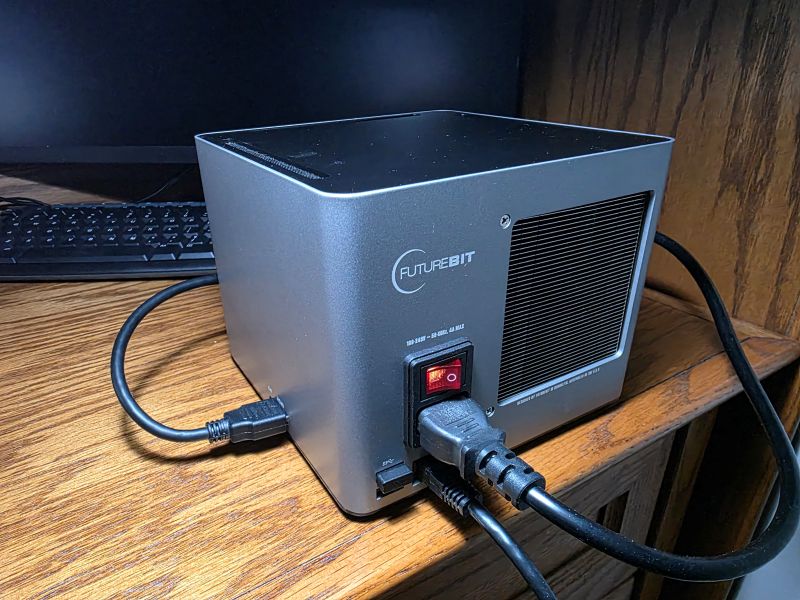
Futurebit Apollo II BTC Full Node & Miner
CHALLENGE
Bitcoin is often discussed through price, mining profitability, and decentralization narratives, but those discussions can remain abstract without direct experience operating the infrastructure.
A full node, miner, and mining-pool connection provide different forms of network participation. Understanding how they interact requires observing validation, hashrate, network difficulty, reward attribution, and operating stability directly.
Small-scale Bitcoin mining is also frequently framed as accessible participation in decentralization. In practice, individual operators face opaque economics, scale disadvantages, reward variance, power constraints, and infrastructure friction.
The challenge was whether direct participation could turn abstract concepts, including network validation, proof of work, hashrate, difficulty, mining pools, and incentives, into practical infrastructure understanding.
The opportunity was to participate in the network firsthand and translate that experience into stronger infrastructure literacy, technical communication, and strategic judgment.
Key Drivers
- Need to understand Bitcoin network validation firsthand.
- Need to distinguish the role of a full node from the role of a miner.
- Need to understand how mining pools connect individual hashrate to network participation.
- Need to observe hashrate, difficulty, reward accumulation, and operating stability directly.
- Need to test common assumptions about home-scale mining against real operating evidence.
- Need to understand the economic limits of residential mining as a finding, not as the starting assumption.
Strategic Question
How could direct participation in Bitcoin infrastructure improve understanding of full-node validation, proof-of-work mining, mining-pool dynamics, network difficulty, and decentralized trust?
This required more than researching Bitcoin infrastructure. It required a bounded operating lab where node behavior, miner performance, mining-pool validation, reward velocity, and residential constraints could be observed together and interpreted through evidence.
MY ROLE
I led the experiment as Web3 Technical Lab Lead, setting up and operating the full node and miner, configuring the monitoring environment, validating device output against pool activity, and documenting how network, mining, and reward mechanics behaved in practice.
I defined learning objectives before operation and used observed evidence to determine when the experiment had produced enough clarity. The decision to stop mining followed from the findings, but the primary objective was infrastructure understanding rather than investment performance.
I treated the lab as a structured learning and decision system. The technical work was not the outcome by itself. It was the evidence used to build stronger judgment about decentralized networks, proof-of-work participation, mining incentives, infrastructure observability, and technical communication.
My responsibilities included:
- Setting up and operating a Bitcoin full node.
- Setting up and operating a home-scale Bitcoin miner.
- Connecting mining activity to pool-level participation evidence.
- Monitoring hashrate, difficulty, uptime, reward velocity, and operating stability.
- Comparing device-level output with pool-side evidence.
- Translating operating evidence into infrastructure and strategy judgment.
This lab demonstrates hands-on Bitcoin infrastructure literacy, full-node operation, home-scale mining analysis, observability design, pool validation, and evidence-based learning discipline. It does not claim profitable mining, professional mining operations, protocol engineering, institutional deployment, investment advice, production infrastructure operations, or enterprise mining architecture ownership.
Engagement at a Glance
Brian’s Scope
Brian operated a FutureBit Apollo II Bitcoin full node and miner, configured monitoring, observed node and mining behavior, exported performance data, validated hardware output against Ocean.xyz pool activity, and used the evidence to evaluate network participation, mining incentives, reward velocity, residential constraints, and the decision to stop operation once additional learning value declined.
HOW I LED THE WORK
- Framed the lab as direct participation before abstraction, using real node operation, miner behavior, and pool validation to ground strategic understanding in observed infrastructure evidence.
- Separated full-node validation from mining participation, documenting how each role contributed differently to Bitcoin network participation and decentralized trust.
- Built observability before interpretation, using device dashboards, DeepSea monitoring, hashrate history, and pool evidence to avoid relying on isolated readings or projection assumptions.
- Compared local output with pool-side activity, validating whether hardware-level mining behavior translated into submitted work, reward accumulation, and actual pool participation.
- Treated economics as a secondary finding, evaluating reward velocity, power constraints, difficulty, and residential infrastructure limits without turning the lab into an investment-performance case.
- Used longitudinal evidence to support judgment, exporting hashrate history and reviewing sustained performance rather than over-weighting snapshot readings.
- Closed the experiment based on decision value, preserving the infrastructure learning while stopping mining once additional operation no longer produced meaningful new insight.
SOLUTION
The solution was a controlled Bitcoin infrastructure participation lab structured around full-node operation, home-scale mining, monitoring visibility, longitudinal performance evidence, mining-pool validation, reward attribution, and disciplined learning thresholds.
The solution connected four infrastructure learning questions:
- What role does a full node play in Bitcoin network participation and validation?
- How does a home-scale miner contribute proof of work through a mining pool?
- How do hashrate, difficulty, uptime, and reward accumulation relate over time?
- What does direct operation reveal about decentralized trust, network scale, and home-mining constraints?
Together, these components created a layered view of Bitcoin participation from local infrastructure through monitoring signals to pool-level rewards.
FutureBit Apollo II Node and Miner Dashboards
The FutureBit Apollo II dashboards made full-node operation and home-scale mining activity visible in one environment. They helped clarify how network validation, mining participation, residential infrastructure, and device-level monitoring worked together in practice.
Key Elements
- Full-node operation.
- Home-scale proof-of-work mining.
- Node and miner operation in one environment.
- Standard 110V residential power deployment.
- Hardwired Ethernet connectivity for stability.
- Device-level operating visibility.
Artifact type: Dashboard / infrastructure evidence.
The artifact captured device-level performance, full-node status, miner operating visibility, residential infrastructure constraints, and local participation in the Bitcoin network.
How It Shaped Decisions
This component clarified that full-node validation and mining participation are related but distinct forms of Bitcoin infrastructure participation. It also showed that participation literacy does not automatically translate into economic viability.
Futurebit Apollo II BTC Full Node & Miner
DeepSea Analytics Dashboard
The DeepSea Analytics Dashboard provided real-time observability into mining performance. It helped interpret hashrate, difficulty, uptime, stability, and operating behavior as dynamic signals rather than static hardware specifications.
Key Elements
- Real-time hashrate monitoring.
- Mining difficulty visibility.
- Miner behavior observation.
- Uptime and stability monitoring.
- Performance signal interpretation.
- Operating evidence instead of projection assumptions.
Artifact type: Observability dashboard / mining performance evidence.
The artifact provided real-time monitoring of hashrate, difficulty, and mining performance, making operating signals visible during the lab.
How It Shaped Decisions
This component showed that hashrate alone did not explain mining participation. Local output had to be interpreted alongside network difficulty, uptime, pool conditions, reward context, and the distinction between node operation and mining activity.
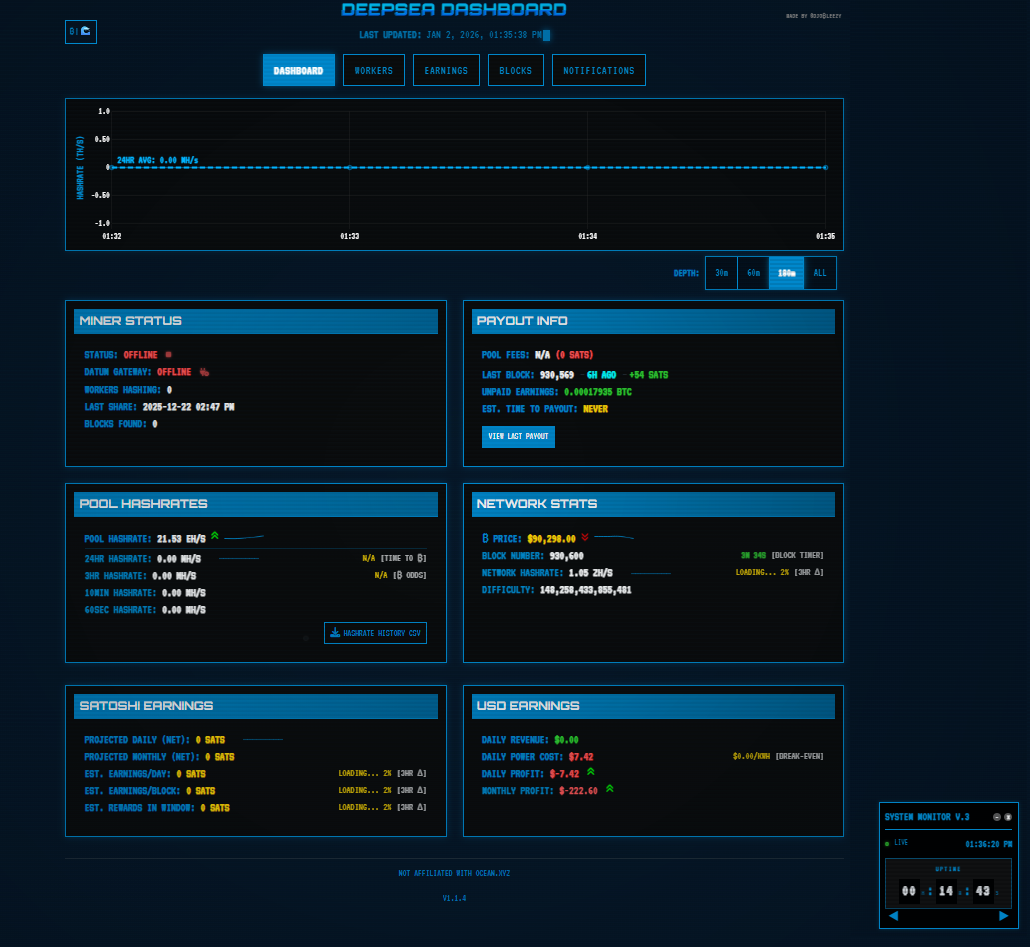
DeepSea Dashboard
Hashrate History CSV Export
The Hashrate History CSV Export captured longitudinal performance evidence across the operating window. It helped avoid relying on isolated dashboard readings by showing how home-scale mining output behaved over time.
Key Elements
- Hashrate history capture.
- Longitudinal performance review.
- Sustained output validation.
- Comparison of short-term readings against operating history.
- Evidence-based interpretation of home-scale performance.
- Structured performance documentation.
Artifact type: Dataset / performance evidence.
The artifact captured longitudinal hashrate performance across the operating window and supported sustained performance analysis.
How It Shaped Decisions
This component supported a more reliable interpretation of mining behavior than single-moment readings or promotional hardware specifications. It reinforced that decentralized infrastructure should be evaluated through longitudinal signals before conclusions are drawn about participation, stability, or continuation.

Hashrate History CSV Export
Ocean.xyz Account Dashboard
The Ocean.xyz Account Dashboard validated pool participation and reward attribution. It connected local mining activity to submitted work, pool participation, accrued BTC, and reward accumulation velocity.
Key Elements
- Ocean.xyz pool participation.
- Local hashrate connection to pool activity.
- Reward accumulation visibility.
- Pool-level validation of mining output.
- Comparison of hardware activity against accrued BTC.
- Economic limits of home-scale mining as a secondary finding.
Artifact type: Pool dashboard / reward validation evidence.
This component made the relationship among local mining activity, pool participation, and reward attribution tangible. It supported the conclusion that the lab succeeded as a learning system even though continued home-scale mining did not justify additional operation once the learning objectives had been met.
How It Shaped Decisions
This component showed that hashrate alone did not explain mining participation. Local output had to be interpreted alongside network difficulty, uptime, pool conditions, reward context, and the distinction between node operation and mining activity.
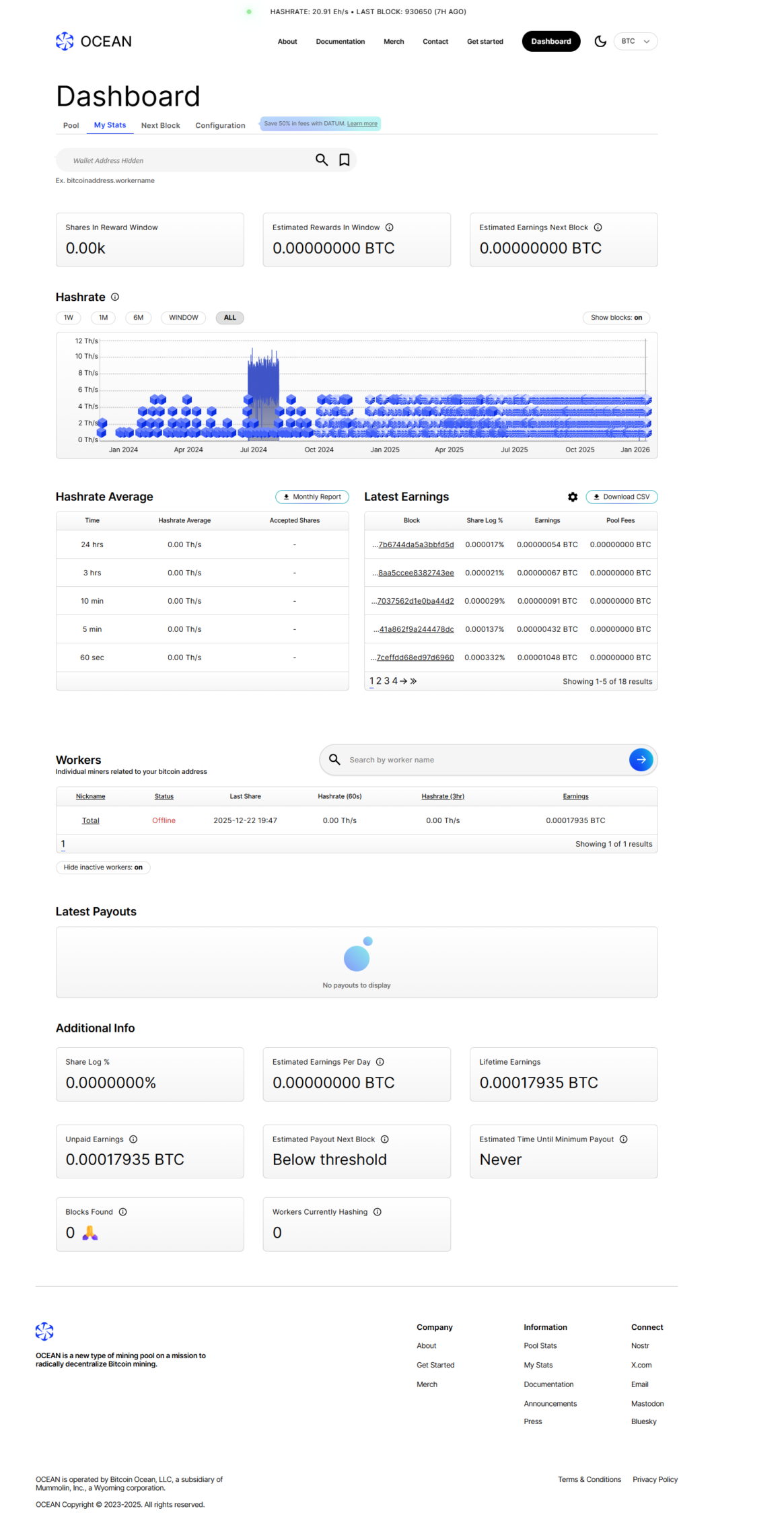
Ocean.xyz Dashboard
TRADEOFFS & DECISIONS
Full-Node Participation vs Mining Participation
- Tradeoff: Running both components increased learning value, but also created the risk of conflating node validation with mining.
- Response: I documented the role of each component separately and observed how they interacted in the operating environment.
Home-Scale Participation vs Network Scale
- Tradeoff: Home-scale mining enabled direct participation, but represented negligible capacity relative to industrial network scale.
- Response: I used local operation to build network and consensus literacy without treating residential performance as representative of professional mining economics.
Snapshot Readings vs Longitudinal Evidence
- Tradeoff: Short-term performance readings could appear sufficient, but infrastructure understanding required evidence across time.
- Response: I exported hashrate history and evaluated sustained performance instead of relying on isolated readings.
Learning Value vs Economic Continuation
- Tradeoff: The experiment continued to produce some learning value even after the economic limitations became clear.
- Response: I separated the success of the learning objective from the viability of continued mining operation and stopped once additional operation no longer produced meaningful infrastructure insight.
OUTCOMES
This independent lab produced firsthand Bitcoin infrastructure evidence, full-node operation experience, home-scale mining analysis, observability artifacts, pool validation, reward-attribution evidence, and network participation learning. The outcomes describe technical literacy, measured operating evidence, and strategic interpretation produced through the lab. They do not claim profitable mining, investment performance, professional mining operations, protocol engineering, institutional deployment, or production infrastructure operations.

Impact Summary
- Built firsthand understanding of Bitcoin full-node operation, proof-of-work mining, and pool participation.
- Clarified the distinct roles of network validation, mining, and reward attribution.
- Developed practical literacy in hashrate, network difficulty, uptime, and mining-pool dynamics.
- Improved ability to communicate with developers and infrastructure specialists about Bitcoin network mechanics.
- Replaced abstract assumptions about home-scale mining with measured operating evidence.

Evidence
- FutureBit Apollo II Node and Miner Dashboards captured device-level performance, full-node status, and miner operating visibility.
- DeepSea Analytics Dashboard provided real-time monitoring of hashrate, difficulty, and mining performance.
- Hashrate History CSV Export captured longitudinal performance data across the operating window.
- Ocean.xyz Account Dashboard validated pool participation, accrued BTC, and reward accumulation velocity.
- Observed 5 to 7 TH/s sustained performance during the operating window.
- Accrued 0.00017935 BTC through pool participation, with no payout taken.

Signals Monitored
- Hashrate consistency and sustained output.
- Network difficulty trend and mining performance context.
- Reward velocity and pool reward accumulation.
- Node, miner, network, and residential infrastructure stability.

Decision Thresholds
- Continue while operation produced new insight into node, miner, pool, or network behavior.
- Continue until local output could be validated against pool-level evidence.
- Stop once recurring operation no longer produced additional infrastructure understanding.
- Separate technical learning success from mining profitability or economic continuation.
Brian completed the Bitcoin full-node and mining lab, captured device and monitoring evidence, exported longitudinal hashrate data, validated reward accumulation against pool activity, and translated direct operation into broader Web3 infrastructure literacy. Profitable mining, investment performance, professional mining operations, protocol engineering, institutional deployment, production infrastructure operations, and enterprise mining architecture ownership remained outside the scope of the lab.
LEADERSHIP REFLECTION
What This Case Demonstrates
- Full-node operation and mining participation are related but distinct forms of Bitcoin infrastructure participation.
- Full nodes matter because they make independent validation part of the trust model.
- Proof-of-work incentives become easier to understand when local mining activity can be traced to pool-level reward attribution.
- Measured system output is more reliable than projection optimism.
What I Would Validate Next
- Node synchronization, peer, and validation metrics more systematically.
- Node and miner roles separately from the beginning.
- Direct power consumption with a dedicated meter.
- Pool-side and device-side data at a more granular interval.
What I Would Watch Closely
- Bitcoin infrastructure being discussed only through price or profitability narratives.
- Node validation and mining participation being conflated.
- Learning value being used to justify continued unfavorable operation.
The central challenge was not whether a Bitcoin full node and miner could be operated.
It was whether direct participation could turn abstract concepts, including network validation, proof of work, hashrate, difficulty, mining pools, and incentives, into practical infrastructure understanding.
RECOMMENDED

CASE STUDY
BLOCKCHAIN INFRASTRUCTURE
Testing Smart Contracts to Understand Trust, Risk, & Governance
Built and operated private Ethereum environments, created genesis blocks, mined native ETH, deployed Solidity contracts, tested transaction execution, observed gas behavior and state changes, and translated hands-on execution testing into trust-boundary, product, risk, and governance judgment.
Smart Contracts
Blockchain Infrastructure
Execution Literacy

CASE STUDY
SETTLEMENT INFRASTRUCTURE
Designing a Capital-Efficient Cross-Border Settlement Strategy Using XRPL
Structured a corridor-level treasury evaluation model comparing correspondent settlement with XRPL-based alternatives across trapped capital, liquidity depth, volatility exposure, regulatory posture, corridor economics, and governed pilot thresholds.
Settlement Strategy
Treasury Infrastructure
XRPL Settlement Evaluation

CASE STUDY
DATA & RESPONSIBLE AI GOVERNANCE
Operationalizing Data & Responsible AI Governance Across a Global Enterprise
Defined a Data and Responsible AI Governance operating model connecting risk-tiered intake, accountable business ownership, cross-functional controls, lifecycle oversight, reassessment, and executive visibility without routing every AI decision through one centralized approval bottleneck.
Data & Responsible AI Governance
Lifecycle Governance
Decision Rights

CASE STUDY
AI VALUE CREATION
AI-Augmented Insurance Brokerage Operating Model
Structured an AI-augmented brokerage workflow model to reduce agent administrative burden by separating automatable support tasks from licensed judgment, then turning reviewed customer interactions into governed intelligence for frontline, operational, partner, and leadership decisions.
AI Transformation
Business Solutions Strategy
Workflow Coordination
Conviction is earned through disciplined experimentation.
If you are evaluating Web3 infrastructure, digital asset participation or decentralized network strategy, let’s connect on LinkedIn.