
Designing a Capital-Efficient Cross-Border Settlement Strategy Using XRPL
Structuring how alternative settlement infrastructure could be evaluated against capital compression, liquidity requirements, volatility exposure, corridor economics, treasury controls, and governed pilot thresholds.
Settlement Strategy
Treasury Infrastructure
XRPL Settlement Evaluation
SETTLEMENT INFRASTRUCTURE
Conceptual Transformation Scenario
Web3 & Payments Strategy Lead
Brian structured a corridor-level settlement evaluation model for assessing whether XRPL-based settlement infrastructure could improve treasury capital efficiency while preserving liquidity control, volatility discipline, regulatory alignment, operational oversight, and executive risk discipline. The work focused on liquidity fragmentation, correspondent banking constraints, bridge-asset exposure, corridor qualification, governance thresholds, and pilot-readiness logic.
A Multinational Corporate Treasury examined whether alternative settlement infrastructure could reduce trapped liquidity and settlement latency across high-volume cross-border corridors without compromising treasury control or expanding institutional risk. Brian created four artifacts: a Cross-Border Liquidity Fragmentation Model, Comparative Settlement Architecture Model, Capital Efficiency and Volatility Exposure Model, and Governed Corridor Adoption Framework, that clarified how treasury leadership could evaluate capital efficiency, liquidity depth, exposure windows, regulatory posture, corridor economics, and adoption gates before pilot consideration.

CHALLENGE
Cross-border settlement processes relied on multi-step intermediary networks, pre-funded accounts, and delayed reconciliation across jurisdictions.
These structures introduced capital inefficiencies, operational latency, and limited transparency into settlement status, liquidity exposure, and working capital utilization.
Emerging blockchain-based settlement models, including XRPL, introduced the potential for near real-time settlement and reduced reliance on pre-funded liquidity. However, treasury leadership could not evaluate alternative rails based on speed alone.
Any settlement modernization strategy needed to account for capital allocation, liquidity depth, corridor economics, regulatory posture, operational control, and risk exposure.
The challenge was this created a structural gap between legacy settlement systems and liquidity-efficient infrastructure alternatives. Leadership needed a structured way to determine whether alternative settlement mechanisms could improve capital efficiency without introducing regulatory risk, operational disruption, or loss of control over treasury liquidity management.
The opportunity was to design a settlement evaluation model that helped treasury leadership assess liquidity fragmentation, compare settlement architectures, model capital efficiency against settlement exposure, and define corridor-level adoption gates.
Key Drivers
- Capital inefficiency driven by pre-funded nostro and vostro account structures.
- Settlement latency across intermediary banking networks.
- Limited transparency into real-time settlement status and liquidity exposure.
- Working capital tied up across high-volume corridors.
- Regulatory and compliance requirements governing cross-border financial flows.
- Need to evaluate bridge-asset liquidity depth before corridor pilot consideration.
Strategic Question
How could a multinational corporate treasury evaluate alternative settlement infrastructure as a capital-efficient alternative to correspondent banking while preserving liquidity control, volatility discipline, regulatory alignment, and corridor-level adoption governance?
This required more than evaluating blockchain transaction speed. It required a treasury decision model for determining where liquidity could be trapped, whether bridge-asset exposure was tolerable, which corridors could qualify, and what governance thresholds would prevent broader exposure before corridor readiness was established.
MY ROLE
I served as Web3 and Payments Strategy Lead, responsible for structuring a disciplined evaluation of digital asset-based settlement alternatives within a corporate treasury modernization context.
My role focused on translating blockchain settlement mechanics into capital efficiency models, volatility exposure analysis, corridor qualification criteria, liquidity-depth requirements, and governed adoption thresholds.
I framed the opportunity as a treasury decision system, aligning liquidity efficiency, regulatory posture, operational control, and executive risk oversight before any pilot decision could advance.
My responsibilities included:
- Modeling corridor-level capital efficiency and liquidity fragmentation.
- Comparing correspondent banking flows with alternative settlement flows.
- Evaluating settlement exposure windows and volatility risk.
- Defining bridge-asset liquidity depth qualification criteria.
- Structuring corridor qualification and disqualification thresholds.
- Designing governance gates for pilot evaluation.
This case demonstrates independent Web3 and payments strategy, treasury modernization analysis, corridor qualification design, bridge-asset risk evaluation, liquidity-depth analysis, and governance threshold definition. It does not claim production implementation, regulatory approval authority, treasury investment authorization, XRP custody ownership, technical architecture ownership, realized capital savings, measured financial performance, transaction volume, institutional adoption, or long-term settlement operations.
Engagement at a Glance
Brian’s Scope
Brian designed the settlement evaluation model for assessing capital efficiency, liquidity fragmentation, settlement architecture alternatives, bridge-asset exposure, volatility tolerance, liquidity-depth requirements, corridor qualification, regulatory posture, and governed pilot thresholds that could support treasury leadership and executive risk review.
HOW I LED THE WORK
- Framed settlement modernization as a treasury capital-efficiency decision, using liquidity control, working capital constraints, volatility discipline, and regulatory posture to move beyond blockchain speed as the primary question.
- Started with liquidity fragmentation before alternative rails, modeling where idle capital, pre-funded accounts, and exposure windows could create material treasury constraints.
- Compared correspondent banking and XRPL-based settlement flows, evaluating differences across capital structure, execution timing, counterparty exposure, operational control, and reconciliation visibility.
- Modeled capital compression against bridge-asset risk, treating potential liquidity efficiency as meaningful only when exposure windows, volatility tolerance, and liquidity depth remained within treasury thresholds.
- Defined corridor qualification logic, recognizing that adoption should be evaluated corridor by corridor rather than through broad enterprise-wide exposure.
- Used disqualification triggers as governance controls, ensuring that regulatory ambiguity, insufficient liquidity depth, excessive volatility exposure, or weak operational control could stop pilot evaluation.
- Translated settlement strategy into executive decision logic, giving treasury leadership a structured way to decide which corridors warranted further evaluation, which should remain out of scope, and which conditions needed monitoring.
SOLUTION
The solution was a corridor-level treasury settlement evaluation model structured around liquidity fragmentation, settlement architecture comparison, capital efficiency, volatility exposure, bridge-asset liquidity depth, corridor qualification, governance thresholds, and pilot-readiness logic.
The solution connected four settlement questions:
- Where could idle capital be trapped across correspondent settlement corridors?
- How did alternative settlement infrastructure compare with existing correspondent banking flows across capital structure, execution timing, counterparty exposure, and operational control?
- When could modeled capital-efficiency benefits justify bridge-asset exposure, volatility risk, and liquidity-depth requirements?
- Which corridors met the thresholds required for governed pilot evaluation?
Together, these components created a governed treasury decision model for evaluating whether XRPL-based settlement could be considered as capital-efficient infrastructure under corridor-specific liquidity, volatility, regulatory, and operational thresholds.
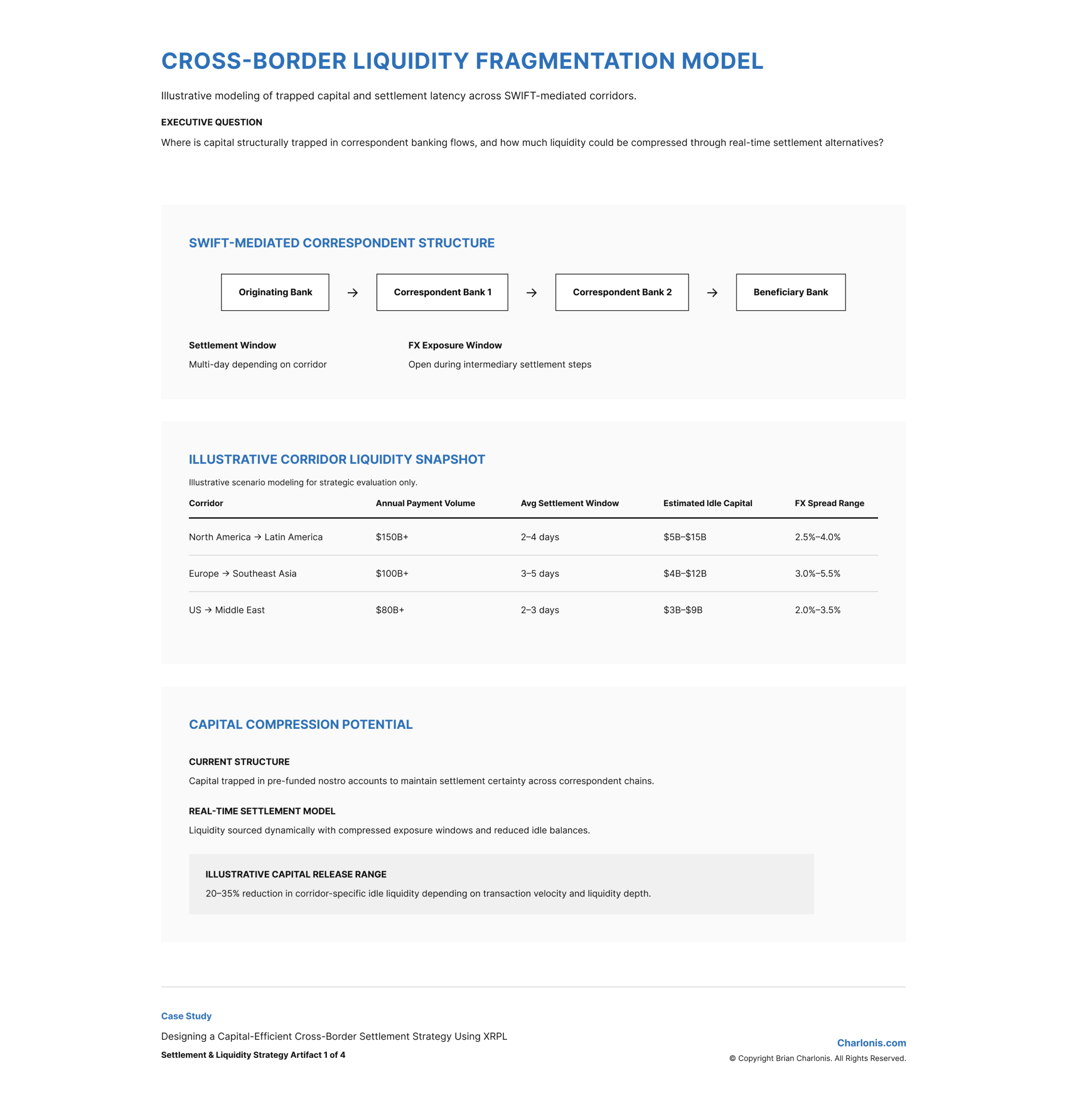
Cross-Border Liquidity Fragmentation Model
The liquidity fragmentation model identified where settlement infrastructure could create material capital inefficiency across correspondent corridors. It focused on trapped liquidity, pre-funded accounts, exposure windows, corridor-level capital constraints, and capital compression opportunity framing.
Key Elements
- Idle capital mapping across correspondent corridors.
- Exposure-window analysis.
- Liquidity fragmentation assessment.
- Corridor-level capital constraint modeling.
- Capital compression opportunity framing.
Artifact type: Liquidity model / corridor capital analysis.
The artifact modeled idle capital, exposure windows, and liquidity fragmentation across correspondent corridors to identify where settlement infrastructure could create material treasury constraint.
How It Shaped Decisions
This component would support treasury strategy, capital planning, and executive stakeholders in determining which corridors could show material capital inefficiency, where trapped liquidity could create a modernization opportunity, and where alternative settlement infrastructure deserved further evaluation.
Comparative Settlement Architecture Model
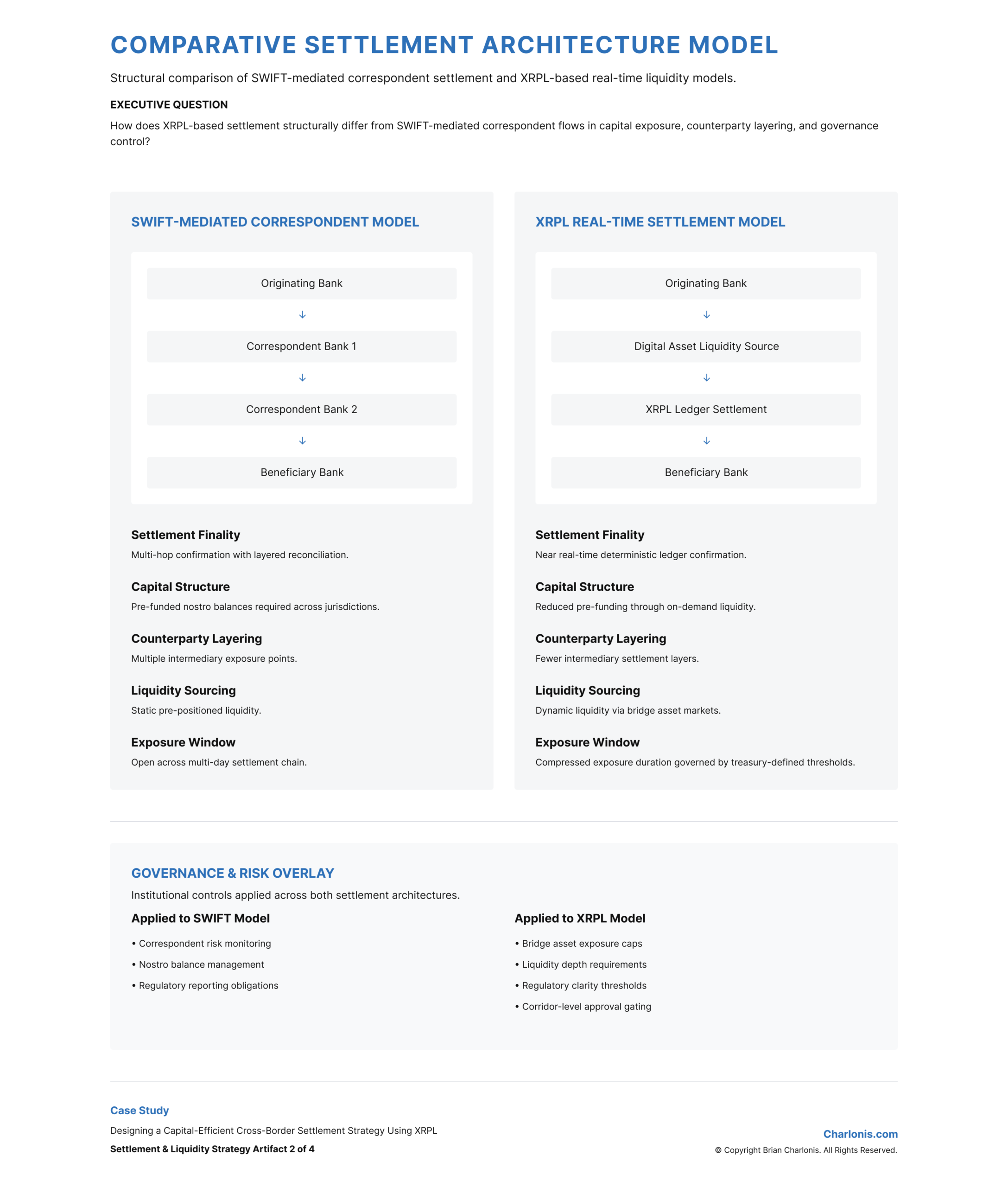
The settlement architecture model compared existing correspondent banking flows with XRPL-based settlement flows. It clarified how alternative settlement infrastructure could change capital structure, execution timing, counterparty exposure, reconciliation visibility, and operational control before any pilot decision could be considered.
Key Elements
- Correspondent banking flow comparison.
- XRPL-based settlement flow comparison.
- Capital structure implications.
- Execution timing differences.
- Counterparty exposure considerations.
- Operational control comparison.
Artifact type: Settlement architecture model / infrastructure comparison.
The artifact compared correspondent banking flows with XRPL-based settlement flows across capital structure, execution timing, counterparty exposure, and operational control.
How It Shaped Decisions
This component would support executive, risk, treasury, and architecture stakeholders in determining whether alternative settlement infrastructure could introduce meaningful capital, timing, or exposure advantages; which tradeoffs required treasury review; and whether the model warranted corridor-level qualification.
Capital Efficiency and Volatility Exposure Model
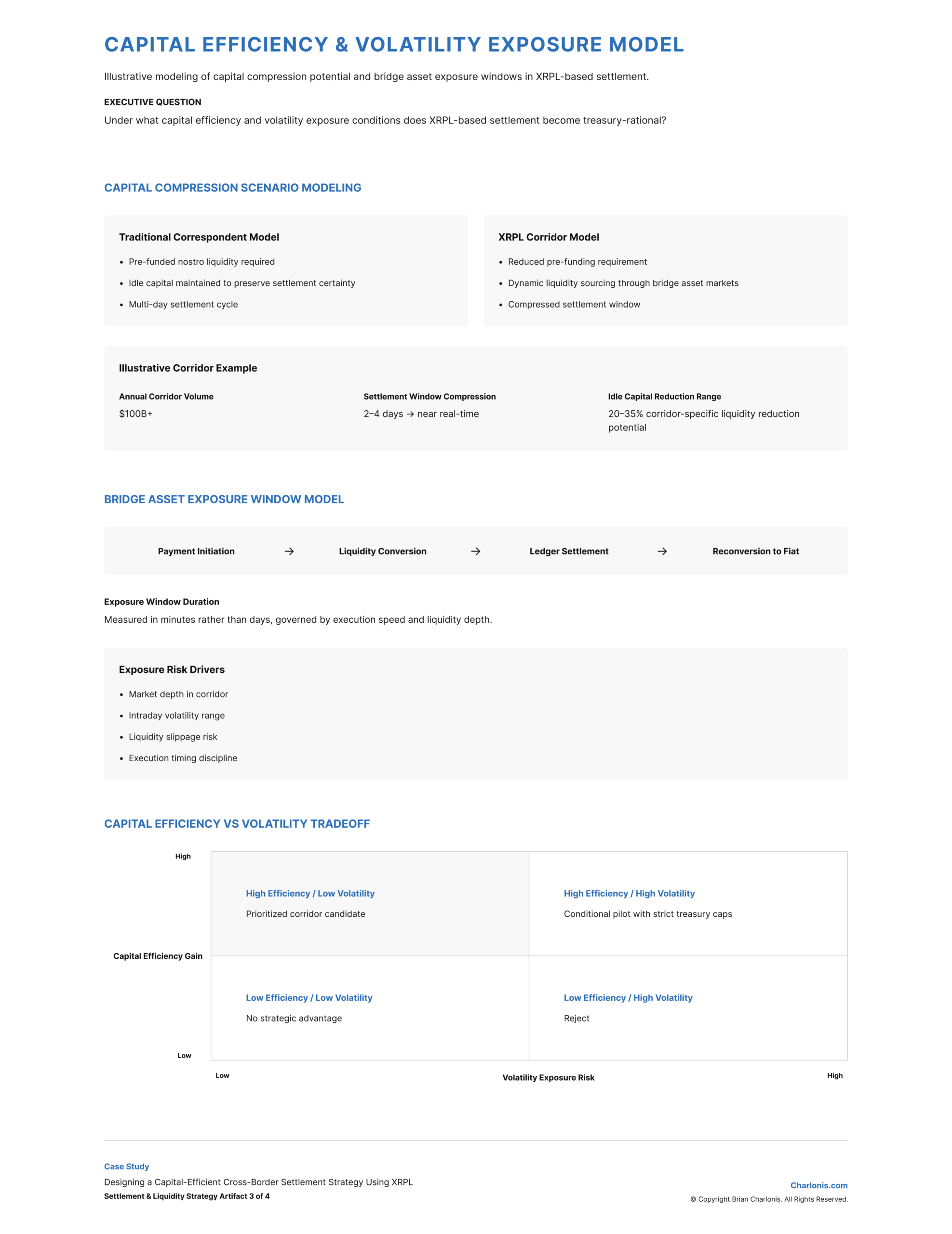
The capital efficiency and volatility exposure model evaluated whether modeled capital-efficiency benefits could justify bridge-asset exposure. It connected capital compression potential with settlement exposure windows, volatility tolerance, liquidity depth, and pilot control assumptions.
Key Elements
- Modeled capital-efficiency benefit analysis.
- Exposure-window analysis.
- Volatility tolerance thresholds.
- Bridge-asset liquidity-depth qualification.
- Capital efficiency and volatility tradeoff modeling.
- Pilot control assumptions.
Artifact type: Treasury risk model / capital and exposure analysis.
The artifact connected modeled capital-efficiency benefits, bridge-asset exposure windows, volatility tolerance, and liquidity depth to evaluate whether capital compression could justify corridor-level settlement exposure.
How It Shaped Decisions
This component would support treasury risk committee and executive decision-makers in determining whether modeled capital-compression benefits could satisfy defined treasury hurdle criteria, whether exposure windows remained within tolerance, and whether bridge-asset liquidity depth could support expected corridor volume.
Governed Corridor Adoption Framework
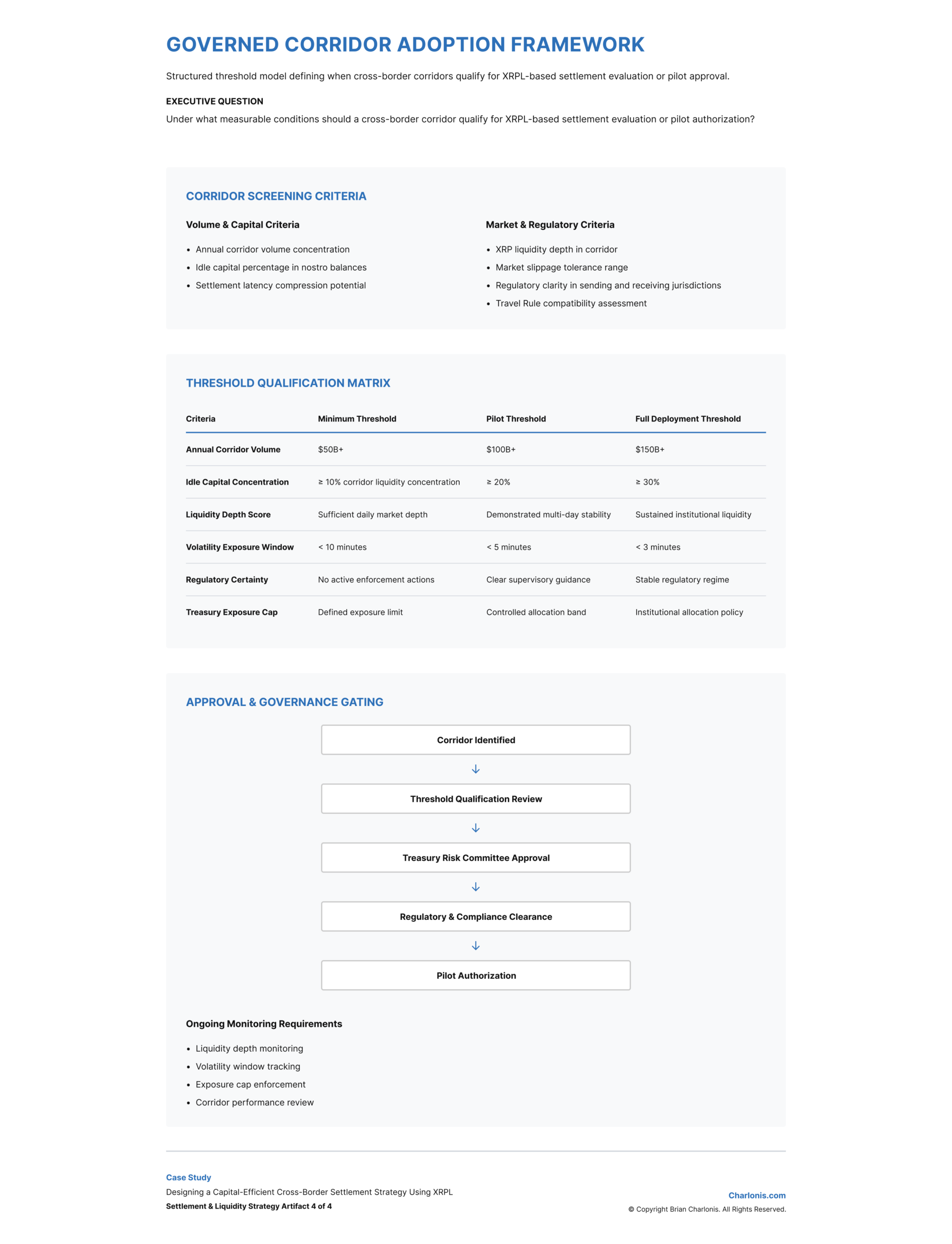
The corridor adoption framework defined which corridors could qualify for controlled pilot evaluation. It established threshold-based qualification, approval gates, disqualification triggers, monitoring requirements, regulatory posture criteria, liquidity-depth criteria, and capital-efficiency hurdle criteria.
Key Elements
- Threshold-based corridor qualification.
- Pilot approval gates.
- Disqualification triggers.
- Monitoring requirements.
- Regulatory posture criteria.
- Liquidity-depth and capital-efficiency hurdle criteria.
Artifact type: Corridor adoption model / pilot qualification framework.
The artifact defined threshold-based corridor qualification, approval gates, disqualification triggers, and monitoring requirements for evaluating alternative settlement infrastructure.
How It Shaped Decisions
This component would support executive risk oversight, treasury, compliance, and operating stakeholders in determining which corridors could qualify for pilot evaluation, which conditions would disqualify a corridor, what monitoring would be required, and how treasury leadership could prevent enterprise-wide exposure before corridor readiness was established.
TRADEOFFS & DECISIONS
Capital Efficiency vs Liquidity Control
- Tradeoff: Alternative settlement infrastructure could reduce idle capital, but treasury needed evidence that liquidity fragmentation was large enough to justify evaluation.
- Response: I mapped trapped liquidity, exposure windows, and corridor-level capital constraints before assessing alternative rails.
Settlement Speed vs Operational Control
- Tradeoff: Alternative rails could improve execution timing, but faster settlement could not come at the expense of operational control, reconciliation discipline, or treasury visibility.
- Response: I compared correspondent and alternative settlement flows across capital structure, execution timing, counterparty exposure, and operational control before pilot consideration.
Capital Compression vs Treasury Exposure
- Tradeoff: Using XRP as a bridge asset could reduce reliance on pre-funded liquidity, but it could introduce exposure during the settlement window.
- Response: I modeled capital efficiency benefits against exposure windows, volatility tolerance, and liquidity depth before corridor qualification.
Pilot Ambition vs Corridor Discipline
- Tradeoff: Broader pilot scope could accelerate learning, but enterprise-wide exposure could increase treasury, regulatory, and operating risk.
- Response: I used corridor-specific qualification thresholds, approval gates, disqualification triggers, and monitoring requirements before pilot evaluation could advance.
OUTCOMES
This case produced a corridor-level settlement evaluation model, four conceptual artifacts, liquidity fragmentation logic, comparative settlement architecture, capital efficiency and volatility exposure analysis, bridge-asset liquidity-depth criteria, and governed corridor adoption thresholds. It was developed as an independent conceptual transformation scenario and does not claim production implementation, regulatory approval, treasury investment authorization, actual XRP custody, technical architecture ownership, realized capital savings, measured financial performance, institutional adoption, transaction volume, or long-term settlement operations.

Impact Summary
- Created a disciplined framework for evaluating treasury capital efficiency before alternative settlement infrastructure was considered.
- Reframed digital asset settlement as a treasury capital-efficiency and risk-governance decision.
- Established a corridor-level model for evaluating where settlement modernization could improve capital utilization.
- Defined corridor-specific pilot evaluation logic without enterprise-wide exposure.
- Clarified how alternative settlement infrastructure could be evaluated under treasury, liquidity, volatility, regulatory, and governance thresholds.

Evidence
- Cross-Border Liquidity Fragmentation Model modeled idle capital, exposure windows, and liquidity fragmentation across correspondent corridors.
- Comparative Settlement Architecture Model compared correspondent banking flows with XRPL-based settlement flows across capital structure, execution timing, counterparty exposure, and operational control.
- Capital Efficiency and Volatility Exposure Model modeled capital-efficiency benefits against bridge-asset exposure windows, volatility tolerance, and liquidity depth.
- Governed Corridor Adoption Framework defined threshold-based corridor qualification, approval gates, disqualification triggers, and monitoring requirements.
- Blockchain Opportunity Assessment evaluated whether multi-party coordination, liquidity friction, and governance-as-execution conditions justified alternative settlement infrastructure evaluation.
- The model translated XRPL settlement mechanics into treasury risk, liquidity, capital, and corridor-qualification decision criteria.

Signals Monitored
- Intraday bridge-asset liquidity depth.
- Bridge-asset volatility during the settlement window.
- Execution timing variance and corridor performance.
- Regulatory clarity posture and corridor qualification status.

Decision Thresholds
- Require minimum corridor qualification before pilot evaluation.
- Require volatility exposure windows to remain below defined treasury tolerance.
- Disqualify corridors where regulatory uncertainty prevents responsible evaluation.
- Require modeled capital-efficiency benefit and sufficient bridge-asset liquidity depth to support expected corridor volume before pilot consideration.
Brian completed the liquidity fragmentation model, comparative settlement architecture model, capital efficiency and volatility exposure model, governed corridor adoption framework, and blockchain opportunity assessment that could support treasury leadership review and corridor-level pilot evaluation. Production implementation, regulatory approval, treasury investment authorization, XRP custody ownership, technical architecture ownership, realized capital savings, measured financial performance, institutional adoption, transaction volume, and long-term settlement operations remained outside the scope of the case.
LEADERSHIP REFLECTION
What This Case Demonstrates
- Blockchain should only be applied where coordination, liquidity, and governance constraints justify it.
- Settlement modernization is a treasury capital decision before it is a technology decision.
- Capital efficiency must be evaluated alongside liquidity depth, volatility tolerance, and corridor economics.
- Corridor-specific qualification can reduce the risk of broad exposure before readiness is established.
What I Would Validate Next
- Real-time liquidity data feeds for corridor scoring.
- Dynamic exposure cap adjustment based on volatility regimes.
- Scenario stress testing across multiple market cycles.
- Regulatory posture across each candidate corridor.
What I Would Watch Closely
- Settlement speed being treated as sufficient justification without capital analysis.
- Capital compression benefits being overstated without liquidity-depth validation.
- Bridge-asset volatility being minimized rather than modeled.
The central challenge was not whether XRPL could enable faster settlement.
It was whether alternative settlement infrastructure could improve treasury capital efficiency under corridor-specific liquidity, volatility, regulatory, and governance thresholds before pilot evaluation could be justified.
RECOMMENDED

CASE STUDY
GOVERNANCE & COMPLIANCE
Designing Programmable Compliance Infrastructure Using Smart Contracts
Defined a governance architecture for smart-contract-based financial agreement execution, showing how programmable compliance could remain subject to institutional authority, lifecycle controls, escalation pathways, audit visibility, and responsibility boundaries.
Programmable Compliance
Smart Contracts
Governed Financial Infrastructure

CASE STUDY
DATA & RESPONSIBLE AI GOVERNANCE
Operationalizing Data & Responsible AI Governance Across a Global Enterprise
Defined a Data and Responsible AI Governance operating model connecting risk-tiered intake, accountable business ownership, cross-functional controls, lifecycle oversight, reassessment, and executive visibility without routing every AI decision through one centralized approval bottleneck.
Data & Responsible AI Governance
Lifecycle Governance
Decision Rights

CASE STUDY
AI PORTFOLIO & INVESTMENT
Agentic AI Systems for Enterprise Regulatory & Risk Intelligence
Structured an AI portfolio investment system for a multi-product fintech, using capability sequencing, staged funding, evidence thresholds, and executive decision logic to determine which AI initiatives should be funded, combined, constrained, accelerated, paused, stopped, or rebalanced.
Agentic AI
Regulatory Intelligence
Monitored Autonomy

CASE STUDY
INSTITUTIONAL GOVERNANCE
Enterprise Governance & Policy Architecture for AI Systems
Defined an enterprise AI governance architecture with an AI charter, portfolio risk taxonomy, capital-allocation governance model, and vendor governance framework to clarify oversight, decision authority, policy expectations, and investment discipline for responsible AI scale.
AI Governance
Enterprise Decision Systems
Capital Discipline
Settlement modernization requires capital discipline.
If you are evaluating alternative settlement infrastructure, bridge-asset liquidity or capital-efficient treasury modernization, let’s connect on LinkedIn.