
Establishing a Governance-First Web3 Strategy for Enterprise Financial Services
Structuring how enterprise financial services leaders could evaluate programmable infrastructure opportunities, prioritize or reject use cases, establish governance controls, and sequence adoption under institutional constraints.
Enterprise Web3 Strategy
Use Case Prioritization
Adoption Sequencing
GOVERNANCE & COMPLIANCE
Conceptual Transformation Scenario
Web3 Product & Strategy Lead
Brian designed a governance-first enterprise Web3 adoption model for evaluating programmable financial infrastructure opportunities in regulated financial services. The work focused on capability evaluation, use case prioritization, rejection logic, governance controls, adoption gates, operating accountability, architecture readiness, and phased sequencing.
A Tier 1 Multinational Financial Institution examined how leadership could determine which programmable infrastructure opportunities deserved attention, which use cases should be rejected, and what governance conditions were required before adoption could advance. Brian created four artifacts: a Capability Opportunity Landscape, Use Case Prioritization Framework, Governance and Operating Model, and Adoption and Capability Roadmap. These clarified how payments, liquidity optimization, tokenization, custody, and interoperability opportunities could be evaluated through enterprise value, institutional fit, regulatory exposure, operating controls, and readiness thresholds.
CHALLENGE
Enterprise financial institutions face growing pressure to evaluate programmable infrastructure, digital assets, tokenized settlement, and blockchain-enabled financial systems.
However, emerging infrastructure often enters the organization through isolated innovation efforts, vendor proposals, market pressure, or executive curiosity before there is clear agreement on business value, control ownership, or institutional readiness.
Without a governance-first adoption model, Web3 exploration can become fragmented. Different teams may pursue pilots, partnerships, or technology experiments without a shared process for deciding what deserves attention, what should be rejected, who controls advancement, and what must be true before adoption can proceed.
The challenge was not whether blockchain technology was relevant. It was whether leadership could evaluate programmable financial infrastructure through enterprise value, governance readiness, operating controls, and adoption sequencing before implementation decisions were justified.
The opportunity was to create an executive decision-making process supported by artifacts that helped leadership evaluate opportunities, prioritize use cases, govern advancement, and sequence adoption.
Key Drivers
- Increasing institutional interest in programmable financial infrastructure.
- Market momentum around tokenized deposits, settlement modernization, custody, and digital asset infrastructure.
- Need to distinguish enterprise-relevant opportunities from speculative or high-risk initiatives.
- Regulatory uncertainty surrounding digital assets, custody, tokenization, and blockchain-enabled financial services.
- Operational risk created by fragmented pilots and unclear adoption authority.
- Need to align architecture readiness, infrastructure maturity, and enterprise risk tolerance.
Strategic Question
How could a Tier 1 multinational financial institution evaluate programmable financial infrastructure opportunities, prioritize or reject use cases, define governance controls, and sequence adoption without exposing the institution to unmanaged regulatory, operational, or infrastructure risk?
This required more than identifying Web3 capabilities. It required a governance-first adoption model for determining which opportunities fit institutional strategy, which should be controlled or rejected, where adoption decision authority should sit, and what readiness conditions were required before pilot or production consideration.
MY ROLE
I served as Web3 Product and Strategy Lead, structuring a governance-first enterprise adoption model for programmable financial infrastructure within a conceptual financial services transformation scenario.
My role was to translate emerging Web3 capabilities into executive decision artifacts that leadership could use to evaluate opportunities, prioritize initiatives, define governance controls, and sequence adoption.
I framed programmable infrastructure as an institutional operating capability rather than a technology trend, connecting payments, liquidity optimization, tokenization, custody, and interoperability opportunities to business value, risk exposure, regulatory constraints, and operating-model readiness.
My responsibilities included:
- Defining enterprise Web3 capability domains across payments, liquidity optimization, asset tokenization, custody infrastructure, and interoperability.
- Establishing prioritization logic for selecting, controlling, or rejecting Web3 use cases.
- Defining governance and operating-model requirements for institutional adoption.
- Structuring adoption gates across evaluation, pilot, production deployment, and enterprise-scale expansion.
- Translating regulatory, risk, architecture, and operational constraints into adoption criteria.
- Creating a phased roadmap aligned with governance readiness and infrastructure maturity.
This case demonstrates independent Web3 product strategy, enterprise strategy, governance design, adoption planning, prioritization logic, rejection discipline, and institutional readiness evaluation. It does not claim production implementation, regulatory approval, technical architecture ownership, actual investment authority, institutional adoption, deployed infrastructure, realized business outcomes, actual pilot success, enterprise-scale deployment, or long-term infrastructure operations.
Engagement at a Glance
Brian’s Scope
Brian designed the enterprise Web3 adoption model for evaluating capability domains, prioritizing or rejecting use cases, defining governance controls, structuring adoption gates, aligning operating accountability, and sequencing adoption based on enterprise value, regulatory posture, architecture readiness, and institutional risk tolerance.
HOW I LED THE WORK
- Framed Web3 adoption as an enterprise decision-making problem, using institutional value, risk exposure, governance readiness, and operating control to move beyond technology-first experimentation.
- Mapped programmable infrastructure capability domains across payments, liquidity optimization, asset tokenization, custody infrastructure, and interoperability.
- Defined prioritization and rejection logic, clarifying which use cases deserved leadership attention, which required controlled consideration, and which should be rejected before consuming executive or delivery capacity.
- Treated governance as a prerequisite for adoption, defining decision-authority requirements, risk controls, pilot gates, approval pathways, and operating accountability before pilot or production advancement.
- Connected adoption sequencing to institutional readiness, aligning phased progression with governance maturity, architecture readiness, infrastructure maturity, and enterprise risk tolerance.
- Preserved strategic optionality without encouraging broad experimentation, using controlled phases to keep viable opportunities visible while preventing unmanaged exposure.
- Translated programmable infrastructure strategy into decision-ready artifacts, giving leadership a structured way to evaluate, prioritize, govern, sequence, or reject Web3 initiatives.
SOLUTION
The solution was a governance-first enterprise Web3 adoption model structured around capability evaluation, use case prioritization, rejection discipline, governance controls, adoption gates, architecture readiness, operating accountability, and phased sequencing.
The solution connected four enterprise adoption questions:
- What programmable infrastructure opportunities deserved leadership attention?
- Which initiatives should be prioritized, controlled, or rejected?
- How should adoption decisions be governed before pilot or production advancement?
- How should programmable infrastructure initiatives move from evaluation toward controlled pilot, governed deployment, and enterprise scale?
Together, these components created a structured enterprise adoption model for evaluating programmable financial infrastructure through business value, governance readiness, regulatory posture, operating controls, and phased adoption discipline.
Capability Opportunity Landscape
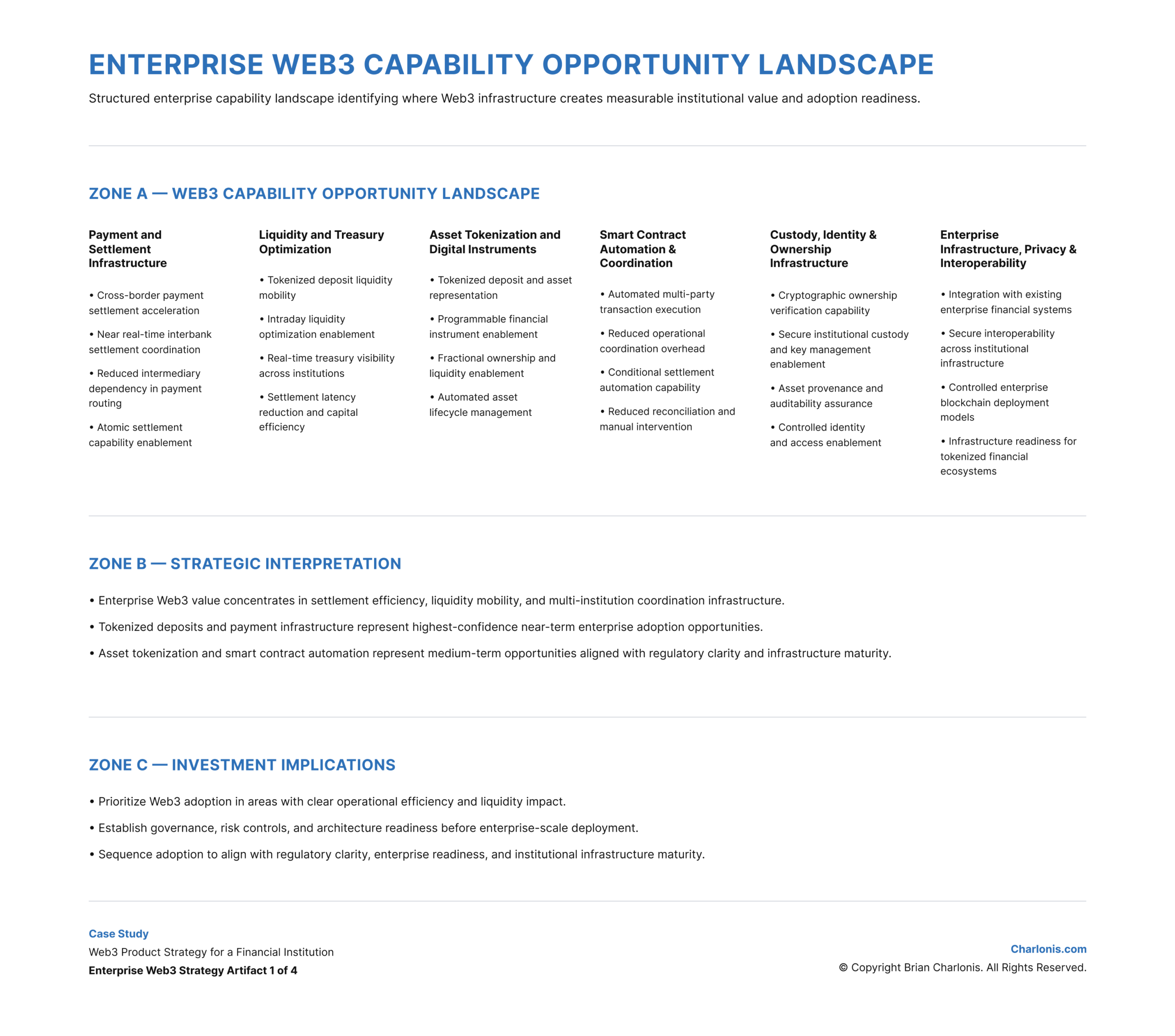
The capability landscape defined the institutional Web3 opportunity space across payments, liquidity optimization, asset tokenization, custody infrastructure, and interoperability. It helped leadership evaluate programmable infrastructure domains without allowing market momentum, vendor pressure, or isolated innovation activity to define the agenda.
Key Elements
- Payments capability evaluation.
- Liquidity optimization opportunity mapping.
- Asset tokenization capability assessment.
- Custody infrastructure consideration.
- Interoperability domain mapping.
- Distinction between enterprise-relevant opportunities and speculative or high-risk distractions.
Artifact type: Enterprise strategy framework / capability landscape.
The artifact defined enterprise Web3 capability domains across payments, liquidity optimization, asset tokenization, custody infrastructure, and interoperability.
How It Shaped Decisions
This component would support executive strategy, architecture, innovation, and risk leadership in determining which programmable infrastructure domains deserved leadership attention, where Web3 could create institutional value, and which capability areas should move into use case prioritization.
Use Case Prioritization Framework
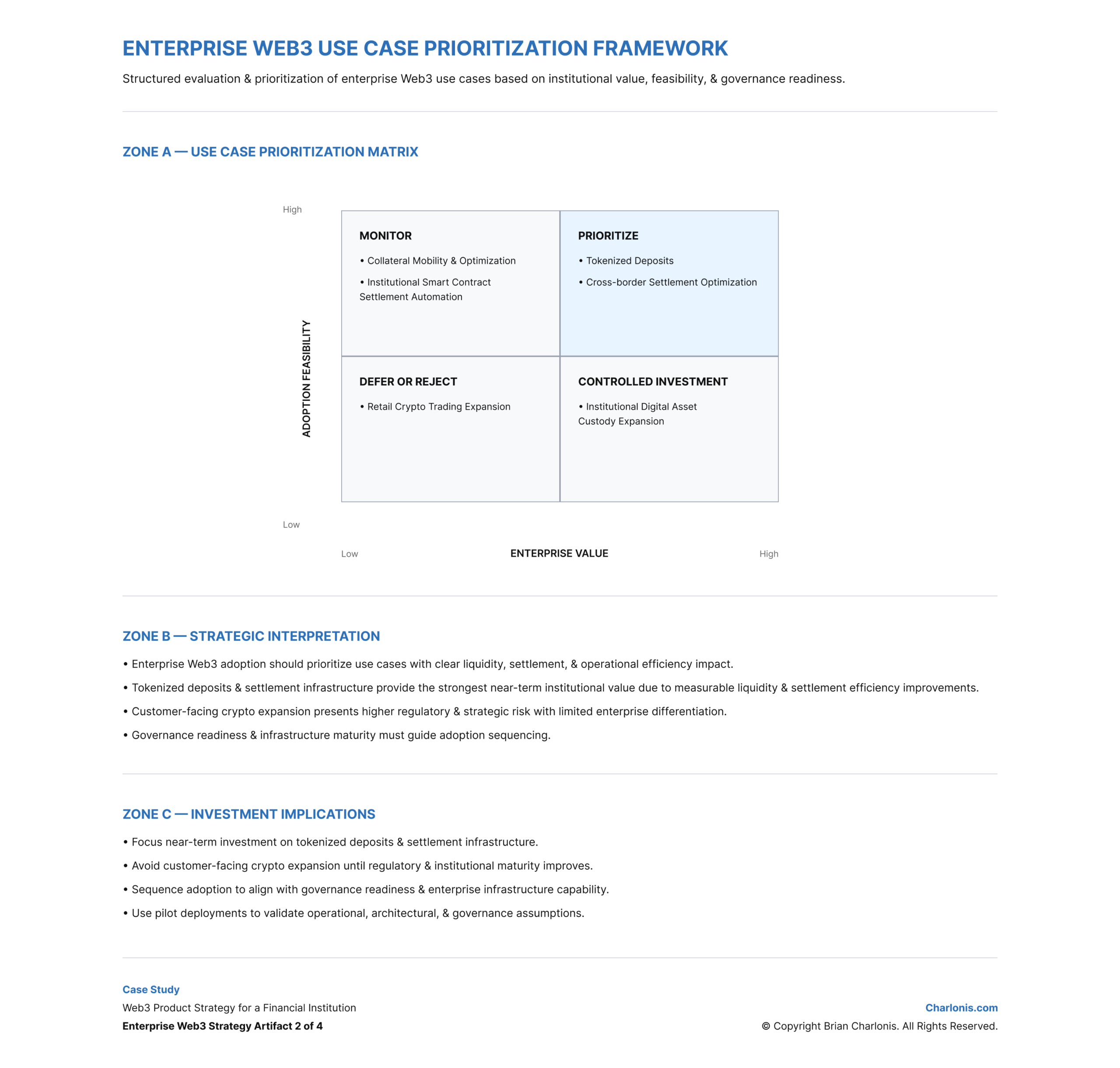
The prioritization framework defined how Web3 use cases should be evaluated, prioritized, controlled, or rejected based on institutional value, adoption feasibility, regulatory exposure, and enterprise readiness. It created explicit rejection logic so high-risk or low-value use cases would not consume capacity merely because they were technically possible or market-visible.
Key Elements
- Higher-priority positioning for tokenized deposits to improve liquidity mobility and settlement efficiency within the scenario.
- Higher-priority positioning for cross-border settlement optimization to reduce latency and operational friction within the scenario.
- Controlled investment consideration for institutional digital asset custody expansion.
- Explicit rejection of retail cryptocurrency trading expansion due to regulatory exposure and limited strategic differentiation.
- Evaluation criteria based on institutional value, feasibility, regulatory exposure, and enterprise readiness.
Artifact type: Prioritization framework / rejection model.
The artifact connected institutional value, adoption feasibility, regulatory exposure, enterprise readiness, and rejection discipline for evaluating Web3 use cases.
How It Shaped Decisions
This component would support executive, strategy, risk, and architecture stakeholders in determining which Web3 initiatives should be prioritized, which should remain controlled, which should be rejected, where institutional attention should be focused, and how speculative use cases could be prevented from consuming capacity.
Governance and Operating Model
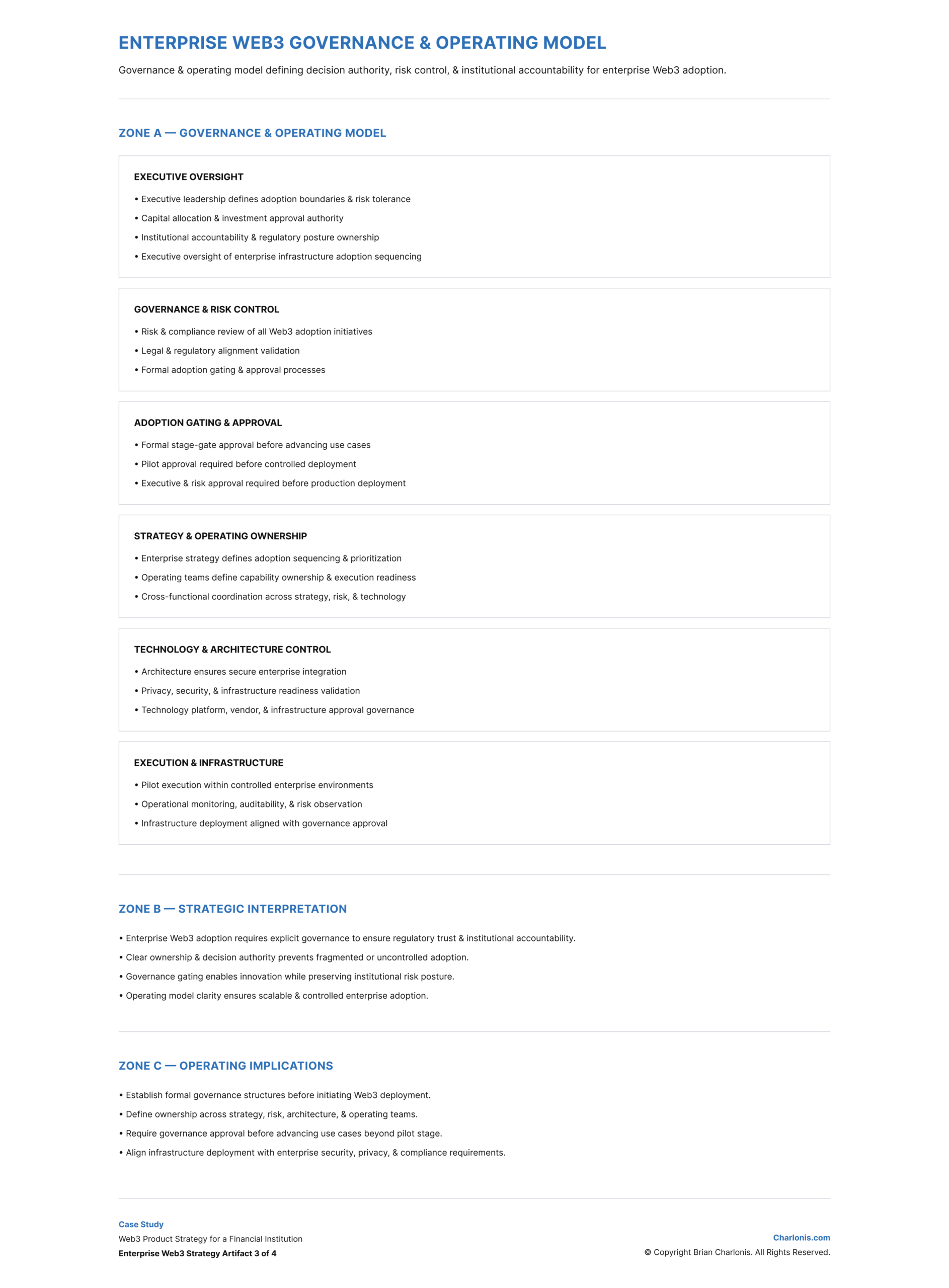
The governance and operating model defined how adoption decisions should advance through institutional authority, risk controls, pilot gates, approval pathways, architecture review, and operating accountability. It clarified that programmable infrastructure initiatives should not move forward through enthusiasm, vendor pressure, or isolated innovation activity alone.
Key Elements
- Executive oversight of adoption boundaries and sequencing.
- Risk and compliance approval integration.
- Formal adoption gating across pilot and production deployment.
- Architecture and infrastructure approval controls.
- Operating accountability for Web3 initiatives.
Artifact type: Governance architecture / operating model.
The artifact showed how customer information moves today and how the proposed model would change documentation, workflow action, reporting, and organizational learning.
How It Shaped Decisions
This component would support executive, risk, compliance, architecture, and innovation leadership in determining where adoption decision authority should sit, what approvals would be required, how pilot and production advancement should be governed, and how regulatory trust and operational accountability could be preserved.
Adoption and Capability Roadmap
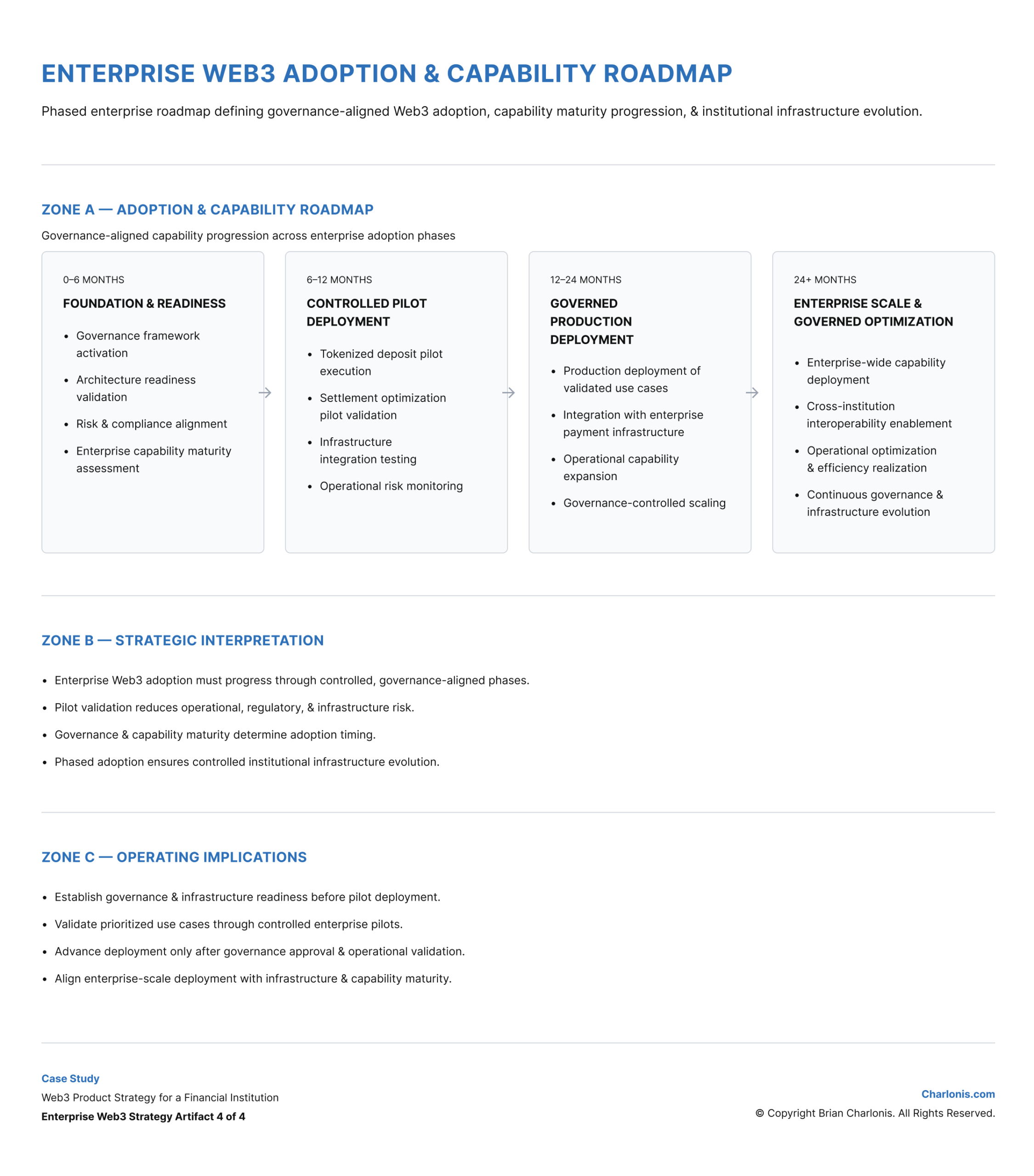
The adoption roadmap defined how programmable infrastructure initiatives could progress from foundation readiness to controlled pilot, governed production deployment, and enterprise-scale expansion. It sequenced adoption based on governance readiness, architecture maturity, infrastructure maturity, and capability value.
Key Elements
- Foundation and readiness through governance activation and architecture alignment.
- Controlled pilot deployment to validate prioritized use cases.
- Governed production deployment aligned with institutional approval.
- Enterprise-scale deployment aligned with infrastructure maturity.
- Sequencing based on governance readiness, architecture maturity, and capability value.
Artifact type: Roadmap / enterprise sequencing model.
The artifact connected governance readiness, architecture maturity, capability value, and phased deployment sequencing.
How It Shaped Decisions
This component would support executive sponsors, operating leaders, architecture teams, and implementation stakeholders in determining how programmable infrastructure initiatives could progress from evaluation to pilot and scale, which maturity conditions would need to be met, and how adoption sequencing could protect institutional trust while preserving strategic optionality.
TRADEOFFS & DECISIONS
Breadth vs Executive Focus
- Tradeoff: Programmable infrastructure could be explored across many domains, but broad exploration risked diluting leadership attention.
- Response: I used the capability landscape to separate enterprise-relevant domains from speculative or low-value distractions.
Innovation vs Rejection Discipline
- Tradeoff: Broad experimentation could increase learning, but unmanaged experimentation could expose the institution to regulatory, operational, or reputational risk.
- Response: I used the prioritization framework to position tokenized deposits and cross-border settlement optimization as higher-priority opportunities while rejecting retail cryptocurrency trading expansion within the scenario.
Control vs Adoption Speed
- Tradeoff: Strong governance controls could slow experimentation, but weak controls could allow initiatives to advance before ownership, approvals, or risk boundaries were clear.
- Response: I defined executive oversight, risk and compliance integration, architecture approval controls, and formal adoption gates before pilot or production advancement.
Strategic Ambition vs Institutional Readiness
- Tradeoff: Enterprise-scale adoption could create long-term advantage, but premature scaling could introduce unmanaged infrastructure, regulatory, or operating risk.
- Response: I sequenced adoption through foundation readiness, controlled pilots, governed production deployment, and enterprise-scale expansion only when maturity conditions were met.
OUTCOMES
This case produced a governance-first enterprise Web3 adoption model, four conceptual artifacts, capability-domain structure, prioritization and rejection logic, governance controls, adoption gates, operating-accountability model, and phased roadmap. It was developed as an independent conceptual transformation scenario and does not claim production implementation, regulatory approval, technical architecture ownership, actual investment authority, institutional adoption, deployed infrastructure, realized business outcomes, actual pilot success, enterprise-scale deployment, or long-term infrastructure operations.

Impact Summary
- Created a decision process for evaluating programmable financial infrastructure.
- Defined where Web3 capabilities deserved executive attention across payments, liquidity, tokenization, custody, and interoperability.
- Focused leadership attention on prioritized use cases while establishing rejection logic for high-risk or low-value initiatives.
- Defined governance controls, adoption gates, and decision-authority requirements before pilot or production advancement.
- Sequenced adoption from readiness through controlled pilot, governed deployment, and enterprise-scale expansion.

Evidence
- Capability Opportunity Landscape defined where programmable infrastructure could create institutional value across payments, liquidity, tokenization, custody, and interoperability.
- Use Case Prioritization Framework distinguished prioritized, controlled-investment, and explicitly rejected opportunities.
- Governance and Operating Model defined executive oversight, approval gates, pilot controls, risk approval pathways, architecture controls, and operating accountability.
- Adoption and Capability Roadmap sequenced initiatives from foundation readiness through controlled pilot, governed production deployment, and enterprise-scale adoption.
- Prioritized use cases included tokenized deposits and cross-border settlement optimization within the scenario.
- Retail cryptocurrency trading expansion was explicitly rejected within the scenario due to regulatory exposure and limited strategic differentiation.

Signals Monitored
- Institutional adoption trends across global financial institutions.
- Regulatory developments impacting digital assets, tokenization, and Web3 infrastructure adoption.
- Enterprise architecture readiness, infrastructure maturity, and governance readiness.
- Liquidity, settlement, custody, and interoperability infrastructure maturity.

Decision Thresholds
- Prioritize infrastructure use cases that could improve liquidity, settlement efficiency, or institutional operating capability.
- Reject use cases that increase regulatory risk without sufficient enterprise value.
- Require governance approval and operating accountability before advancing use cases beyond pilot consideration.
- Advance initiatives only when capability value, regulatory posture, operating controls, architecture readiness, and governance maturity support the next phase.
Brian completed the capability opportunity landscape, use case prioritization framework, governance and operating model, adoption and capability roadmap, and executive decision logic that could support stakeholder review and enterprise Web3 adoption planning. Production implementation, regulatory approval, technical architecture ownership, actual investment authority, institutional adoption, deployed infrastructure, realized business outcomes, actual pilot success, enterprise-scale deployment, and long-term infrastructure operations remained outside the scope of the case.
LEADERSHIP REFLECTION
What This Case Demonstrates
- Programmable infrastructure should be evaluated as an enterprise adoption decision, not a technology trend.
- Governance must precede pilot expansion in regulated financial environments.
- Explicit rejection logic is as important as prioritization logic.
- Use cases should advance only when enterprise value, regulatory posture, operating controls, and architecture readiness align.
What I Would Validate Next
- Corridor-specific liquidity and settlement data to refine prioritized use cases.
- Regulatory posture across tokenized deposits, custody, and settlement infrastructure.
- Architecture readiness for interoperability and custody integration.
- Operating ownership across risk, compliance, treasury, technology, and product teams.
What I Would Watch Closely
- Technology momentum outpacing governance readiness.
- Use cases advancing without clear enterprise value.
- Regulatory uncertainty being treated as an implementation detail.
The central challenge was not whether Web3 infrastructure could be explored.
It was whether the institution could evaluate programmable infrastructure through enterprise value, governance readiness, operating controls, and adoption sequencing before implementation decisions were justified.
RECOMMENDED

CASE STUDY
SETTLEMENT INFRASTRUCTURE
Designing a Capital-Efficient Cross-Border Settlement Strategy Using XRPL
Structured a corridor-level treasury evaluation model comparing correspondent settlement with XRPL-based alternatives across trapped capital, liquidity depth, volatility exposure, regulatory posture, corridor economics, and governed pilot thresholds.
Settlement Strategy
Treasury Infrastructure
XRPL Settlement Evaluation

CASE STUDY
AI PORTFOLIO & INVESTMENT
Agentic AI Systems for Enterprise Regulatory & Risk Intelligence
Designed a monitored-autonomy model for agentic regulatory intelligence, defining how regulatory signals would be classified, routed, monitored, contained, escalated, and translated into executive decision support for high-risk enterprise workflows.
Agentic AI
Regulatory Intelligence
Monitored Autonomy

CASE STUDY
FEDERATED AI ADOPTION
Enterprise AI Adoption Across a Decentralized Software Portfolio
Defined a federated AI adoption model for a decentralized software portfolio, connecting business-unit readiness, local ownership, workflow-change evidence, value signals, and cross-unit learning to move AI adoption beyond tool access and isolated pilots.
AI Adoption
Enterprise AI Adoption
Federated Operating Model

CASE STUDY
DATA & RESPONSIBLE AI GOVERNANCE
Operationalizing Data & Responsible AI Governance Across a Global Enterprise
Defined a Data and Responsible AI Governance operating model connecting risk-tiered intake, accountable business ownership, cross-functional controls, lifecycle oversight, reassessment, and executive visibility without routing every AI decision through one centralized approval bottleneck.
Data & Responsible AI Governance
Lifecycle Governance
Decision Rights
Governed Web3 adoption starts with disciplined strategy.
If your organization is evaluating programmable infrastructure for payments, settlement, tokenization, custody or liquidity modernization, let’s connect on LinkedIn.