
CASE STUDY
AI-Augmented Insurance Brokerage Operating Model
Using conversation intelligence, workflow coordination, and human review to reduce agent administration, strengthen customer engagement, and turn reviewed interactions into enterprise intelligence.
AI Transformation
Business Solutions Strategy
Workflow Coordination
AI VALUE CREATION
Conceptual Transformation Scenario
AI & Business Solutions Strategy Lead
Brian designed an AI-augmented insurance brokerage operating model that connected customer conversation preparation, interaction documentation, CRM updates, follow-up coordination, human review, and enterprise customer intelligence. The work defined how AI could reduce administrative burden around broker workflows while preserving licensed-agent judgment and accountability.
A Regional Insurance Distribution and Financial-Services Organization wanted to build on its existing CRM and operating capabilities without replacing licensed agents or introducing a disconnected AI tool. Brian created four artifacts: a current-to-future operating model, sales agent operational view, enterprise customer intelligence view, and enterprise value and performance view. These clarified how reviewed customer interactions could support frontline work, operational coordination, partner management, compliance awareness, and leadership decision-making.
This case was realized through Brian’s Governed Intelligence Operating System. The system developed recurring market signals about insurance distribution workflow burden, licensed-agent judgment, customer-interaction documentation, and enterprise customer intelligence into an independent conceptual transformation scenario.
CHALLENGE
The organization relied on existing CRM, policy, document, carrier, partner, communication, and reporting workflows to support sales, service, and relationship management. But much of the work surrounding customer conversations remained manual, fragmented, and difficult to translate into timely business insight.
Agents needed to prepare for conversations, find relevant customer context, document what occurred, update CRM records, coordinate follow-up, track commitments, and identify missing information. At the same time, marketing, partner, operations, compliance, and leadership teams lacked timely access to recurring customer needs, objections, product interests, service concerns, and workflow friction.
The challenge was not whether AI could summarize a conversation. It was whether the enterprise could use that capability to make the broker’s work easier, preserve professional judgment, and turn reviewed customer interactions into better organizational decisions.
The opportunity was to create a structured intelligence and coordination layer around existing systems that could reduce administrative effort, improve information quality, accelerate operational action, and connect frontline interactions to broader business decisions.
Key Drivers
- Reduce administrative work surrounding customer preparation, documentation, and follow-up.
- Improve the completeness and timeliness of CRM and workflow information.
- Give agents greater everyday value from existing technology.
- Identify stalled work, customer concerns, and capacity pressure sooner.
- Give business and partner teams earlier access to governed customer signals.
- Preserve licensed judgment through transparent, evidence-based, auditable human review.
Strategic Question
How could the organization use AI to reduce the work surrounding customer conversations, improve the speed and quality of CRM and workflow information, and help agents, managers, operations, partners, and leadership act from a shared understanding of the customer?
This required more than an AI summarization feature. It required an operating model that connected agent workflow value, CRM information quality, role-based access, human review, workflow coordination, enterprise intelligence, and value measurement.
MY ROLE
I led the development of the conceptual AI-augmented operating model, translating agent, customer, partner, operational, compliance, and leadership needs into a coordinated business-solutions and transformation strategy. My role focused on defining how conversation intelligence, CRM workflows, human review, external platform data, operational actions, and enterprise reporting could work together.
This was an independent AI value-creation case developed as a conceptual transformation scenario for an insurance distribution and financial-services environment. I structured the work around frontline administrative burden, licensed-agent accountability, customer-interaction data, CRM updates, workflow coordination, governed enterprise intelligence, and measurable business value.
The work established a future-state operating model that could help business and technology leaders decide what should be configured, built, purchased, integrated, piloted, measured, or requested from platform and carrier partners.
My responsibilities included:
- Mapping the current and future customer-interaction, CRM, follow-up, and reporting workflow.
- Defining the AI-assisted conversation-intelligence capability and agent-facing work products.
- Structuring how reviewed interaction data could create CRM updates, operational tasks, and enterprise insight.
- Defining human-review, correction, override, escalation, access, and prohibited-action requirements.
- Identifying CRM, workflow, analytics, carrier, and partner integration needs.
- Establishing pilot measures, governance requirements, auditability expectations, and scaling criteria.
This case demonstrates independent strategy, operating-model design, workflow definition, human-review logic, business-solutions architecture, value-measure design, and conceptual artifacts. It does not claim client-enterprise deployment, production implementation, licensed insurance decision-making, technical architecture ownership, CRM implementation, vendor contracting, carrier integration, institutional adoption, measured productivity gains, or realized business outcomes.
Engagement at a Glance
Brian’s Scope
Brian designed the end-to-end AI-augmented brokerage operating model for preparing customer conversations, drafting interaction documentation, supporting agent review, proposing CRM updates, coordinating follow-up, surfacing governed customer signals, and translating reviewed frontline information into enterprise value and performance measures that could support pilot planning and implementation decisions.
HOW I LED THE WORK
- Started with the work agents already performed, using customer preparation, documentation, CRM updates, and follow-up coordination to ground AI value in daily workflow rather than abstract automation.
- Framed AI as an augmentation layer around existing systems, designing the model to build on CRM, policy, carrier, document, communication, and analytics environments instead of replacing them.
- Preserved licensed-agent judgment as the authority boundary, defining where AI could prepare, summarize, organize, and recommend while agents remained responsible for review, correction, communication, and insurance decisions.
- Connected frontline workflow improvement to enterprise intelligence, structuring reviewed interaction signals so they could inform operations, partner management, compliance awareness, leadership decisions, and customer engagement.
- Separated customer-level information from aggregated business insight, using role-based access, evidence requirements, and purpose limitations to prevent broader enterprise use from becoming uncontrolled exposure.
- Embedded adoption and trust into the operating model, recognizing that agents would need immediate workflow value, inspectable evidence, and control over what enters official records.
- Defined pilot and scaling logic around value, adoption, information quality, integration feasibility, commercial signal, and governance performance so expansion would depend on evidence rather than AI enthusiasm.
SOLUTION
The solution was an AI-assisted conversation intelligence and workflow coordination layer around the organization’s existing CRM, policy information, carrier data, documents, communications, and operational workflows.
It was designed to improve the work surrounding customer conversations while preserving licensed-agent judgment and creating a governed path for reviewed frontline information to support broader enterprise decisions.
The solution connected four value-creation questions:
- How should AI reduce the work before and after customer conversations?
- How should licensed agents review, correct, approve, restrict, or escalate AI-prepared information?
- How should reviewed interaction signals support operations, partners, compliance, and leadership without exposing unrestricted customer-level data?
- How should value, adoption, workflow quality, governance, and business outcomes be measured before scale?
Together, these components created an AI-augmented brokerage operating model that connected frontline productivity, human judgment, workflow coordination, enterprise intelligence, and value measurement.
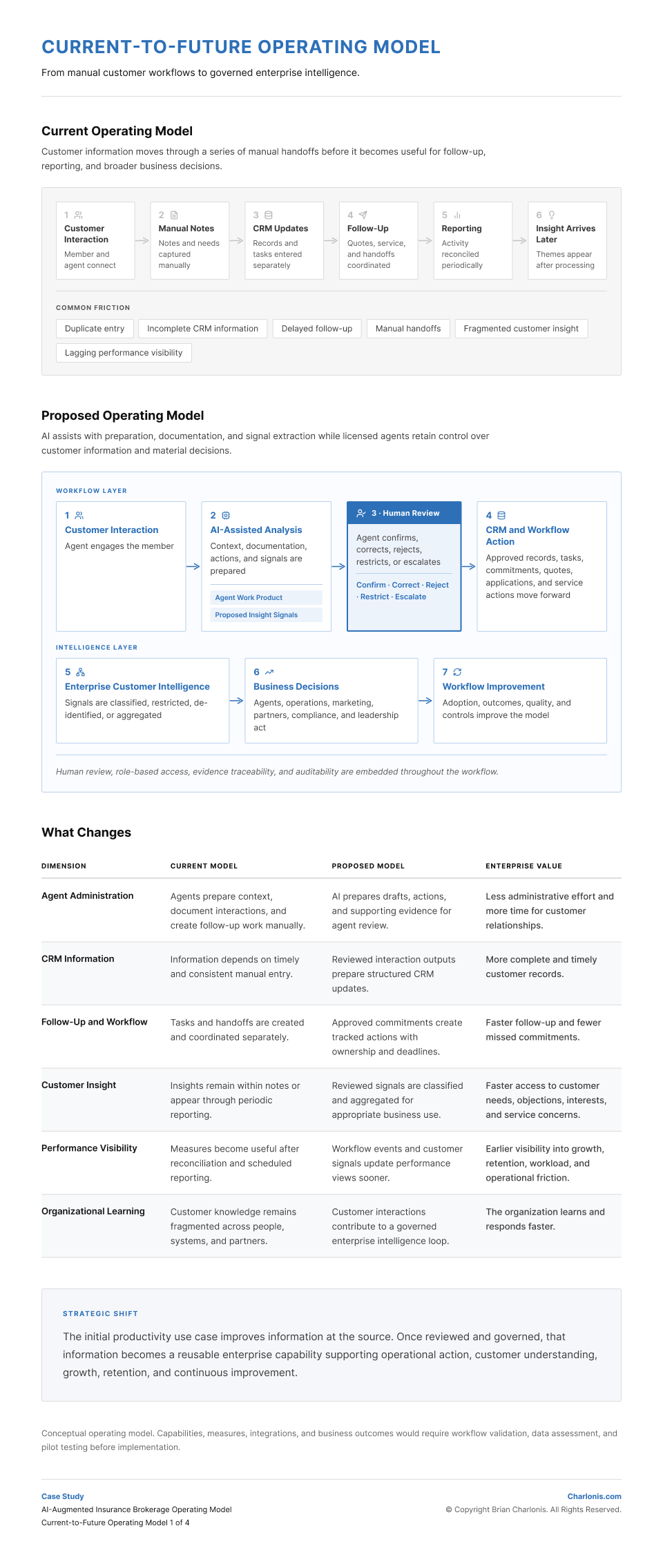
Current-to-Future Operating Model
The operating model showed how customer information moved through preparation, conversation, documentation, CRM updates, follow-up, reporting, and organizational learning. It established how the future state would use AI to prepare agent work products, route reviewed information into existing systems, coordinate operational work, and turn customer interactions into governed business intelligence.
Key Elements
- Current customer-interaction, CRM, follow-up, partner, and reporting workflow.
- Future-state AI-assisted preparation, documentation, and coordination layer.
- Human review before official record updates or customer-facing action.
- CRM, workflow, analytics, carrier, partner, and communication-system inputs.
- Reviewed signals flowing into operational and enterprise intelligence.
Artifact type: Operating model / workflow transformation map.
The artifact showed how customer information moves today and how the proposed model would change documentation, workflow action, reporting, and organizational learning.
How It Shaped Decisions
This component would support business, operations, technology, CRM, partner, and leadership stakeholders in deciding how AI should fit around existing systems rather than replace them. It clarified which workflow steps could be augmented, where human review was required, and what integration or configuration decisions would need to be evaluated before implementation.
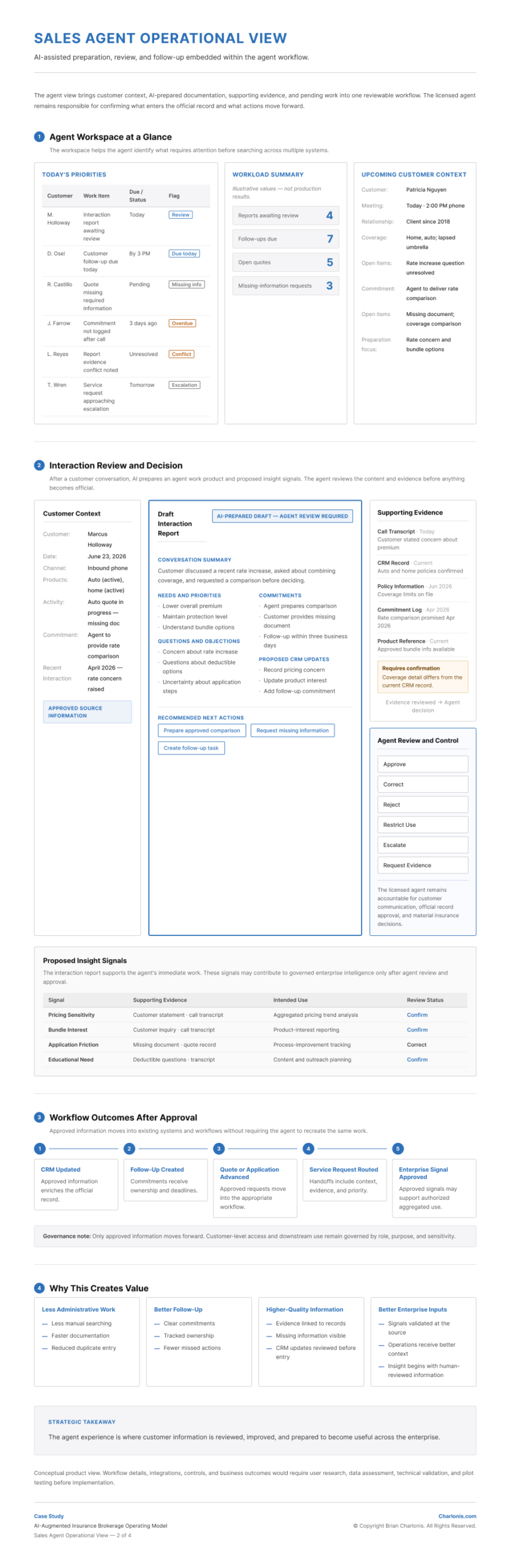
Sales Agent Operational View
The sales agent view defined the frontline experience and control model for AI-assisted conversation work. It showed how agents could receive preparation context before conversations and review draft reports, CRM updates, follow-up tasks, commitments, missing information, supporting evidence, and recommended next actions afterward.
Key Elements
- Pre-conversation preparation brief assembled from approved sources.
- Draft interaction report after the customer conversation.
- Proposed CRM updates, follow-up tasks, commitments, and next actions.
- Supporting evidence for proposed insight signals.
- Agent controls to confirm, correct, reject, reclassify, restrict, or escalate.
Artifact type: Agent workflow / operational view.
The artifact showed immediate frontline value, supporting evidence, recommended next actions, and review controls agents could use before information entered customer workflows or broader enterprise intelligence.
How It Shaped Decisions
This component would support agents, managers, operations leaders, product stakeholders, and implementation teams in determining whether the AI layer created enough practical workflow value to earn adoption. It clarified that the first value test was not enterprise reporting, but whether the proposed experience could reduce agent effort, provide trustworthy evidence, and preserve control over customer information.
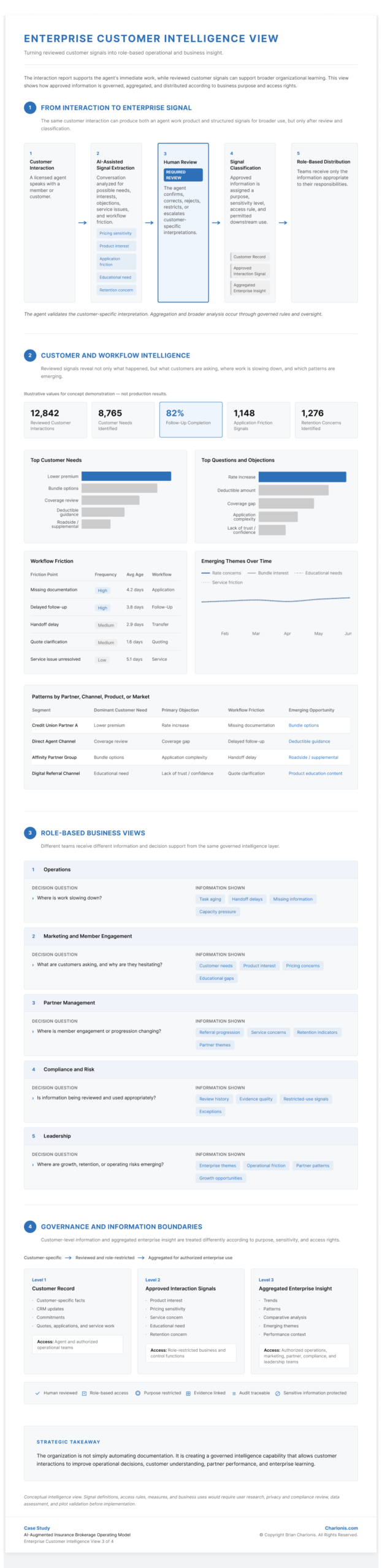
Enterprise Customer Intelligence View
The enterprise customer intelligence view defined how reviewed customer-interaction signals could support business decisions beyond the immediate sales workflow. It organized customer needs, objections, product interests, service concerns, retention risk, channel preferences, application friction, partner patterns, and operational themes into role-based intelligence.
Key Elements
- Reviewed interaction signals from agent-approved customer conversations.
- Aggregated customer themes across agents, products, partners, channels, and markets.
- Role-based access separating customer-level data from business insight.
- Operational, marketing, partner, compliance, and leadership intelligence views.
- Evidence, consent, purpose, and access requirements for downstream use.
Artifact type: Enterprise intelligence / role-based decision view.
The artifact showed how reviewed interaction signals could support business decisions without exposing unrestricted customer-level information.
How It Shaped Decisions
This component would support marketing, operations, partner management, compliance, and leadership teams in determining which reviewed signals could inform action and which information should remain restricted. It clarified how frontline interactions could become governed enterprise intelligence rather than unstructured reporting or uncontrolled data reuse.
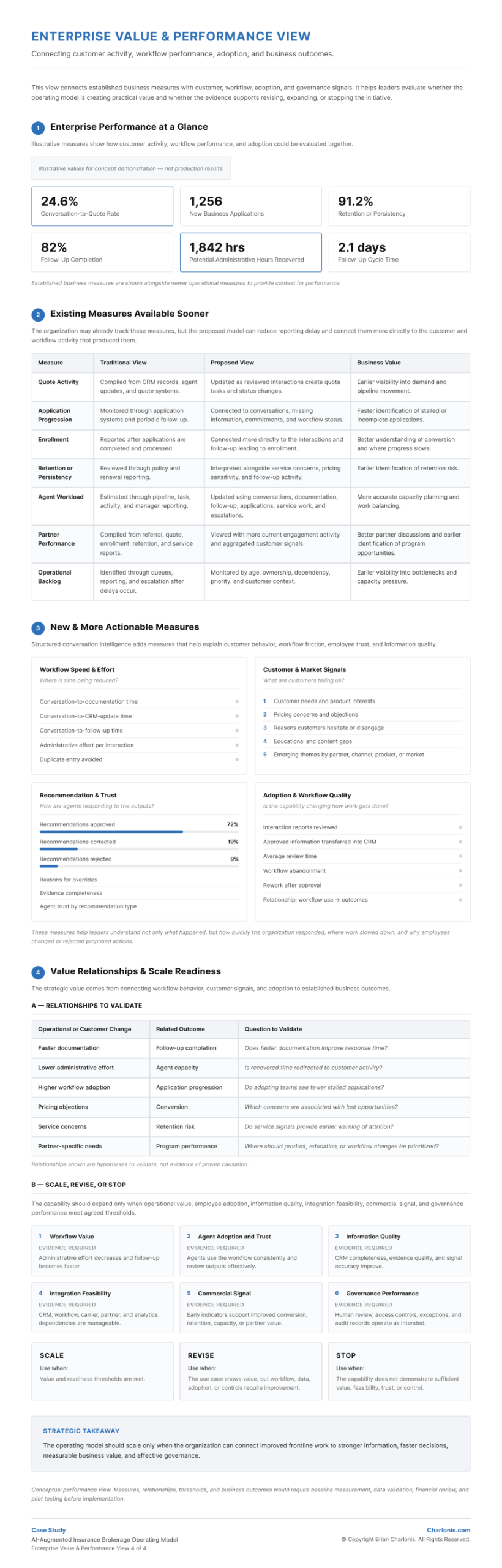
Enterprise Value and Performance View
The enterprise value and performance view connected customer, workflow, adoption, governance, and business measures so leaders could assess whether the operating model was creating value before scaling. It distinguished established performance measures made available sooner from new measures created through structured conversation intelligence.
Key Elements
- CRM completeness, missing information, and duplicate-entry signals.
- Follow-up, quote, application, enrollment, and retention progression.
- Customer needs, objections, product interests, and service concerns.
- Agent adoption, trust, review behavior, overrides, and workflow abandonment.
- Evidence quality, exceptions, access controls, audit status, and workflow bottlenecks.
Artifact type: Value measurement / performance view.
The artifact connected customer, workflow, adoption, governance, and business measures to show what was changing, why it mattered, and what evidence would be needed before scale.
How It Shaped Decisions
This component would support executives, operations leaders, sales managers, compliance stakeholders, and transformation teams in deciding whether the model should continue, change, scale, or remain constrained. It clarified that productivity signals, information quality, adoption behavior, governance performance, and commercial indicators should be evaluated together rather than treated as isolated success measures.
TRADEOFFS & DECISIONS
Agent Productivity vs Licensed Judgment
- Tradeoff: AI could reduce administrative work around preparation, documentation, CRM updates, and follow-up, but licensed agents still needed to own customer communication, professional judgment, and insurance decisions.
- Response: I structured the model so AI prepares, organizes, summarizes, and recommends while agents review, correct, approve, reject, restrict, or escalate information before it enters the official record or affects customer-facing action.
Frontline Value vs Enterprise Intelligence
- Tradeoff: Leadership could gain value from aggregated customer signals, but if the model prioritized enterprise reporting before agent usefulness, adoption and trust could fail.
- Response: I designed the agent work product as the first value layer, then defined how reviewed and approved interaction signals could support operations, partners, compliance, and leadership.
Information Access vs Customer Protection
- Tradeoff: Reviewed customer interactions could create valuable intelligence, but broader access to customer-level information could create privacy, contractual, consent, and role-boundary concerns.
- Response: I separated customer-level information from aggregated business insight and defined role, purpose, consent, contractual, and partner-access restrictions.
Early Productivity Signals vs Scalable Value
- Tradeoff: Early signs of faster documentation or better CRM completion could appear promising, but they would not prove commercial value, adoption stability, information quality, or governance readiness.
- Response: I connected pilot and scale decisions to a broader evidence model that included workflow value, agent trust, information quality, integration feasibility, commercial signal, and governance performance.
OUTCOMES
This case produced an AI-augmented brokerage operating model, four conceptual artifacts, human-review logic, workflow coordination requirements, value measures, and scaling criteria. It was developed as an independent conceptual transformation scenario and does not claim production deployment, institutional adoption, measured administrative reduction, realized growth impact, carrier integration, CRM implementation, or quantified business gains.

Impact Summary
- Defined an AI-augmented operating model intended to reduce the administrative work surrounding customer interactions.
- Connected conversation intelligence, human review, CRM updates, follow-up, operational workflows, and enterprise reporting into one coordinated information flow.
- Preserved licensed-agent judgment while using AI to prepare context, draft documentation, organize evidence, and recommend next actions.
- Established a governed path for reviewed customer signals to support operations, marketing, partner management, compliance, and leadership.
- Created a value-measurement model connecting workflow, adoption, information quality, governance, and business signals before scale.

Evidence
- Current-to-Future Operating Model showed how customer information could move from conversation to documentation, workflow action, reporting, and organizational learning.
- Sales Agent Operational View defined the agent-facing work products, supporting evidence, recommended next actions, and review controls.
- Enterprise Customer Intelligence View structured how reviewed interaction signals could support role-based business decisions without unrestricted customer-level exposure.
- Enterprise Value and Performance View connected customer, workflow, adoption, governance, and business measures.
- The model defined human-review, correction, override, escalation, access, and prohibited-action requirements.
- The model established proposed pilot measures, governance requirements, auditability expectations, and scaling criteria.

Signals Monitored
- CRM completeness, documentation quality, missing information, and duplicate-entry signals.
- Follow-up, quote, application, enrollment, and retention progression.
- Customer needs, objections, product interests, service concerns, and application friction.
- Agent adoption and review behavior, evidence quality, exceptions, workflow bottlenecks, and capacity pressure.

Decision Thresholds
- Permit low-risk drafting, summarization, retrieval, and task preparation only within approved data and workflow boundaries.
- Require human review before material customer information enters the official record, especially when information is missing, contradictory, outdated, or unsupported by approved sources.
- Require appropriately authorized human review before AI-generated recommendations, advice, or other consequential customer-facing actions are issued.
- Scale only when workflow value, adoption, information quality, integration feasibility, commercial signals, and governance performance meet agreed thresholds.
Brian completed the operating model, workflow logic, agent review controls, enterprise intelligence model, value-measurement view, and pilot-readiness criteria that could support implementation planning and stakeholder review. Production deployment, licensed insurance decisions, CRM implementation, technical architecture, vendor selection, carrier integration, compliance approval, institutional adoption, and realized business outcomes remained outside the scope of the case.
LEADERSHIP REFLECTION
What This Case Demonstrates
- AI creates more value when it reduces the work surrounding customer conversations rather than attempting to replace the people responsible for those relationships.
- Frontline workflow value and enterprise intelligence should be designed together, but adoption depends first on whether the user gains practical help in daily work.
- Human review is not only a compliance safeguard; it is the mechanism that turns AI-prepared information into trusted operational data.
- Value measurement should combine workflow efficiency, information quality, adoption behavior, governance performance, and business signals before scale decisions are made.
What I Would Validate Next
- Whether agents trust the preparation briefs, draft interaction reports, supporting evidence, and recommended next actions.
- Whether reviewed AI outputs improve CRM completeness and follow-up coordination without creating extra review burden.
- Whether role-based access rules are sufficient for customer-level data, aggregated intelligence, partner themes, and compliance-sensitive signals.
- Whether early productivity and information-quality signals correlate with customer, retention, partner, or growth outcomes.
What I Would Watch Closely
- AI-generated documentation creating additional review work instead of reducing it.
- Customer information moving into official records without sufficient human review.
- Enterprise teams requesting broader access than their responsibilities require.
The central challenge was not whether AI could summarize a conversation.
It was whether the enterprise could use that capability to make the broker’s work easier, preserve professional judgment, and turn reviewed customer interactions into better organizational decisions.
RECOMMENDED

CASE STUDY
DATA & RESPONSIBLE AI GOVERNANCE
Operationalizing Data & Responsible AI Governance Across a Global Enterprise
Defined a Data and Responsible AI Governance operating model connecting risk-tiered intake, accountable business ownership, cross-functional controls, lifecycle oversight, reassessment, and executive visibility without routing every AI decision through one centralized approval bottleneck.
Data & Responsible AI Governance
Lifecycle Governance
Decision Rights

CASE STUDY
OPERATIONAL AI GOVERNANCE
Human-in-the-Loop Governance for AI Decision Systems
Defined a human-in-the-loop governance model for regulated AI-assisted decisions, establishing confidence thresholds, escalation controls, override tolerance, monitoring signals, synthetic scenario comparison, and recalibration logic for when automation should defer to human judgment.
Operational AI Governance
Human-in-the-Loop Decision Systems
Monitoring & Recalibration

CASE STUDY
FEDERATED AI ADOPTION
Enterprise AI Adoption Across a Decentralized Software Portfolio
Defined a federated AI adoption model for a decentralized software portfolio, connecting business-unit readiness, local ownership, workflow-change evidence, value signals, and cross-unit learning to move AI adoption beyond tool access and isolated pilots.
AI Adoption
Enterprise AI Adoption
Federated Operating Model

CASE STUDY
AI PORTFOLIO & INVESTMENT
Allocating Enterprise AI Investment Across a Multi-Product Consumer Fintech
Structured an AI portfolio investment system for a multi-product fintech, using capability sequencing, staged funding, evidence thresholds, and executive decision logic to determine which AI initiatives should be funded, combined, constrained, accelerated, paused, stopped, or rebalanced.
Enterprise AI Strategy
AI Portfolio Strategy
Evidence-Based Funding
Can Customer Conversations Become Enterprise Intelligence?
I help organizations redesign how customer interactions become coordinated workflows, governed intelligence & better business decisions, while keeping people accountable for the judgments that matter.