
CASE STUDY
Operationalizing Data & Responsible AI Governance Across a Global Enterprise
Embedding risk-tiered governance, clear decision rights, shared services, and lifecycle oversight into how AI is selected, approved, used, monitored, and scaled.
Data & Responsible AI Governance
Lifecycle Governance
Decision Rights
DATA & RESPONSIBLE AI GOVERNANCE
Conceptual Transformation Scenario
Data & Responsible AI Governance Lead
Brian designed a Data & Responsible AI Governance operating model that connected enterprise AI direction, business ownership, data-use boundaries, risk-tiered intake, cross-functional review, monitoring, reassessment, and executive decision visibility. The work defined how AI governance could become part of business execution rather than a policy layer outside the work.
A Global Consumer-Products Enterprise was adopting AI across functions, regions, brands, vendors, agencies, and embedded tools faster than governance practices could mature. Brian created four artifacts: an enterprise governance operating model, risk-tiered intake and review pathways, governance accountability and decision-rights network, and executive AI governance portfolio view. These clarified how distributed organizations could support AI adoption at scale within proportionate, accountable, and visible guardrails.
This case was realized through Brian’s Governed Intelligence Operating System. The system developed recurring market signals about distributed AI use, risk-tiered governance, lifecycle oversight, accountable local execution, and executive governance visibility into an independent conceptual transformation scenario.
CHALLENGE
AI adoption was accelerating through global functions, regional business units, brand teams, product organizations, technology platforms, and external partners.
Marketing provided one of the clearest examples. Teams were using generative AI for campaign copy, product imagery, consumer research, translation, localization, and agency collaboration. Other functions were introducing AI into customer service, analytics, planning, knowledge work, and operational workflows.
The enterprise had policies, subject-matter experts, and control functions, but governance was not consistently embedded into how AI use cases were identified, assessed, approved, implemented, and monitored.
The challenge was not to prevent experimentation. It was to create a governance system capable of distinguishing lower-risk uses from higher-impact applications, routing each through the appropriate pathway, and preserving accountable local execution within visible enterprise guardrails.
The opportunity was to embed Data & Responsible AI Governance into business workflows so teams could move faster within clear, accountable, and proportionate guardrails.
Key Drivers
- Create enterprise visibility into AI use cases, models, vendors, data, and ownership.
- Apply proportionate governance based on impact and risk.
- Clarify enterprise, functional, regional, and local decision rights.
- Embed data, model, vendor, brand, and Responsible AI controls into the lifecycle.
- Standardize evidence, approval conditions, exceptions, and monitoring.
- Give leadership a reliable view of exposure, control health, unresolved decisions, and repeated governance needs.
Strategic Question
How could a global consumer-products enterprise embed Data & Responsible AI Governance into business workflows so teams could adopt AI safely, consistently, and at scale without creating a centralized approval bottleneck?
This required more than policies, training, or centralized review. It required a lifecycle operating model that connected local business execution, cross-functional review, risk-tiered pathways, shared governance services, executive decision visibility, and ongoing reassessment.
MY ROLE
I led the development of the conceptual Data & Responsible AI Governance operating model, translating enterprise AI ambition, global operating complexity, distributed ownership, control requirements, and business-enablement needs into a scalable governance system.
This was an independent Data & Responsible AI Governance case developed as a conceptual transformation scenario for a global consumer-products enterprise. I approached the challenge as an operating-model problem rather than a policy-writing exercise, defining how governance could operate across intake, classification, cross-functional assessment, control design, decision, implementation evidence, monitoring, reassessment, and retirement.
The work established how a Data & Responsible AI Governance Lead could own the governance system while business and functional leaders remained accountable for use cases, outcomes, resources, local execution, and approved operating conditions.
My responsibilities included:
- Defining the enterprise Data & Responsible AI Governance lifecycle.
- Establishing Standard, Elevated, and High-Impact intake and review pathways.
- Clarifying accountability across governance, business, data, model, technology, regional, vendor, agency, and control functions.
- Defining shared governance services and reusable approved patterns.
- Embedding monitoring, exceptions, reassessment, and retirement into the lifecycle.
- Establishing executive portfolio visibility and decision logic.
This case demonstrates independent strategy, governance operating-model design, lifecycle architecture, decision-rights definition, shared-service logic, executive decision-view design, and conceptual artifacts. It does not claim client-enterprise deployment, production implementation, legal interpretation, control execution, technical model development, platform architecture ownership, institutional adoption, measured risk reduction, or realized financial outcomes.
Engagement at a Glance
Brian’s Scope
Brian designed the end-to-end Data & Responsible AI Governance operating model for intake, classification, review, approval conditions, accountability, monitoring, reassessment, executive visibility, and shared governance capability development that could support stakeholder review and implementation planning.
HOW I LED THE WORK
- Reframed governance as a lifecycle operating system, using intake, classification, evidence, decision rights, monitoring, reassessment, and retirement to move beyond one-time approval.
- Treated governance as an enabler of safe scale, designing proportionate pathways so lower-risk work could move efficiently while higher-impact uses received stronger evidence, authority, and monitoring.
- Embedded governance into business workflows, preserving accountable local execution while standardizing risk boundaries, evidence, review pathways, data conditions, and escalation logic.
- Separated governance-system ownership from use-case ownership, making clear that the governance lead owns the system while business and functional leaders own purpose, resources, workflows, outcomes, and approved conditions.
- Connected repeated governance demand to shared enterprise capability, identifying where similar reviews, vendor questions, data-use concerns, or oversight gaps could become approved patterns, evidence packages, standards, or monitoring services.
- Designed executive visibility around decisions, not activity volume, focusing on exposure, control health, exceptions, overdue reviews, reassessment needs, and unresolved risks requiring authority.
- Preserved accountable judgment inside standardized pathways, using classification to structure review depth and evidence rather than automate final governance decisions.
SOLUTION
The solution was an enterprise Data & Responsible AI Governance operating model connecting policy, accountable business ownership, risk classification, cross-functional review, lifecycle controls, shared governance capability, and executive oversight.
It defined how governance should operate from enterprise direction through intake, classification, assessment, control design, decision, implementation evidence, monitoring, reassessment, and retirement.
The solution connected four governance questions:
- Who is accountable for AI and data-enabled use cases?
- How should use cases be classified by risk and impact?
- Who must review, approve, challenge, escalate, or remain accountable after approval?
- How should approved uses be monitored, reassessed, and surfaced for executive decision-making over time?
Together, these components created a common governance system that allowed lower-risk work to move efficiently while requiring stronger evidence, review, authority, and monitoring for higher-impact uses.
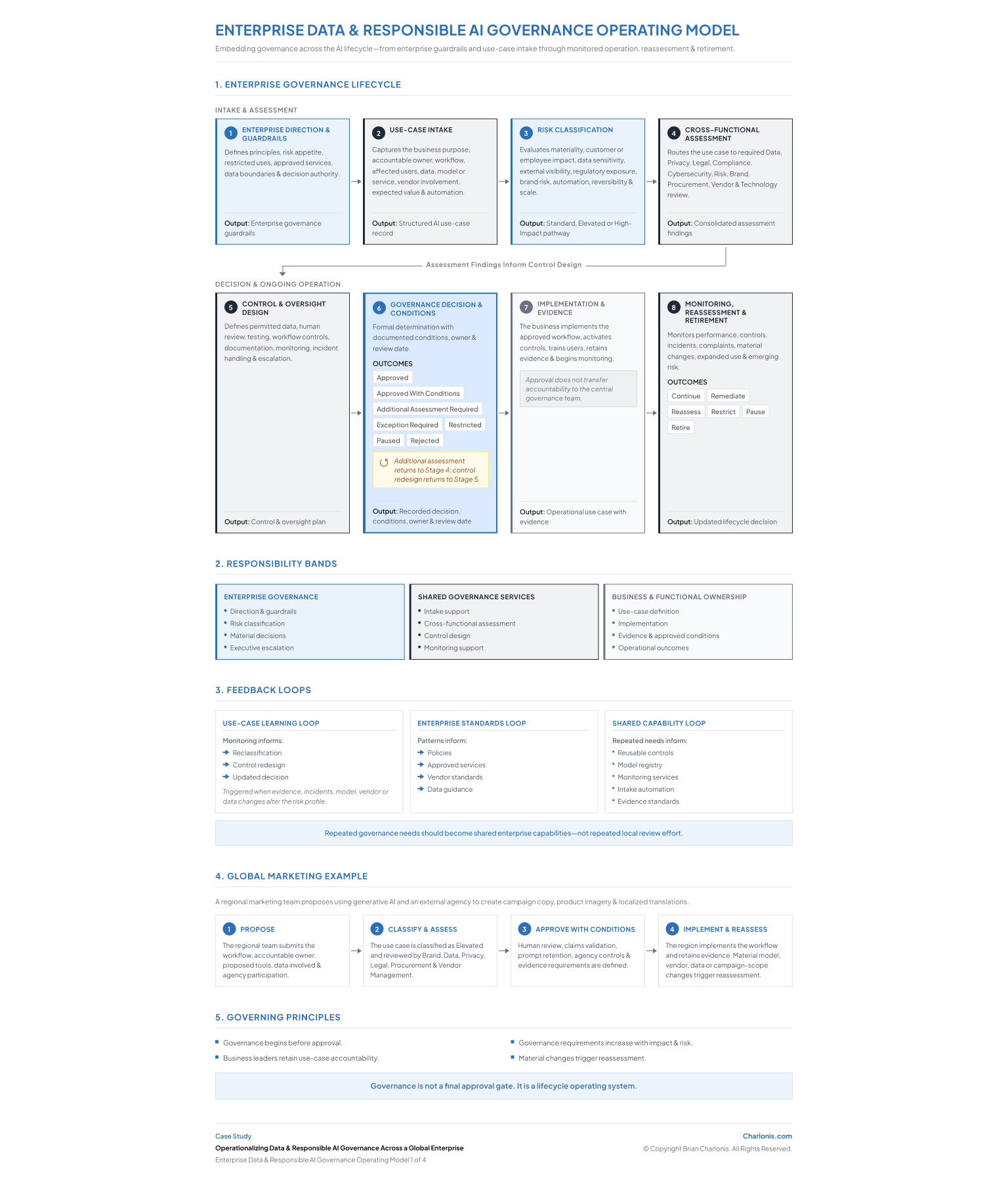
Enterprise Data & Responsible AI Governance Operating Model
The operating model defined governance as a lifecycle system rather than a final approval gate. It connected enterprise direction, use-case intake, risk classification, cross-functional assessment, control design, governance decision, implementation evidence, monitoring, reassessment, and retirement so governance could remain active as use cases, vendors, data, models, scale, workflows, or intended uses changed.
Key Elements
- Enterprise direction, principles, restricted uses, risk appetite, approved services, and data boundaries.
- Use-case intake covering business purpose, accountable owner, workflow, data, model, vendor, expected value, and intended automation.
- Risk classification and cross-functional assessment.
- Governance decisions, approval conditions, exceptions, remediation, restriction, pause, rejection, or retirement.
- Monitoring, material-change reassessment, and lifecycle retirement logic.
Artifact type: Lifecycle operating model / governance process.
The artifact showed how enterprise direction becomes intake, classification, assessment, control design, decision, implementation, monitoring, reassessment, and retirement.
How It Shaped Decisions
This component would support governance leaders, business and functional leaders, Data Owners, Product, Model or Service Owners, technology teams, regional teams, and control functions in determining what enters governance, which pathway applies, what controls are required, who must review, what conditions apply, and when reassessment is necessary.
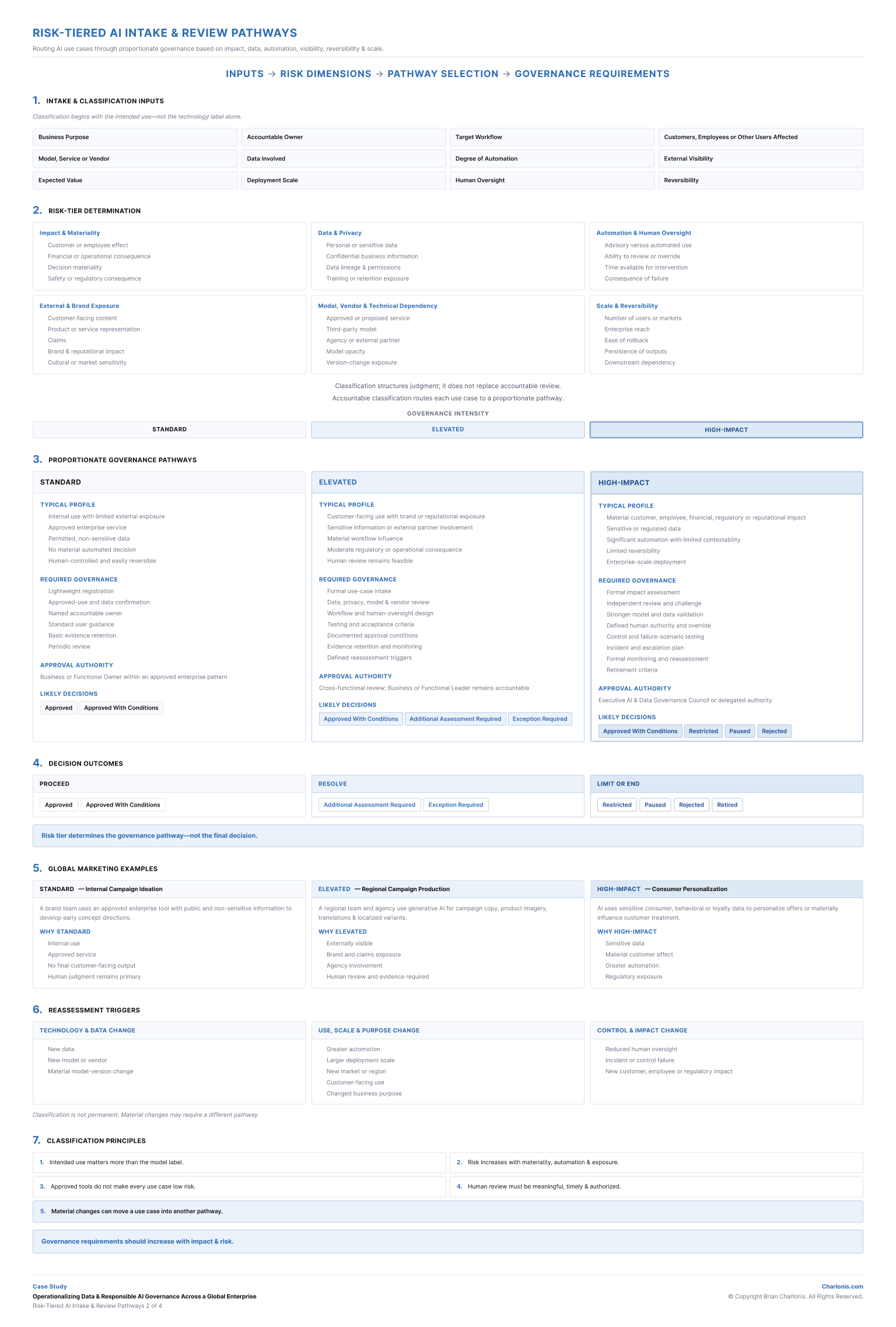
Risk-Tiered AI Intake & Review Pathways
The pathway model applied governance requirements proportionate to impact and risk. It separated Standard, Elevated, and High-Impact use cases so lower-risk work could move through reusable pathways while customer-facing, sensitive, externally exposed, automated, or material uses received stronger review, evidence, monitoring, and approval authority.
Key Elements
- Standard pathway for lower-risk internal uses within approved boundaries.
- Elevated pathway for customer-facing content, sensitive information, brand exposure, external partners, or moderate operational consequence.
- High-Impact pathway for material customer, employee, financial, regulatory, reputational, automation, or enterprise-scale exposure.
- Classification criteria across impact, data, privacy, automation, oversight, external exposure, vendor dependency, scale, and reversibility.
- Evidence, review depth, authority, and monitoring requirements by pathway.
Artifact type: Routing model / governance pathway.
The artifact showed how use-case characteristics could determine proportionate governance requirements, evidence, review depth, monitoring, and decision authority.
How It Shaped Decisions
This component would support business sponsors, governance teams, Data Owners, Product, Model or Service Owners, control functions, agencies, and vendors in determining which pathway applies, what evidence is required, who must review, and whether a use case may proceed, proceed with conditions, require remediation, or escalate.
Governance Accountability & Decision Rights Network
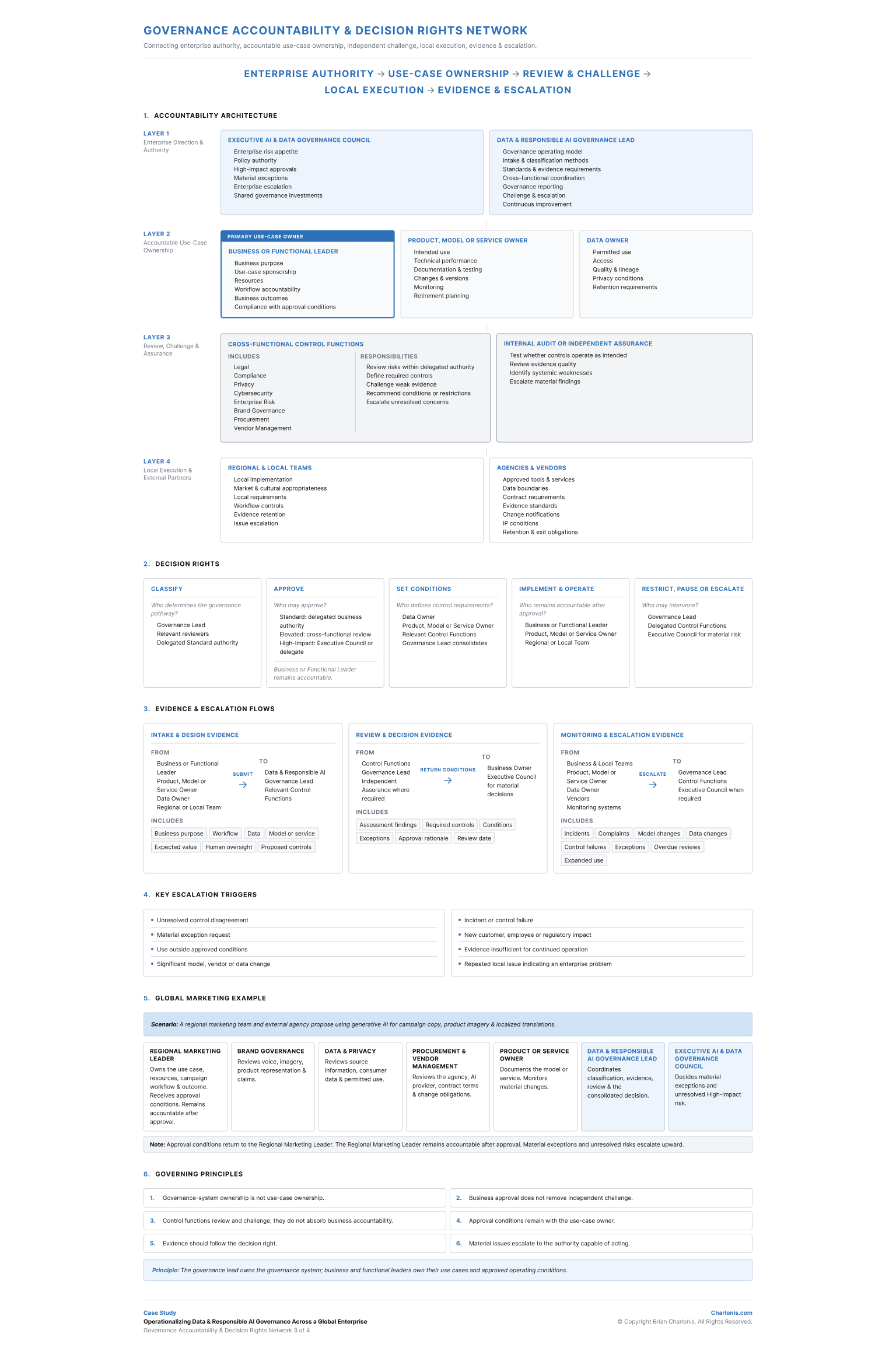
The accountability network clarified how governance could scale without centralizing all ownership or distributing responsibility so broadly that no one remained accountable. It distinguished enterprise authority, governance-system ownership, primary use-case ownership, data ownership, model or service ownership, control-function review, local execution, agency and vendor responsibilities, evidence retention, and escalation.
Key Elements
- Proposed Executive AI & Data Governance Council authority over risk appetite, policy, material exceptions, High-Impact approvals, and enterprise escalation.
- Data & Responsible AI Governance Lead ownership of the governance operating model, classification method, evidence standards, coordination, reporting, challenge, escalation, and continuous improvement.
- Business or Functional Leader accountability for purpose, sponsorship, resources, workflow, outcomes, and approved operating conditions.
- Data Owner, Product, Model, Service Owner, control-function, regional, local, agency, and vendor responsibilities.
- Escalation relationships when unresolved risk requires authority capable of acting.
Artifact type: Accountability and decision-rights model.
The artifact showed who owns the governance system, use case, data, model or service, review, challenge, implementation, evidence, and proposed escalation logic.
How It Shaped Decisions
This component would support executive governance, the Data & Responsible AI Governance Lead, business leaders, Data Owners, Product, Model or Service Owners, control functions, regional teams, agencies, and vendors in determining who owns the use case, who reviews specific risks, who may approve or restrict it, what must escalate, and who remains accountable after approval.
Executive AI Governance Portfolio & Decision View
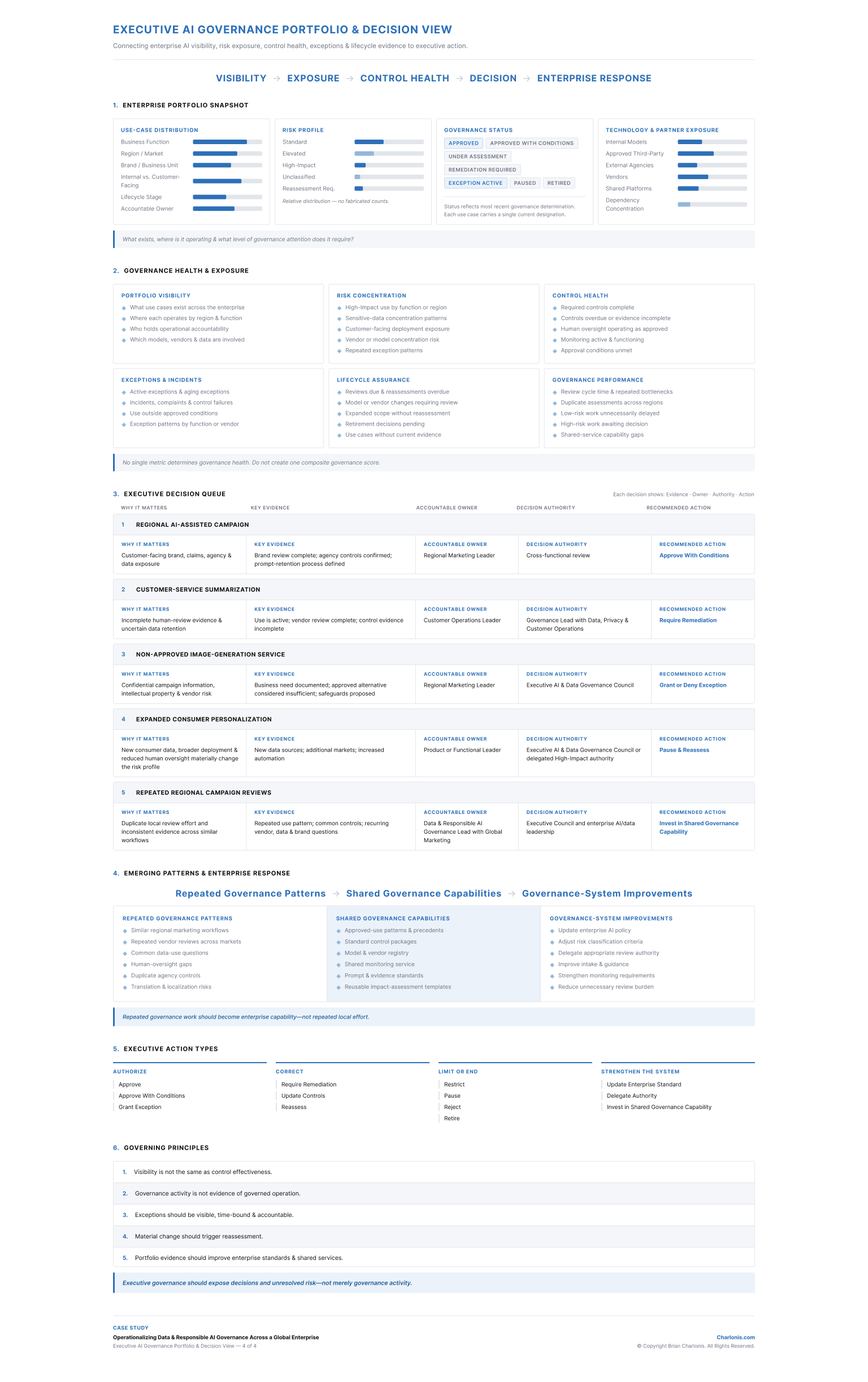
The executive view connected portfolio visibility, risk concentration, control health, exceptions, lifecycle assurance, governance performance, and repeated governance needs to leadership action. It shifted executive reporting away from counts of policies, training sessions, registered use cases, or completed reviews and toward unresolved risk, decision queues, overdue conditions, reassessment needs, and shared capability opportunities.
Key Elements
- Portfolio visibility into use cases, ownership, models, vendors, regions, functions, and lifecycle status.
- Risk concentration, dependency concentration, incomplete controls, aging exceptions, incidents, and overdue decisions.
- Executive Decision Queue showing why the issue matters, what evidence exists, who owns it, which authority can act, and what decision is required.
- Potential actions including approval, conditional approval, remediation, exception decision, reassessment, restriction, pause, rejection, retirement, standard update, delegated authority, or shared capability investment.
- Repeated governance patterns that may justify approved patterns, reusable control packages, common evidence standards, shared monitoring services, or revised classification criteria.
Artifact type: Executive governance decision view.
The artifact showed how portfolio visibility, exposure, control health, exceptions, lifecycle evidence, and governance performance could support executive decisions and enterprise improvement.
How It Shaped Decisions
This component would support executive governance, Data and AI leadership, enterprise risk, business leaders, control functions, and independent assurance in determining where intervention is required, which risks remain unresolved, which conditions or reviews are overdue, and where repeated governance work should become shared enterprise capability.
TRADEOFFS & DECISIONS
Enablement vs Control
- Tradeoff: Governance must reduce unacceptable risk without turning every use case into a lengthy approval exercise.
- Response: I structured proportionate pathways, reusable approved patterns, and shared governance services so lower-risk work could move through understood routes while higher-impact work received stronger review and monitoring.
Enterprise Consistency vs Local Flexibility
- Tradeoff: The enterprise needed common standards, evidence, and decision authority, while functions and regions needed to respond to local markets, regulations, workflows, and cultural conditions.
- Response: I standardized minimum requirements and governance logic while preserving accountable local execution within defined enterprise guardrails.
Central Expertise vs Business Ownership
- Tradeoff: Central governance and control functions provide expertise, challenge, and coordination, but they cannot own every use case or business outcome.
- Response: I kept business and functional leaders accountable for purpose, resources, workflow, outcomes, and approved operating conditions while governance owned the system, methods, evidence standards, challenge, and escalation.
Visibility vs Administrative Burden
- Tradeoff: The enterprise needed reliable visibility into AI use, ownership, risk, and control health, but excessive documentation could push teams outside the governance system.
- Response: I matched intake, evidence, monitoring, and review requirements to the use case’s impact and risk so governance burden remained proportionate.
OUTCOMES
This case produced a Data & Responsible AI Governance operating model, four conceptual artifacts, risk-tiered pathways, accountability logic, executive decision-view design, and lifecycle reassessment model. It was developed as an independent conceptual transformation scenario and does not claim production deployment, institutional adoption, realized financial impact, quantified risk reduction, or measured governance performance.

Impact Summary
- Defined an enterprise Data & Responsible AI Governance lifecycle embedded into how AI is selected, approved, implemented, monitored, reassessed, and retired.
- Established proportionate Standard, Elevated, and High-Impact governance pathways.
- Clarified governance-system ownership, primary use-case ownership, review authority, evidence flow, and escalation.
- Created an executive portfolio view centered on exposure, control health, unresolved decisions, and shared capability needs.
- Embedded exceptions, material-change reassessment, and retirement into the governance lifecycle.Created portfolio-level visibility logic for material AI exposure and unresolved risk.

Evidence
- Enterprise Data & Responsible AI Governance Operating Model showed how enterprise direction becomes intake, classification, assessment, control design, decision, implementation, monitoring, reassessment, and retirement.
- Risk-Tiered AI Intake & Review Pathways structured how impact and risk determine governance requirements, evidence, review depth, and decision authority.
- Governance Accountability & Decision Rights Network clarified who owns the governance system, use case, data, model or service, review, challenge, implementation, evidence, and escalation.
- Executive AI Governance Portfolio & Decision View connected portfolio visibility, exposure, control health, exceptions, lifecycle evidence, and governance performance to executive decisions.
- The model defined proposed governance decisions including approval, conditional approval, remediation, exception handling, reassessment, restriction, pause, rejection, and retirement.
- The model established how repeated governance demand could become reusable enterprise standards, evidence packages, approved patterns, or shared monitoring services.

Signals Monitored
- Use-case volume, function, region, accountable owner, lifecycle status, risk tier, external exposure, customer or employee impact, and deployment scale.
- Data sensitivity, permitted use, lineage, retention, privacy conditions, models, services, vendors, agencies, and dependency concentration.
- Human-oversight design, control completion, approval conditions, active exceptions, incidents, complaints, and uses outside approved conditions.
- Material changes, monitoring findings, overdue reviews, reassessment status, repeated bottlenecks, delayed decisions, and recurring governance patterns that may require shared standards, services, or controls.

Decision Thresholds
- Do not approve a use case without an accountable business owner, defined purpose, workflow, data, model or service, approval conditions, and monitoring plan.
- Require stronger evidence, authority, and monitoring as impact and exposure increase.
- Require reassessment when the model, vendor, data, automation, scale, market, workflow, or intended use changes materially.
- Restrict, pause, retire, or escalate uses where required controls, evidence, approved conditions, or High-Impact risk cannot be maintained by the authority capable of acting.
Brian completed the governance lifecycle model, risk-tiered pathways, accountability and decision-rights network, executive portfolio view, and shared-capability logic that could support stakeholder review and implementation planning. Production deployment, legal interpretation, control execution, technical model development, platform architecture, institutional adoption, quantified risk reduction, and realized financial outcomes remained outside the scope of the case.
LEADERSHIP REFLECTION
What This Case Demonstrates
- Governance is more scalable when it operates as a lifecycle system rather than a final approval gate.
- Proportionate pathways help governance enable safe scale by matching review effort, evidence, and authority to impact and risk.
- Governance-system ownership is different from use-case ownership; the governance lead owns the system, while business and functional leaders remain accountable for the work.
- Executive reporting should expose unresolved risk, overdue decisions, control health, and shared capability needs, not merely governance activity.
What I Would Validate Next
- How AI use cases currently enter the enterprise across functions, regions, vendors, agencies, and embedded tools.
- Which use-case characteristics should determine pathway, approval authority, evidence, and monitoring depth.
- Whether current data, model, vendor, human-oversight, and lifecycle evidence is reliable enough for governance decisions.
- Which repeated governance needs should become approved patterns, shared evidence standards, reusable control packages, or shared monitoring services.
What I Would Watch Closely
- Governance becoming a centralized approval queue.
- Business leaders treating approval as a transfer of accountability.
- Documentation being completed without controls operating in practice.
The central challenge was not whether the enterprise could write Data & Responsible AI policies.
It was whether governance could operate inside business workflows so teams knew what was allowed, higher-impact uses received proportionate review, leaders remained accountable, controls stayed active through the lifecycle, and evidence determined what could continue, change, or scale.
RECOMMENDED

CASE STUDY
FEDERATED AI ADOPTION
Enterprise AI Adoption Across a Decentralized Software Portfolio
Defined a federated AI adoption model for a decentralized software portfolio, connecting business-unit readiness, local ownership, workflow-change evidence, value signals, and cross-unit learning to move AI adoption beyond tool access and isolated pilots.
AI Adoption
Enterprise AI Adoption
Federated Operating Model

CASE STUDY
INSTITUTIONAL GOVERNANCE
Enterprise Governance & Policy Architecture for AI Systems
Defined an enterprise AI governance architecture with an AI charter, portfolio risk taxonomy, capital-allocation governance model, and vendor governance framework to clarify oversight, decision authority, policy expectations, and investment discipline for responsible AI scale.
AI Governance
Enterprise Decision Systems
Capital Discipline

CASE STUDY
AI PORTFOLIO & INVESTMENT
Allocating Enterprise AI Investment Across a Multi-Product Consumer Fintech
Structured an AI portfolio investment system for a multi-product fintech, using capability sequencing, staged funding, evidence thresholds, and executive decision logic to determine which AI initiatives should be funded, combined, constrained, accelerated, paused, stopped, or rebalanced.
Enterprise AI Strategy
AI Portfolio Strategy
Evidence-Based Funding

CASE STUDY
OPERATIONAL AI GOVERNANCE
Human-in-the-Loop Governance for AI Decision Systems
Defined a human-in-the-loop governance model for regulated AI-assisted decisions, establishing confidence thresholds, escalation controls, override tolerance, monitoring signals, synthetic scenario comparison, and recalibration logic for when automation should defer to human judgment.
Operational AI Governance
Human-in-the-Loop Decision Systems
Monitoring & Recalibration
Can Your Governance Model Keep Pace With AI Adoption?
I help enterprises embed Data & Responsible AI Governance into business workflows so teams can move faster within clear, accountable & proportionate guardrails.