
CASE STUDY
Operationalizing AI Adoption Across Enterprise Workflows
Creating the accountability, workflow change, evidence & learning system required to move AI from isolated pilots into sustained business value.
PAGE STATUS 06/25/2026: Working draft of content. Semi-final artifacts. Case needs optimization for length, readability, clarity, and formatting.
AI Strategy
Enterprise Transformation
Organizational Adoption
CONCEPTUAL TRANSFORMATION SCENARIO
AI Transformation & Adoption Lead
A global enterprise software portfolio organization, a decentralized group of vertical-market software businesses had invested in AI tools, pilots & shared expertise, but progress remained uneven across its business units.
Some teams had active experiments. Others were still identifying where AI could create value. Similar use cases were being explored independently, employees used available capabilities inconsistently, and leadership lacked a reliable way to distinguish access and activity from sustained workflow adoption and measurable value.
The proposed operating model treats AI adoption as an organizational capability rather than a technology rollout. It connects enterprise direction, business-unit readiness, accountable local leadership, workflow activation, manager reinforcement, adoption evidence, value realization & cross-unit learning.
The result is a repeatable system that allows autonomous business units to move at different speeds without becoming disconnected—and gives leadership a clearer basis for deciding what should continue, revise, embed, replicate, adapt, pause or stop.
Deployment is not adoption.
AI changes the organization only when accountable leaders change how work gets done.
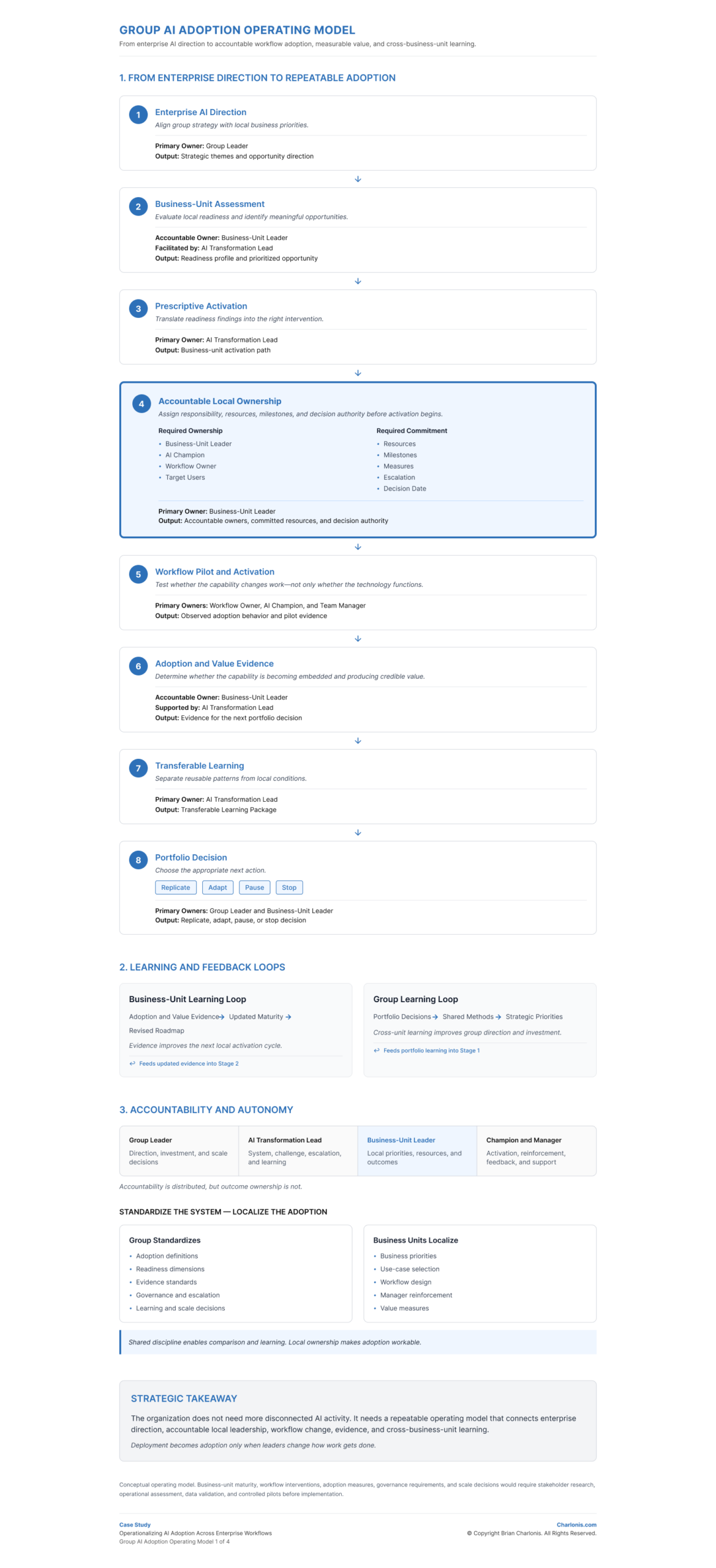
Group AI Adoption Operating Model
Challenge
The organization had already made AI capabilities available across multiple business units.
Leadership expected those investments to improve productivity, strengthen operations, accelerate customer-facing innovation & create new commercial value. Yet the organization was not changing consistently.
Some employees experimented with AI regularly, while others rarely used the available capabilities. Some business units had moved into pilots, while others remained in discovery. Similar initiatives emerged independently. Local leaders, managers, Champions & central teams often interpreted priorities and success differently.
The visible symptoms included:
- Inconsistent adoption across business units
- Uneven use among teams and roles
- Duplicated experiments and pilot activity
- Fragmented local practices
- Business units progressing at different speeds
- Pilots that demonstrated functionality without becoming standard work
- AI Champions operating without sufficient authority, time or support
- Managers who were not equipped to reinforce new behaviors
- Reporting focused on licenses, training, logins & pilot counts
- Limited evidence connecting AI usage to workflow or business outcomes
- Difficulty transferring successful practices between units
- Uncertainty about which initiatives should continue, change, scale, pause or stop
Leadership could see activity:
- Tools enabledEmployees trained
- Pilots initiated
- Demonstrations completedUse cases proposed
- Champion sessions conducted
But those measures did not answer the questions that mattered:
- Were target users repeatedly applying the capability within the intended workflow?
- Had responsibilities, decisions, handoffs & management routines changed?
- Were managers reinforcing the new behavior?
- Was credible operational, customer, commercial, employee, quality or risk value emerging?
- Which barriers were local, and which required group intervention?
- Which patterns could transfer to another business unit?
- Which initiatives justified continued investment?
The organization did not lack technology, executive interest or potential use cases.
It lacked a repeatable operating model for translating enterprise AI ambition into local accountability, redesigned workflows, sustained employee behavior, credible evidence & reusable learning.
The executive question became: If we invested in AI, why has the organization not changed?
The opportunity was to create a repeatable operating model that translated enterprise AI ambition into local accountability, embedded workflow change, measurable value, and transferable learning.
Strategic Question
How could a decentralized group move from AI tool deployment to sustained enterprise capability adoption while preserving business-unit autonomy?
Key Drivers
- Translate enterprise AI strategy into practical business-unit priorities and roadmaps.
- Distinguish capability availability, experimentation, regular use, embedded adoption & measurable value.
- Assess differences in leadership commitment, workflow readiness, workforce capability, data conditions, delivery capacity & measurement discipline.
- Connect readiness gaps to specific interventions rather than a generic maturity score.
- Make Business-Unit Leaders accountable for local resources, workflow participation & outcomes.
- Give AI Champions clear responsibilities, practical tools, support & escalation pathways.
- Equip Team Managers to reinforce new expectations through normal operating routines.
- Clarify how Workflow Owners translate business objectives into role, decision, handoff & standard-work changes.
- Test workflow adoption and business value, not technical functionality alone.
- Detect abandonment, workarounds, trust concerns, support demand & capability gaps early.
- Create comparable adoption definitions while preserving use-case-specific value measures.
- Capture local learning in a form that can be assessed and reused across business units.
- Give executives an evidence-based basis for Continue, Revise, Embed, Replicate, Adapt, Pause & Stop decisions.
My Role
I led the development of the conceptual AI adoption operating model, translating enterprise AI ambition, business-unit autonomy, workflow realities, leadership accountability, employee behavior & value-realization needs into a coordinated transformation strategy.
I approached the challenge as an organizational operating-model problem rather than a technology deployment problem.
My role was to define how an AI Transformation & Adoption Lead could:
- Assess business-unit readiness consistently
- Translate group priorities into local adoption roadmaps
- Structure opportunity identification and prioritization
- Connect readiness gaps to prescriptive activation interventions
- Establish accountability across Group Leaders, Business-Unit Leaders, Champions, Workflow Owners, Team Managers & Target Users
- Design pilots around workflow adoption, behavior change, feasibility, controls & value
- Measure adoption beyond access, training or login activitySurface barriers, dependencies & overdue decisions
- Support escalation without absorbing local responsibility
- Turn local experience into transferable organizational learning
- Give executives a balanced view of adoption, value, risk, sustainability & scale readiness
The role does not build the AI solutions or assume ownership of local business outcomes.
The operating principle is: The transformation lead owns the adoption system; Business-Unit Leaders own the outcomes.
Scope
- Defined the future-state Group AI Adoption Operating Model.
- Mapped how enterprise direction translates into local priorities, workflows, milestones & accountability.
- Established a shared definition of adoption from availability through sustained value-producing use.
- Defined eight business-unit readiness dimensions.
- Connected readiness conditions to prescriptive activation paths and next decisions.Structured workflow-centered pilot and activation logic.
- Clarified responsibilities for the Group Leader, AI Transformation Lead, Business-Unit Leader, AI Champion, Workflow Owner, Team Manager, Target Users & Shared Enabling Functions.
- Defined decision rights, evidence flows, escalation triggers & accountability boundaries.
- Established adoption, workflow, value, risk, sustainability & scale-readiness evidence domains.Defined evidence-confidence levels and decision thresholds.
- Formalized a Transferable Learning Package for cross-business-unit reuse.
- Defined Continue, Revise, Embed, Replicate, Adapt, Pause & Stop decision criteria.Produced four conceptual transformation artifacts.
Technical model development, platform architecture, vendor selection, MLOps, and production integration design were outside the scope.
Approach & Methodology
Approach
- Treat AI adoption as an accountability and operating-model problem rather than a tool rollout.
- Begin with the business unit and workflow rather than the technology.
- Preserve business-unit autonomy while standardizing methods, definitions, evidence expectations & decision criteria.
- Make Business-Unit Leaders accountable for local outcomes.
- Use readiness assessment to determine intervention, not merely describe current state.
- Separate business-unit readiness from workflow adoption depth.
- Define adoption through sustained workflow behavior rather than access or isolated use.
- Treat managers as the primary reinforcement layer for new operating behavior.
- Position AI Champions as coordinators and translators, not substitute sponsors.
- Design pilots to test workflow fit, adoption, value, feasibility, quality & governance.
- Treat training as one intervention rather than the adoption strategy.
- Scale learning before scaling technology.Require evidence before continued investment or cross-unit replication.
- Treat Pause & Stop as legitimate outcomes of disciplined transformation.
Methodology
- Mapped the failure chain from enterprise AI ambition to uneven local activity and unclear value.
- Identified breakdowns in strategy translation, accountability, workflow ownership, management reinforcement, measurement & learning.
- Defined stakeholder responsibilities, decision rights & accountability boundaries.
- Established eight business-unit readiness dimensions.
- Created five prescriptive activation conditions: Early Stage, Developing, Activating, Embedding & Scaling.
- Defined the Available-to-Value-Producing adoption continuum.
- Structured a six-phase execution method: Align, Assess, Design, Activate, Embed & Learn to Scale.
- Designed the Transferable Learning Package.
- Defined six balanced evidence domains covering adoption, workflow integration, value, trust, sustainability & transferability.
- Established four evidence-confidence levels: Directional, Emerging, Credible & Validated.
- Defined escalation triggers, evidence thresholds & scale-readiness criteria.
- Developed four conceptual artifacts to communicate the operating model.
Solution
The proposed solution is a Group AI Adoption Operating Model that connects enterprise direction to business-unit readiness, accountable local leadership, workflow activation, measurable adoption, value evidence & cross-unit learning.
It does not prescribe one AI tool, one use case or one uniform rollout. Instead, it creates a shared system through which autonomous business units can identify meaningful opportunities, understand their readiness, receive the right intervention, change how work is performed & produce evidence for the next leadership decision.
The group standardizes:
- Adoption definitions
- Readiness dimensions
- Evidence expectations
- Accountability boundaries
- Escalation pathways
- Learning requirements
- Portfolio decision logic
Business units localize:
- Business priorities
- Opportunity selection
- Workflow design
- Resource commitments
- Manager reinforcement
- Value measures
- Activation timing
This creates consistency without removing local autonomy.
Group AI Adoption Operating Model
The operating model connects eight stages:
1. Enterprise AI Direction
Group leadership establishes strategic themes, investment boundaries, operating principles & areas where shared effort may create leverage.
The objective is not to create one universal use-case list. It is to give business units enough direction to identify opportunities aligned with group and local priorities.
2. Business-Unit Assessment
Each business unit evaluates its readiness and identifies meaningful customer, commercial, product or operational opportunities.
The assessment considers:
- Strategic alignment
- Leadership commitment
- Opportunity clarity
- Data & technology readiness
- Workflow readiness
- Workforce readiness
- Delivery capacity
- Measurement discipline
The output is not a maturity score. It is a readiness profile that determines what happens next.
3. Prescriptive Activation
The readiness profile determines the required intervention.
An Early-Stage unit may need leadership alignment and opportunity clarification. A Developing unit may need workflow design and manager enablement. An Activating unit may need barrier removal and repeat-use support. An Embedding unit may need standard-work integration and ownership transition. A Scaling unit may need receiving-unit assessment and adaptation planning.
Maturity matters only when it changes the intervention.
4. Accountable Local Ownership
No opportunity advances without:
- An accountable Business-Unit Leader
- An AI Champion
- A Workflow Owner
- A Team Manager
- Defined Target Users
- Required Shared Enabling Functions
- Resources
- Milestones
- Measures
- Escalation triggers
- A next-decision date
The Business-Unit Leader owns the local priority, committed resources, workflow-change authority, adoption outcomes & value realization.
5. Workflow Pilot & Activation
The pilot tests whether the organization can change how work gets done—not only whether the technology functions.
It examines:
- Workflow fit
- Role and decision changes
- Employee use and judgment
- Manager reinforcement
- Data and technical dependencies
- Human review and escalation
- Abandonment and workarounds
- Quality, trust and risk
- Operational or commercial value
6. Adoption & Value Evidence
Adoption is measured through workflow behavior rather than access.
The model distinguishes:
Available
The capability can be accessed.
Tried
Employees have experimented with it.
Used
Some Target Users apply it regularly.
Embedded
The capability is integrated into roles, workflow steps, decisions, management routines & standard work.
Value-Producing
Sustained use is associated with credible and validated business or operational improvement.
A frequently used capability may still fail to become Embedded if management routines and standard work remain unchanged.
7. Transferable Learning
Every meaningful pilot or embedded workflow produces a structured Transferable Learning Package.
It captures:
- Business problem & value hypothesis
- Former and AI-enabled workflow
- Roles, decisions, handoffs, review points & exceptions
- Adoption evidence
- Value evidence
- Required capabilities
- Barriers & failed assumptions
- Governance considerations
- Reusable and local elements
- Replication recommendation
The organization scales learning before it scales technology.
8. Portfolio Decision
Leadership selects the action supported by the evidence:
- Replicate
- Adapt
- Pause
- Stop
These decisions feed back into group priorities, shared methods and future business-unit roadmaps.
Group AI Adoption Operating Model
Defined
A repeatable operating loop connecting enterprise direction, business-unit assessment, prescriptive activation, accountable ownership, workflow pilots, evidence, learning & portfolio decisions.
Served
Group Leaders, AI Transformation Leads, Business-Unit Leaders, AI Champions, Workflow Owners, Team Managers & Shared Enabling Functions.
Shaped Decisions
Where to focus, which intervention a unit requires, whether local ownership is sufficient, what evidence is needed & whether an initiative should replicate, adapt, pause or stop.
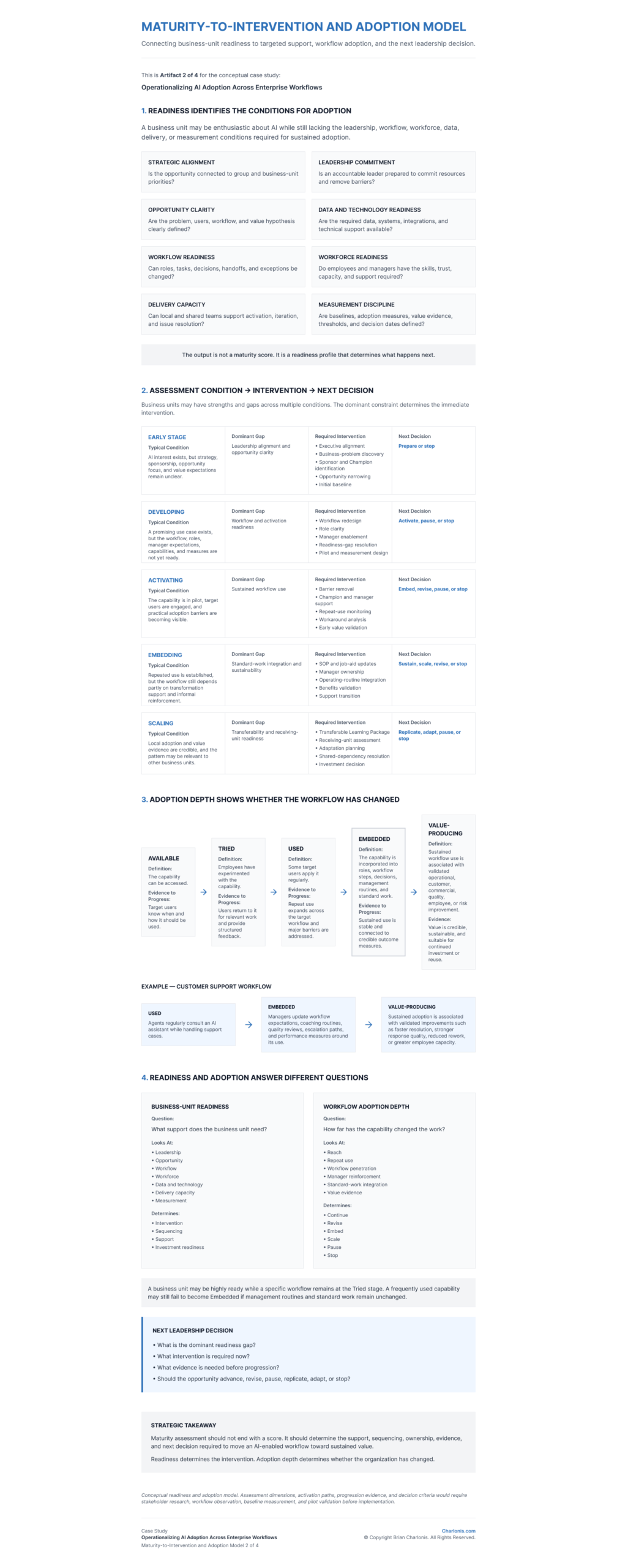
Maturity-to-Intervention & Adoption Model
Readiness and adoption depth answer different questions.
Readiness determines what support the business unit needs. Adoption depth determines how far the workflow has changed.
Business-Unit Readiness
The model assesses eight dimensions:
- Strategic Alignment
- Leadership Commitment
- Opportunity Clarity
- Data & Technology Readiness
- Workflow Readiness
- Workforce Readiness
- Delivery Capacity
- Measurement Discipline
The dimensions create a readiness profile rather than a single composite score.
Prescriptive Activation Paths
Five conditions connect assessment findings to action:
Early Stage
Primary need: leadership alignment and opportunity clarity
Next decision: Prepare or Stop
Developing
Primary need: workflow and activation readiness
Next decision: Activate, Pause or Stop
Activating
Primary need: sustained workflow use
Next decision: Embed, Revise, Pause or Stop
Embedding
Primary need: standard-work integration and sustainability
Next decision: Sustain, Scale, Revise or Stop
Scaling
Primary need: transferability and receiving-unit readiness
Next decision: Replicate, Adapt, Pause or Stop
Business units may have strengths and gaps across several conditions. The dominant constraint determines the immediate intervention.
Workflow Adoption Depth
The Available-to-Value-Producing continuum measures the selected workflow rather than the general capability of the business unit.
A ready business unit may still have a workflow at the Tried stage. Frequent use does not become Embedded adoption until responsibilities, management routines and standard work change.
Customer-Support Example
Used
Agents regularly consult an AI assistant while handling support cases.
Embedded
Managers update workflow expectations, coaching, quality review, escalation and performance measures around its use.
Value-Producing
Sustained adoption is associated with validated improvements such as faster resolution, stronger response quality, reduced rework or greater employee capacity.
Maturity-to-Intervention & Adoption Model
Defined
A model connecting readiness conditions to dominant gaps, required interventions, workflow adoption depth & the next leadership decision.
Served
Business-Unit Leaders, AI Transformation Leads, AI Champions, Workflow Owners, Team Managers & Shared Enabling Functions.
Shaped Decisions
What support is required, whether a unit is prepared to activate, whether a workflow is becoming embedded & what evidence is required before progression.
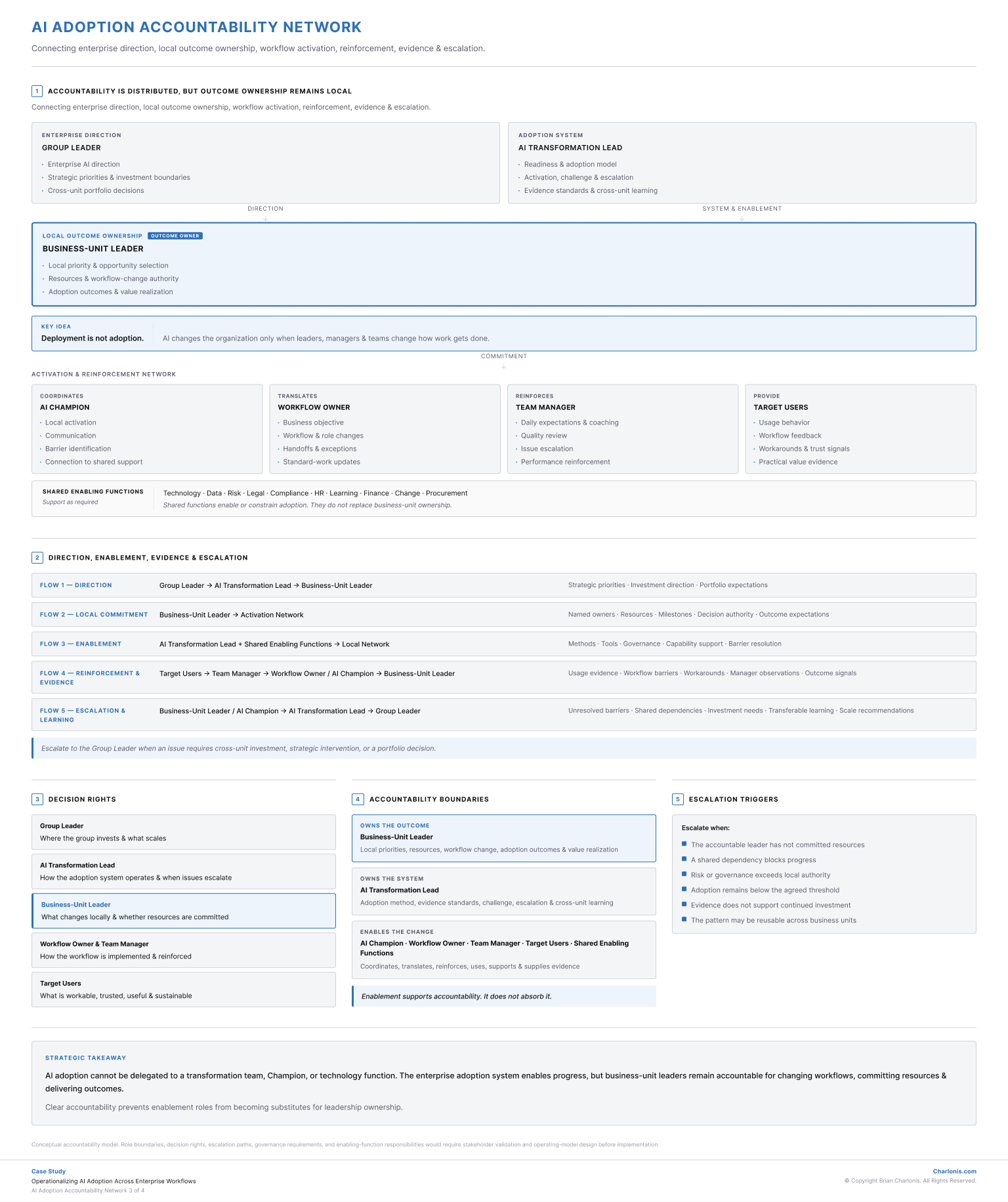
AI Adoption Accountability Network
The dominant organizational risk is accountability diffusion.
When AI is described as everyone’s responsibility, local outcomes can become no one’s responsibility.
The network clarifies three forms of ownership.
Enterprise Direction
Group Leader
Owns:
- Enterprise AI direction
- Strategic priorities & investment boundaries
- Cross-unit portfolio decisions
Adoption System
AI Transformation Lead
Owns:
- Readiness & adoption model
- Activation, challenge & escalation
- Evidence standards & cross-unit learning
The AI Transformation Lead does not own local business outcomes.
Local Outcome Ownership
Business-Unit Leader
Owns:
- Local priority & opportunity selection
- Resources & workflow-change authority
- Adoption outcomes & value realization
The Business-Unit Leader is the local outcome owner and operational hero of the transformation.
Activation & Reinforcement Network
AI Champion
Coordinates:
- Local activation
- Communication
- Barrier identification
- Connection to shared support
Workflow Owner
Translates:
- Business objective
- Workflow & role changes
- Handoffs & exceptions
- Standard-work updates
Team Manager
Reinforces:
- Daily expectations & coaching
- Quality review
- Issue escalation
- Performance reinforcement
Target Users
Provide:
- Usage behavior
- Workflow feedback
- Workarounds & trust signals
- Practical value evidence
Shared Enabling Functions
May include:
Technology · Data · Risk · Legal · Compliance · HR · Learning · Finance · Change · Procurement
Shared functions enable or constrain adoption. They do not replace business-unit ownership.
Accountability Boundary
Enablement supports accountability. It does not absorb it.
Evidence & Escalation
Evidence moves from Target Users through Team Managers, Workflow Owners and AI Champions to the Business-Unit Leader.
Unresolved barriers, shared dependencies, investment needs, governance concerns and transferable learning move through the AI Transformation Lead to the Group Leader when cross-unit intervention or a portfolio decision is required.
AI Adoption Accountability Network
Defined
The ownership, enablement, reinforcement, evidence & escalation relationships required to make adoption operational.
Served
Group Leaders, AI Transformation Leads, Business-Unit Leaders, AI Champions, Workflow Owners, Team Managers, Target Users & Shared Enabling Functions.
Shaped Decisions
Who commits resources, who owns local outcomes, who reinforces the workflow, who supplies evidence, when support is required & when an issue must escalate.
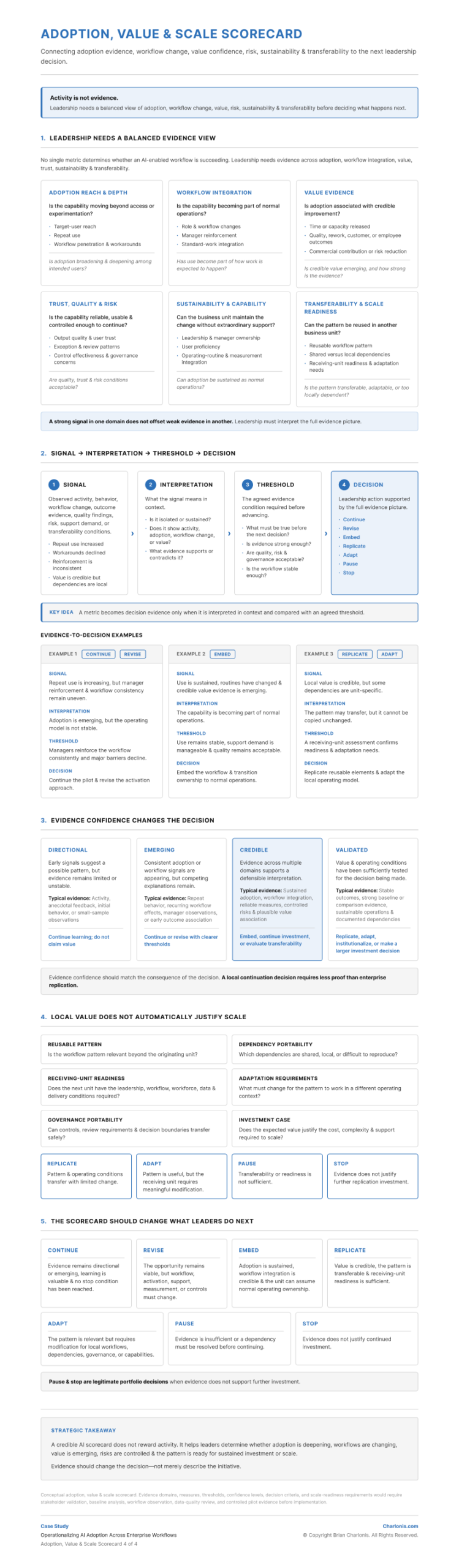
Adoption, Value & Scale Scorecard
Activity does not prove adoption, and adoption alone does not prove value.
Leadership needs a balanced evidence view across six domains.
Adoption Reach & Depth
Examines whether the capability is moving beyond access and experimentation.
Representative signals include:
- Target-user reach
- Repeat use
- Workflow penetration
- Abandonment & workarounds
Workflow Integration
Examines whether use is becoming part of normal operations.
Representative signals include:
- Role & workflow changes
- Manager reinforcement
- Standard-work integration
- Reduced reliance on extraordinary support
Value Evidence
Examines whether adoption is associated with credible improvement.
Value may appear through:
- Time or capacity released
- Quality or rework improvement
- Customer or employee outcomes
- Commercial contribution
- Risk reduction
Trust, Quality & Risk
Examines whether the capability is reliable, usable and controlled enough to continue.
Representative signals include:
- Output quality
- User trust
- Exception and review patterns
- Control effectiveness
- Governance concerns
Sustainability & Capability
Examines whether the business unit can maintain the change as normal operations.
Representative signals include:
- Leadership ownership
- Manager capability
- User proficiency
- Operating-routine integration
- Measurement discipline
Transferability & Scale Readiness
Examines whether the pattern can transfer to another business unit.
Representative signals include:
- Reusable workflow pattern
- Shared versus local dependencies
- Receiving-unit readiness
- Adaptation requirements
- Governance portability
- Investment required
Evidence-to-Decision Logic
The scorecard connects:
Signal → Interpretation → Threshold → Decision
A metric becomes decision evidence only when it is interpreted in context and compared with an agreed threshold.
Evidence Confidence
Evidence may be:
Directional
Early signals suggest a possible pattern, but the evidence remains limited or unstable.
Emerging
Consistent adoption or workflow signals are appearing, but competing explanations remain.
Credible
Evidence across multiple domains supports a defensible interpretation.
Validated
The value relationship and operating conditions have been sufficiently tested for the consequence of the decision.
Evidence confidence should match the decision. A local continuation decision requires less proof than enterprise replication.
Leadership Decisions
The balanced evidence picture supports:
- Continue
- Revise
- Embed
- Replicate
- Adapt
- Pause
- Stop
Pause & Stop are legitimate portfolio decisions when evidence does not justify further investment.
Adoption, Value & Scale Scorecard
Defined
A balanced evidence model connecting adoption, workflow integration, value, trust, sustainability, transferability, evidence confidence & thresholds to leadership action.
Served
Group Leaders, Business-Unit Leaders, AI Transformation Leads, Finance, governance stakeholders & Shared Enabling Functions.
Shaped Decisions
Whether evidence supports continued learning, workflow revision, normal operating ownership, cross-unit replication, local adaptation, pause or termination.
Execution Method
The operating model defines the enterprise system and decision cycle.
The execution method describes how an individual opportunity moves through it.
Align
Confirm:
- Business priority
- Accountable Business-Unit Leader
- Target problem and workflow
- Initial value hypothesis
- Resources
- Decision authority
- Decision date
Decision:
Is there enough strategic relevance and leadership commitment to proceed?
Assess
Evaluate:
- Business-unit readiness
- Workflow conditions
- Target Users and managers
- Capabilities and dependencies
- Trust and governance concerns
- Measurement readiness
Decision:
Is the unit prepared to design a credible activation pilot?
Design
Define:
- Future workflow
- Role and decision changes
- Manager reinforcement
- Champion responsibilities
- Target Users
- Human-review requirements
- Measures and thresholds
- Escalation model
Decision:
Is the organization ready to activate?
Activate
Introduce the capability through:
- Role-specific onboarding
- In-workflow guidance
- Manager coaching
- Champion support
- Feedback collection
- Barrier removal
- Milestone-based reviews
Decision:
Is initial use becoming repeatable workflow behavior?
Embed
Move from supported use to normal operations through:
- Standard-work updates
- Manager reinforcement
- Operating-routine integration
- Workaround reduction
- Benefits validation
- Ownership transition
- Sustainability monitoring
Decision:
Can the capability operate as normal business practice?
Learn & Scale
- Conduct a structured retrospective
- Produce the Transferable Learning Package
- Separate reusable and local elements
- Assess receiving units
- Resolve shared dependencies
- Decide whether to Replicate, Adapt, Pause or Stop
Training supports every phase.
It does not replace the adoption system.
Tradeoffs & Decisions
Group Consistency & Local Autonomy
Tradeoff
The group needs consistent definitions, methods, evidence expectations & decision criteria. Business units need flexibility to respond to their own customers, products, workflows & operating conditions.
Design Response
Standardize the adoption system while localizing opportunity selection, workflow design, activation & value measures.
Speed & Readiness
Tradeoff
Leadership wants rapid progress, but moving before sponsorship, workflow, data, skills and measurement are ready can create visible failure and distrust.
Design Response
Use readiness evidence to sequence support and distinguish controlled learning from scale readiness.
Champion Energy & Leader Accountability
Tradeoff
Champions can accelerate local adoption, but overreliance on them allows leaders to avoid committing resources or changing management routines.
Design Response
Define Champion responsibilities and limits while making Business-Unit Leader commitments visible.
Usage & Value
Tradeoff
Frequent use can appear successful even when the workflow or business outcome has not improved.
Design Response
Connect adoption behavior to workflow integration, quality, customer, commercial, employee and risk evidence.
Replication Speed & Local Adaptation
Tradeoff
A successful pilot creates pressure to scale, but copying it unchanged may reproduce the technology without reproducing the value.
Design Response
Separate reusable and local components, assess receiving-unit readiness and define adaptation requirements.
Support & Accountability
Tradeoff
Business units need expertise and support, but excessive central intervention can shift responsibility away from local leaders.
Design Response
Provide methods, challenge, expertise, evidence standards and escalation while keeping local outcomes with the Business-Unit Leader.
Outcomes
Because this is a conceptual transformation scenario, the outcomes describe the operating model, decision framework, evidence system & artifacts that would require validation through stakeholder research and business-unit pilots. No production deployment, realized financial impact or quantified business gains are claimed.

Impact Summary

Defined a repeatable Group AI Adoption Operating Model connecting enterprise direction, local accountability, workflow activation, evidence, learning & portfolio decisions.
Connected business-unit readiness conditions to prescriptive interventions rather than a descriptive score.
Distinguished readiness from workflow adoption depth.
Clarified accountability, decision rights, enablement boundaries, evidence flows & escalation.
Established the Business-Unit Leader as the local outcome owner and the AI Transformation Lead as owner of the adoption system.
Distinguished activity, adoption, workflow integration, value, trust, sustainability & transferability.

Evidence & Outcome Signals
- Qwerty

Signals Monitored
- Qwerty

Decision Thresholds
- Qwerty

Strategic Work Produced
- Qwerty
Artifacts
The artifacts should make the transformation easier to understand and demonstrate how business needs become workflows, requirements, controls, and measurable outcomes.
Qwerty

Qwerty
Key Takeaways
Qwerty
Qwerty
Qwerty
Qwerty
Qwerty
Qwerty
Reflection
What I Would Validate Next
- Qwerty
AI Opportunities
- Qwerty
Supporting AI Professional Specializations
University of Pennsylvania

AI for Business Specialization
Built foundational knowledge of AI applications across marketing, finance, and people management, with emphasis on AI strategy and governance for business leaders.
IBM

Generative AI for Executives & Business Leaders Specialization
Developed a strategic understanding of generative AI, including foundational concepts, integration strategies, and business use cases for practical executive decision-making.
Vanderbilt University

Generative AI Strategic Leader Specialization
Learned advanced generative AI concepts, including deep research, prompt engineering, and agentic AI, with a focus on strategic leadership and decision-making.
Vanderbilt University
Prompt Engineering & Trustworthy AI Specialization
Acquired practical skills in designing effective AI prompts, advanced data analysis, and principles for trustworthy generative AI deployment.
Web3 Opportunities
- Qwerty
- Potential value includes faster onboarding, stronger consent traceability, and reduced duplication.
Supporting Web3 Professional Specializations
Duke University

Decentralized Finance (DeFi): The Future of Finance Specialization
Gained expertise in DeFi infrastructure, primitives, opportunities, and risks, enabling evaluation and strategy for decentralized financial systems.
INSEAD

Blockchain Revolution Specialization
Explored blockchain technologies and applications, focusing on transactions, business opportunities, and strategic analysis for enterprise adoption.
University of Pennsylvania
FinTech: Foundations & Applications of Financial Technology Specialization
Developed a comprehensive understanding of fintech ecosystems, including payments, digital currencies, lending, and the application of AI, InsurTech, and real estate technology within regulated financial environments.
University at Buffalo

Blockchain Specialization
Built a practical foundation in blockchain architecture, Ethereum-based systems, and smart contract execution, with hands-on experience standing up private Ethereum networks, managing accounts, mining blocks, and deploying Solidity smart contracts.
- Blockchain Basics
- Smart Contracts
- Decentralized Applications (Dapps)
- Blockchain Platforms
Recommended
If you liked this case study, you may also be interested in these…
Decision Systems
AI Strategy
Portfolio Strategy
CASE STUDY
PLACEHOLDER
From AI Pilots to Enterprise Capability
Qwerty
Decision Systems
AI Strategy
Portfolio Strategy
CASE STUDY
PLACEHOLDER
Embedded Governance for Enterprise AI
Qwerty
Decision Systems
AI Strategy
Portfolio Strategy
CASE STUDY
STRATEGIC OPERATING MODEL
Building a Governed Intelligence Operating System
Built a governed intelligence system that converts market signals, opportunity evaluations, and portfolio decisions into structured, human-reviewed execution.
Decision Systems
AI Strategy
Portfolio Strategy
Is AI Changing How Your Organization Works?
I help enterprises turn uneven AI activity into accountable workflow adoption, credible value evidence & disciplined scale decisions.