
CASE STUDY
Enterprise AI Adoption Across a Decentralized Software Portfolio
Creating the accountability, workflow change, evidence & learning system required to move AI from isolated pilots into sustained business value.
AI Strategy
Enterprise Transformation
Organizational Adoption
CONCEPTUAL TRANSFORMATION SCENARIO
AI Transformation & Adoption Lead
A global enterprise software portfolio, a decentralized group of vertical-market software businesses, had invested in AI tools, pilots & shared expertise, but progress remained uneven across its business units.
Some teams had active experiments. Others were still identifying where AI could create value. Similar use cases were being explored independently, managers reinforced new behaviors inconsistently & leadership lacked a reliable way to distinguish AI activity from embedded workflow adoption and credible value.
The proposed operating model treats adoption as an enterprise capability rather than a technology rollout. It connects business-unit readiness, accountable local leadership, workflow activation, evidence & cross-unit learning while preserving the autonomy of individual businesses.
Deployment is not adoption. AI changes the organization only when accountable leaders change how work gets done.
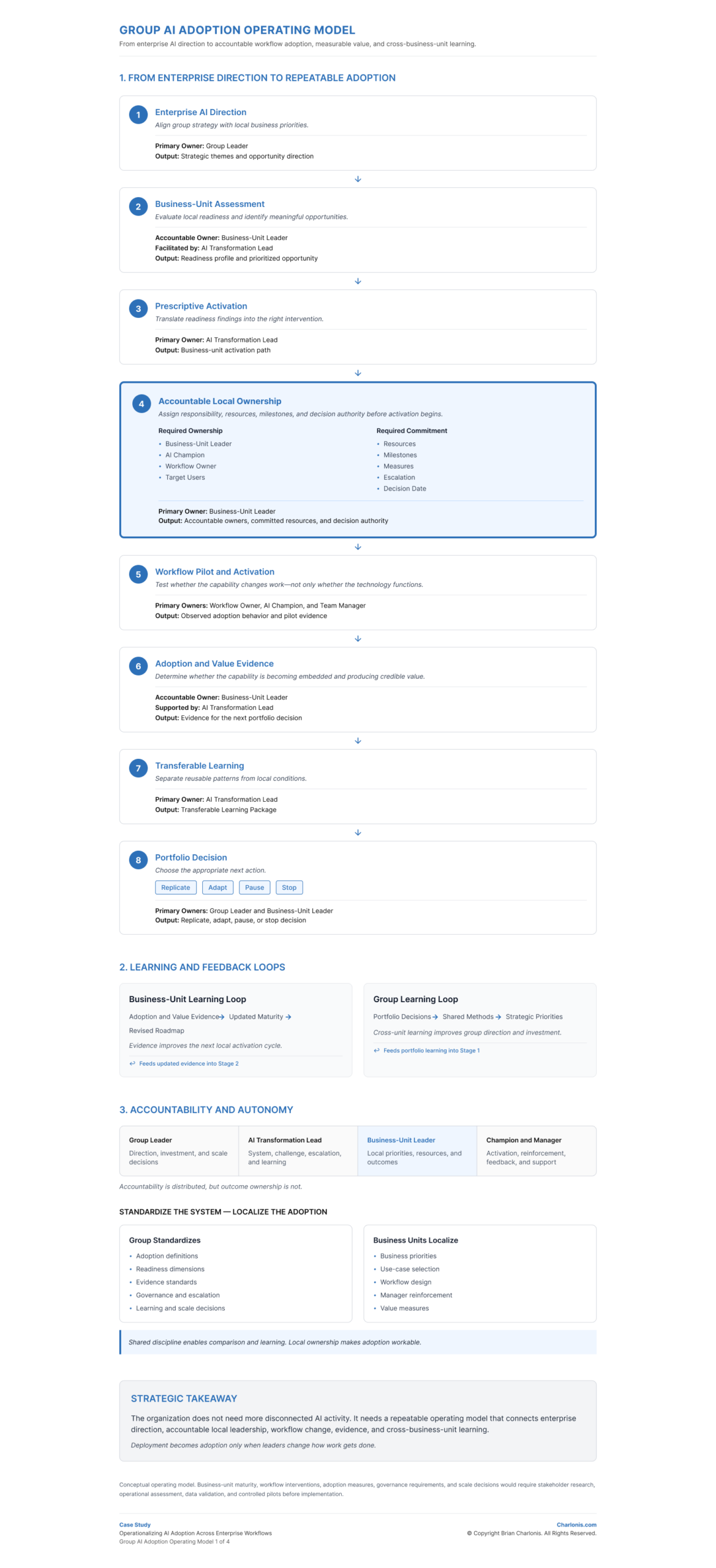
Group AI Adoption Operating Model
Challenge
The organization had already made AI capabilities available across multiple business units.
Leadership expected those investments to improve productivity, strengthen operations, accelerate customer-facing innovation & create commercial value. Yet access to technology was not producing consistent organizational change.
Business units were moving at different speeds. Some had active pilots, while others remained in discovery. Similar opportunities were being explored independently. AI Champions often carried responsibility without sufficient authority, and managers were not consistently equipped to reinforce new workflow expectations.
Leadership could see:
- Tools enabled
- Employees trained
- Pilots launched
- Demonstrations completed
- Use cases proposed
Those measures did not show whether:
- Target Users repeatedly applied AI within the intended workflow
- Roles, decisions, handoffs & management routines had changed
- Business-Unit Leaders were committing resources and removing barriers
- Managers were reinforcing the new operating behavior
- Credible operational or commercial value was emerging
- Successful patterns could transfer to another business unit
The enterprise did not lack technology, executive interest or potential use cases. It lacked a repeatable operating model for translating enterprise AI ambition into local accountability, sustained workflow change, credible evidence & reusable learning.
The executive question became:
If we invested in AI, why has the organization not changed?
Strategic Question
How could a decentralized group move from AI tool deployment to sustained enterprise capability adoption while preserving business-unit autonomy?
Key Drivers
- Translate enterprise AI direction into practical business-unit priorities and adoption roadmaps.
- Assess readiness across leadership, workflow, workforce, data, delivery & measurement conditions.
- Connect readiness gaps to specific interventions rather than a generic maturity score.
- Make Business-Unit Leaders accountable for resources, workflow change, adoption outcomes & value.
- Measure repeated workflow behavior rather than access, training or initial experimentation.
- Capture local evidence and learning in a form that can support cross-unit decisions.
- Distinguish local success from enterprise replication readiness.
- Preserve business-unit autonomy while creating consistent enterprise expectations.
My Role
I led the development of the conceptual adoption operating model, translating enterprise AI ambition, business-unit autonomy, workflow realities, leadership accountability & value-realization needs into a coordinated transformation strategy.
I approached the challenge as an operating-model and accountability problem rather than a technology-deployment or communications problem.
My role was to define how an AI Transformation & Adoption Lead could:
- Assess business-unit conditions and determine the intervention each unit required
- Translate group direction into locally owned adoption roadmaps
- Clarify accountability across Group Leaders, Business-Unit Leaders, AI Champions, Workflow Owners, Team Managers & Target Users
- Design pilots around workflow change, behavior, feasibility, controls & value
- Establish adoption, evidence, escalation & scale-decision methods
- Convert local experience into reusable organizational learning
The transformation lead owns the adoption system, evidence method, challenge process & cross-unit learning. Business-Unit Leaders own local outcomes.
Scope
- Defined the future-state Group AI Adoption Operating Model.
- Established business-unit readiness dimensions and prescriptive activation paths.
- Defined adoption progression from availability through value-producing workflow use.
- Clarified accountability, decision rights, evidence flows & escalation boundaries.
- Established adoption, workflow, value, trust, sustainability & scale-readiness evidence.
- Formalized transferable learning and evidence-based portfolio decisions.
- Defined how an individual opportunity moves through the enterprise adoption system.
Technical model development, platform architecture, vendor selection, MLOps & production integration design were outside the scope.
Approach & Methodology
Approach
- Begin with the business unit and target workflow rather than the technology.
- Preserve local autonomy while standardizing definitions, evidence & decision expectations.
- Use readiness assessment to determine intervention.
- Make leaders and managers accountable for operating change.
- Measure workflow behavior, not deployment activity alone.
- Scale learning before attempting to scale technology.
- Separate reusable enterprise patterns from local adaptation requirements.
- Require stronger evidence as the consequence of the decision increases.
Methodology
- Mapped the failure chain from enterprise ambition to uneven adoption and unclear value.
- Defined readiness dimensions that diagnose business-unit constraints.
- Separated business-unit readiness from workflow adoption depth.
- Established ownership, reinforcement, evidence & escalation relationships.
- Defined how local workflows move from opportunity selection through embedded operating use.
- Connected signals, interpretation, thresholds & confidence to leadership decisions.
- Structured how validated local experience becomes transferable enterprise learning.
Solution
The proposed solution is a Group AI Adoption Operating Model connecting enterprise direction to business-unit readiness, accountable local ownership, workflow activation, evidence & cross-unit learning.
It does not prescribe one AI tool, one use case or one uniform rollout. The group standardizes the adoption system:
- Shared definitions
- Readiness expectations
- Accountability boundaries
- Evidence principles
- Escalation pathways
- Learning requirements
- Portfolio decisions
Business units retain ownership of their priorities, workflows, resources, activation timing & outcomes.
This creates consistency without removing autonomy.
Group AI Adoption Operating Model
The operating model creates an eight-stage cycle:
- Enterprise AI Direction
- Business-Unit Assessment
- Prescriptive Activation
- Accountable Local Ownership
- Workflow Pilot & Activation
- Adoption & Value Evidence
- Transferable Learning
- Portfolio Decision
Group leadership establishes strategic direction and investment boundaries.
Each business unit then assesses its conditions, identifies a meaningful workflow opportunity & receives an intervention suited to its readiness.
No opportunity progresses without:
- An accountable Business-Unit Leader
- A defined workflow
- An AI Champion
- A Workflow Owner
- A Team Manager
- Identified Target Users
- Measures
- Escalation triggers
- A next-decision date
Pilots test whether the organization can change how work gets done, not only whether the technology functions.
Evidence and learning then inform whether the pattern should be:
- Sustained locally
- Revised
- Embedded into normal work
- Adapted for another unit
- Replicated
- Paused
- Stopped
The purpose is not to centralize every implementation. It is to prevent each business unit from rediscovering the same barriers, requirements & operating lessons independently.
Defined
A repeatable operating loop connecting enterprise direction, business-unit assessment, prescriptive activation, accountable ownership, workflow change, evidence, learning & portfolio decisions.
Served
Group Leaders, AI Transformation Leads, Business-Unit Leaders, AI Champions, Workflow Owners, Team Managers, Target Users & Shared Enabling Functions.
Shaped Decisions
Where to focus, what intervention a unit requires, whether ownership is sufficient, what evidence is needed & what should replicate, adapt, pause or stop.
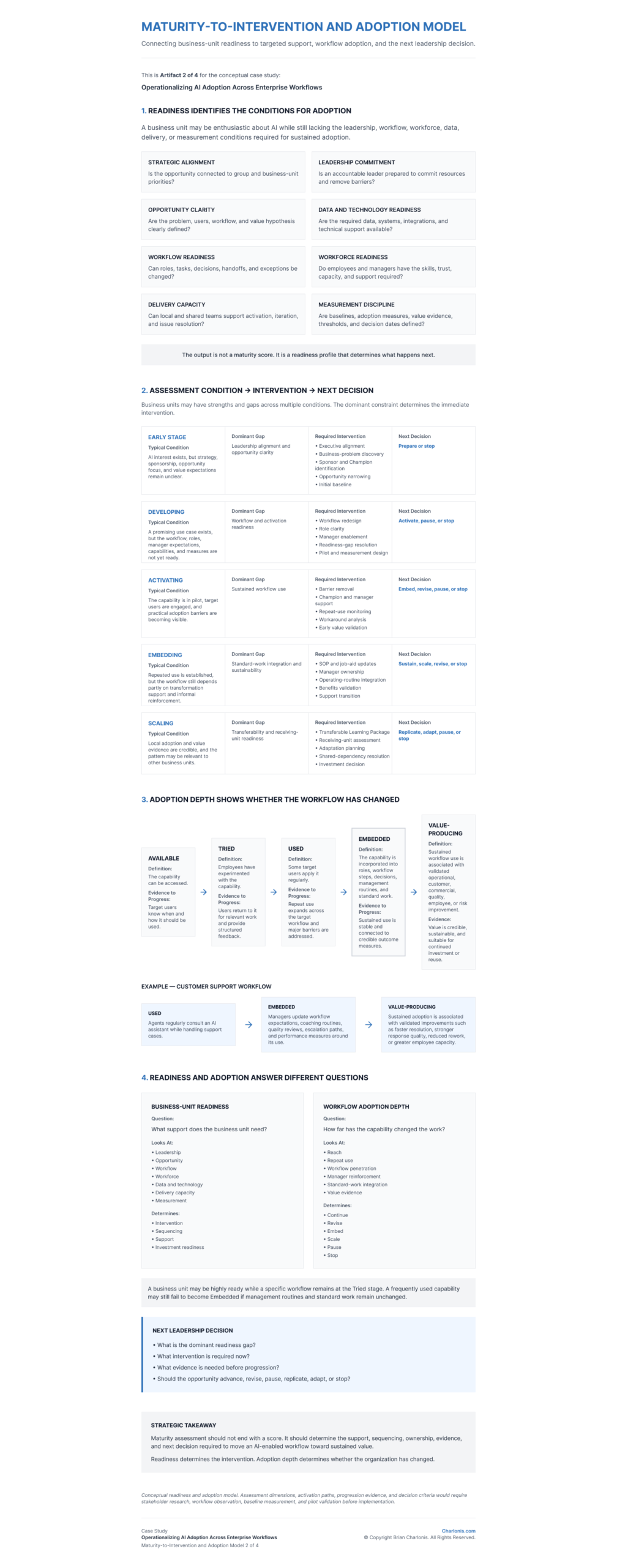
Maturity-to-Intervention & Adoption Model
Readiness and adoption depth answer different questions.
- Readiness determines what support the business unit needs.
- Adoption depth determines how far the workflow has changed.
The Readiness Profile considers:
- Strategic alignment
- Leadership commitment
- Opportunity clarity
- Data & technology readiness
- Workflow readiness
- Workforce readiness
- Delivery capacity
- Measurement discipline
The profile does not produce one composite score. Its purpose is to identify the dominant constraint and prescribe the next intervention.
Five operating conditions guide that intervention:
- Early Stage: Align leadership and clarify the opportunity
- Developing: Prepare the workflow, managers, measures & dependencies
- Activating: Build repeated use and remove adoption barriers
- Embedding: Integrate the capability into standard work and normal ownership
- Scaling: Test transferability, receiving-unit readiness & adaptation needs
Adoption Depth is evaluated separately:
Available → Tried → Used → Embedded → Value-Producing
A capability can be frequently used without becoming embedded.
Embedded adoption requires changes to:
- Roles
- Workflow expectations
- Management routines
- Measures
- Standard work
- Ownership
- Support structures
Maturity matters only when it changes the intervention.
Defined
A model connecting business-unit conditions to required interventions, workflow adoption depth & the next leadership decision.
Served
Business-Unit Leaders, AI Transformation Leads, AI Champions, Workflow Owners, Team Managers & Shared Enabling Functions.
Shaped Decisions
What support is required, whether a unit is ready to activate, whether use is becoming embedded & what evidence is needed before progression.
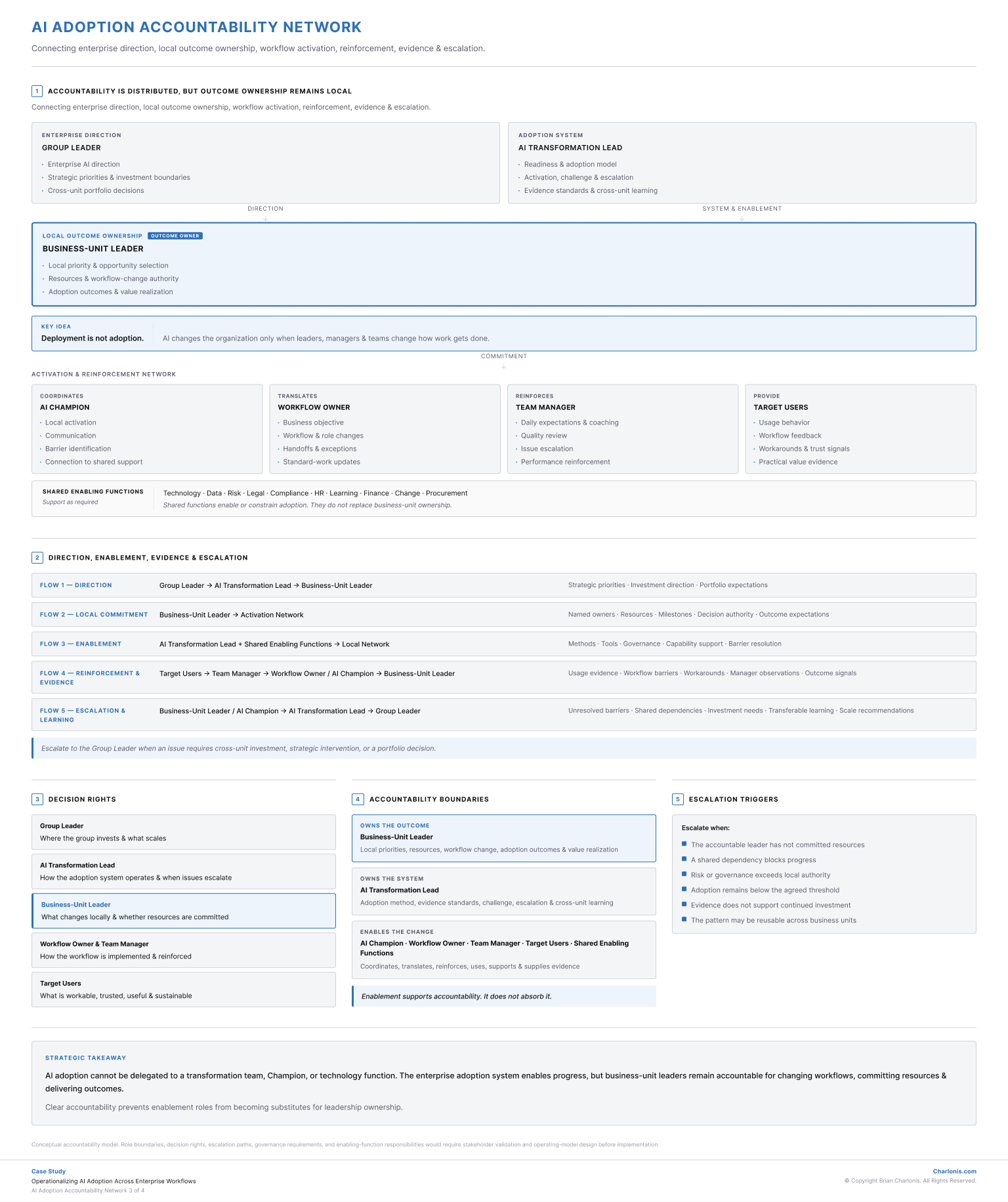
AI Adoption Accountability Network
The primary organizational risk is accountability diffusion.
When AI adoption is described as everyone’s responsibility, local outcomes can become no one’s responsibility.
The accountability model establishes three primary ownership layers.
- Group Leader
Owns enterprise direction, strategic priorities, investment boundaries & cross-unit portfolio decisions. - AI Transformation Lead
Owns the adoption system, readiness method, evidence standards, challenge, escalation & cross-unit learning.
The transformation lead does not own local business outcomes. - Business-Unit Leader
Owns the local priority, resources, workflow-change authority, adoption outcomes & value realization.
The Business-Unit Leader is the local outcome owner and operational hero of the transformation.
The Business-Unit Leader is the local outcome owner and operational hero of the transformation.
The activation network supports that accountability:
- AI Champion: Coordinates local activation and surfaces barriers
- Workflow Owner: Translates the objective into roles, decisions, handoffs & standard work
- Team Manager: Reinforces expectations, coaching, quality & performance
- Target Users: Provide behavior, trust, workaround & practical-value evidence
- Shared Enabling Functions: Provide technology, data, risk, legal, compliance, HR, finance, learning & change support
Enablement supports accountability. It does not absorb it.
Defined
The ownership, reinforcement, enablement, evidence & escalation relationships required to make adoption operational.
Served
Group Leaders, AI Transformation Leads, Business-Unit Leaders, AI Champions, Workflow Owners, Team Managers, Target Users & Shared Enabling Functions.
Shaped Decisions
Who commits resources, who owns local outcomes, who reinforces the workflow, when support is required & when an issue must escalate.
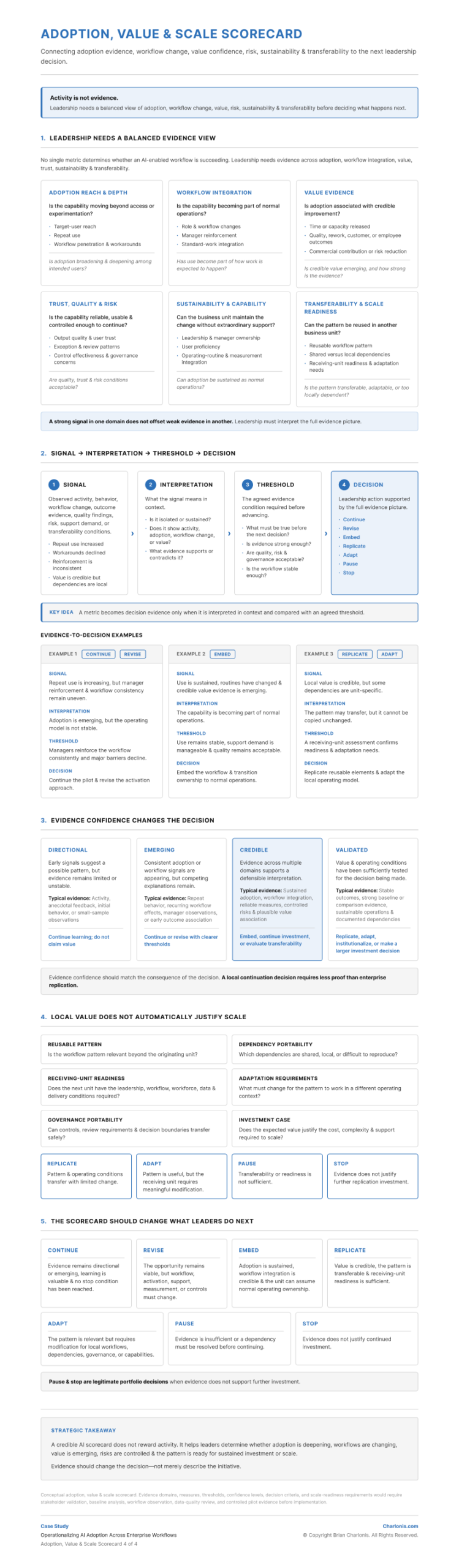
Adoption, Value & Scale Scorecard
Activity does not prove adoption. Adoption alone does not prove value.
The scorecard gives leadership a balanced evidence view across six domains:
- Adoption Reach & Depth
- Workflow Integration
- Value Evidence
- Trust, Quality & Risk
- Sustainability & Capability
- Transferability & Scale Readiness
The purpose is not to create one score. It is to turn evidence into a decision:
Signal → Interpretation → Threshold → Decision
Evidence confidence progresses from:
- Directional
- Emerging
- Credible
- Validated
The evidence standard should match the consequence of the decision.
Continued local learning requires less proof than embedding a workflow into normal operations. Enterprise replication requires stronger evidence than either.
Leadership may decide to:
- Continue
- Revise
- Embed
- Replicate
- Adapt
- Pause
- Stop
Defined
A balanced evidence model connecting adoption, workflow integration, value, trust, sustainability, transferability, evidence confidence & thresholds to leadership action.
Served
Group Leaders, Business-Unit Leaders, AI Transformation Leads, Finance, governance stakeholders & Shared Enabling Functions.
Shaped Decisions
Whether evidence supports continued learning, workflow revision, normal operating ownership, replication, local adaptation, pause or termination.
Moving an Opportunity Through the Model
The operating model defines the enterprise system. A six-phase execution method moves an individual workflow opportunity through it.
- Align: Confirm the priority, accountable leader, workflow, value hypothesis, resources & decision date.
- Assess: Evaluate readiness, target-user needs, dependencies, trust, governance & measurement conditions.
- Design: Define the future workflow, role changes, manager reinforcement, human review, measures & escalation.
- Activate: Introduce the capability through role-specific support, manager coaching, Champion coordination, feedback & barrier removal.
- Embed: Integrate the capability into standard work, management routines, measures & normal operating ownership.
- Learn & Scale: Capture transferable learning, separate reusable and local elements, assess receiving units & determine the next portfolio decision.
Capture transferable learning, separate reusable and local elements, assess receiving units & determine the next portfolio decision.
Training supports these phases. It does not replace the adoption system.
Tradeoffs & Decisions
Group Consistency & Local Autonomy
- Tradeoff: The group needs shared methods and evidence. Business units need flexibility to respond to their own customers, products, workflows & operating conditions.
- Design Response: Standardize the adoption system while localizing opportunity selection, workflow design, activation & value measures.
Speed & Readiness
- Tradeoff: Leadership wants rapid progress, but moving before sponsorship, workflow, data, skills & measurement are ready can create visible failure and distrust.
- Design Response: Use readiness evidence to determine the intervention and distinguish controlled learning from scale readiness.
Champion Energy & Leader Accountability
- Tradeoff: Champions can accelerate adoption, but overreliance on them allows leaders and managers to avoid changing resources, expectations or operating routines.
- Design Response: Define Champion responsibilities and limits while making leader commitments and management reinforcement visible.
Replication & Local Adaptation
- Tradeoff: A successful pilot creates pressure to scale, but copying it unchanged may reproduce the technology without reproducing the value.
- Design Response: Separate reusable and local elements, assess receiving-unit readiness & define adaptation requirements before replication.
Activity & Value
- Tradeoff: Tool access, training completion and initial use can create the appearance of momentum without demonstrating changed work or credible outcomes.
- Design Response: Require evidence of repeated workflow behavior, management reinforcement, operational integration & business value before progression.
Central Enablement & Local Ownership
- Tradeoff: Central teams can provide expertise and coordination, but they can also unintentionally absorb responsibility from the business units expected to change.
- Design Response: Keep central enablement responsible for methods, evidence, challenge & learning while Business-Unit Leaders retain outcome ownership.
Outcomes
Because this is a conceptual transformation scenario, the outcomes describe the operating model, evidence system & decision framework that would require validation through stakeholder research and business-unit pilots. No production deployment, realized financial impact or quantified business gains are claimed.

Impact Summary

Defined a repeatable operating model connecting enterprise direction, business-unit readiness, local accountability, workflow activation, evidence & learning.
Connected readiness conditions to prescriptive interventions while separating readiness from adoption depth.
Clarified ownership across the Group Leader, AI Transformation Lead, Business-Unit Leader & activation network.
Established a maturity model showing progression from availability to value-producing workflow use.
Created an evidence-based system for Continue, Revise, Embed, Replicate, Adapt, Pause & Stop decisions.
Formalized how validated local experience becomes transferable enterprise learning.
Distinguished enterprise replication from local deployment.

Evidence & Outcome Signals
- Repeated workflow use and reduced workarounds could demonstrate adoption more reliably than access or training.
- Manager reinforcement and standard-work changes could show whether the capability is becoming operationally embedded.
- Balanced value, trust, quality & sustainability evidence could support more credible investment decisions.
- Local learning packages and receiving-unit assessments could reduce premature or ineffective replication.
- Clear ownership could expose whether adoption barriers require business leadership, management reinforcement or shared enablement.
- Comparable evidence could help the group distinguish isolated local success from a reusable enterprise pattern.

Signals Monitored
- Leadership commitment, ownership & readiness gaps
- Target User reach, repeat use, workflow penetration & abandonment
- Manager reinforcement, operating-routine integration & support demand
- Workarounds, role ambiguity & unresolved workflow barriers
- Value evidence, trust, quality, risk & dependencies
- Evidence confidence & progression against thresholds
- Reusable patterns, local variation & transferability
- Receiving-unit readiness and adaptation needs
- Decisions overdue, escalations unresolved & ownership commitments unmet
- Opportunities continued, revised, embedded, replicated, adapted, paused or stopped

Decision Thresholds
- Do not advance without an accountable Business-Unit Leader, defined workflow, value hypothesis, resources & decision date.
- Do not treat access, training or initial experimentation as proof of adoption.
- Do not consider a capability Embedded until workflow use is sustained and normal operating ownership is credible.
- Do not Replicate until value is credible and reusable elements, local dependencies & receiving-unit readiness are understood.
- Revise the workflow when use is high but workarounds, management routines or value evidence remain weak.
- Pause when readiness gaps prevent meaningful learning.
- Stop when the opportunity lacks accountable ownership, operational relevance or credible value.
- Adapt rather than copy when local conditions materially differ.
- Escalate when Champions or enabling teams are carrying responsibilities that require leader authority.

Strategic Work Produced
- Reframed uneven AI activity as an accountability and operating-model problem.
- Defined the Group AI Adoption Operating Model.
- Established the readiness-to-intervention method and adoption-depth continuum.
- Defined the accountability network and local outcome ownership.
- Created the Adoption, Value & Scale Scorecard.
- Established evidence, escalation, learning & portfolio-decision logic.
- Produced four executive-ready conceptual artifacts.
Artifacts
Group AI Adoption Operating Model

Shows how enterprise direction becomes assessment, intervention, accountable ownership, workflow adoption, evidence, learning & portfolio decisions.
Maturity-to-Intervention & Adoption Model
Shows how readiness determines intervention and adoption depth reveals whether the workflow has changed.
AI Adoption Accountability Network
Shows who owns enterprise direction, the adoption system, local outcomes, activation, reinforcement, evidence & escalation.
Adoption, Value & Scale Scorecard
Shows how balanced evidence, confidence, thresholds & transferability support the next leadership decision.
Key Takeaways
Deployment is not adoption.
A capability going live does not prove that employees use it, workflows changed or value was created.
Enterprise AI value is created through workflows, not licenses.
Technology creates potential. Changed operating behavior creates value.
The transformation lead owns the adoption system.
Business-Unit Leaders own local outcomes.
Maturity matters only when it changes the intervention.
Readiness and adoption depth are related, but they are not the same.
The organization should scale learning before scaling technology.
Local success does not automatically justify enterprise replication.
Enablement supports accountability.
It does not replace leader ownership or manager reinforcement.
Reflection
What I Would Validate Next
- How AI priorities, resources & accountability are currently established across the group
- Which readiness conditions are preventing selected workflows from progressing
- How managers, Champions & Target Users currently reinforce, avoid or work around AI
- Which adoption and value measures have reliable baselines
- What evidence leaders require before embedding or replicating a workflow
- Which local practices, prompts, workflow changes & enablement patterns are genuinely reusable
- How business units currently share learning and whether that learning influences investment decisions
- Where central support is compensating for weak local ownership
- Which receiving units have the conditions required to adapt a successful pattern
What I Would Watch Closely
- Readiness assessments becoming reporting artifacts instead of intervention tools
- Central support unintentionally absorbing local accountability
- Champions carrying responsibilities that require leader or manager authority
- Activity or mandatory use being presented as value
- High use being mistaken for embedded adoption
- Local pilot success being mistaken for replication readiness
- Standardization erasing meaningful differences among business units
- Enterprise learning becoming a document repository rather than a decision input
- Managers failing to reinforce the workflow after launch
- Scale decisions being made before evidence confidence matches the consequence
The central challenge is not getting more employees to try AI. It is changing ownership, workflows, management routines & evidence standards so useful AI capabilities become part of how the organization operates—and so local learning improves decisions across the enterprise.
AI Opportunities
- Assessment Synthesis
- Use AI to summarize readiness interviews, workflow observations & business-unit evidence while preserving human interpretation.
- Opportunity Clustering
- Identify similar customer, product, commercial & operational opportunities across business units to reduce duplicated discovery.
- Adoption-Barrier Intelligence
- Analyze Champion feedback, manager input, employee comments, workarounds & support requests to identify recurring barriers.
- Adoption-Risk Detection
- Surface declining repeat use, increasing abandonment, delayed manager action or unresolved dependencies.
- Evidence Synthesis
- Organize adoption, workflow, value, quality, risk & sustainability evidence for human review.
- Learning Retrieval
- Help business units find relevant workflow patterns, adoption lessons, barriers & capability requirements from prior initiatives.
AI may support analysis, synthesis, coordination & retrieval. It should not autonomously determine readiness, accountability, realized value, employee performance, replication or investment decisions.
Supporting AI Professional Specializations
University of Pennsylvania

AI for Business Specialization
Built foundational knowledge of AI applications across marketing, finance, and people management, with emphasis on AI strategy and governance for business leaders.
IBM

Generative AI for Executives & Business Leaders Specialization
Developed a strategic understanding of generative AI, including foundational concepts, integration strategies, and business use cases for practical executive decision-making.
Vanderbilt University

Generative AI Strategic Leader Specialization
Learned advanced generative AI concepts, including deep research, prompt engineering, and agentic AI, with a focus on strategic leadership and decision-making.
Vanderbilt University
Prompt Engineering & Trustworthy AI Specialization
Acquired practical skills in designing effective AI prompts, advanced data analysis, and principles for trustworthy generative AI deployment.
Web3 Opportunities
Blockchain would be most relevant where independently operated business units or external entities need trusted provenance, shared records or clear reuse rights.
- Transferable Learning Provenance
- Create a verifiable record of where reusable workflow patterns, prompt assets, operating practices & adoption evidence originated.
- Cross-Unit Evidence Integrity
- Preserve tamper-evident records of pilot milestones, approvals, evidence submissions & portfolio decisions.
- Shared Capability Registry
- Maintain a trusted record of approved AI capabilities, owners, usage conditions, dependencies & participating business units.
- Decision & Accountability History
- Record major adoption decisions, ownership commitments, exceptions, escalations & review dates where several entities need a shared source of truth.
- Reusable Asset Rights & Attribution
- Track ownership, permitted reuse, attribution & modification rights for prompts, workflow patterns, training materials & operating templates.
- Federated Governance Records
- Support a distributed model in which business units retain operational autonomy while selected governance and adoption records remain verifiable across the group.
Blockchain would not replace enterprise data platforms, adoption analytics, portfolio governance or normal management accountability.
Supporting Web3 Professional Specializations
Duke University

Decentralized Finance (DeFi): The Future of Finance Specialization
Gained expertise in DeFi infrastructure, primitives, opportunities, and risks, enabling evaluation and strategy for decentralized financial systems.
INSEAD

Blockchain Revolution Specialization
Explored blockchain technologies and applications, focusing on transactions, business opportunities, and strategic analysis for enterprise adoption.
University of Pennsylvania
FinTech: Foundations & Applications of Financial Technology Specialization
Developed a comprehensive understanding of fintech ecosystems, including payments, digital currencies, lending, and the application of AI, InsurTech, and real estate technology within regulated financial environments.
University at Buffalo

Blockchain Specialization
Built a practical foundation in blockchain architecture, Ethereum-based systems, and smart contract execution, with hands-on experience standing up private Ethereum networks, managing accounts, mining blocks, and deploying Solidity smart contracts.
- Blockchain Basics
- Smart Contracts
- Decentralized Applications (Dapps)
- Blockchain Platforms
Recommended
If you liked this case study, you may also be interested in these…
CASE STUDY
AI VALUE CREATION
AI-Augmented Insurance Brokerage Operating Model
Defined an AI-enabled brokerage operating model connecting priority workflows, human decision authority, automation opportunities, shared capabilities, and value measures, enabling leadership to target investment toward stronger advisor, client, operational, and growth outcomes while preserving accountability in regulated work.
AI Strategy
Digital Product Strategy
Insurance Distribution
CASE STUDY
DATA & RESPONSIBLE AI GOVERNANCE
Operationalizing Data & Responsible AI Governance Across a Global Enterprise
Defined an enterprise Data & Responsible AI Governance system connecting risk-tiered review, accountable business ownership, cross-functional controls, lifecycle oversight, and executive portfolio visibility, enabling AI adoption to scale within proportionate guardrails without creating a centralized approval bottleneck.
AI Strategy
Enterprise Transformation
Decision Systems
CASE STUDY
AI PORTFOLIO & INVESTMENT
Allocating Enterprise AI Investment Across a Multi-Product Consumer Fintech
Structured an enterprise AI investment system connecting capability sequencing, portfolio balance, executive capital-allocation decisions, and stage-appropriate evidence, helping leadership determine what to fund, combine, constrain, accelerate, or stop while directing capacity toward reusable capabilities and durable business outcomes.
AI Strategy
Enterprise Transformation
Decision Systems
CASE STUDY
STRATEGIC OPERATING MODEL
Building a Governed Intelligence Operating System
Built a governed intelligence system that converts market signals, opportunity evaluations, and portfolio decisions into structured, human-reviewed execution.
Decision Systems
AI Strategy
Portfolio Strategy
Is AI Changing How Your Organization Works?
I help enterprises turn uneven AI activity into accountable workflow adoption, credible value evidence & disciplined scale decisions.