
CASE STUDY
Operationalizing Data & Responsible AI Governance Across a Global Enterprise
Embedding risk-tiered governance, clear decision rights, shared services & lifecycle oversight into how AI is selected, approved, used, monitored & scaled.
AI Strategy
Enterprise Transformation
Decision Systems
CONCEPTUAL TRANSFORMATION SCENARIO
Data & Responsible AI Governance Lead
A global consumer-products enterprise was adopting AI across regions, brands, marketing teams, product organizations, corporate functions & external agencies faster than its governance practices could mature.
Teams were using AI for campaign development, product imagery, consumer research, translation, customer insights, knowledge work, planning & operational automation. Yet models, vendors, data practices, review requirements & approval methods varied across the organization.
Leadership lacked a reliable enterprise view of what AI was in use, who was accountable, which risks and controls applied, where exceptions existed & which decisions required intervention.
The proposed operating model embeds Data & Responsible AI Governance into the AI lifecycle. It combines shared enterprise standards with proportionate review pathways, accountable business ownership, cross-functional governance services, lifecycle monitoring & executive oversight.
Responsible AI governance should enable safe enterprise scale, not operate as a policy layer outside the work.
Challenge
AI adoption was accelerating through global functions, regional business units, brand teams, product organizations, technology platforms & external partners.
Marketing provided one of the clearest examples. Teams were using generative AI for campaign copy, product imagery, consumer research, translation, localization & agency collaboration. Other functions were introducing AI into customer service, analytics, planning, knowledge work & operational workflows.
The enterprise had policies, subject-matter experts & control functions, but governance was not consistently embedded into how AI use cases were identified, assessed, approved, implemented & monitored.
This created several enterprise risks:
- Incomplete visibility into AI use across functions, regions, models & vendors
- Uncertainty about approved services, data-use boundaries & review requirements
- Similar use cases receiving different levels of scrutiny
- Inconsistent human oversight, documentation & monitoring
- Agencies and vendors operating under uneven expectations
- Local exceptions and emerging risks remaining invisible
- Lower-risk work facing unnecessary delay while higher-impact uses escaped sufficient review
- Executive reporting emphasizing governance activity rather than exposure, control health & unresolved decisions
The challenge was not to prevent experimentation. It was to create a governance system capable of distinguishing lower-risk uses from higher-impact applications, routing each through the appropriate pathway & preserving accountable local execution within visible enterprise guardrails.
Strategic Question
How could a global CPG enterprise embed Data & Responsible AI Governance into business workflows so teams could adopt AI safely, consistently & at scale without creating a centralized approval bottleneck?
Key Drivers
- Create enterprise visibility into AI use cases, models, vendors, data & ownership.
- Apply proportionate governance based on impact and risk.
- Clarify enterprise, functional, regional & local decision rights.
- Embed data, model, vendor, brand & Responsible AI controls into the lifecycle.
- Standardize evidence, approval conditions, exceptions & monitoring.
- Give leadership a reliable view of exposure, control health & unresolved decisions.
My Role
I led the development of the conceptual Data & Responsible AI Governance operating model, translating enterprise AI ambition, global operating complexity, distributed ownership, control requirements & business-enablement needs into a scalable governance system.
I approached the challenge as an operating-model problem rather than a policy-writing exercise.
My role was to define how a Data & Responsible AI Governance Lead could:
- Establish the enterprise governance lifecycle
- Create risk-tiered intake and review pathways
- Clarify roles, decision rights & accountability
- Connect business ownership with independent review and challenge
- Define shared governance services, evidence requirements & monitoring
- Structure exception, escalation & reassessment processes
- Give executives visibility into enterprise AI exposure and decision needs
The role does not own every use case, perform every control review or replace business accountability. The governance lead owns the governance system; business and functional leaders own their use cases and approved operating conditions.
Scope
- Defined the enterprise Data & Responsible AI Governance lifecycle.
- Established Standard, Elevated & High-Impact intake and review pathways.
- Clarified accountability across governance, business, data, model, technology, regional & control functions.
- Defined shared governance services and reusable approved patterns.
- Embedded monitoring, exceptions, reassessment & retirement into the lifecycle.
- Established executive portfolio visibility and decision logic.
Technical model development, platform architecture, legal interpretation, control execution & production implementation were outside the scope.
Approach & Methodology
Approach
- Treat governance as an enabler of safe scale rather than a final approval gate.
- Embed governance into business workflows and the AI lifecycle.
- Apply controls proportionate to impact and risk.
- Preserve accountable local execution within enterprise guardrails.
- Standardize evidence and decision rights without centralizing every decision.
Methodology
- Mapped how AI entered the enterprise through functions, regions, vendors, agencies & embedded tools.
- Identified gaps in visibility, ownership, data use, model approval, human oversight & monitoring.
- Defined the lifecycle from enterprise guardrails through reassessment or retirement.
- Established three proportionate governance pathways.
- Clarified ownership, review, challenge, approval & escalation responsibilities.
- Defined the executive evidence required to identify exposure and trigger action.
Solution
The proposed solution is an enterprise Data & Responsible AI Governance operating model connecting policy, accountable business ownership, risk classification, cross-functional review, lifecycle controls & executive oversight.
It does not send every use case through the same process. Instead, it creates a common governance system in which lower-risk work can move efficiently while higher-impact uses require stronger evidence, review, authority & monitoring.
The enterprise standardizes:
- Risk boundaries
- Intake information
- Review pathways
- Data, model & vendor requirements
- Responsible AI expectations
- Evidence and documentation
- Exceptions and escalation
- Monitoring and reassessment
Business functions and regions retain accountability for:
- Business purpose
- Workflow implementation
- Local appropriateness
- Resources
- Human oversight
- Approved conditions
- Operational outcomes
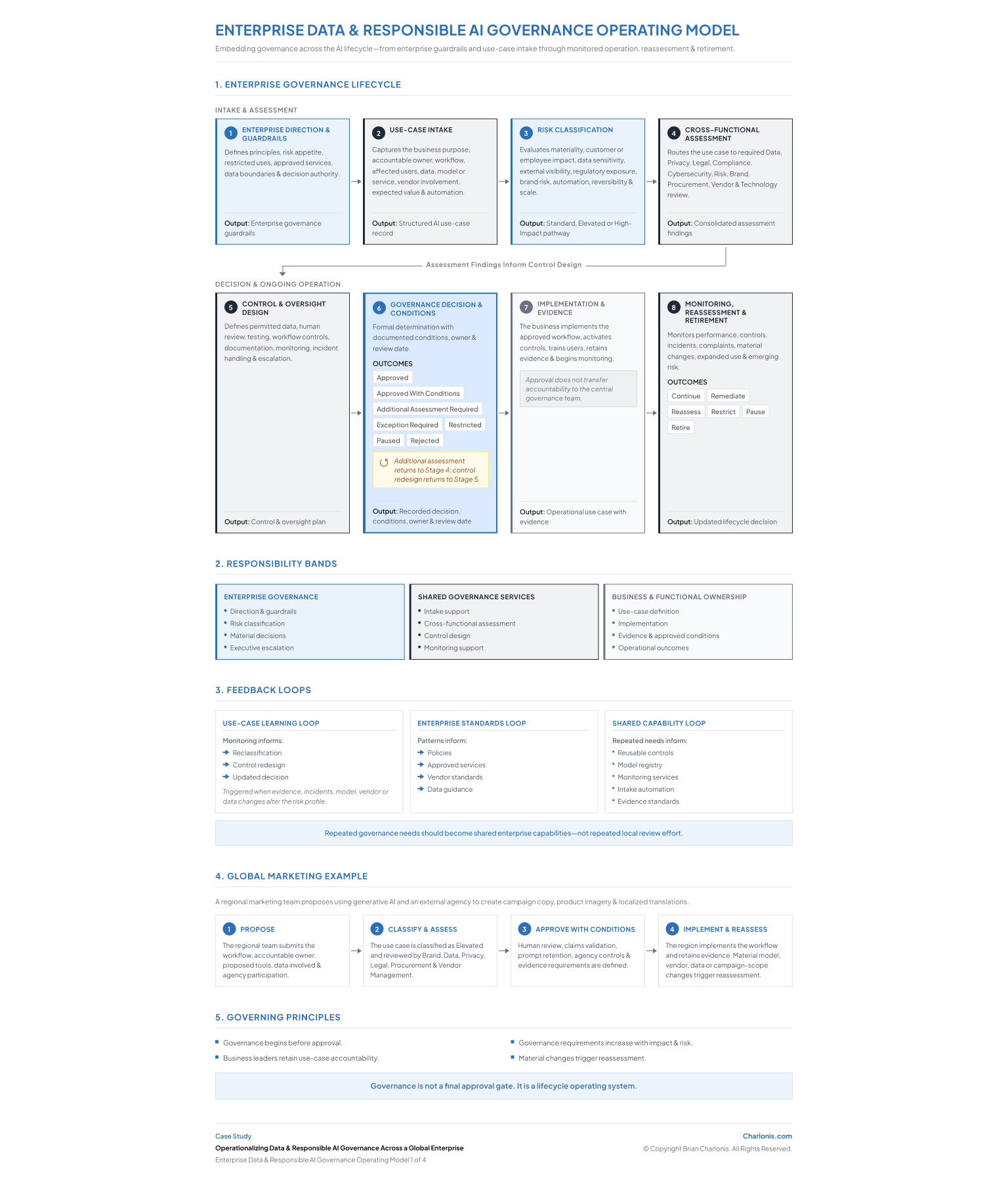
Enterprise Data & Responsible AI Governance Operating Model
Governance operates across the lifecycle rather than as a one-time approval.
The model connects eight stages:
- Enterprise Direction & Guardrails
- Use-Case Intake
- Risk Classification
- Cross-Functional Assessment
- Control & Oversight Design
- Governance Decision & Conditions
- Implementation & Evidence
- Monitoring, Reassessment & Retirement
Enterprise direction defines principles, restricted uses, risk appetite, approved services, data boundaries & decision authority.
Use-case intake establishes the purpose, owner, workflow, users affected, data, model or service, vendor involvement, expected value & intended automation.
Classification determines the appropriate governance pathway. Cross-functional review then defines the evidence, controls, conditions & authority required before the use case proceeds.
Approval does not end governance. Material changes in the model, vendor, data, scale, workflow or intended use can trigger reassessment, remediation, restriction, pause or retirement.
Governance is not a final approval gate. It is a lifecycle operating system.
Defined
A lifecycle connecting enterprise direction, intake, classification, assessment, control design, decision, implementation, monitoring & retirement.
Served
Governance leaders, business and functional leaders, Data Owners, Product, Model or Service Owners, technology teams & control functions.
Shaped Decisions
What enters governance, which pathway applies, what controls are required, who must review & when reassessment is necessary.
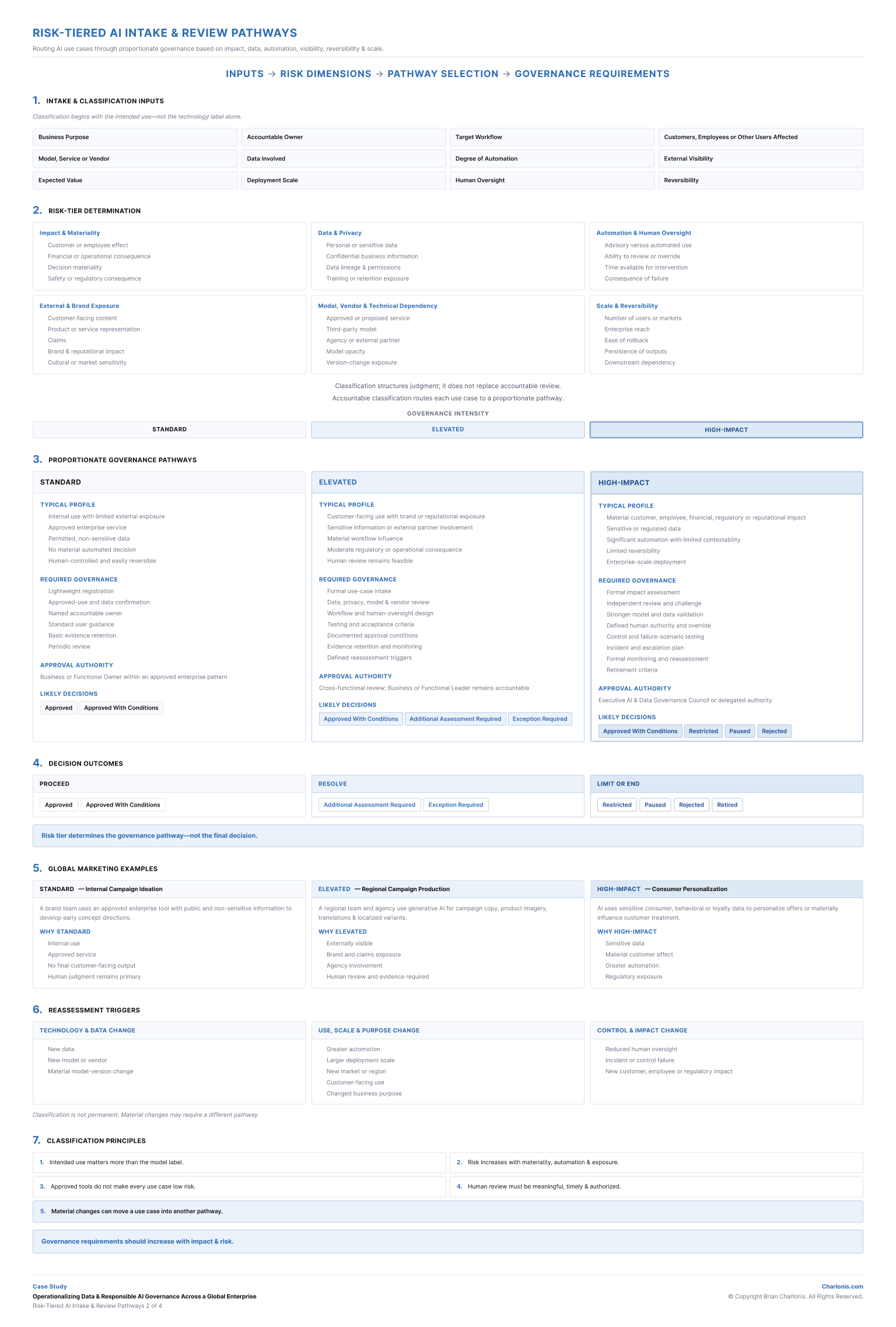
Risk-Tiered AI Intake & Review Pathways
Governance requirements increase with impact and risk.
Classification considers:
- Impact & materiality
- Data & privacy
- Automation & human oversight
- External & brand exposure
- Model, vendor & technical dependency
- Scale & reversibility
The model uses three pathways. The pathway structures accountable judgment. It does not automatically determine the final decision.
Standard
For lower-risk internal uses involving approved enterprise services, permitted data, limited external exposure, meaningful human control & high reversibility.
Typical governance includes lightweight registration, approved-use confirmation, a named owner, basic evidence retention & periodic review.
Elevated
For customer-facing content, sensitive information, material workflow influence, external partners, brand exposure or moderate regulatory and operational consequence.
Typical governance includes formal intake, data and vendor review, human-oversight design, testing, documented approval conditions, evidence retention & monitoring.
High-Impact
For uses involving material customer, employee, financial, regulatory or reputational impact, sensitive data, significant automation, limited contestability or enterprise-scale deployment.
Typical governance includes formal impact assessment, independent review and challenge, stronger validation, defined human authority, control testing, formal monitoring & reassessment.
Defined
A routing model connecting use-case characteristics to proportionate governance requirements, evidence & approval authority.
Served
Business sponsors, governance teams, Data Owners, Product, Model or Service Owners, control functions, agencies & vendors.
Shaped Decisions
Which pathway applies, what evidence is required, who must review & whether the use case may proceed, require conditions or need escalation.
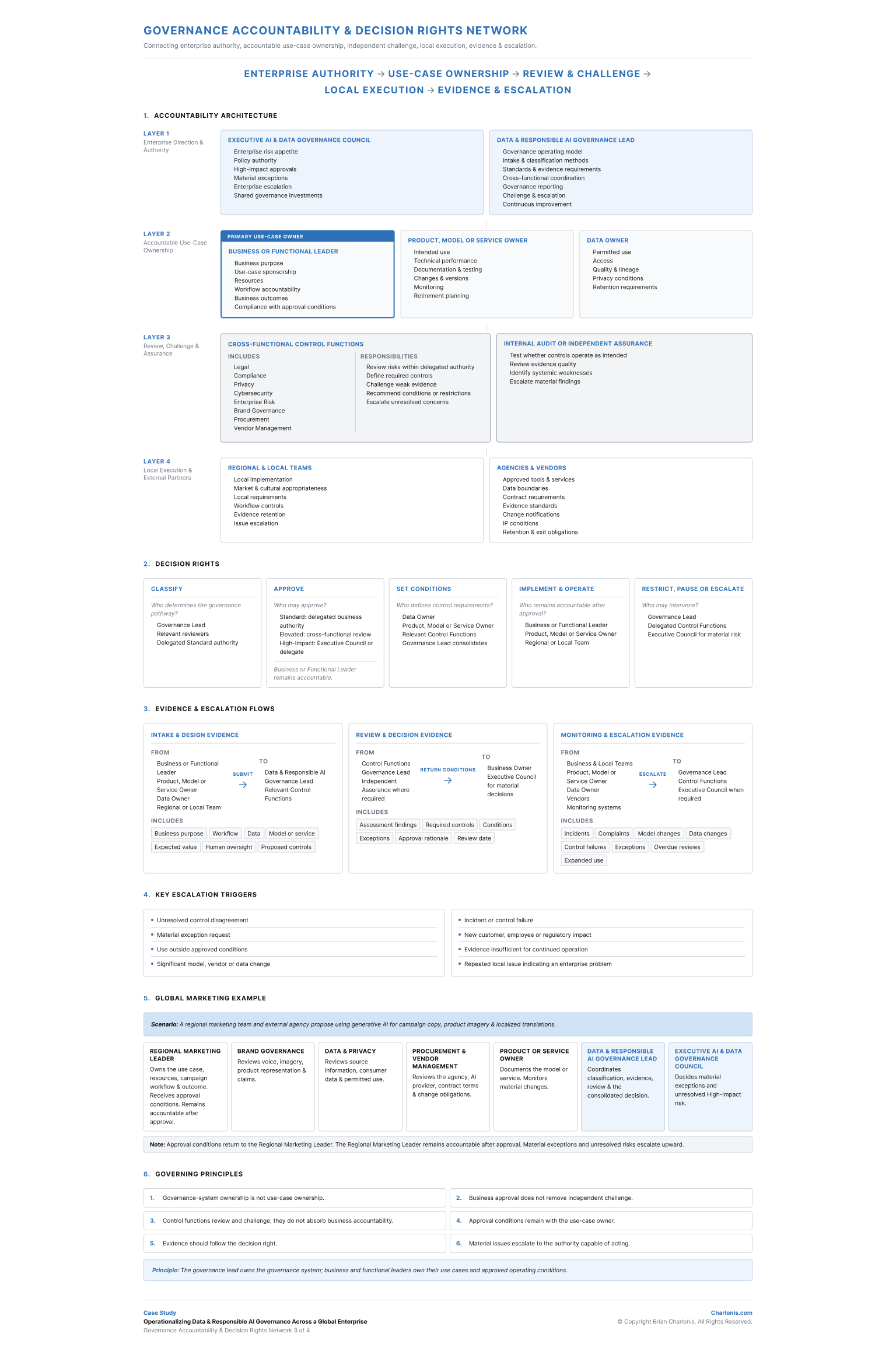
Governance Accountability & Decision Rights Network
Governance cannot scale if accountability is either centralized completely or distributed without clarity.
The network distinguishes enterprise authority, use-case ownership, independent challenge, local execution, evidence & escalation.
Enterprise Authority
The Executive AI & Data Governance Council owns enterprise risk appetite, policy authority, material exceptions, High-Impact approvals & enterprise escalation.
The Data & Responsible AI Governance Lead owns the governance operating model, intake and classification methods, evidence standards, cross-functional coordination, reporting, challenge & continuous improvement.
Accountable Use-Case Ownership
The Business or Functional Leader is the primary use-case owner. That leader owns:
- Business purpose
- Sponsorship
- Resources
- Workflow accountability
- Business outcomes
- Compliance with approved operating conditions
Product, Model or Service Owners remain accountable for intended use, technical performance, documentation, changes, monitoring & retirement planning.
Data Owners remain accountable for permitted use, access, quality, lineage, privacy & retention conditions.
Review, Challenge & Local Execution
Control functions review, challenge & define requirements within their authority. They do not absorb business accountability.
Regional and Local Teams implement the use case, apply local and cultural judgment, retain evidence & escalate issues.
Agencies and Vendors must comply with approved services, data boundaries, contracts, evidence standards, change requirements & intellectual-property conditions.
Governance-system ownership is not use-case ownership.
Defined
The ownership, review, challenge, approval, implementation, evidence & escalation relationships required to operate governance at scale.
Served
Executive governance, the Data & Responsible AI Governance Lead, business leaders, Data Owners, Product, Model or Service Owners, control functions, regional teams, agencies & vendors.
Shaped Decisions
Who owns the use case, who reviews specific risks, who may approve or restrict it, what must escalate & who remains accountable after approval.
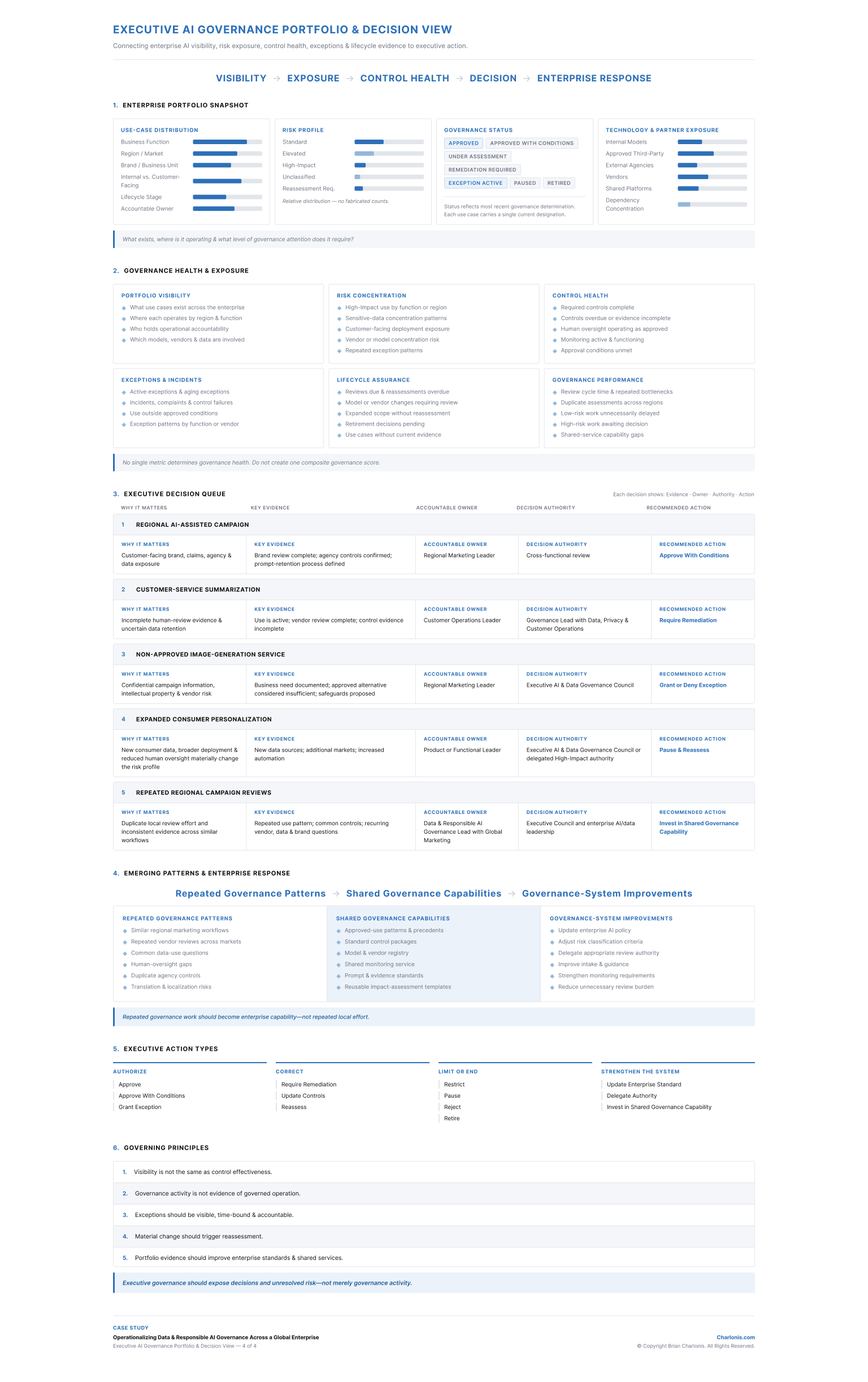
Executive AI Governance Portfolio & Decision View
Executive governance requires more than counts of policies, training sessions, registered use cases or completed reviews.
Leadership needs a decision view connecting:
- Enterprise portfolio visibility
- Risk concentration
- Control health
- Exceptions & incidents
- Lifecycle assurance
- Governance performance
The view shows where AI is operating, who owns it, which models and vendors create dependency concentration, where controls remain incomplete, which exceptions are aging & what changes require reassessment.
Its central feature is an Executive Decision Queue showing:
- Why the issue matters
- What evidence exists
- Who owns it
- Which authority can act
- What decision is required
Potential actions include:
- Approve
- Approve With Conditions
- Require Remediation
- Grant or Deny an Exception
- Reassess
- Restrict
- Pause
- Reject
- Retire
- Update an Enterprise Standard
- Delegate Authority
- Invest in Shared Governance Capability
Repeated governance issues should also inform enterprise improvement. Similar reviews, vendor questions, data-use concerns or oversight gaps may justify reusable control packages, approved patterns, common evidence standards or shared monitoring services.
Executive governance should expose decisions and unresolved risk, not merely governance activity.
Defined
An executive view connecting portfolio visibility, exposure, control health, exceptions, lifecycle evidence & governance performance to leadership action.
Served
Executive governance, Data and AI leadership, enterprise risk, business leaders, control functions & independent assurance.
Shaped Decisions
Where intervention is required, which risks remain unresolved, which conditions or reviews are overdue & where repeated governance work should become shared enterprise capability.
Tradeoffs & Decisions
Enablement & Control
- Tradeoff: Governance must reduce unacceptable risk without turning every use case into a lengthy approval exercise.
- Design Response: Use proportionate pathways, reusable approved patterns & shared governance services.
Enterprise Consistency & Local Flexibility
- Tradeoff: The enterprise needs common standards, while functions and regions must respond to local markets, regulations, workflows & cultural conditions.
- Design Response: Standardize minimum requirements, evidence & decision authority while preserving accountable local execution.
Central Expertise & Business Ownership
- Tradeoff: Central teams provide expertise and challenge, but they cannot own every use case or business outcome.
- Design Response: Keep business and functional leaders accountable for purpose, resources, workflow, outcomes & approved conditions.
Visibility & Administrative Burden
- Tradeoff: The enterprise needs reliable visibility, but excessive documentation can push work outside the governance system.
- Design Response: Match intake, evidence and monitoring requirements to the use case’s impact and risk
Outcomes
Because this is a conceptual transformation scenario, the outcomes describe the governance operating model, decision system & artifacts that would require validation through stakeholder research and selected enterprise use cases. No production implementation, realized financial impact or quantified risk reduction is claimed.

Impact Summary

Defined an enterprise Data & Responsible AI Governance lifecycle embedded into how AI is selected, approved, implemented, monitored & retired.
Established proportionate Standard, Elevated & High-Impact governance pathways.
Clarified governance-system ownership, primary use-case ownership, review authority, evidence flow & escalation.
Created an executive portfolio view centered on exposure, control health, unresolved decisions & shared capability needs.

Evidence & Outcome Signals
- A governed use-case inventory could improve visibility into AI ownership, models, vendors, data & operating context.
- Risk-tiered pathways could reduce unnecessary review for lower-risk work while increasing scrutiny for higher-impact uses.
- Explicit decision rights and approved conditions could reduce accountability gaps after deployment.
- Lifecycle evidence could identify model, vendor, data, automation, scale or purpose changes requiring reassessment.
- Repeated governance patterns could reveal where shared standards, services or controls would reduce duplicated local effort.

Signals Monitored
- Use-case volume, function, region, accountable owner & lifecycle status
- Risk tier, external exposure, customer or employee impact & deployment scale
- Data sensitivity, permitted use, lineage, retention & privacy conditions
- Models, services, vendors, agencies & dependency concentration
- Human-oversight design, control completion & approval conditions
- Active exceptions, incidents, complaints & uses outside approved conditions
- Model, vendor, data, automation, market or intended-use changes
- Monitoring findings, overdue reviews, reassessment status & retirement decisions
- Review cycle time, repeated bottlenecks, duplicate assessments & delayed decisions
- Recurring governance patterns that may require shared standards, services or controls

Decision Thresholds
- Do not approve a use case without an accountable business owner, defined purpose, workflow, data, model or service & monitoring plan.
- Do not apply the same governance requirements to materially different risk profiles.
- Require reassessment when the model, vendor, data, automation, scale, market or intended use changes materially.
- Restrict, pause or retire uses where required controls, evidence or approved conditions cannot be maintained.
- Escalate material exceptions and unresolved High-Impact risk to the authority capable of acting.

Actions Taken
- Reframed governance as a lifecycle operating system rather than a final approval gate.
- Defined risk-tiered intake, review & decision pathways.
- Established accountability, decision rights, evidence flow & escalation.
- Created an executive governance portfolio and decision view.
- Produced four executive-ready conceptual artifacts.
Artifacts
Enterprise Data & Responsible AI Governance Operating Model

Shows how enterprise direction becomes intake, classification, assessment, control design, decision, implementation, monitoring & reassessment.
Risk-Tiered AI Intake & Review Pathways
Shows how impact and risk determine governance requirements, evidence, review depth & decision authority.
Governance Accountability & Decision Rights Network
Shows who owns the governance system, use case, data, model or service, review, challenge, implementation & escalation.
Executive AI Governance Portfolio & Decision View
Shows how portfolio visibility, exposure, control health, exceptions & lifecycle evidence support executive decisions and enterprise improvement.
Key Takeaways
Governance is an operating model, not a policy document.
Governance requirements should increase with impact & risk.
Lower-risk work should move through reusable, lightweight pathways while higher-impact use receives stronger scrutiny.
The governance lead owns the governance system; business and functional leaders own their use cases.
Approval is not the end of governance.
Material changes in data, models, vendors, automation, scale or intended use should trigger reassessment.
Executive reporting should expose unresolved risk and decisions—not merely governance activity.
Reflection
What I Would Validate Next
- How AI use cases currently enter the enterprise across functions, regions, vendors & agencies
- Where existing policies and controls are interpreted inconsistently
- Which characteristics should determine pathway, approval authority & monitoring depth
- Whether current data, model, vendor & human-oversight evidence is reliable
- Which repeated governance needs should become shared enterprise services
- What leaders need to see to intervene in unresolved risk or governance bottlenecks
What I Would Watch Closely
- Governance becoming a centralized approval queue
- Lower-risk uses receiving unnecessarily heavy review
- Business leaders treating approval as a transfer of accountability
- Local exceptions remaining invisible to enterprise governance
- Documentation being completed without controls operating in practice
- Executive reporting emphasizing volume rather than exposure and decision needs
The hardest governance problem is not writing the policy. It is creating a system in which teams know what is allowed, risks receive proportionate review, leaders remain accountable, controls operate inside the workflow & evidence determines what can continue, change or scale.
AI Opportunities
- Use-Case Intake Assistance
Help teams structure business purpose, workflow, data, model, vendor, impact & oversight information before human review. - Risk-Classification Support
Identify likely risk factors and suggest a preliminary pathway while preserving human accountability for classification. - Policy & Control Mapping
Connect use-case characteristics to relevant policies, approved patterns, evidence requirements & control owners. - Documentation Quality Review
Detect missing, inconsistent or outdated information across assessments, model records, vendor reviews & monitoring plans. - Governance Portfolio Intelligence
Surface repeated exceptions, control gaps, dependency concentration, overdue decisions & shared capability needs. - Monitoring Signal Synthesis
Organize incidents, performance changes, model updates, complaints, audit findings & control evidence for reassessment. - Approved-Pattern Retrieval
Help teams find relevant approved use cases, controls, prompt patterns, vendor conditions & human-oversight models.
AI may support intake, synthesis, classification, monitoring & retrieval. It should not autonomously approve use cases, grant exceptions, determine acceptable risk or replace accountable human review.
Supporting AI Professional Specializations
University of Pennsylvania

AI for Business Specialization
Built foundational knowledge of AI applications across marketing, finance, and people management, with emphasis on AI strategy and governance for business leaders.
IBM

Generative AI for Executives & Business Leaders Specialization
Developed a strategic understanding of generative AI, including foundational concepts, integration strategies, and business use cases for practical executive decision-making.
Vanderbilt University

Generative AI Strategic Leader Specialization
Learned advanced generative AI concepts, including deep research, prompt engineering, and agentic AI, with a focus on strategic leadership and decision-making.
Vanderbilt University
Prompt Engineering & Trustworthy AI Specialization
Acquired practical skills in designing effective AI prompts, advanced data analysis, and principles for trustworthy generative AI deployment.
Web3 Opportunities
- AI Asset & Model Provenance
Preserve tamper-evident records of approved models, versions, vendors, prompt patterns, generated assets & material changes. - Approval & Exception History
Create a verifiable record of approvals, conditions, exceptions, reviewers, evidence & reassessment dates across regions and functions. - Content & Campaign Provenance
Track the origin, review, modification & approval of AI-assisted marketing assets where multiple teams and agencies contribute. - Vendor Compliance Records
Support shared verification of contract conditions, model changes, data-handling commitments & required evidence across external partners. - Cross-Entity Governance Evidence
Provide a trusted record where regions, agencies, vendors & enterprise governance require shared evidence without relying on one party’s local system.
Blockchain would be most relevant where multiple organizations or autonomous entities require trusted provenance, evidence integrity or shared approval history. It would not replace enterprise governance platforms, data controls or accountable decision-making.
Supporting Web3 Professional Specializations
Duke University

Decentralized Finance (DeFi): The Future of Finance Specialization
Gained expertise in DeFi infrastructure, primitives, opportunities, and risks, enabling evaluation and strategy for decentralized financial systems.
INSEAD

Blockchain Revolution Specialization
Explored blockchain technologies and applications, focusing on transactions, business opportunities, and strategic analysis for enterprise adoption.
University of Pennsylvania
FinTech: Foundations & Applications of Financial Technology Specialization
Developed a comprehensive understanding of fintech ecosystems, including payments, digital currencies, lending, and the application of AI, InsurTech, and real estate technology within regulated financial environments.
University at Buffalo

Blockchain Specialization
Built a practical foundation in blockchain architecture, Ethereum-based systems, and smart contract execution, with hands-on experience standing up private Ethereum networks, managing accounts, mining blocks, and deploying Solidity smart contracts.
- Blockchain Basics
- Smart Contracts
- Decentralized Applications (Dapps)
- Blockchain Platforms
Recommended
If you liked this case study, you may also be interested in these…
Decision Systems
AI Strategy
Portfolio Strategy
CASE STUDY
PLACEHOLDER
From AI Pilots to Enterprise Capability
Qwerty
Decision Systems
AI Strategy
Portfolio Strategy
CASE STUDY
PLACEHOLDER
Embedded Governance for Enterprise AI
Qwerty
Decision Systems
AI Strategy
Portfolio Strategy
CASE STUDY
STRATEGIC OPERATING MODEL
Building a Governed Intelligence Operating System
Built a governed intelligence system that converts market signals, opportunity evaluations, and portfolio decisions into structured, human-reviewed execution.
Decision Systems
AI Strategy
Portfolio Strategy
Can Your Governance Model Keep Pace With AI Adoption?
I help enterprises embed Data & Responsible AI Governance into business workflows so teams can move faster within clear, accountable & proportionate guardrails.