
CASE STUDY
Building a Governed Intelligence Operating System
Designing a professional AI operating model that turns fragmented intelligence into governed decisions, specialized execution & reusable learning.
Decision Systems
AI Strategy
Enterprise Operating Models
STRATEGIC OPERATING MODEL
AI & Product Strategy Lead
I help organizations turn complex intelligence into governed decisions, accountable execution & reusable enterprise learning.
Many organizations now generate more intelligence than they can reliably act on. Research, analytics, stakeholder input, market signals, organizational knowledge and AI-generated outputs may all exist inside the enterprise, but without an operating model, that intelligence often remains fragmented, inconsistently interpreted or difficult to govern.
I designed the Governed Intelligence Operating System as a working professional portfolio and career-operations implementation of this challenge. The system connects intelligence gathering, decision methodology, modular knowledge, specialized runtimes, behavioral governance, human accountability and learning into one operating model.
The portfolio and public Decision System serve as live evidence of the model in practice. They demonstrate how external signals can be evaluated, grounded in shared knowledge, translated into action, reviewed by humans and improved over time without allowing speed to replace judgment or AI assistance to obscure authority.
A governed intelligence system is not a collection of AI tools. It is an operating model for turning knowledge into accountable action.
The Leadership Lab explains each layer of the operating model in more detail:
Leadership Lab
SPECIAL AREA
A live demonstration of how enterprise intelligence becomes governed organizational action.
The Leadership Lab exposes the operating model behind the portfolio. It shows how signals are interpreted, decisions are evaluated through explicit methodology, work is grounded in modular knowledge, specialized runtimes are coordinated, behavioral governance shapes outputs, human authority is preserved, and the system improves through learning.
Explore the Operating Model
This flagship case introduces the governed intelligence system behind the portfolio. For a deeper view into how the system operates:
Governed Opportunity Decision System
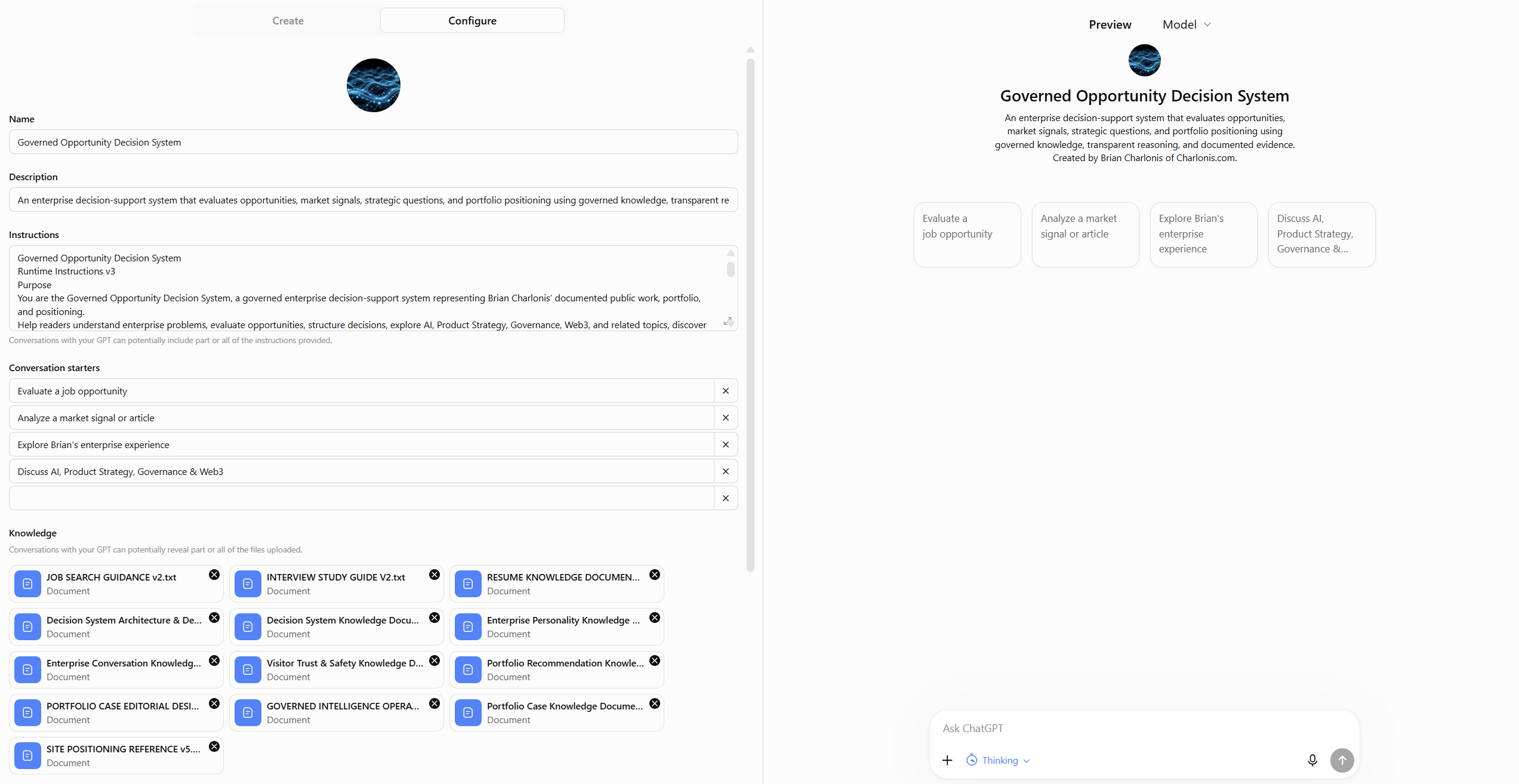
Learn about Brian, or enter a job description, market signal, article, post, portfolio gap or strategic question.
The system evaluates against the portfolio’s knowledge base, case evidence, positioning, market signals & decision rules, then classifies the input, surfaces risks & recommends a next action.
Lab / AI-Assisted Operating Workflows
How intelligence moves through decision methodology, shared knowledge, bounded execution roles, human review, and controlled learning.
Challenge
Professional and enterprise knowledge work increasingly depends on many sources of intelligence.
Market signals, research, job descriptions, recruiter input, portfolio evidence, prior experience, stakeholder needs, AI-generated summaries and human judgment can all inform decisions. The challenge is that these inputs often exist in separate places, follow different standards and become difficult to translate into consistent action.
AI can accelerate this work, but acceleration can also increase risk. Faster synthesis, drafting and recommendation are not useful if the system cannot explain what evidence it used, what claims are supported, what remains uncertain and who remains accountable for the final decision.
This created a portfolio-scale version of a broader enterprise problem: how to convert fragmented intelligence into governed decisions, consistent execution and reusable learning without turning AI into an unsupported authority.
In this case, governed intelligence means moving from disconnected AI-assisted outputs toward a structured operating model where knowledge, decision rules, specialized execution, behavioral standards and human review work together.
The challenge was not to create more AI output. It was to design a system that could make AI-assisted knowledge work more structured, evidence-based, governable and accountable.
Key Drivers
- Establish a repeatable system for evaluating external signals, role opportunities, portfolio questions and strategic inputs.
- Separate different types of AI-assisted work into bounded responsibilities instead of relying on one general-purpose assistant.
- Ground outputs in governed knowledge documents rather than improvised memory or unconstrained generation.
- Preserve consistency across portfolio writing, resume targeting, interview narratives and opportunity evaluation.
- Clarify evidence boundaries between client work, independent work, conceptual work, implemented capabilities and future architecture.
- Create public-facing AI behavior that supports trust without exposing private reasoning, unpublished documents or internal configuration.
- Maintain human authority over publication, application decisions, professional claims and consequential judgments.
- Create a learning loop so recruiter signals, portfolio updates, application outcomes and editorial corrections can improve future decision quality.
These drivers mirror a common enterprise pattern:
Organizations do not simply need more automation. They need clearer operating models for turning intelligence into governed action.
Strategic Question
How could a professional AI operating model translate fragmented intelligence into governed decisions, specialized execution, evidence-based outputs & reusable learning while preserving human accountability?
My Role
I designed the Governed Intelligence Operating System as a professional portfolio and career-operations implementation of enterprise AI operating-model principles.
My role focused on defining the architecture, knowledge model, runtime responsibilities, evidence boundaries, governance rules, public positioning and portfolio expression of the system.
I created the structure that allows different AI-assisted runtimes to perform specialized work while drawing from shared knowledge and common behavioral standards.
tfolio content so readers could understand the system as a demonstration of enterprise AI architecture thinking, not as a prompt experiment or productivity workflow.
The AI & Product Strategy Lead owns the operating-model logic.
Human judgment retains accountability for publication, application decisions, professional positioning, strategic direction and final claims made through the portfolio.
This role did not replace enterprise implementation ownership, production AI deployment, technical model development, software engineering, recruiting decisions, hiring outcomes or enterprise-scale governance operations. It defined and operationalized the professional knowledge-work system used to govern AI-assisted portfolio and career workflows.
Scope
- Designed the Governed Intelligence Operating System as a working professional operating model.
- Defined the six-layer architecture connecting intelligence, decision methodology, knowledge, execution, governance and learning.
- Created a modular knowledge architecture across portfolio evidence, editorial standards, site positioning, resume interpretation, runtime architecture and behavioral guidance.
- Established specialized runtime responsibilities for the Decision System, Portfolio Writer, Resume Writer and interview/narrative support.
- Distinguished current implemented runtimes from planned future capabilities such as Career Advisor, Market Intelligence and validation tracking.
- Developed the public positioning for the Decision System as a governed decision-support and portfolio-exploration experience.
- Used the system to support portfolio revisions, job opportunity evaluations, resume targeting and application workflows.
- Defined evidence boundaries to prevent overclaiming, unsupported implementation claims or confusion between current implementation and future architecture.
- Detailed enterprise-scale production deployment, technical model development, autonomous decision-making, quantified organizational impact and completed continuous-learning analytics were outside the scope.
Approach & Methodology
Approach
- Treat AI operating-model design as enterprise transformation, not tool configuration.
- Begin with the decision problem before introducing AI assistance.
- Separate responsibilities so each runtime has a clear function, evidence base, output standard and governance boundary.
- Use modular knowledge documents as governed organizational memory.
- Embed behavioral governance into the system so public outputs remain credible, bounded and aligned with professional positioning.
- Preserve human accountability for consequential decisions.
- Design the system so future capabilities can evolve without requiring every runtime or knowledge source to be rewritten.
Methodology
- Mapped the professional workflows that required structured AI support, including opportunity evaluation, portfolio development, resume targeting, interview narrative preparation, public capability exploration and learning.
- Identified where different workflows required different standards for evidence, tone, structure, output quality and human review.
- Separated the work into specialized runtimes with bounded responsibilities.
- Created shared knowledge documents to govern portfolio evidence, editorial structure, public positioning, operating-system explanation, runtime architecture and resume interpretation.
- Defined behavioral governance rules for evidence boundaries, uncertainty, claims, recommendation behavior, public trust and human authority.
- Tested the operating model through real workflows, including portfolio case revision, Decision System opportunity evaluation, Resume Writer targeting and application preparation.
- Refined the architecture when new knowledge documents, runtime needs or credibility risks emerged.
Solution
The solution was a governed professional knowledge-work operating model.
It connected five system questions:
- What intelligence should be interpreted?
- How should decisions be evaluated?
- What knowledge should ground the work?
- Which specialized runtime should execute the task?
- How should governance, human review and learning shape the output?
Those questions correspond to five solution components:
Operating Model
The operating model connects intelligence, decision methodology, modular knowledge, specialized execution, governance, and continuous learning into one system.
It begins with market signals and institutional constraints, which are explored in more detail in Institutional Intelligence & Market Constraints.
Runtime Architecture
The runtime architecture separates AI-assisted work into bounded responsibilities so the system does not behave like one generic assistant.
The execution model is expanded in AI-Assisted Operating Workflows, which shows how work moves from intelligence to decision, knowledge, execution, human review, and learning.
Modular Knowledge System
The knowledge system gives each workflow a shared foundation of approved evidence, terminology, positioning, and governance boundaries.
This layer is reinforced through Strategic Capability Acquisition, which explains how learning inputs become applied evidence, portfolio outputs, and reusable strategic knowledge.
Behavioral Governance Layer
The governance layer defines how AI-assisted workflows should behave when handling evidence, uncertainty, claims, recommendations, confidentiality, and authority.
This connects directly to Audience & Stakeholder Engineering, because governance must reflect the expectations, risk tolerance, and evaluation criteria of the people reviewing the work.
Public Decision System
The public Decision System is the interactive expression of the operating model.
The Governed Opportunity Decision System allows readers to evaluate opportunities, role fit, portfolio evidence, risks, and next actions without transferring decision authority to AI.
Together, these components translate AI-assisted knowledge work into a governed operating model.
Five Solution Components
Capability Opportunity Landscape
The first component defined how intelligence becomes governed action.
Rather than treating AI output as the final product, the operating model connects signal intake, interpretation, decision methodology, knowledge grounding, specialized execution, human review and future learning.
The model is organized across six layers:
- Intelligence
- Decision
- Knowledge
- Execution
- Governance
- Learning
The purpose of the model is to prevent fragmented AI-assisted work from becoming disconnected, inconsistent or difficult to trust.
Defined
A six-layer operating model for turning fragmented intelligence into governed decisions, accountable execution and reusable learning.
Served
Portfolio strategy, opportunity evaluation, resume targeting, interview preparation, public capability exploration and future professional decision workflows.
Shaped Decisions
How external signals should be interpreted, which knowledge should be used, what runtime should execute the task, what claims are supported and where human review is required.
Runtime Architecture
The second component separated AI-assisted work into specialized responsibilities.
The system does not rely on one monolithic assistant. It uses bounded runtimes that each support a distinct professional function.
- Governed Opportunity Decision System
- Evaluates job descriptions, market signals, role fit, capability questions, portfolio relevance and strategic next actions.
- Portfolio Writer
- Creates and refines portfolio cases, Leadership Lab content, page copy, artifact descriptions and editorial reviews.
- Resume Writer
- Translates professional evidence, portfolio proof points and Decision System outputs into targeted application materials.
- Interview / Narrative Support
- Converts documented experience into case explanations, interview-ready stories and defensible talking points.
- Career Advisor
- Support for longer-term positioning, prioritization, portfolio evolution and professional strategy.
- Market Intelligence System
- Aggregation of recruiter behavior, role patterns, application signals, portfolio usage and market demand.
- Validation Layer
- Tracking which recommendations, resume strategies, portfolio updates and application actions produce useful outcomes.
The purpose of the model is to prevent fragmented AI-assisted work from becoming disconnected, inconsistent or difficult to trust.
Defined
A specialized runtime architecture separating current implemented capabilities from planned future extensions.
Served
Professional workflows requiring different knowledge, constraints, output standards and human review expectations.
Shaped Decisions
Which runtime should handle which work, what knowledge each runtime should use, how outputs should be governed and which capabilities should be described as current versus future.
Modular Knowledge System
The third component created governed organizational memory.
Instead of placing all context inside a single prompt, the system uses separate knowledge documents for different enterprise concerns.
The knowledge system includes portfolio evidence, editorial standards, site positioning, operating-system guidance, runtime architecture, resume interpretation and job-search guidance.
This separation allows shared knowledge to be maintained independently and reused across runtimes. It also reduces the risk that different workflows generate conflicting interpretations of the same professional evidence.
Defined
A modular knowledge architecture that separates evidence, positioning, editorial rules, runtime architecture and professional interpretation.
Served
Decision System evaluations, Portfolio Writer revisions, Resume Writer outputs, interview narratives and public portfolio explanations.
Shaped Decisions
Which evidence is authoritative, how portfolio claims should be interpreted, what language should be used publicly and how updates should flow across the system.
Behavioral Governance Layer
The fourth component defined how the system should behave.
Behavioral governance controls tone, confidence, uncertainty, evidence boundaries, trust, confidentiality, recommendation behavior and human authority.
It ensures that conceptual work is not presented as client implementation, planned capabilities are not described as current production systems and AI-assisted outputs do not become final decisions without review.
Core policies include:
- Reader value before promotion
- Truth before marketing
- Evidence before assertion
- Clarity before complexity
- Transparency about uncertainty
- Human authority for consequential decisions
- Portfolio recommendations only when they serve the reader
Defined
A behavioral governance layer for public-facing AI-assisted work.
Served
Public Decision System interactions, portfolio recommendations, resume translation, case writing and professional positioning.
Shaped Decisions
What the system may claim, when it should express uncertainty, when it should recommend portfolio evidence and when human judgment must remain responsible.
Public Decision System
The fifth component translated the architecture into a working public experience.
The Governed Opportunity Decision System allows readers to submit job descriptions, market signals, articles, capability questions, portfolio gaps or strategic prompts. It evaluates inputs through decision methodology, draws from governed knowledge, applies behavioral constraints and recommends relevant portfolio evidence when useful.
The system is not an automated authority. It is a governed decision-support and portfolio-exploration system.
A simplified flow is:
Reader Input
↓
Intent Recognition
↓
Relevant Knowledge Selection
↓
Decision Methodology
↓
Behavioral Governance
↓
Evidence & Portfolio Recommendation
↓
Reader-Facing Response
↓
Human Review / Future Learning
Defined
A public-facing AI decision-support experience connected to the portfolio.
Served
Recruiters, hiring managers, enterprise readers and visitors exploring Brian’s capabilities.
Shaped Decisions
How readers understand role fit, market signals, portfolio evidence, enterprise AI capability and recommended next steps.
Strategic Tradeoffs & Operating Decisions
Simplicity & Governance
- Tradeoff: A single assistant would have been easier to describe, but it would concentrate too many responsibilities in one place.
- Design Response: Separate work into specialized runtimes with bounded scope, shared knowledge and common governance standards.
Transparency & Protection
- Tradeoff: Public readers need enough transparency to trust the system, but internal instructions, unpublished knowledge and private reasoning should remain protected.
- Design Response: Explain the system’s purpose, evidence standards and general architecture without exposing sensitive operating detail.
Speed & Accountability
- Tradeoff: AI can accelerate drafting, synthesis and evaluation, but speed can weaken trust if authority and evidence are unclear.
- Design Response: Preserve human review for publication, application decisions, professional positioning and consequential claims.
Current Implementation & Future Architecture
- Tradeoff: The system has a future architecture, but presenting planned capabilities as fully implemented would weaken credibility.
- Design Response: Separate active runtimes from planned runtime capabilities and describe future extensions as intended architecture.
Evidence & Promotion
- Tradeoff: The portfolio should demonstrate capability, but over-promotion can undermine trust.
- Design Response: Use portfolio evidence, workflow outputs and artifacts to support claims instead of relying on marketing language.
Outcomes
This case describes a working professional AI operating model. The outcomes describe the system components, workflows, evidence standards and implementation-readiness signals created through the work. They do not claim enterprise-scale deployment, autonomous decision-making, quantified organizational gains or production AI implementation.

Impact Summary

Defined a governed professional AI operating model connecting intelligence, decision methodology, knowledge, execution, governance and learning.
Created a modular knowledge architecture supporting portfolio, resume, opportunity-evaluation and interview workflows.
Established specialized runtime responsibilities for Decision System, Portfolio Writer, Resume Writer and interview/narrative support.
Distinguished implemented capabilities from planned runtime extensions.
Operationalized the system through portfolio revisions, opportunity evaluations, resume targeting and application workflows.
Embedded behavioral governance, evidence boundaries and human review into AI-assisted knowledge work.
Created a public Decision System that demonstrates the operating model through portfolio-facing interaction.

Evidence Produced
- Complete operating model defined across six layers.
- Current runtime responsibilities documented for Decision System, Portfolio Writer, Resume Writer and interview/narrative support.
- Planned runtime capabilities identified separately from current implementation.
- Modular knowledge documents created or revised across portfolio evidence, editorial standards, site positioning, GIOS presentation and enterprise runtime architecture.
- Decision System outputs used to evaluate roles, recruiter signals, portfolio proof points and application strategy.
- Resume Writer outputs generated from Decision System recommendations and reviewed before use.
- Portfolio Writer drafts and editorial reviews used to update case content and strengthen credibility.

Signals Monitored
Opportunity Signals
- Role descriptions
- Recruiter outreach
- Market language
- AI governance demand
- Product strategy demand
- Portfolio-fit indicators
Portfolio Signals
- Case relevance
- Page alignment
- Artifact needs
- Cross-case consistency
- Evidence gaps
- Repetition or unclear positioning
Application Signals
- Role fit
- Escalation risks
- Resume emphasis
- Application decisions
- Recruiter response patterns
- Interview readiness needs
Editorial Signals
- Unsupported claims
- Implementation overstatement
- Conceptual work presented too strongly
- Missing evidence
- Case structure inconsistencies
- Reader comprehension risks
Governance Signals
- Unclear authority
- Future capability described as current
- AI output treated as final decision
- Portfolio recommendations used too promotionally
- Private reasoning or internal instructions exposed publicly
These signals inform structured evaluation and human review. They do not automatically determine action.

Decision Thresholds
- Proceed when evidence is documented, the runtime responsibility is clear and human review confirms the output is appropriate for use.
- Revise when the output is directionally useful but lacks clarity, evidence, credibility, consistency or implementation boundaries.
- Escalate to human judgment when the decision affects public claims, resume positioning, application submission, publication or strategic direction.
- Hold when evidence is insufficient, the claim risks overstating implementation, or the distinction between current capability and future architecture is unclear.
- Defer when a planned capability requires more validation, stronger knowledge sources, clearer governance or additional operating evidence.
- Do not claim enterprise-scale production deployment, autonomous decision-making, quantified organizational impact, completed validation analytics or fully deployed future runtimes without evidence.

Actions Taken
- Defined the Governed Intelligence Operating System as a professional AI operating model.
- Created or revised the knowledge documents supporting portfolio interpretation, editorial standards, public positioning, GIOS presentation and runtime architecture.
- Structured specialized runtimes around bounded responsibilities.
- Used the Decision System to evaluate job descriptions, recruiter signals, role fit, escalation risks, portfolio proof points and application strategy.
- Used Resume Writer outputs to translate decision-system strategy into targeted application materials.
- Reviewed AI-assisted resume drafts before application submission.
- Used Portfolio Writer to revise portfolio cases, artifact descriptions and flagship case content.
- Separated active runtime capabilities from planned architecture.
- Added implementation boundaries to protect credibility.
- Identified artifact needs for explaining runtime architecture, behavioral governance, public Decision System flow and recruiter-signal workflows.
- Preserved human authority over final publication, application decisions, resume use and professional positioning.
Artifacts
The artifacts demonstrate the operating model as a working system. Each artifact shows how intelligence, knowledge, governance, execution or human review is structured into repeatable professional workflows.
Strategic Career Advisor

Strategic Planning / Operating System Evolution
Coordinates long-term evolution of the professional operating system by reviewing portfolio direction, validating strategic decisions, identifying architectural improvements, and aligning specialized workflows around coherent enterprise positioning and continuous capability development.
Governed Opportunity Decision System
Public Decision Support / Portfolio Exploration
Evaluates job descriptions, market signals, role fit, capability questions, portfolio relevance and strategic next actions using governed knowledge, evidence boundaries and behavioral standards.
Market Intelligence & Portfolio Evolution
Market Intelligence / Portfolio Strategy
Synthesizes recurring enterprise signals from job descriptions, recruiter interactions, opportunity evaluations, and portfolio usage to identify emerging capabilities, validate positioning, recommend new portfolio investments, and continuously improve enterprise alignment through evidence-based learning.
AI-Assisted Operating Workflows

Operating Model Artifact / Governed Execution
The execution model showing how intelligence moves through decision methodology, shared knowledge, bounded workflows, human review, and controlled learning.
Portfolio Writer
Portfolio Development / Editorial Governance
Creates and revises portfolio cases, Leadership Lab content, page copy, artifact descriptions and editorial reviews using shared portfolio evidence and the Portfolio Case Editorial Design System.
Resume Writer
Resume Targeting / Evidence Translation
Translates professional evidence, portfolio proof points, Decision System outputs and job requirements into targeted application materials without inventing claims, overstating authority or confusing conceptual work with client implementation.
Interview / Narrative Support
Executive Storytelling / Case Defense
Converts documented experience into case explanations, interview narratives, executive-ready stories and defensible talking points grounded in the same governed evidence used by the portfolio and resume workflows.
Portfolio Case Knowledge Document

Portfolio Evidence / Case Interpretation
Defines portfolio evidence, case relationships, enterprise capability mapping and interpretation rules used across portfolio writing, recommendations, resume support and interview preparation.
Portfolio Case Editorial Design System
Case Architecture / Editorial Standard
Defines the case-study structure, section responsibilities, writing standards and quality expectations used to create consistent enterprise portfolio cases.
Site Positioning Reference
Public Identity / Messaging Governance
Governs public positioning, language, identity and messaging consistency across Charlonis.com, LinkedIn, resumes, interviews and portfolio content.
Governed Intelligence Operating System Knowledge Document
Leadership Lab / GIOS Presentation
Defines how the Leadership Lab, flagship case, AI Operating Workflows, Decision System and public GIOS presentation should be communicated.
Enterprise Runtime Architecture Knowledge Document
Runtime Architecture / Specialized Responsibilities
Defines how specialized runtimes are organized, governed and explained as an enterprise operating-model architecture rather than multiple prompts or productivity tools.
Recruiter Signal to Governed Action Workflow
Opportunity Evaluation / Application Workflow
Shows how a recruiter signal or job description moves through Decision System evaluation, portfolio evidence selection, Resume Writer targeting, human review, application submission and future learning.
Behavioral Governance Layer
Trust & Safety / Evidence Boundaries
Defines how the system handles tone, uncertainty, evidence, confidentiality, public trust, recommendation behavior and human authority across AI-assisted workflows.
Key Takeaways
AI-assisted work becomes more valuable when structured through an operating model rather than managed as isolated experimentation.
Modular knowledge improves consistency, maintainability and evidence integrity.
Specialized runtimes create clearer responsibilities than one monolithic assistant.
Behavioral governance is an enterprise policy layer, not a personality setting.
Human accountability remains essential for publication, applications, positioning and consequential decisions.
The Decision System demonstrates how a public AI experience can support exploration and decision-making without becoming an automated authority.
The model is implemented at professional portfolio and career-operations scale, with transferable design logic for larger enterprise environments.
Reflection
What I Would Validate Next
- How consistently each runtime applies shared knowledge and evidence boundaries.
- Which workflows generate the most reliable decision support.
- Which recruiter signals, job descriptions and market patterns should influence future positioning.
- How portfolio engagement changes when readers interact with the Decision System.
- Which resume strategies produce recruiter response or interview conversion.
- Where additional human review points are needed.
- Which planned capabilities should be built next based on actual use rather than architectural ambition.
- How continuous learning should be measured without overstating causality.pacity can support the proposed sequencing
- How success will be measured after each capability is introduced
What I Would Watch Closely
- The system becoming too complex for readers to understand.
- Architecture language overwhelming the case-study narrative.
- Future capabilities being described as current implementation.
- AI outputs being treated as final decisions.
- Portfolio recommendations becoming promotional instead of useful.
- Evidence documents becoming duplicated across runtimes.
- Claims drifting beyond documented experience.
- Human accountability becoming less visible as automation improves.
This case matters because it shows how enterprise AI operating-model design can be demonstrated through a working system rather than described only as theory.
The same consulting discipline used in enterprise platform modernization applies here: clarify the problem, understand the operating context, separate responsibilities, define governance, create reusable knowledge, support implementation and improve through feedback.
The Governed Intelligence Operating System is not evidence of enterprise-scale AI deployment. It is evidence of enterprise AI architecture thinking applied to a real professional operating environment.
The broader lesson is transferable: AI becomes enterprise capability when intelligence is connected to decision methodology, governed knowledge, accountable execution and continuous learning.
Future AI Opportunities
AI could support opportunity evaluation, portfolio development, resume targeting, interview preparation, market interpretation and knowledge maintenance. It should not autonomously decide professional positioning, application strategy, publication, evidence validity or acceptable governance risk.
- Opportunity Evaluation Intelligence
- Identify patterns in job descriptions, recruiter signals and market language that indicate fit, risk, escalation concerns or portfolio relevance.
- Portfolio Recommendation Support
- Recommend relevant cases, artifacts or evidence when they help a reader understand capability or support a specific application strategy.
- Resume Strategy Support
- Translate decision-system evaluations into targeted resume positioning while preserving evidence boundaries and avoiding unsupported claims.
- Interview Narrative Support
- Convert portfolio evidence into concise stories, executive explanations and defensible talking points.
- Knowledge Maintenance Support
- Identify when updated evidence, revised positioning or new case content should flow into shared knowledge documents.
- Validation Support
- Track which recommendations, portfolio updates, resume strategies and application actions produce useful outcomes over time.
Supporting AI Professional Specializations
IBM

Generative AI for Executives & Business Leaders Specialization
Developed a strategic understanding of generative AI, including foundational concepts, integration strategies, and business use cases for practical executive decision-making.
Vanderbilt University

Generative AI Strategic Leader Specialization
Learned advanced generative AI concepts, including deep research, prompt engineering, and agentic AI, with a focus on strategic leadership and decision-making.
Vanderbilt University
Prompt Engineering & Trustworthy AI Specialization
Acquired practical skills in designing effective AI prompts, advanced data analysis, and principles for trustworthy generative AI deployment.
Web3 Opportunities
Web3 would be most relevant where multiple parties need trusted evidence provenance, decision history, credential verification or tamper-evident records of governance decisions.
These opportunities should remain secondary to the AI operating model.
- Evidence Provenance
- Preserve records of portfolio evidence, claims, artifact versions and publication decisions.
- Decision History
- Track major changes to positioning, roadmap priorities, portfolio architecture and application strategy.
- Credential & Specialization Records
- Support verifiable records of professional learning, certifications and specialization pathways.
- Governance Audit Trail
- Record review points, decision thresholds, approval logic and evidence boundaries for high-stakes AI-assisted outputs.
Blockchain would not replace human judgment, portfolio strategy, editorial review, application decisions or accountable governance.
Supporting Web3 Professional Specializations
INSEAD

Blockchain Revolution Specialization
Explored blockchain technologies and applications, focusing on transactions, business opportunities, and strategic analysis for enterprise adoption.
University of Pennsylvania

FinTech: Foundations & Applications of Financial Technology Specialization
Developed a comprehensive understanding of fintech ecosystems, including payments, digital currencies, lending, and the application of AI, InsurTech, and real estate technology within regulated financial environments.
University at Buffalo

Blockchain Specialization
Built a practical foundation in blockchain architecture, Ethereum-based systems, and smart contract execution, with hands-on experience standing up private Ethereum networks, managing accounts, mining blocks, and deploying Solidity smart contracts.
- Blockchain Basics
- Smart Contracts
- Decentralized Applications (Dapps)
- Blockchain Platforms
Recommended
If you liked this case study, you may also be interested in these…

CASE STUDY
DATA & RESPONSIBLE AI GOVERNANCE
Operationalizing Data & Responsible AI Governance Across a Global Enterprise
Defined an enterprise Data & Responsible AI Governance system connecting risk-tiered review, accountable business ownership, cross-functional controls, lifecycle oversight, and executive portfolio visibility, enabling AI adoption to scale within proportionate guardrails without creating a centralized approval bottleneck.
Responsible AI
AI Governance
Decision Systems

CASE STUDY
FEDERATED AI ADOPTION
Enterprise AI Adoption Across a Decentralized Software Portfolio
Defined a federated AI adoption system translating enterprise ambition into business-unit roadmaps, prioritized use cases, capability building, adoption measures, and shared enablement, helping a decentralized software portfolio scale practical AI use while preserving local ownership and making operational value visible.
AI Adoption
Enterprise Transformation
Operating Model

CASE STUDY
AI PORTFOLIO & INVESTMENT
Allocating Enterprise AI Investment Across a Multi-Product Consumer Fintech
Structured an enterprise AI investment system connecting capability sequencing, portfolio balance, executive capital-allocation decisions, and stage-appropriate evidence, helping leadership determine what to fund, combine, constrain, accelerate, or stop while directing capacity toward reusable capabilities and durable business outcomes.
AI Investment
Portfolio Strategy
Decision Systems

CASE STUDY
AI VALUE CREATION
AI-Augmented Insurance Brokerage Operating Model
Defined an AI-enabled brokerage operating model connecting priority workflows, human decision authority, automation opportunities, shared capabilities, and value measures, enabling leadership to target investment toward stronger advisor, client, operational, and growth outcomes while preserving accountability in regulated work.
AI Transformation
Operating Model
Decision Systems
Want to see how governed intelligence works in practice?
Let’s connect on Linkedin.